
@codeforces - 793G@ Oleg and chess
@description - translation@
给定一个 n*n 的棋盘,并划定一些不能放棋子的矩形区域。
现在要在棋盘上放最多的车(读作 ju),使得这些车两两之间不会攻击。
input:
第一行整数 n ——棋盘边长(1 <= n <= 10000)。
第二行整数 q ——划定的矩形个数(0 <= q <= 10000)。
接下来 q 行,每一行都是 x1, y1, x2, y2(1 <= x1 <= x2 <= n, 1 <= y1 <= y2 <= n),描述矩阵的左下角与右上角。
保证矩形两两不会相交。
output:
输出最多的车的个数。
sample input:
5
5
1 1 2 1
1 3 1 5
4 1 5 5
2 5 2 5
3 2 3 5
sample output:
3
sapmle explain:
如图。
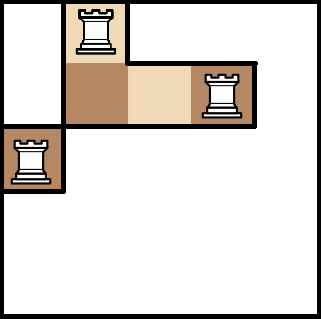
@solution@
一道网络流题。
一道建模极其简单,建图极其恶心的网络流题。
@part - 1@
考虑建模。棋盘是一个很经典的二分图,可以是黑白染色建模,也可以是行列建模。考虑到车的攻击方式是同行同列攻击,所以我们选择后者。
假如某一个格子(i, j)没有被划定不能放车,我们就第 i 行与第 j 列连边。再跑一个最大匹配就可以求出最多放置多少车了。
然而显然是会 TLE 的,而且还会 T 的很惨,惨兮兮。
@part - 2@
优化建图的话,因为划定的是规则的矩形,所以我们考虑用线段树来优化建图。
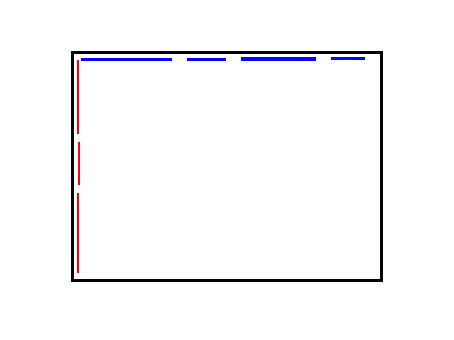
如图是一个内部完全没有限制的矩形,我们用行、列两棵线段树将它的两个横竖的边界拆成log n条线段树上的线段:
然后横着的和竖着的两两连边,连 log^2 n 条边【图片略鬼畜】:
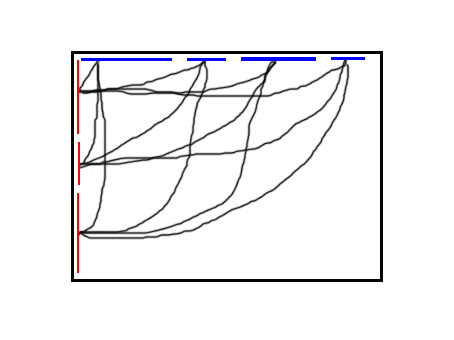
这样就处理完了一个没有限制的矩形。
最后:两棵线段树的底层端点,一棵连 S,一棵连 T,容量都为 1。线段树内部的父子连容量为 inf 的边。
@part - 3@
然而问题又来了:我们给定的是限制的矩形区域。
所以,我们必须把原棋盘切割成若干个内部没有限制的矩形,才能运用上面所提到的优化。
怎么切?下面是一个比较显然的思路:
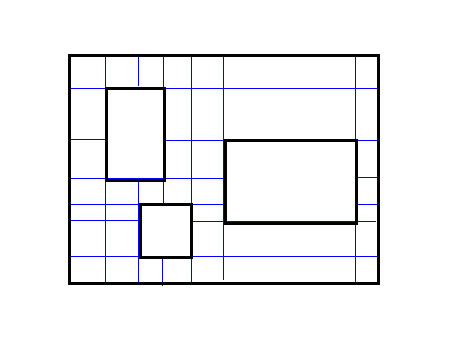
即对于每一个矩形,它的上下左右边界往两边割。
然而,如果下面这个图……
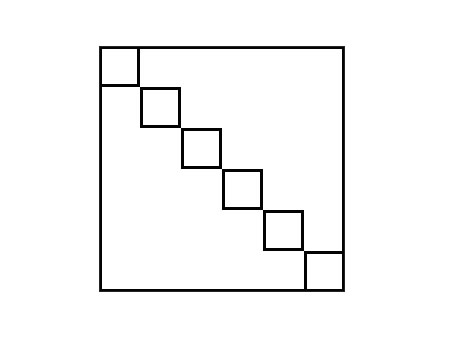
直接卡成 O(n^2)。
我们发现上面的那种切割方法,有很多小矩形是可以合并成大矩形。所以我们优化一下切割方法:
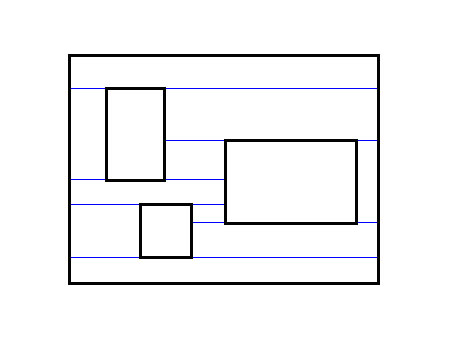
即上下边界往两边切,遇到其他矩形的边界或棋盘的边界,则停下来。
这样切,可以证明最多只会分出 4*n 个矩形。
怎么证明呢?【感性理解】每一个矩形的上下边界向左右各引一条线,一共 4 条线,每条线可以把一个矩形切割成两个矩形,相当于多增加了 4 个矩形。所以最多 4n 个矩形。
@part - 4@
OK 现在来看看怎么实现切割。
我们用扫描线算法,从左往右扫描。对于每一行,维护扫描线左边距离扫描线最近的矩形边界。如图,我们维护的就是左边的那弯弯曲曲的曲线:
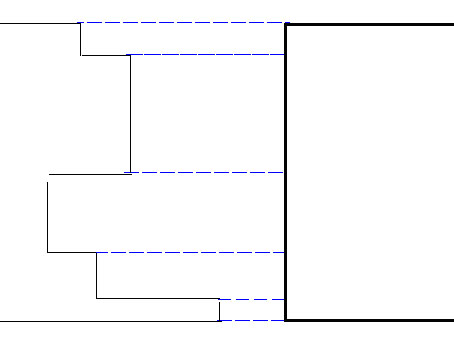
假如遇到矩形左边界,我们就从这个矩形的上边界开始往下暴力遍历(对你没听错就是暴力遍历,这样的确是 O(n^2) 的,但是其实 n 不大,对吧)。假如遇到不平坦的地方(对应到代码中就是相邻两行维护的东西不相等),则说明又产生了新的矩形。我们就进行线段树建图。
假如遇到矩形右边界,更新 “扫描线左边距离扫描线最近的矩形边界”。
注意,这个算法是基于矩阵不相交的前提的。
@accepted code@
口胡完毕。至于代码量,我不清楚我不知道,大家自己慢慢调,总会调出来的 qwq。
#include<cstdio>

#include<vector>

#include<algorithm>

using namespace std;

const int MAXN = 10000;

const int MAXM = 100000;

const int MAXK = 2000000;

const int INF = (1<<30);

struct FlowGraph{

	struct edge{

		int to, cap, flow;

		edge *nxt, *rev;

	}edges[2*MAXK + 5], *adj[MAXM + 5], *ecnt=&edges[0];

	int S, T, d[MAXM + 5], vd[MAXM + 5];

	void addedge(int u, int v, int c) {

		edge *p = (++ecnt);

		p->to = v, p->cap = c, p->flow = 0;

		p->nxt = adj[u], adj[u] = p;

		edge *q = (++ecnt);

		q->to = u, q->cap = 0, q->flow = 0;

		q->nxt = adj[v], adj[v] = q;

		p->rev = q, q->rev = p;

	}

	int aug(int x, int tot) {

		if( x == T ) return tot;

		int mind = T+1, sum = 0;

		for(edge *p=adj[x];p!=NULL;p=p->nxt) {

			if( p->cap > p->flow ) {

				if( d[p->to] + 1 == d[x] ) {

					int del = aug(p->to, min(tot-sum, p->cap-p->flow));

					p->flow += del, p->rev->flow -= del, sum += del;

					if( d[S] == T+1 ) return sum;

					if( sum == tot ) return sum;

				}

				mind = min(mind, d[p->to]);

			}

		}

		if( sum == 0 ) {

			vd[d[x]]--;

			if( vd[d[x]] == 0 )

				d[S] = T+1;

			d[x] = mind + 1;

			vd[d[x]]++;

		}

		return sum;

	}

	int max_flow() {

		int flow = 0;

		while( d[S] < T+1 )

			flow += aug(S, INF);

		return flow;

	}

}G;

int cnt = 0;

struct SegmentTree{

	int le, ri, num;

}t[2][4*MAXN + 5];

vector<int>v[2];

void build_segtree(int x, int l, int r, int n) {

	t[n][x].le = l, t[n][x].ri = r, t[n][x].num = (++cnt);

	if( l == r ) return ;

	int mid = (l + r) >> 1;

	build_segtree(x<<1, l, mid, n);

	build_segtree(x<<1|1, mid+1, r, n);

}

void build_edge_segtree(int x, int n) {

	if( t[n][x].le == t[n][x].ri ) {

		if( n == 0 ) G.addedge(G.S, t[n][x].num, 1);

		else G.addedge(t[n][x].num, G.T, 1);

	}

	else {

		if( n == 0 ) {

			G.addedge(t[n][x<<1].num, t[n][x].num, INF);

			G.addedge(t[n][x<<1|1].num, t[n][x].num, INF);

		}

		else {

			G.addedge(t[n][x].num, t[n][x<<1].num, INF);

			G.addedge(t[n][x].num, t[n][x<<1|1].num, INF);

		}

		build_edge_segtree(x<<1, n);

		build_edge_segtree(x<<1|1, n);

	}

}

void get_segment(int x, int l, int r, int n) {

	if( l <= t[n][x].le && t[n][x].ri <= r ) {

		v[n].push_back(t[n][x].num);

		return ;

	}

	if( l > t[n][x].ri || r < t[n][x].le )

		return ;

	get_segment(x<<1, l, r, n);

	get_segment(x<<1|1, l, r, n);

}

void build_edge_area(int x1, int y1, int x2, int y2) {

	if( x1 > x2 || y1 > y2 ) return ;

	v[0].clear(), v[1].clear();

	get_segment(1, x1, x2, 0);

	get_segment(1, y1, y2, 1);

	for(int i=0;i<v[0].size();i++)

		for(int j=0;j<v[1].size();j++)

			G.addedge(v[0][i], v[1][j], INF);

}

struct node{

	int le, ri;

	node(int _l=0, int _r=0):le(_l), ri(_r){}

};

vector<node>vec[MAXN + 5][2];

int left[MAXN + 5];

int main() {

	int n, q;

	scanf("%d%d", &n, &q);

	build_segtree(1, 1, n, 0); build_segtree(1, 1, n, 1); G.T = cnt + 1;

	build_edge_segtree(1, 0); build_edge_segtree(1, 1);

	for(int i=1;i<=q;i++) {

		int x1, y1, x2, y2;

		scanf("%d%d%d%d", &y1, &x1, &y2, &x2);

		vec[x1][0].push_back(node(y1, y2));

		vec[x2][1].push_back(node(y1, y2));

	}

	vec[n+1][0].push_back(node(1, n));

	for(int i=1;i<=n+1;i++) {

		for(int j=0;j<vec[i][0].size();j++) {

			int lst = vec[i][0][j].le;

			for(int k=vec[i][0][j].le+1;k<=vec[i][0][j].ri;k++)

				if( left[k] != left[k-1] )

					build_edge_area(left[k-1]+1, lst, i-1, k-1), lst = k;

			build_edge_area(left[vec[i][0][j].ri]+1, lst, i-1, vec[i][0][j].ri);

		}

		for(int j=0;j<vec[i][1].size();j++)

			for(int k=vec[i][1][j].le;k<=vec[i][1][j].ri;k++)

				left[k] = i;

	}

//注意我们必须要先处理矩形的左边再处理矩形的右边,不然遇到宽度为 1 的矩形就直接 GG 了。

	int ans = G.max_flow();

	printf("%d\n", ans);

}
@details@
一开始我写的从上往下的扫描线,结果发现 TLE 在 144th 组数据上。
气的我一怒之下把扫描线改成从左往右的。
然后……它就 AC 了???
听说机房里的另外一个人遇到了一样的情况,然后他把 isap 换成了 dinic 才过的。
好玄妙啊,果然是网络流。
@codeforces - 793G@ Oleg and chess的更多相关文章
- 【Codeforces】【网络流】【线段树】【扫描线】Oleg and chess (CodeForces - 793G)
题意: 给定一个n*n的矩阵,一个格子上可以放一个车.其中有q个子矩阵,且q个子矩阵互不相交或者是重叠(但边界可以衔接).这q个子矩阵所覆盖的地方都是不能够放车的.车可以越过子矩阵覆盖的地方进行攻击( ...
- Solution -「CF 793G」Oleg and Chess
\(\mathcal{Description}\) Link. 给一个 \(n\times n\) 的棋盘,其中 \(q\) 个互不重叠的子矩阵被禁止放棋.问最多能放多少个互不能攻击的车. ...
- Codeforces 734D. Anton and Chess(模拟)
Anton likes to play chess. Also, he likes to do programming. That is why he decided to write the pro ...
- Codeforces 1173B Nauuo and Chess
题目链接:http://codeforces.com/problemset/problem/1173/B 思路参考:https://www.cnblogs.com/blowhail/p/1099123 ...
- 【Codeforces】【网络流】【树链剖分】【线段树】ALT (CodeForces - 786E)
题意 现在有m个人,每一个人都特别喜欢狗.另外还有一棵n个节点的树. 现在每个人都想要从树上的某个节点走到另外一个节点,且满足要么这个人自带一条狗m,要么他经过的所有边h上都有一条狗. 2<=n ...
- Gym100947E || codeforces 559c 组合数取模
E - Qwerty78 Trip Time Limit:2000MS Memory Limit:65536KB 64bit IO Format:%I64d & %I64u S ...
- codeforces613E
Puzzle Lover CodeForces - 613E Oleg Petrov loves crossword puzzles and every Thursday he buys his fa ...
- 【Codeforces 738A】Interview with Oleg
http://codeforces.com/contest/738/problem/A Polycarp has interviewed Oleg and has written the interv ...
- Codeforces Round #379 (Div. 2) D. Anton and Chess 水题
D. Anton and Chess 题目连接: http://codeforces.com/contest/734/problem/D Description Anton likes to play ...
随机推荐
- PHP拓展 - xhprof性能分析工具
Windows安装 参考:https://www.cnblogs.com/buexplain/p/4821619.html dll文件下载:https://windows.php.net/downlo ...
- 直接在安装了redis的Linux机器上操作redis数据存储类型--对Sorted-Sets操作
一.概述: Sorted-Sets和Sets类型极为相似,它们都是字符串的集合,都不允许重复的成员出现在一个Set中.它们之间的主要差别是Sorted-Sets中的每一个成员都会有一个分数(score ...
- 【Scala学习笔记】一、函数式编程的思想
1. 函数是头等值. 在函数编程中,函数也是值,与整数和字符串处于同一地位.函数可以像变量一样被创建,修改,并当成变量一样传递,返回或是在函数中嵌套函数. 函数可以当做参数传递给其他函数. ...
- org.springframework.beans.BeanInstantiationException: Could not instantiate bean class [com.hs.model.StudentModel]: No default constructor found; nested exception is java.lang.NoSuchMethodException: c
root cause org.springframework.beans.BeanInstantiationException: Could not instantiate bean class [c ...
- MySQL错误1055
问题描述:在MySQL数据库下,执行SQL插入语句报错.错误信息如下: 错误原因:在MySQL5.7之后,sql_mode中默认存在ONLY_FULL_GROUP_BY,SQL语句未通过ONLY_FU ...
- SELECT (@i :=@i + 1)生成序列号
转载自https://blog.csdn.net/qq_27922171/article/details/86477544 同类别自动生成序列号:https://bbs.csdn.net/topics ...
- jS生成二叉树,二叉树的遍历,查找以及插入
js递归,二叉树的操作 //递归算法n次幂 function foo(n) { if (n == 1) { return 1; } else { return n * foo(n - 1); } } ...
- Lua报unexpected symbol near错误
如果Lua脚本没有错误,那可能是UTF8 BOM的问题
- Django 用 userena 做用户注册验证登陆
django-admin startproject userena2 cd userena2python manage.py startapp accounts vim userena2/settin ...
- 微信小程序开发之图片等比例缩放 获取屏幕尺寸图片尺寸 自适应
wxml: <image style="width: {{imagewidth}}px; height: {{imageheight}}px;" src="{{i ...