
跟我一起学STL(2)——vector容器详解
一、引言
在上一个专题中,我们介绍了STL中的六大组件,其中容器组件是大多数人经常使用的,因为STL容器是把运用最广的数据结构实现出来,所以我们写应用程序时运用的比较多。然而容器又可以序列式容器和关联式容器两类,C++语言本身提供了一个序列式容器数组,另外STL又提供vector,list,deque等序列式容器,本专题将详细介绍下vector容器。
二、vector详解
2.1 vector容器介绍
vector容器的数据结构为单端数组,其操作方式与数组的操作非常相似,唯一不同的是——数组是静态空间,一旦配置了数组大小就不能改变,而vector是动态空间,随着元素的插入,vector类内部机制会自行扩充空间来容纳新的元素,我们不需要担心因为空间不足而一开始就申请一个空间较大的数组,使用vector更加灵活。vector与C++中数组的区别,如.NET中List<T>类与数组的区别一样。
2.2 vector对象创建详解
vector有8个构造函数,其8个构造函数的定义如下代码所示:
       // 默认无参构造函数

     ① vector()

        : _Mybase()

        {    // construct empty vector

        }

        //

   ② explicit vector(const _Alloc& _Al)

        : _Mybase(_Al)

        {    // construct empty vector with allocator

        }

    ③ explicit vector(size_type _Count)

        : _Mybase()

        {    // construct from _Count * _Ty()

        resize(_Count);

        }

   ④ vector(size_type _Count, const _Ty& _Val)

        : _Mybase()

        {    // construct from _Count * _Val

        _Construct_n(_Count, _STD addressof(_Val));

        }

   ⑤ vector(size_type _Count, const _Ty& _Val, const _Alloc& _Al)

        : _Mybase(_Al)

        {    // construct from _Count * _Val, with allocator

        _Construct_n(_Count, _STD addressof(_Val));

        }

        // 拷贝构造函数

   ⑥ vector(const _Myt& _Right)

        : _Mybase(_Right._Alval)

        {    // construct by copying _Right

        if (_Buy(_Right.size()))

            _TRY_BEGIN

            this->_Mylast = _Ucopy(_Right.begin(), _Right.end(),

                this->_Myfirst);

            _CATCH_ALL

            _Tidy();

            _RERAISE;

            _CATCH_END

        }

   ⑦ template<class _Iter>

        vector(_Iter _First, _Iter _Last)

        : _Mybase()

        {    // construct from [_First, _Last)

        _Construct(_First, _Last, _Iter_cat(_First));

        }

   ⑧ template<class _Iter>

        vector(_Iter _First, _Iter _Last, const _Alloc& _Al)

        : _Mybase(_Al)

        {    // construct from [_First, _Last), with allocator

        _Construct(_First, _Last, _Iter_cat(_First));

        }
下面演示下利用上面的构造函数来创建不同的vector对象,并输出每个vector对象中的元素,具体演示代码如下所示:
// 额外引入vector头文件

#include <vector>

#include <iostream>

using namespace std;

void main()

{

    // 使用_Vector_iterator<int>类默认无参构造函数初始化6个迭代器对象

    vector<int>::iterator v1_Iter,v2_Iter,v3_Iter,v4_Iter,v5_Iter,v6_Iter;

    // 创建一个空的vector对象v0,调用了①构造函数

    vector<int> v0;

    // 创建vector对象v1,v1包含3个默认值为0的元素,调用③构造函数

    vector<int> v1();

    // 创建vector对象v2,v2包含5个值为2的元素,调用④构造函数

    vector<int> v2(,);

    // 创建vector对象v3,v3包含3个值为1的元素和空间配置器,调用了⑤构造函数

    vector<int> v3(,,v2.get_allocator());

    // 创建了vector对象v2的拷贝v4,调用了⑥构造函数

    vector<int> v4(v2);

    // 创建一个临时vector对象并对对象元素进行初始化

    vector<int> v5();

    for(int index=;index<;index++)

    {

        v5[index]=index;

    }

    // 创建vector对象v6,调用⑦构造函数

    vector<int> v6(v5.begin()+,v5.begin()+);

    // 输出v1容器元素

    cout<<"v1=";

    for(v1_Iter=v1.begin();v1_Iter!=v1.end();v1_Iter++)

    {

        cout<<" "<<*v1_Iter;

    }

    cout<<endl;

    // 输出v2容器元素

    cout<<"v2=";

    for(v2_Iter=v2.begin();v2_Iter!=v2.end();v2_Iter++)

    {

        cout<<" "<<*v2_Iter;

    }

    cout<<endl;

    // 输出v3容器元素

    cout<<"v3=";

    for(v3_Iter=v3.begin();v3_Iter!=v3.end();v3_Iter++)

    {

        cout<<" "<<*v3_Iter;

    }

    cout<<endl;

    // 输出v1容器元素

    cout<<"v4=";

    for(v4_Iter=v4.begin();v4_Iter!=v4.end();v4_Iter++)

    {

        cout<<" "<<*v4_Iter;

    }

    cout<<endl;

    cout << "v5 =";

    for ( v5_Iter = v5.begin( ) ; v5_Iter != v5.end( ) ; v5_Iter++ )

    {

        cout << " " << *v5_Iter;

    }

    cout << endl;

    cout << "v6 =";

    for ( v6_Iter = v6.begin( ) ; v6_Iter != v6.end( ) ; v6_Iter++ )

    {

        cout << " " << *v6_Iter;

    }

    cout << endl;

    // move(v2)返回v2类型即vector类型,v7是通过拷贝构造函数进行创建的

    vector<int> v7(move(v2));

    vector <int>::iterator v7_Iter;

    cout << "v7 =";

    for ( v7_Iter = v7.begin( ) ; v7_Iter != v7.end( ) ; v7_Iter++ )

    {

        cout << " " << *v7_Iter;

    }

    cout << endl;

}
上面演示代码运行结果如下图所示:

2.3 vector元素操作
vector类中提供了很多成员函数,下面演示下一些常用函数使用,具体演示代码如下:
#include <vector>

#include <iostream>

using namespace std;

void print(vector<int> &v)

{

    for(size_t i=;i<v.size();i++)

    {

        cout<<v[i]<<" ";

    }

    cout<<endl;

}

void main()

{

    #pragma region 元素的遍历访问

    // 可以采用数组下标、at()函数和迭代器的方式进行遍历访问

    vector<int> vint;

    // 向尾端插入一个元素20

    vint.push_back();

    vint.push_back();

    vint.push_back();

    vint.push_back();

    // 使用数组小标方式

    cout<<"vint[1] = "<<vint[]<<endl;

    for(size_t i=;i <vint.size();i++)

    {

        // 数组小标访问

        //cout<<"vint["<<i<<"] = "<<vint[i]<<" ";

        // 使用at函数访问

        cout<<"vint["<<i<<"] = "<<vint.at(i)<<" ";

    }

    cout<<endl;

    #pragma endregion

    #pragma region 利用erase函数删除元素

    // 删除第二个元素,即删除11

    vint.erase(vint.begin()+);

    cout<<"删除第一个元素后:"<<endl;

    int index1;

    vector<int>::iterator iter;

    // 使用迭代器访问元素

    for(iter=vint.begin(),index1=;iter!=vint.end();iter++,index1++)

    {

        cout<<"vint["<<index1<<"] = "<<*iter<<" ";

    }

    cout<<endl;

    #pragma endregion

    #pragma region 利用pop_back函数删除尾部元素

    // 调用pop_back删除尾部元素,即删除25

    vint.pop_back();

    cout<<"删除最后一个元素后:"<<endl;

    vector<int>::iterator iter1;

    int j;

    // 使用迭代器访问元素

    for(iter1=vint.begin(),j=;iter1!=vint.end();iter1++,j++)

    {

        cout<<"vint["<<j<<"] = "<<*iter1<<" ";

    }

    cout<<endl;

    #pragma endregion

    #pragma region 反向遍历 vector 的元素

    // 调用inser把元素插入到vector容器中指定位置

    // 插入11到容器中第二个位置

    vint.insert(vint.begin()+,);

    // 插入25到容器中最后一个位置,等效于push_back函数

    vint.insert(vint.end(),);

    vector<int>::iterator iter2;

    int k;

    cout<<"insert两个元素后容器元素为:"<<endl;

    // 使用迭代器访问元素

    for(iter2=vint.begin(),k=;iter2!=vint.end();iter2++,k++)

    {

        cout<<"vint["<<k<<"] = "<<*iter2<<" ";

    }

    cout<<endl;

    cout<<"反向遍历的结果为:"<<endl;

    vector<int>::reverse_iterator riter;

    int index;

    for( riter=vint.rbegin(),index=;riter!=vint.rend();riter++,index++)

    {

        cout<<"vint["<<index<<"] = "<<*riter<<" ";

    }

    cout<<endl;

    #pragma endregion

    #pragma region 两个vector容器元素的交换

    // 创建vector<int>对象vint2

    vector<int> vint2;

    vint2.push_back();

    vint2.push_back();

    vint2.push_back();

    // 把vint与vint2进行交换

    //swap(vint,vint2);

    vint.swap(vint2);

    cout<<"vint与vint2交换后的结果:"<<endl;

    cout<<"vint = ";

    print(vint);

    cout<<"vint2 = ";

    print(vint2);

    #pragma endregion

}
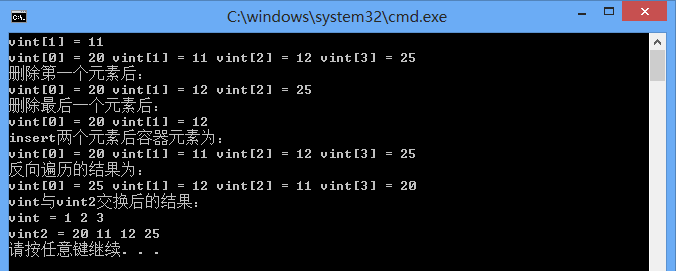
上面代码的运行结果为:
三、小结
到这里,本专题的内容介绍结束了,vector向量容器实现为数据线性存储的泛型类,本文介绍了使用数组下标、at()函数和迭代器方式来进行元素访问,然后演示了一些常用函数的使用。vector尾部添加和移除元素效率非常高,但在中部或头部插入元素和删除元素效率较低,这与它的数据结构(线性连续存储方式)有着密切的关系。
跟我一起学STL(2)——vector容器详解的更多相关文章
- STL之vector容器详解
vector 容器 vector是C++标准模版库(STL,Standard Template Library)中的部分内容.之所以认为是一个容器,是因为它能够像容器一样存放各种类型的对象,简单的说: ...
- [转]STL之vector容器详解
vector 容器 vector是C++标准模版库(STL,Standard Template Library)中的部分内容.之所以认为是一个容器,是因为它能够像容器一样存放各种类型的对象,简单的说: ...
- 2.3 C++STL vector容器详解
文章目录 2.3.1 引入 2.3.2 代码实例 2.3.3 运行结果 总结 2.3.1 引入 vector 容器 动态数组 可变数组 vector容器 单口容器(尾部操作效率高) vector动态增 ...
- C++STL之Vector向量详解,用法和例子 一起学习 一起加油
C++ STL之vector用法总结 1 ...
- [转]STL之list容器详解
List 容器 list是C++标准模版库(STL,Standard Template Library)中的部分内容.实际上,list容器就是一个双向链表,可以高效地进行插入删除元素. 使用list容 ...
- [转]STL之deque容器详解
Deque 容器 deque容器是C++标准模版库(STL,Standard Template Library)中的部分内容.deque容器类与vector类似,支持随机访问和快速插入删除,它在容器中 ...
- 2.8 C++STL set/multiset容器详解
文章目录 2.8.1 引入 2.8.2 代码示例 2.8.3 代码运行结果 2.8.4 对组pair的补充 代码实例 运行结果 总结 2.8.1 引入 set/multiset容器概念 set和mul ...
- 2.9 C++STL map/multimap容器详解
文章目录 2.9.1 引入 2.9.2 代码示例 map案列 multimap案列 2.9.3 代码运行结果 总结 2.9.1 引入 map相对于set区别,map具有键值和实值,所有元素根据键值自动 ...
- 带你深入理解STL之Vector容器
C++内置了数组的类型,在使用数组的时候,必须指定数组的长度,一旦配置了就不能改变了,通常我们的做法是:尽量配置一个大的空间,以免不够用,这样做的缺点是比较浪费空间,预估空间不当会引起很多不便. ST ...
随机推荐
- C++ 用libcurl库进行http通讯网络编程
使用libcurl完成http通讯,很方便而且是线程安全,转载一篇比较好的入门文章 转载自 http://www.cnblogs.com/moodlxs/archive/2012/10/15/2724 ...
- postman-根据接口文档进行测试
根据接口文档来测试 1.get请求
- ajax分页
html显示 <center> <div id="fyh"> <ul class="pagination" id="fy ...
- 关于启用 HTTPS 的一些经验分享
https://imququ.com/post/sth-about-switch-to-https.html 随着国内网络环境的持续恶化,各种篡改和劫持层出不穷,越来越多的网站选择了全站 HTTPS. ...
- javascript组件化
http://purplebamboo.github.io/2015/03/16/javascript-component/#%E5%BC%95%E5%85%A5%E4%BA%8B%E4%BB%B6% ...
- GBDT(MART) 迭代决策树入门教程 | 简介
GBDT(MART) 迭代决策树入门教程 | 简介 http://blog.csdn.net/w28971023/article/details/8240756
- Android_layout 布局(一)
今天主要学习了Android 的layout布局. Android layout 布局一般分为五种: LinearLayout (线性布局) :子组件按照垂直或者水平方向来布局. RelativeLa ...
- [INS-32025] 所选安装与指定 Oracle 主目录中已安装的软件冲突
windows server 2008 r2 enterprise下的解决办法为:删除C:\Program Files (x86)\Oracle\Inventory\ContentsXML目录下的in ...
- MATLAB - 练习程序,求灰度图像均值、最大、最小数值
clear all; close all; clc img=imread('lena.bmp'); figure; imshow(uint8(img)); [m n]=size(img); img_m ...
- 揭开HTTP网络协议神秘面纱系列(二)
HTTP报文内的HTTP信息 HTTP协议交互的信息被称为HTTP报文,请求端的HTTP报文叫做请求报文,响应端的叫做响应报文. HTTP为了提升传输速率,其在传输数据时,按照数据原样进行压缩传输,相 ...