
mybatis源码分析之04Mapper接口的动态代理
在工作中,使用mybatis操作数据库,只需要提供一个接口类,定义一些方法,然后调用接口里面的方法就可以CRUD,感觉是牛了一逼!
该篇就是记录一下,mybatis是如何完成这波骚操作的,即分析我们测试代码的第4行。
FemaleMapper femaleMapper = sqlSession.getMapper(FemaleMapper.class);
由上篇可知,sqlSession的真实类型是DefaultSqlSession. 所以,我们直接是看DefaultSqlSession#getMapper(Class<T> type)方法,当然,断点也是少不了的!
  public <T> T getMapper(Class<T> type) {

    return configuration.getMapper(type, this);

  }
是不是有点熟悉。。。。 接着走。。。
public <T> T getMapper(Class<T> type, SqlSession sqlSession) {

    return mapperRegistry.getMapper(type, sqlSession);

  }
再接着走。。。。
public <T> T getMapper(Class<T> type, SqlSession sqlSession) {

    final MapperProxyFactory<T> mapperProxyFactory = (MapperProxyFactory<T>) knownMappers.get(type);

    if (mapperProxyFactory == null) {

      throw new BindingException("Type " + type + " is not known to the MapperRegistry.");

    }

    try {

      return mapperProxyFactory.newInstance(sqlSession);

    } catch (Exception e) {

      throw new BindingException("Error getting mapper instance. Cause: " + e, e);

    }

  }
看到上面这段代码 ,肯定有反应了。 在上上篇中,我们说到解析xml配置时,会将Mapper接口缓存到MapperRegistry#knownMappers集合中,key是Mapper接口全路径,
Value是该Mapper接口的一个代理工厂类MapperProxyFactory, 源代码就是MapperRegistry#addMapper(Class<T> type)方法,代码如下:
  public <T> void addMapper(Class<T> type) {

      try {

        knownMappers.put(type, new MapperProxyFactory<>(type));

      } finally {

      }

  }
回归正题,此时getMapper()就是根据Mapper接口类型,去knownMappers集合中拿到其对应的代理工厂类。然后通过这个代理工厂类去创建Mapper接口的代理对象。
请看MapperProxyFactory#newInstance(SqlSession sqlSession)方法
  public T newInstance(SqlSession sqlSession) {

    final MapperProxy<T> mapperProxy = new MapperProxy<>(sqlSession, mapperInterface, methodCache);

    return newInstance(mapperProxy);

  }
又new了个MapperProxy, 看框架就是麻烦 ,封装了一层又一层, 但是还得看, 因为MapperProxy才是真正干事的!
然后就是下面这个方法,创建代理类
  protected T newInstance(MapperProxy<T> mapperProxy) {

    return (T) Proxy.newProxyInstance(mapperInterface.getClassLoader(), new Class[] { mapperInterface }, mapperProxy);

  }
debug 看一下,感觉不用debug完全活不下去了。。。
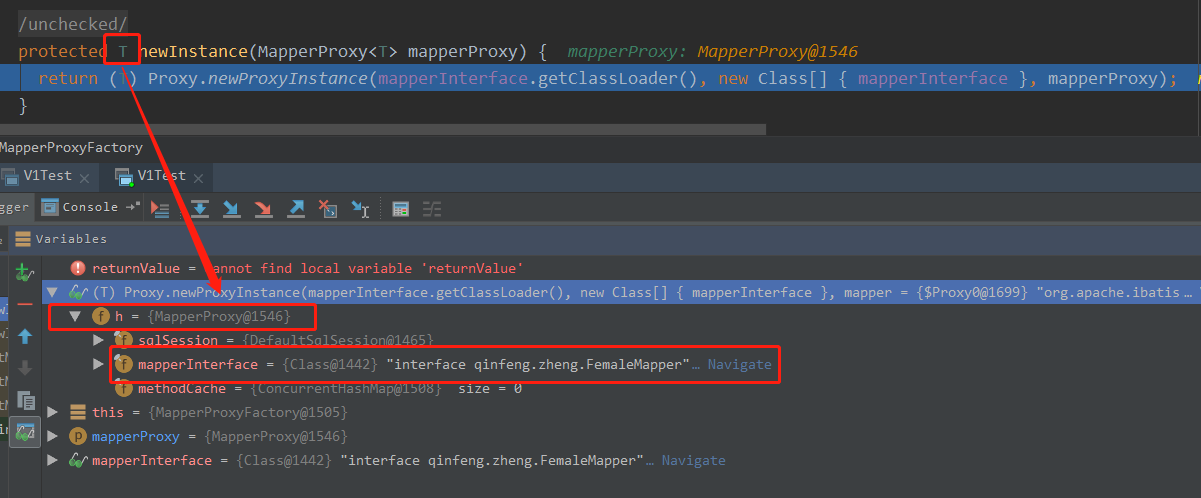
看到没有, 返回的是一个MapperProxy@1546
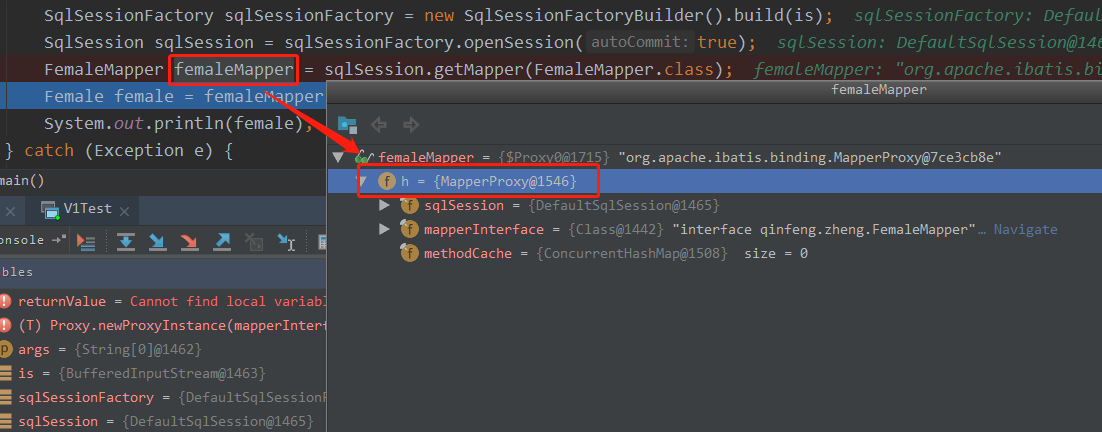
好,测试代码 FemaleMapper femaleMapper = sqlSession.getMapper(FemaleMapper.class) 这一句执行完毕,返回了一个MapperProxy代码对象,即然是代理,那肯定是
要去看看它的invoke()方法了, 这才是重头戏。
而当程序执行 Female female = femaleMapper.getFemaleById(1) 这行代理时,就会调用MapperProxy#invoke()方法。
MapperProxy#invoke()方法,源码如下:
  public Object invoke(Object proxy, Method method, Object[] args) throws Throwable {

    try {

      if (Object.class.equals(method.getDeclaringClass())) {

        return method.invoke(this, args);

      } else if (method.isDefault()) {

        return invokeDefaultMethod(proxy, method, args);

      }

    } catch (Throwable t) {

      throw ExceptionUtil.unwrapThrowable(t);

    }

    final MapperMethod mapperMethod = cachedMapperMethod(method);

    return mapperMethod.execute(sqlSession, args);

  }
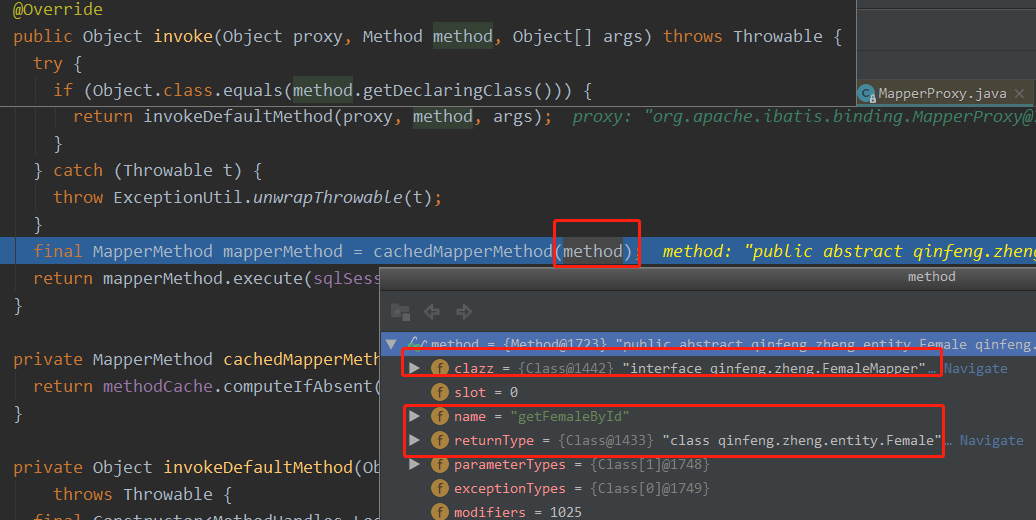
所以,应该去看看cachedMapperMethod(method)在干啥?
  private MapperMethod cachedMapperMethod(Method method) {

    return methodCache.computeIfAbsent(method, k -> new MapperMethod(mapperInterface, method, sqlSession.getConfiguration()));

  }
创建 MapperMethod,并缓存起来,所以说,mybatis也没那么傻,并不是每次都去构造MapperMethod实例 ,这个实例干嘛呢? 接着看!
 public MapperMethod(Class<?> mapperInterface, Method method, Configuration config) {

    this.command = new SqlCommand(config, mapperInterface, method);

    this.method = new MethodSignature(config, mapperInterface, method);

  }
这里就不具体说了,代码也很简单。
<1> SqlCommand两个属性,一个name,一个type, debug一下,啥都明白了

<2> MethodSignature 方法签名,就是对方法的返回值判断,还有比如@Param注解等处理。。。

MapperProxy#invoke()方法的最后就是调用MapperMethod#execute(sqlSession,args)方法,该方法最终就是调用Executor类中方法操作数据库。
<1> MapperMethod#execute()
  public Object execute(SqlSession sqlSession, Object[] args) {

    Object result;

    switch (command.getType()) {

      case INSERT: {

        Object param = method.convertArgsToSqlCommandParam(args);

        result = rowCountResult(sqlSession.insert(command.getName(), param));

        break;

      }

      case UPDATE: {

        Object param = method.convertArgsToSqlCommandParam(args);

        result = rowCountResult(sqlSession.update(command.getName(), param));

        break;

      }

      case DELETE: {

        Object param = method.convertArgsToSqlCommandParam(args);

        result = rowCountResult(sqlSession.delete(command.getName(), param));

        break;

      }

      case SELECT:

        if (method.returnsVoid() && method.hasResultHandler()) {

          executeWithResultHandler(sqlSession, args);

          result = null;

        } else if (method.returnsMany()) {

          result = executeForMany(sqlSession, args);

        } else if (method.returnsMap()) {

          result = executeForMap(sqlSession, args);

        } else if (method.returnsCursor()) {

          result = executeForCursor(sqlSession, args);

        } else {

          Object param = method.convertArgsToSqlCommandParam(args);

          result = sqlSession.selectOne(command.getName(), param);

          if (method.returnsOptional()

              && (result == null || !method.getReturnType().equals(result.getClass()))) {

            result = Optional.ofNullable(result);

          }

        }

        break;

      case FLUSH:

        result = sqlSession.flushStatements();

        break;

      default:

        throw new BindingException("Unknown execution method for: " + command.getName());

    }

    if (result == null && method.getReturnType().isPrimitive() && !method.returnsVoid()) {

      throw new BindingException("Mapper method '" + command.getName()

          + " attempted to return null from a method with a primitive return type (" + method.getReturnType() + ").");

    }

    return result;

  }
该方法就是根据sql的类型,执行具体的逻辑 ,咱们的测试代码是SELECT,所以会走到这儿

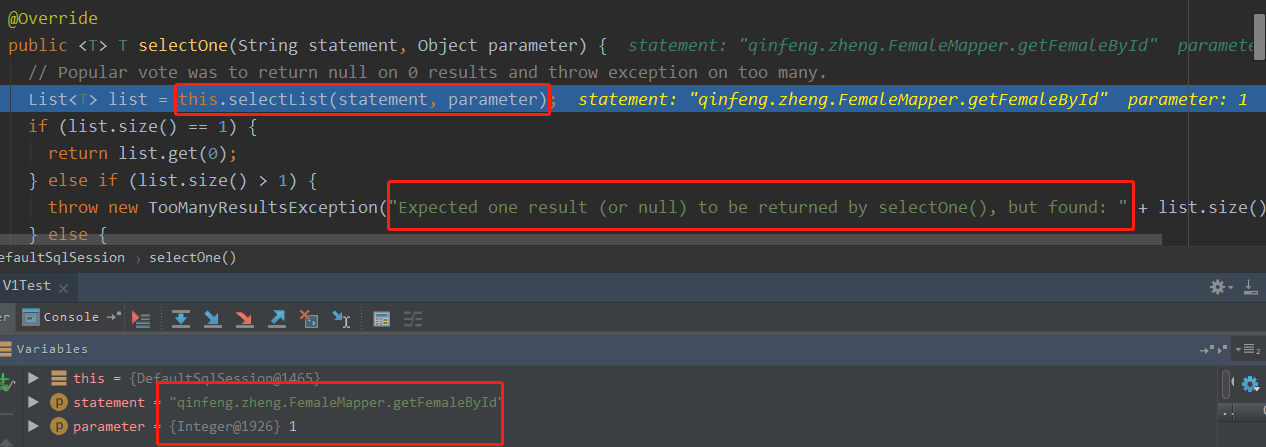
selectOne底层还是调用的selectList,只是取的get(0) , 还有这个异常,工作中也是很常见的呀,原来是这儿抛出来的!
接着看selectList()方法
  @Override

  public <E> List<E> selectList(String statement, Object parameter) {

    return this.selectList(statement, parameter, RowBounds.DEFAULT);

  }
RowBounds, mybatis提供的分页功能,不过这里使用的是DEFAULT,即是偏移量是0,limit 是 Integer.MAX_VALUE, 没啥用,如果我们想使用RowBounds分页,传一个自定义的RowBounds对象即可!
一路往前奔。。。 终于来到这儿。。。
  @Override

  public <E> List<E> selectList(String statement, Object parameter, RowBounds rowBounds) {

    try {

      MappedStatement ms = configuration.getMappedStatement(statement);

      return executor.query(ms, wrapCollection(parameter), rowBounds, Executor.NO_RESULT_HANDLER);

    } catch (Exception e) {

      throw ExceptionFactory.wrapException("Error querying database.  Cause: " + e, e);

    } finally {

      ErrorContext.instance().reset();

    }

  }
前文说过,跟数据库sql相关的东西都封装在MappedStatement 对象中,最终操作数据库的都是Executor实例 ,这儿可以得到证明!
到这儿就差不多了,剩下的就是jdbc操作数据库那一套了。
总结:
1. mybatis创建了一个MapperProxy的代理,用于操作Mapper接口的方法,从而做到CRUD, 在此过程中需要用到的一些实例,前期都已经准备好了!
2. 流程图
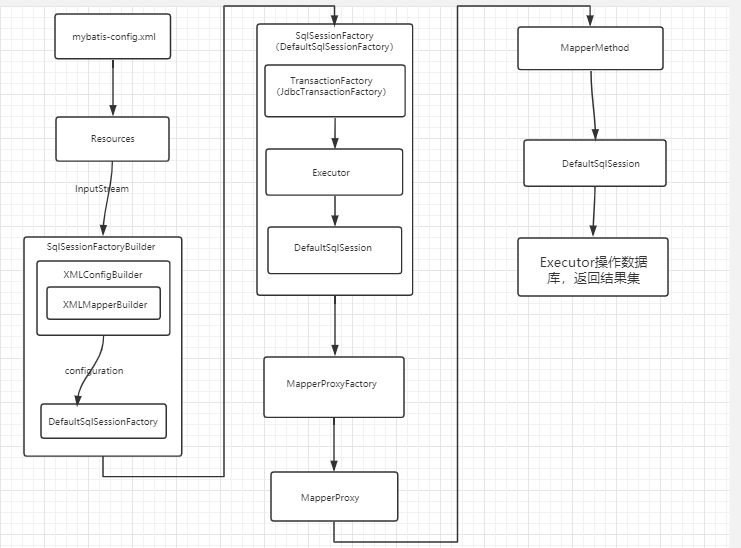
mybatis源码分析之04Mapper接口的动态代理的更多相关文章
- MyBatis源码分析(七):动态代理(Mybatis核心机制)
一.动态代理 动态代理是一种比较高级的代理模式,它的典型应用就是Spring AOP. 在传统的动态代理模式中,客户端通过ProxySubject调用RealSubject类的request( )方法 ...
- MyBatis 源码分析——生成Statement接口实例
JDBC的知识对于JAVA开发人员来讲在简单不过的知识了.PreparedStatement的作用更是胸有成竹.我们最常见用到有俩个方法:executeQuery方法和executeUpdate方法. ...
- MyBatis源码分析(3)—— Cache接口以及实现
@(MyBatis)[Cache] MyBatis源码分析--Cache接口以及实现 Cache接口 MyBatis中的Cache以SPI实现,给需要集成其它Cache或者自定义Cache提供了接口. ...
- 精尽MyBatis源码分析 - MyBatis初始化(二)之加载Mapper接口与XML映射文件
该系列文档是本人在学习 Mybatis 的源码过程中总结下来的,可能对读者不太友好,请结合我的源码注释(Mybatis源码分析 GitHub 地址.Mybatis-Spring 源码分析 GitHub ...
- MyBatis源码分析-MyBatis初始化流程
MyBatis 是支持定制化 SQL.存储过程以及高级映射的优秀的持久层框架.MyBatis 避免了几乎所有的 JDBC 代码和手动设置参数以及获取结果集.MyBatis 可以对配置和原生Map使用简 ...
- MyBatis源码分析-SQL语句执行的完整流程
MyBatis 是支持定制化 SQL.存储过程以及高级映射的优秀的持久层框架.MyBatis 避免了几乎所有的 JDBC 代码和手动设置参数以及获取结果集.MyBatis 可以对配置和原生Map使用简 ...
- MyBatis源码分析(5)——内置DataSource实现
@(MyBatis)[DataSource] MyBatis源码分析(5)--内置DataSource实现 MyBatis内置了两个DataSource的实现:UnpooledDataSource,该 ...
- MyBatis源码分析(2)—— Plugin原理
@(MyBatis)[Plugin] MyBatis源码分析--Plugin原理 Plugin原理 Plugin的实现采用了Java的动态代理,应用了责任链设计模式 InterceptorChain ...
- 【MyBatis源码分析】select源码分析及小结
示例代码 之前的文章说过,对于MyBatis来说insert.update.delete是一组的,因为对于MyBatis来说它们都是update:select是一组的,因为对于MyBatis来说它就是 ...
随机推荐
- selenium中的多窗口切换
在selenium中,我们会遇到一些问题,就是多窗口处理的问题,我们爬取的内容在一个新窗口上,这个时候,我们就需要先切换到这个新的窗口上,然后进行抓取内容. 如何切换呢? 首先,获取当前窗口句柄 1. ...
- 安装依赖的时候,报错npm WARN checkPermissions
解决办法1 . 删除node_modules文件夹,重新安装依赖. 解决办法2 . 统一使用同一个npm安装依赖 . 原因:有的依赖包是用npm安装的,有的依赖包是用cnpm安装的.
- jenkins之启动与关闭
jenkins可以通过内置的应用服务器或者借助其他应用服务器启动 目录 1.启动jenkins 2.关闭jenkins 3.重启jenkins 4.重新加载jenkins配置信息 1.启动jenkin ...
- TCP 为什么是三次握手,而不是两次或四次?
记得第一次看TCP握手连接的时候,有同样的疑问,我的疑问是,为何不是两次呢?后来随着对网络的理解深入,明白TCP报文是交由IP网络来负责运输,IP网络并不能保证TCP报文到达目的地,既然IP网络是指望 ...
- python self和cls的区别
1.self表示一个具体的实例本身.如果用了staticmethod,那么就可以无视这个self,将这个方法当成一个普通的函数使用. 2.cls表示这个类本身.
- Python3数据科学入门与实践学习教程
整个课程都看完了,这个课程的分享可以往下看,下面有链接,之前做java开发也做了一些年头,也分享下自己看这个视频的感受,单论单个知识点课程本身没问题,大家看的时候可以关注下面几点: 1.为了追求精 ...
- TCP协议-流量控制
流量控制是通过滑动窗口来实现控制的.使用了坚持定时器,防止发送失败导致死锁.
- HashMap和布隆过滤器命中性能测试
package datafilter; import com.google.common.base.Stopwatch; import com.google.common.hash.BloomFilt ...
- [ARC083]Collecting Balls
Description 有一个 \(n\times n\) 的矩阵,矩阵内有 \(2n\) 个球.对于 \(i \in [1,n]\) ,\((0,i) (i,0)\) 的位置各有一个启动后往右走/往 ...
- android环境问题
1.android studio bundle和android studio ide区别 android studio bundle和android studio ide区别 准确的说是这三种: 最开 ...