
ARM64 Linux kernel virtual address space
墙外通道:http://thinkiii.blogspot.com/2014/02/arm64-linux-kernel-virtual-address-space.html
Now let's talk about the Linux kernel virtual address space on 64-bit ARM CPU. You can find information about ARMv8 in ARM official website. http://www.arm.com/products/processors/armv8-architecture.php
Actually 2^64 is too large, so in the Linux kernel implementation, only part of 64 bits are used (42 bits for CONFIG_ARM64_64K_PAGES, 39 bit for 4K page). This article is assuming 4K page is used (VA_BITS = 39 case)
#ifdef CONFIG_ARM64_64K_PAGES

#define VA_BITS                 (42)

#else

#define VA_BITS                 (39)

#endif
All user virtual addresses have 25 leading zeros and kernel addresses have 25 leading ones. Address between user space and kernel space are not used and they are used to trap illegal accesses.
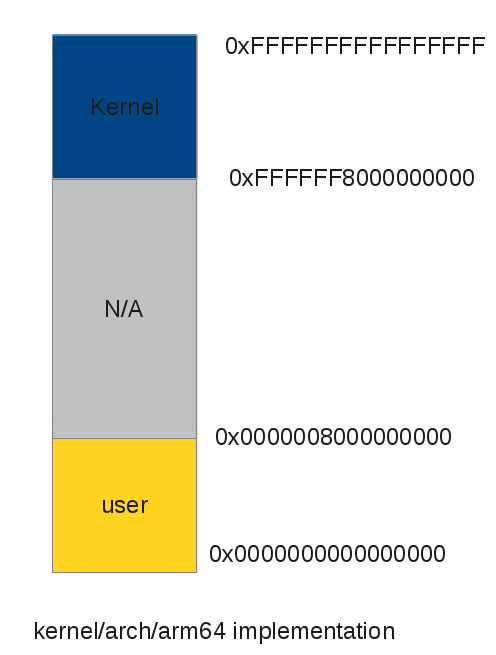
ARM64 Linux virtual address space layout
kernel:
Although we have no ARM64 environment now, we can analysis the kernel virtual address space by reading the source code and observing a running AMD64 Linux box.
In arch/arm64/include/asm/memory.h, we can see the some differences: we have no lowmem zone, since the virtual address is so big that we can treat all memory of lowmem and do not have to worry about virtual address. (Yes, there is still a limit of kernel virtual address). Second, the order of different kernel virtual address changes:
#ifdef CONFIG_ARM64_64K_PAGES

#define VA_BITS                 (42)

#else

#define VA_BITS                 (39)

#endif

#define PAGE_OFFSET             (UL(0xffffffffffffffff) << (VA_BITS - 1))

#define MODULES_END             (PAGE_OFFSET)

#define MODULES_VADDR           (MODULES_END - SZ_64M)

#define EARLYCON_IOBASE         (MODULES_VADDR - SZ_4M)
        pr_notice("Virtual kernel memory layout:\n"

                  "    vmalloc : 0x%16lx - 0x%16lx   (%6ld MB)\n"

#ifdef CONFIG_SPARSEMEM_VMEMMAP

                  "    vmemmap : 0x%16lx - 0x%16lx   (%6ld MB)\n"

#endif

                  "    modules : 0x%16lx - 0x%16lx   (%6ld MB)\n"

                  "    memory  : 0x%16lx - 0x%16lx   (%6ld MB)\n"

                  "      .init : 0x%p" " - 0x%p" "   (%6ld kB)\n"

                  "      .text : 0x%p" " - 0x%p" "   (%6ld kB)\n"

                  "      .data : 0x%p" " - 0x%p" "   (%6ld kB)\n",

                  MLM(VMALLOC_START, VMALLOC_END),

#ifdef CONFIG_SPARSEMEM_VMEMMAP

                  MLM((unsigned long)virt_to_page(PAGE_OFFSET),

                      (unsigned long)virt_to_page(high_memory)),

#endif

                  MLM(MODULES_VADDR, MODULES_END),

                  MLM(PAGE_OFFSET, (unsigned long)high_memory),

                  MLK_ROUNDUP(__init_begin, __init_end),

                  MLK_ROUNDUP(_text, _etext),

                  MLK_ROUNDUP(_sdata, _edata));
see also:
arch/arm64/mm/init.c
arch/arm64/include/asm/pgtable.h
You can see that there is no pkmap or fixmap, it's because the kernel is assuming every memory has a valid kernel virtual address and there's no need to create pkmap/fixmap.
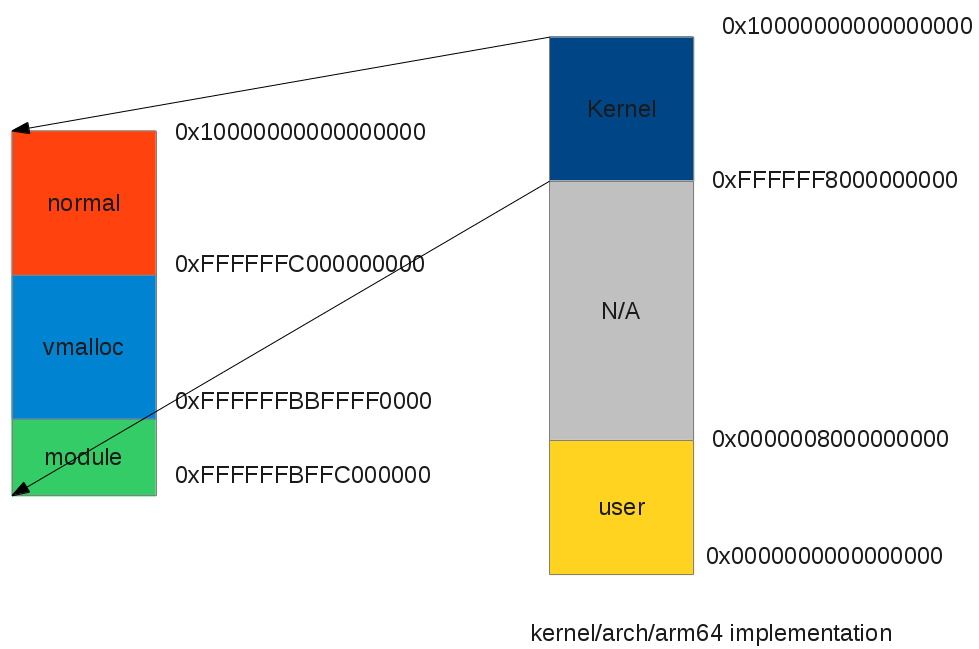
ARM64 kernel virtual address space layout
One interesting topic is that ARM claims the ARMv8 is compatible with ARM 32-bit applications, all 32-bit applications can run on ARMv8 without modification.How does the 32-bit application virtual memory layout look like on a 64-bit kernel?
Actually, all process on 64-bit kernel is a 64-bit process. To run ARM 32-bit applications, Linux kernel still create a process from a 64-bit init process, but limit the user address space to 4GB. In this way, we can have both 32-bit and 64-bit application on a 64-bit Linux kernel.
#ifdef CONFIG_COMPAT

#define TASK_SIZE_32            UL(0x100000000)

#define TASK_SIZE               (test_thread_flag(TIF_32BIT) ? \

                                TASK_SIZE_32 : TASK_SIZE_64)

#else

#define TASK_SIZE               TASK_SIZE_64

#endif /* CONFIG_COMPAT */
64-bit ARM applications on 64-bit Linux kernel

ARM64 64-bit user space program virtual address space layout
32-bit ARM applications on 64-bit Linux kernel
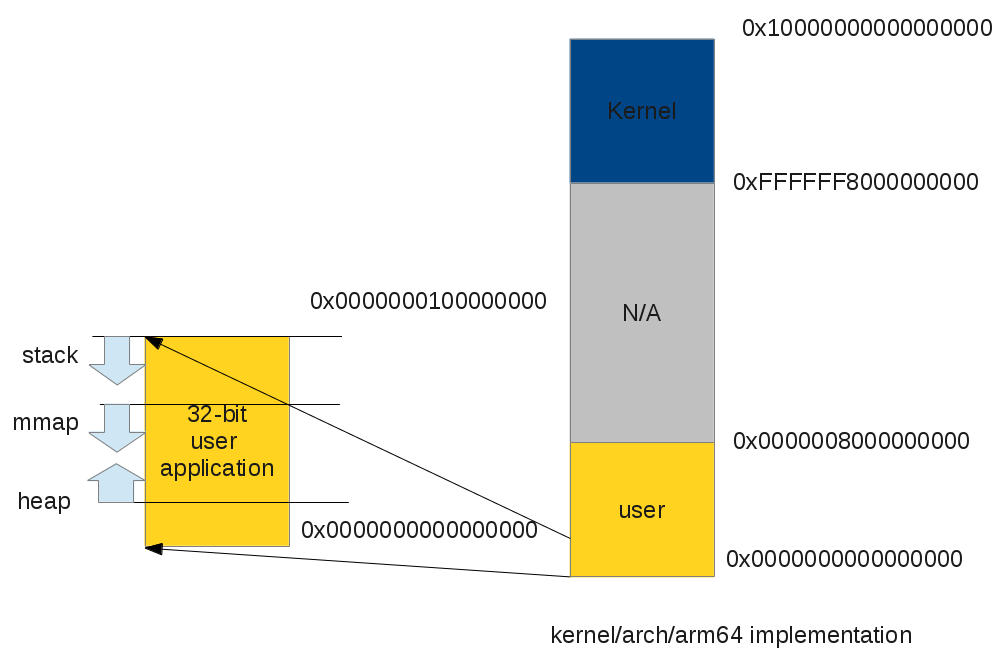
ARM64 32-bit user space program virtual address space layout
Note that the 32-bit application still have a 512GB kernel virtual address space and do not share it's own 4GB of virtual address space with kernel, the user applications have a complete 4GB of virtual address. On the other hand, 32-bit applications on 32-bit kernel have only 3GB of virtual address space.
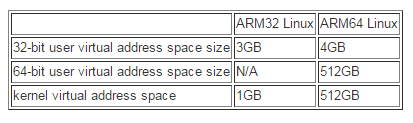
ARM64 Linux kernel virtual address space的更多相关文章
- ARM32 Linux kernel virtual address space
http://thinkiii.blogspot.jp/2014/02/arm32-linux-kernel-virtual-address-space.html The 32-bit ARM C ...
- Memory Layout (Virtual address space of a C process)
Memory Layout (Virtual address space of a C process) 分类: C语言基础2012-12-06 23:16 2174人阅读 评论(0) 收藏 举报 f ...
- linux内核可以接受的参数 | Linux kernel启动参数 | 通过grub给内核传递参数
在Linux中,给kernel传递参数以控制其行为总共有三种方法: 1.build kernel之时的各个configuration选项. 2.当kernel启动之时,可以参数在kernel被GRUB ...
- Linux kernel学习-内存管理【转】
转自:https://zohead.com/archives/linux-kernel-learning-memory-management/ 本文同步自(如浏览不正常请点击跳转):https://z ...
- Linux kernel Programming - Allocating Memory
kmalloc #include <linux/slab.h> void *kmalloc(size_t size,int flags); void kfree(void *addr); ...
- Linux kernel学习-内存管理
转自:https://zohead.com/archives/linux-kernel-learning-memory-management/ 本文同步自(如浏览不正常请点击跳转):https://z ...
- Android linux kernel privilege escalation vulnerability and exploit (CVE-2014-4322)
In this blog post we'll go over a Linux kernel privilege escalation vulnerability I discovered which ...
- Linux Kernel - Debug Guide (Linux内核调试指南 )
http://blog.csdn.net/blizmax6/article/details/6747601 linux内核调试指南 一些前言 作者前言 知识从哪里来 为什么撰写本文档 为什么需要汇编级 ...
- Linux kernel memory-faq.txt
## Linux kernel memory-faq.txt What is some existing documentation on Linux memory management? Ulric ...
随机推荐
- Netsharp平台工具常见问题(FAQ)
1. 请问EntityId如何填? 回答:Netsharp中EntityId是经常需要输入的一个字段,因为Netsharp工具一般的源头是实体元数据,也就是一般常说的所谓模型驱动.所以很多工具都需要E ...
- eclipse里maven项目An error occurred while filtering resources解决办法
在使用eclipse构建maven项目时,突然出现错误提示:An error occurred while filtering resources,在项目中到处都找不到哪里有问题,最后在国外网站找到解 ...
- 别人的Linux私房菜(7)文件与目录管理
- 代表上一个工作目录 ~username代表用户所在的家目录 cd切换目录 配合之上的参数 . .. / ~ ~name (change directory) pwd显 ...
- 机器学习面试--一句话概括传统ML算法
机器学习过程主要包括:数据的特征提取.数据预处理.训练模型.测试模型.模型评估改进等几部分 传统机器学习算法主要包括以下五类: 回归:建立一个回归方程来预测目标值,用于连续型分布预测 分类:给定大量带 ...
- 获取Lambda表达式内表达式的值
随着Linq的盛行,对于Linq和Lmabda表达式的使用也越来越多,Lambda表达式在.net framework 3.5中提出来,Lambda表达式是一个匿名方法,通常在LINQ中被用来创建委托 ...
- 通过HPS控制FPGA的GPIO
1.学习目的 本例程主要是让 SoC FPGA 初学者了解 HPS/ARM 如何跟 FPGA 交互.“My First HPS-FPGA”工程演示了实现方法的细节.这个工程包括 Quartus II ...
- Springboot高版本中@ConfigurationProperties注解取消location属性
在spring boot 1.5 版本之前 在@ConfigurationProperties注释中有两个属性:locations:指定配置文件的所在位置prefix:指定配置文件中键名称的前缀 sp ...
- 736. Parse Lisp Expression
You are given a string expression representing a Lisp-like expression to return the integer value of ...
- Java学习笔记51(综合项目:家庭记账系统)
javaEE的开发模式 1.什么是模式 模式在开发过程中总结出的“套路”,总结出的一套约定俗成的设计模式 2.javaEE经历的模式 model1模式: 技术组成:jsp+javaBean model ...
- 【Spark调优】:如果实在要shuffle,使用map侧预聚合的算子
因业务上的需要,无可避免的一些运算一定要使用shuffle操作,无法用map类的算子来替代,那么尽量使用可以map侧预聚合的算子. map侧预聚合,是指在每个节点本地对相同的key进行一次聚合操作,类 ...