
[ICLR'17] DEEPCODER: LEARNING TO WRITE PROGRAMS
DEEPCODER: LEARNING TO WRITE PROGRAMS
Basic Information
- Authors: Matej Balog, Alexander L. Gaunt, Marc Brockschmidt, Sebastian Nowozin, Daniel Tarlow
- Publication: ICLR'17
- Description: Generate code based on input-output examples via neural network techniques
INDUCTIVE PROGRAM SYNTHESIS (IPS)
The Inductive Program Synthesis (IPS) problem is the following: given input-output examples, produce a program that has behavior consistent with the examples.
Building an IPS system requires solving two problems:
- Search problem: to find consistent programs we need to search over a suitable set of possible programs. We need to define the set
(i.e., the program space) and search procedure. - Ranking problem: if there are multiple programs consistent with the input-output examples, which one do we return?
Domain Specific Languages (DSLs)
- DSLs are programming languages that are suitable for a
specialized domain but are more restrictive than full-featured programming languages. - Restricted DSLs can also enable more efficient special-purpose search algorithms.
- The choice of DSL also affects the difficulty of the ranking problem.
Search Techniques
Technique for searching for programs consistent with input-output examples.
- Special-purpose algorithm
- Satisfiability Modulo Theories (SMT) solving
Ranking
LEARNING INDUCTIVE PROGRAM SYNTHESIS (LIPS)
The components of LIPS are:
a DSL specification,
An attribute function A that maps programs P of the DSL to finite attribute vectors a = A(P). (Attribute vectors of different programs need not have equal length.) Attributes serve as the link between the machine learning and the search component of LIPS: the machine learning model predicts a distribution q(a | E), where E is the set of input-output examples, and the search procedure aims to search over programs P as ordered by q(A(P) | E). Thus an attribute is useful if it is both predictable from input-output examples, and if conditioning on its value significantly reduces the effective size of the search space.
Possible attributes are the (perhaps position-dependent) presence or absence of high-level functions (e.g., does the program contain or end in a call to SORT). Other possible attributes include control
flow templates (e.g., the number of loops and conditionals).a data-generation procedure,
Generate a dataset ((P(n), a(n), E(n)))Nn=1 of programs P(n) in the chosen DSL, their attributes a(n), and accompanying input-output examples E(n)).
a machine learning model that maps from input-output examples to program attributes,
Learn a distribution of attributes given input-output examples, q(a | E).
a search procedure that searches program space in an order guided by the model from (3).
Interface with an existing solver, using the predicted q(a | E) to guide the search.
DEEPCODER: Instantiation of LIPS
- DSL AND ATTRIBUTES
A program in our DSL is a sequence of function calls, where the result of each call initializes a fresh variable that is either a
singleton integer or an integer array. Functions can be applied to any of the inputs or previously computed (intermediate) variables. The output of the program is the return value of the last function
call, i.e., the last variable. See Fig. 1 for an example program of length T = 4 in our DSL.
Overall, our DSL contains the first-order functions HEAD, LAST, TAKE, DROP, ACCESS, MINIMUM, MAXIMUM, REVERSE, SORT, SUM, and the higher-order functions MAP, FILTER, COUNT, ZIPWITH, SCANL1.
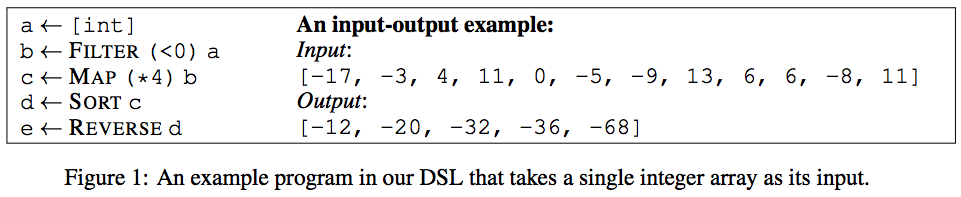
- DATA GENERATION
- MACHINE LEARNING MODEL
- an encoder: a differentiable mapping from a set of M input-output examples generated by
a single program to a latent real-valued vector, and - a decoder: a differentiable mapping from the latent vector representing a set of M inputoutput
examples to predictions of the ground truth program’s attributes.
- an encoder: a differentiable mapping from a set of M input-output examples generated by

- SEARCH
- Depth-first search (DFS)
- “Sort and add” enumeration
- Sketch
- TRAINING LOSS FUNCTION
Negative cross entropy loss
Implementation
[ICLR'17] DEEPCODER: LEARNING TO WRITE PROGRAMS的更多相关文章
- 17、Learning and Transferring IDs Representation in E-commerce笔记
一.摘要 电子商务场景:主要组成部分(用户ID.商品ID.产品ID.商店ID.品牌ID.类别ID等) 传统的编码两个缺陷:如onehot,(1)存在稀疏性问题,维度高(2)不能反映关系,以两个不同的i ...
- SysML——AI-Sys Spring 2019
AI-Sys Syllabus Projects Grading AI-Sys Spring 2019 When: Mondays and Wednesdays from 9:30 to 11:00 ...
- [综述]Deep Compression/Acceleration深度压缩/加速/量化
Survey Recent Advances in Efficient Computation of Deep Convolutional Neural Networks, [arxiv '18] A ...
- (zhuan) Deep Reinforcement Learning Papers
Deep Reinforcement Learning Papers A list of recent papers regarding deep reinforcement learning. Th ...
- Machine Learning 方向读博的一些重要期刊及会议 && 读博第一次组会时博导的交代
读博从报道那天算起到现在已经3个多月了,这段时间以来和博导总共见过两次面,寥寥数语的见面要我对剩下的几年读书生活没有了太多的期盼,有些事情一直想去做却总是打不起来精神,最后挣扎一下还是决定把和博导开学 ...
- 【Deep Learning Nanodegree Foundation笔记】第 0 课:课程计划
第一周 机器学习的类型,以及何时使用机器学习 我们将首先简单介绍线性回归和机器学习.这将让你熟悉这些领域的常用术语,你需要了解的技术进展,并了解深度学习在更大的机器学习背景中的位置. 直播:线性回归 ...
- Github项目推荐-图神经网络(GNN)相关资源大列表
文章发布于公号[数智物语] (ID:decision_engine),关注公号不错过每一篇干货. 转自 | AI研习社 作者|Zonghan Wu 这是一个与图神经网络相关的资源集合.相关资源浏览下方 ...
- 库、教程、论文实现,这是一份超全的PyTorch资源列表(Github 2.2K星)
项目地址:https://github.com/bharathgs/Awesome-pytorch-list 列表结构: NLP 与语音处理 计算机视觉 概率/生成库 其他库 教程与示例 论文实现 P ...
- CNN结构:场景分割与Relation Network
参考第一个回答:如何评价DeepMind最新提出的RelationNetWork 参考链接:Relation Network笔记 ,暂时还没有应用到场景中 LiFeifei阿姨的课程:CV与ML课程 ...
随机推荐
- 重新看待Jar包冲突问题及解决方案
Jar包冲突是老生常谈的问题,几乎每一个Java程序猿都不可避免地遇到过,并且也都能想到通常的原因一般是同一个Jar包由于maven传递依赖等原因被引进了多个不同的版本而导致,可采用依赖排除.依赖管理 ...
- pytorch写一个LeNet网络
我们先介绍下pytorch中的cnn网络 学过深度卷积网络的应该都非常熟悉这张demo图(LeNet): 先不管怎么训练,我们必须先构建出一个CNN网络,很快我们写了一段关于这个LeNet的代码,并进 ...
- 四方定理(递归) --java
四方定理 数论中有著名的四方定理:所有自然数至多只要用四个数的平方和就可以表示. 我们可以通过计算机验证其在有限范围的正确性. import java.*; import java.util.*; p ...
- JDBC(10)—批处理
批量处理JDBC语句,提高处理速度. 当需要成批的的插入或更新记录时可以采用java的批量更新机制,这一机制允许多条语句一次性提交给数据库批量处理,通常情况下比单独提交处理更有效率. 批量处理的方法: ...
- 首席技术官应该考虑的网络安全问题 IT大咖说 - 大咖干货,不再错过
首席技术官应该考虑的网络安全问题 IT大咖说 - 大咖干货,不再错过 http://www.itdks.com/dakalive/detail/5523
- hadoop ha 读取 activce状态的活动节点
方式一 package com.xxx.hadoop; import com.sun.demo.jvmti.hprof.Tracker; import com.sun.xml.bind.util.Wh ...
- 自动化运维之PSSH
1.PSSH简介 PSSH提供OpenSSH和相关工具的并行版本.包括pssh,pscp,prsync,pnuke和pslurp.该项目包括psshlib,可以在自定义应用程序中使用. pssh是py ...
- Android_编程开发规范
Android编程开发规范 原文地址 http://www.jianshu.com/p/9b8aeca9b281 一.约定 Activity.onCreate(),Fragment. ...
- ionic android返回键
每次点击返回键只会执行一个事件, 在自定义事件中要控制条件不满足时实行原默认动作. 如果只在一个view中监控, 还需要及时注销事件. http://www.jianshu.com/p/b567cc6 ...
- SpringBoot乱码
第一步: 第一步,约定好传参编码格式 不管是运用httpclient,还是原生http,都要设置传参的编码,为了统一,这儿全部设置为utf-8 第二步,修正application.properties ...