
Organization SYMMETRIC MULTIPROCESSORS
COMPUTER ORGANIZATION AND ARCHITECTURE DESIGNING FOR PERFORMANCE NINTH EDITION
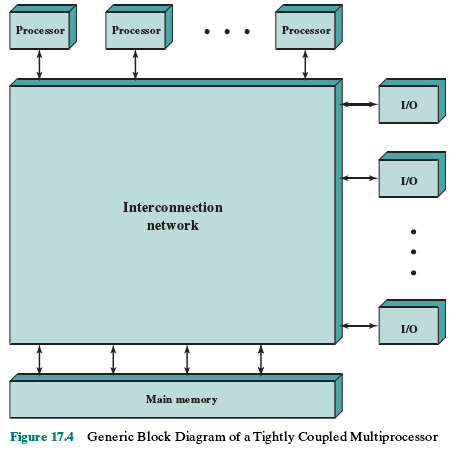
Figure 17.4 depicts in general terms the organization of a multiprocessor system.
There are two or more processors. Each processor is self-contained, including a
control unit, ALU, registers, and, typically, one or more levels of cache. Each pro-
cessor has access to a shared main memory and the I/O devices through some form
of interconnection mechanism. The processors can communicate with each other
through memory (messages and status information left in common data areas). It
may also be possible for processors to exchange signals directly. The memory is
often organized so that multiple simultaneous accesses to separate blocks of mem-
ory are possible. In some configurations, each processor may also have its own pri-
vate main memory and I/O channels in addition to the shared resources.
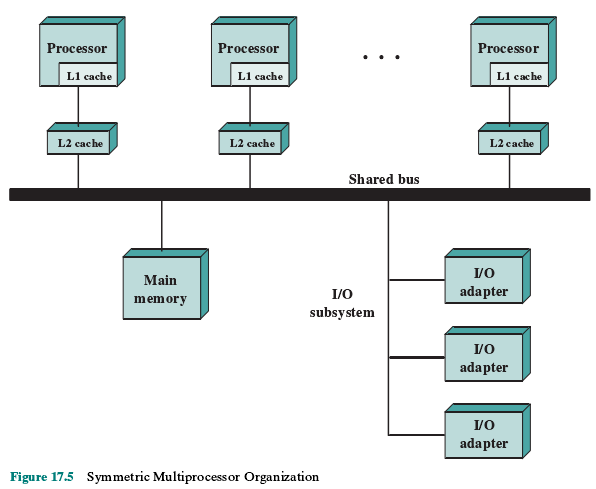
The most common organization for personal computers, workstations, and
servers is the time-shared bus. The time-shared bus is the simplest mechanism for
constructing a multiprocessor system (Figure 17.5). The structure and interfaces are
basically the same as for a single-processor system that uses a bus interconnection.
The bus consists of control, address, and data lines. To facilitate DMA transfers
from I/O subsystems to processors, the following features are provided:
• Addressing: It must be possible to distinguish modules on the bus to deter-
mine the source and destination of data.
• Arbitration: Any I/O module can temporarily function as “master.” A mecha-
nism is provided to arbitrate competing requests for bus control, using some
sort of priority scheme.
• Time-sharing: When one module is controlling the bus, other modules are
locked out and must, if necessary, suspend operation until bus access is achieved.
hese uniprocessor features are directly usable in an SMP organization. In
this latter case, there are now multiple processors as well as multiple I/O processors
all attempting to gain access to one or more memory modules via the bus.
The bus organization has several attractive features:
• Simplicity: This is the simplest approach to multiprocessor organization. The
physical interface and the addressing, arbitration, and time-sharing logic of
each processor remain the same as in a single-processor system.
• Flexibility: It is generally easy to expand the system by attaching more proces-
sors to the bus.
• Reliability: The bus is essentially a passive medium, and the failure of any
attached device should not cause failure of the whole system.
The main drawback to the bus organization is performance. All memory ref-
erences pass through the common bus. Thus, the bus cycle time limits the speed
of the system. To improve performance, it is desirable to equip each processor
with a cache memory. This should reduce the number of bus accesses dramatically.
Typically, workstation and PC SMPs have two levels of cache, with the L1 cache
internal (same chip as the processor) and the L2 cache either internal or external.
Some processors now employ a L3 cache as well.
The use of caches introduces some new design considerations. Because each
local cache contains an image of a portion of memory, if a word is altered in one
cache, it could conceivably invalidate a word in another cache. To prevent this, the
other processors must be alerted that an update has taken place. This problem is
known as the cache coherence problem and is typically addressed in hardware rather
than by the operating system. We address this issue in Section 17.4.
Organization SYMMETRIC MULTIPROCESSORS的更多相关文章
- SYMMETRIC MULTIPROCESSORS
COMPUTER ORGANIZATION AND ARCHITECTURE DESIGNING FOR PERFORMANCE NINTH EDITION As demands for perfor ...
- Multiprocessor Operating System Design Considerations SYMMETRIC MULTIPROCESSORS
COMPUTER ORGANIZATION AND ARCHITECTURE DESIGNING FOR PERFORMANCE NINTH EDITION An SMP operating syst ...
- parallelism
COMPUTER ORGANIZATION AND ARCHITECTURE DESIGNING FOR PERFORMANCE NINTH EDITION Traditionally, the co ...
- Massively parallel supercomputer
A novel massively parallel supercomputer of hundreds of teraOPS-scale includes node architectures ba ...
- QEMU中smp,socket,cores,threads几个参数的理解
在用QEMU创建KVM guest的时候,为了指定guest cpu资源,用到了-smp, -sockets, -cores, -threads几个参数, #/usr/bin/qemu-system- ...
- c++多线程同步使用的对象
线程的同步 Critical section(临界区)用来实现“排他性占有”.适用范围是单一进程的各线程之间.它是: · 一个局部性对象,不是一个核心对象. · 快速而 ...
- 第4章 同步控制 Synchronization ----同步机制的摘要
同步机制摘要Critical Section Critical section(临界区)用来实现"排他性占有".适用范围是单一进程的各线程之间.它是: 一个局部性对象,不是一个核 ...
- 线程的同步控制(Synchronization)
临界区(Critical Sections) 摘要 临界区(Critical Section) 用来实现"排他性占有".适合范围时单一进程的各线程之间. 特点 一个局部对象,不是一 ...
- 分布式计算课程补充笔记 part 1
▶ 高性能计算机发展历程 真空管电子计算机,向量机(Vector Machine),并行向量处理机(Parallel Vector Processors,PVP),分布式并行机(Parallel Pr ...
随机推荐
- linux下ssh的几种验证方式
ssh的认证方式有很多种,大概可以概括为以下几类: 1.pam认证方式 在配置文件/etc/ssh/sshd_config中对应参数:UsePAM 2.密钥认证方式 配置文件/etc/ssh/sshd ...
- [Linux]Linux系统调用列表
本文列出了大部分常见的Linux系统调用,并附有简要中文说明. 以下是Linux系统调用的一个列表,包含了大部分常用系统调用和由系统调用派生出的的函数.这可能是你在互联网上所能看到的唯一一篇中文注释的 ...
- Linux网络管理2---(网络环境查看命令、网络测试命令)
1.网络环境查看命令 ifconfig命令 查看或临时修改网络状态的命令 可以看到IP.子网掩码……信息 关闭和启动网卡 ifdown 网卡设备名(比如: ifdown eth0):禁用该网卡设备 i ...
- c#关于类的继承
public class D { public virtual void Run(string name) { Console.WriteLine(name + ",good"); ...
- module_init的加载和释放
转自:http://blog.csdn.net/dysh1985/article/details/7597105 像你写C程序需要包含C库的头文件那样,Linux内核编程也需要包含Kernel头文件, ...
- MVC Controller Dependency Injection for Beginners【翻译】
在codeproject看到一篇文章,群里的一个朋友要帮忙我翻译一下顺便贴出来,这篇文章适合新手,也算是对MEF的一个简单用法的介绍. Introduction In a simple stateme ...
- [Unity3D插件]2dToolKit系列三 碰撞检测功能的实现以及障碍物的随机摆放
貌似有一段时间没更新2dtoolkit系列了,这段时间一直在忙着其他事情,今天开始继续这个插件系列的教程,网上搜索,貌似关于这个插件的教程无非还是跟官方的教程很类似,有的甚至都没有自己照着亲手实践一遍 ...
- 进击的Python【第一章】:Python背景初探与Python基础(一)
Python背景初探 一.Python起源 Python的创始人为Guido van Rossum.1989年圣诞节期间,在阿姆斯特丹,Guido为了打发圣诞节的无趣,决心开发一个新的脚本解释程序,做 ...
- Xamarin设备相关图片尺寸要求
Xamarin设备相关图片尺寸要求 Xamarin跨平台开发,要兼顾iOS.Android.尤其是图片方面,各个平台有对应的不同要求.在iOS中,需要提供没有后缀(设备无关单位尺寸).@2x(双倍 ...
- XD, XR, DR 股票
股权登记日与除权除息日 所以,如果投资者想得到一家上市公司的分红.配股权,就必须弄清这家公司的股权登记日在哪一天,否则就会失去分红.配股的机会. 股权登记日后的第一天就是除权日或除息日,这一天或以后购 ...