
GeneralizedLinearAlgorithm in Spark MLLib
SparkMllib涉及到的算法
- Classification
- Linear Support Vector Machines (SVMs)
- Logistic regression
- Regression
- Linear least squares, Lasso, and ridge regression
- Streaming linear regression
GeneralizedLinearAlgorithm
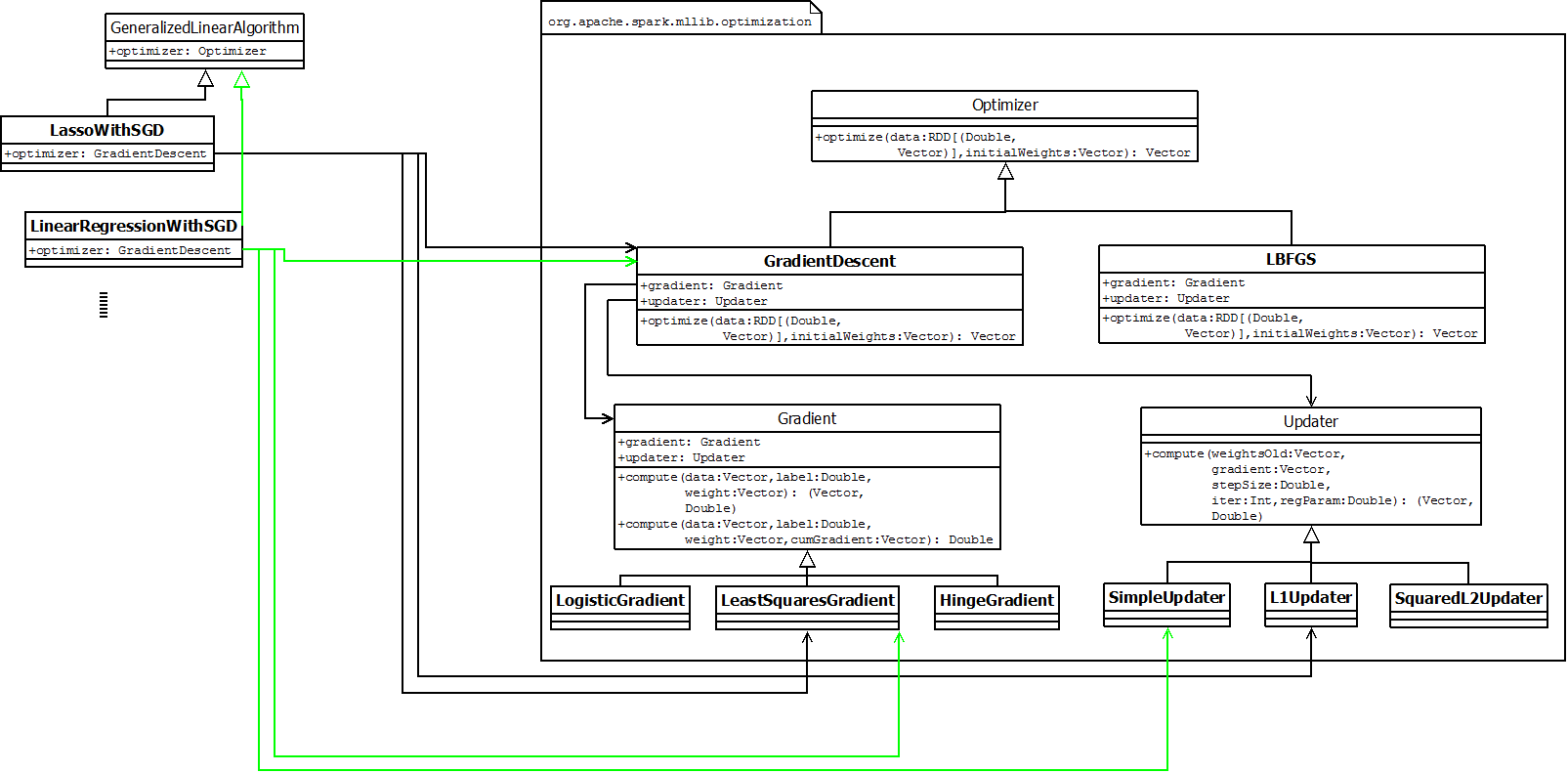
GLA,通用线性算法,作为通用回归算法(regression)和分类算法(classification)的抽象算法,run函数中实现了算法的流程,并最终产生通用线性模型。抽象算法流程主要包括:addIntercept, useFeatureScaling, 调用optimizer计算参数等。其中optimizer是抽象类,具体的线性算法需要指定具体的optimizer实现类。【模板模式——子类的训练大多调用了GLA中的run函数】
进一步地,optimizer是算法的核心,也是迭代算法的逻辑所在。具体类包括梯度下降等算法。这些优化算法又可以抽象并归纳出两个模块:梯度计算器(Gradient)和参数更新(Updater)。
综上,对于某一个具体的线性算法时主要一个优化器,而优化器是通过选择梯度计算器和参数更新器的组合来得到。【bridge pattern】
当前版本中GLA有多个子类,覆盖了多个分类和回归算法:
- LassoWithSGD (org.apache.spark.mllib.regression)
- LinearRegressionWithSGD (org.apache.spark.mllib.regression)
- RidgeRegressionWithSGD (org.apache.spark.mllib.regression)
- LogisticRegressionWithLBFGS (org.apache.spark.mllib.classification)
- LogisticRegressionWithSGD (org.apache.spark.mllib.classification)
- SVMWithSGD (org.apache.spark.mllib.classification)
例如,LinearRegressionWithSGD算法,对应的Optimizer是GradientDecent,对应的梯度计算器是LeaseSquareGradent,x位置的梯度$$\vec{\triangledown} = (\vec{x}^T\cdot\vec{w} - y)\cdot\vec{x}$$,对应的更新器为SimpleUpdater,更新算法是$$\vec{w} =: \vec{w} - \alpha / \sqrt{iter}\cdot\vec{\triangledown}/m$$
GeneralizedLinearModel
Algorithm will create a model by calling:
def createModel(...): M
**GeneralizedLinearModel **(GLM) represents a model trained using GeneralizedLinearAlgorithm. GLMs consist of a weight vector and an intercept.
Parameters:
- weights - Weights computed for every feature.
- intercept - Intercept computed for this model.
基本上每个线性算法都对应到一个线性模型: - LassoModel
- LinearRegressionModel
- LogisticRegressionModel
- RidgeRegressionModel
- SVMModel
GradientDecent梯度下降法
梯度下降法对convex函数必然能求解。
function [theta, J_history] = gradientDescent(X, y, theta, alpha, num_iters)

%GRADIENTDESCENT Performs gradient descent to learn theta

% theta = GRADIENTDESCENT(X, y, theta, alpha, num_iters) updates theta by

% taking num_iters gradient steps with learning rate alpha

% Initialize some useful values

m = length(y); % number of training examples

J_history = zeros(num_iters, 1);

for iter = 1:num_iters

% ====================== YOUR CODE HERE ======================

% Instructions: Perform a single gradient step on the parameter vector

% theta.

%

% Hint: While debugging, it can be useful to print out the values

% of the cost function (computeCost) and gradient here.

%

theta = theta - alpha * X' * (X * theta - y) / m;

% ============================================================

% Save the cost J in every iteration

J_history(iter) = computeCost(X, y, theta);

end
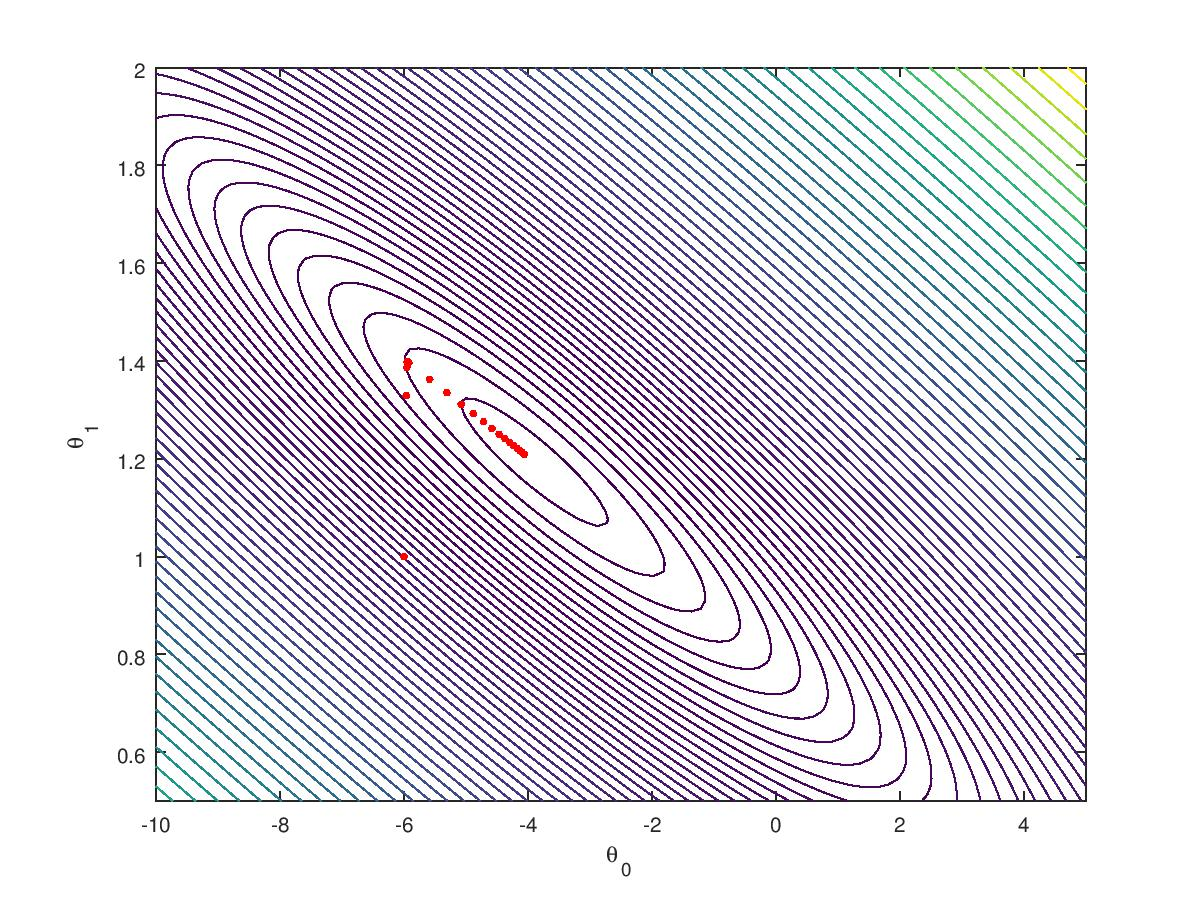
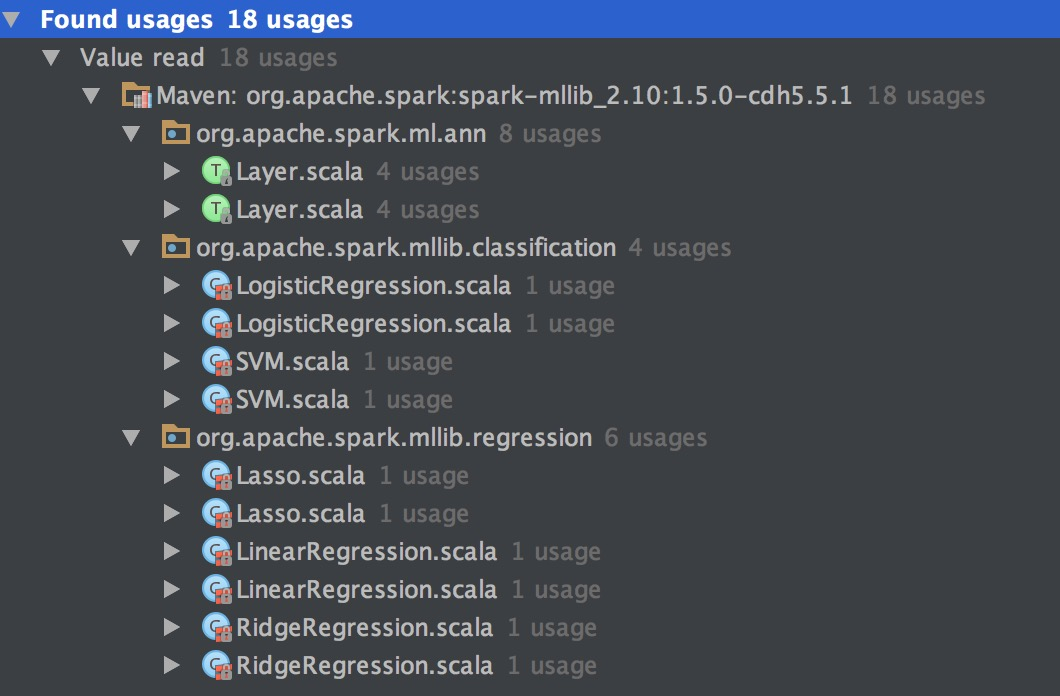
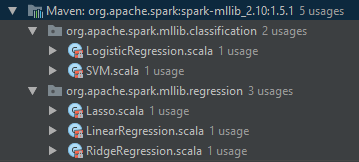
代码中可以发现多处使用了梯度下降法,包括ann,LR/SVM分类算法,Lasso/Linear/Ridge回归等算法。
主要构造函数:
class GradientDescent private[spark] (

private var gradient: Gradient,

private var updater: Updater)

extends Optimizer with Logging {

private var stepSize: Double = 1.0

private var numIterations: Int = 100

private var regParam: Double = 0.0

private var miniBatchFraction: Double = 1.0

private var convergenceTol: Double = 0.001
其中gradient为计算梯度的公式,updater为根据梯度的值去更新权重的公式。除了这两个参数之外,还有算法训练过程中的一些技术参数。
算法的基本参数设定之后便,再给定训练样本,便可以训练得到模型权重:
def optimize(

data: RDD[(Double, Vector)],

initialWeights: Vector): Vector = {

val (weights, _) = GradientDescent.runMiniBatchSGD(

data,

gradient,

updater,

stepSize,

numIterations,

regParam,

miniBatchFraction,

initialWeights,

convergenceTol)

weights

}
=> 调用迭代梯度下降法
def runMiniBatchSGD(data: RDD[(Double, Vector)],

gradient: Gradient,

updater: Updater,

stepSize: Double,

numIterations: Int,

regParam: Double,

miniBatchFraction: Double,

initialWeights: Vector,

convergenceTol: Double): (Vector, Array[Double])
Run stochastic gradient descent (SGD) in parallel using mini batches. In each iteration, we sample a subset (fraction miniBatchFraction) of the total data in order to compute a gradient estimate. Sampling, and averaging the subgradients over this subset is performed using one standard spark map-reduce in each iteration.
Parameters:
- data - Input data for SGD. RDD of the set of data examples, each of the form (label, [feature values]).
- gradient - Gradient object (used to compute the gradient of the loss function of one single data example)
- updater - Updater function to actually perform a gradient step in a given direction.
- stepSize - initial step size for the first step
- numIterations - number of iterations that SGD should be run.
- regParam - regularization parameter
- miniBatchFraction - fraction of the input data set that should be used for one iteration of SGD. Default value 1.0.
- initialWeights - initial weights for model training.
- convergenceTol - Minibatch iteration will end before numIterations if the relative difference between the current weight and the previous weight is less than this value. In measuring convergence, L2 norm is calculated. Default value 0.001. Must be between 0.0 and 1.0 inclusively.
Returns:
A tuple containing two elements. The first element is a column matrix containing weights for every feature, and the second element is an array containing the stochastic loss computed for every iteration.
迭代梯度下降法 (SGD)
上述分析可以发现梯度下降法采用的实现法法是SGD,该算法对模型进行迭代更新,非常适合分布式计算,算法流程:
- Sample a subset of data or just use all the data;
- [MAPPER] for each entry, calculate gradient and model loss by
Gradient$$(g^{(i)}, l^{(i)}) := \cal{Gradient}(x^{(i)}, y^{(i)}, \theta)$$; - [AGGREGATION] sum of gradient = $$\sum_ig^{(i)}$$, sum of loss = $$\sum_i l^{(i)}$$, counter = $$\sum_i 1$$;
Updater$$\theta' := \cal{Update}(\theta, \sum_ig^{(i)} / \sum_i 1, \alpha, ...)$$;- if $$||\theta'-\theta||_2 / ||\theta'||_2 < convergenceTol$$ finish, else $$\theta := \theta'$$, repeat from step 1.
各线性算法的G/U组合
| Algorithm | optimizer | Gradient | updater |
|---|---|---|---|
| LinearRegressionWithSGD | GradientDescent | LeastSquares | Simple |
| LassoWithSGD | GradientDescent | LeastSquares | L1Updater |
| RidgeRegressionWithSGD | GradientDescent | LeastSquares | SquaredL2 |
| LogisticRegressionWithSGD | GradientDescent | Logistic | SquaredL2 |
| LogisticRegressionWithLBFGS | LBFGS | Logistic | SquaredL2 |
| SVMWithSGD | GradientDescent | Hinge | SquaredL2 |
GradientDecent以及SGD算法的流程在上面已经描述,接下来具体分析各种梯度计算和权重更新算法:
LeaseSquareGradent
lost function:
\]
\]
SimpleUpdater
A simple updater for gradient descent without any regularization.
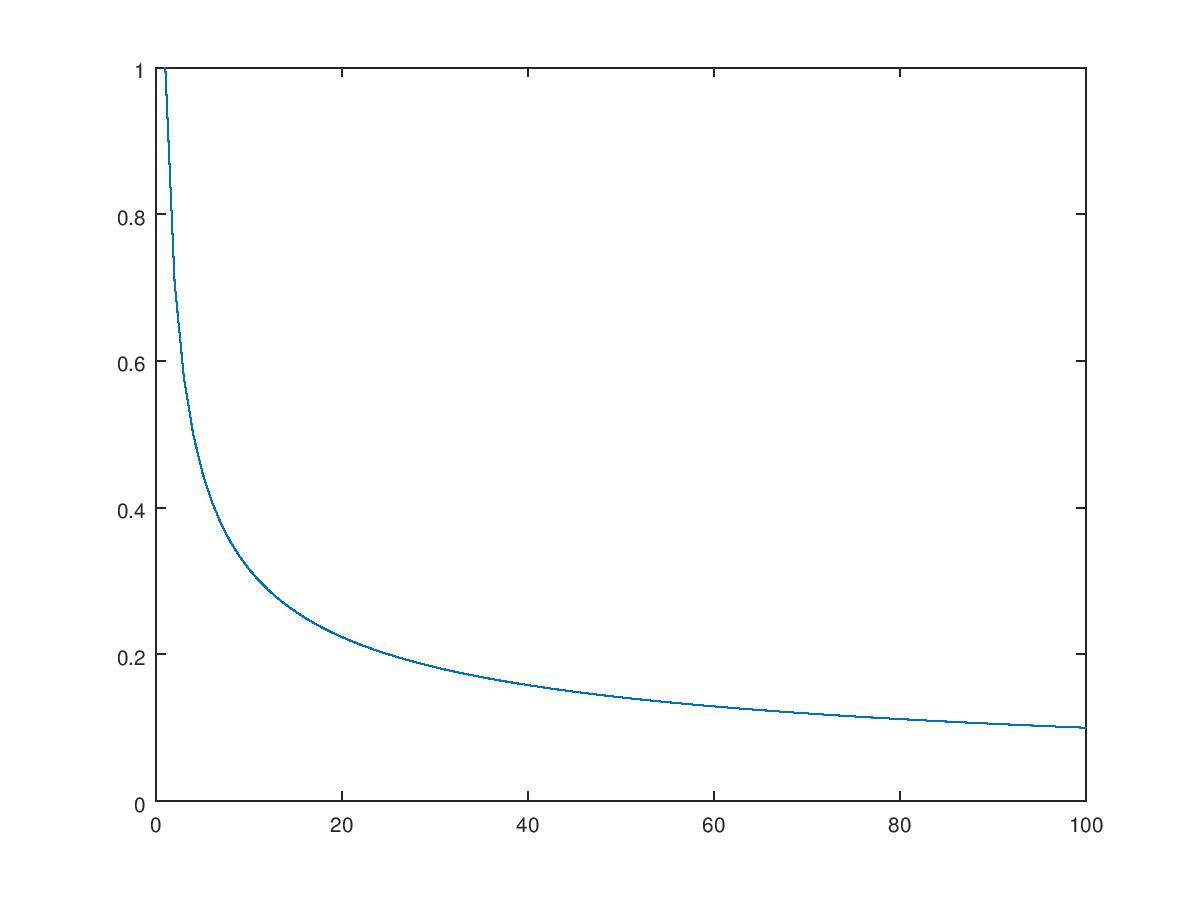
更新算法是$$\vec{w} := \vec{w} - \alpha / \sqrt{iter}\cdot\vec{\triangledown}$$,
其中$$ \vec{\triangledown} = \sum_i{\vec{\triangledown_i} / \sum_i {i}}$$
算法迭代过程中整体的步长会随着迭代次数而逐渐减小,
SquaredL2Updater
L2 regularized problems:
L = 1/n ||X \cdot w - y||^2 + R(w),\\
\text{then:} \frac{dL}{dw}=\vec{\triangledown} + \lambda w\\
w:=w' - \alpha \cdot \frac{dL}{dw}\\
\ \ \ = (1-\alpha \lambda)\vec{w} - \alpha / \sqrt{iter}\cdot\vec{\triangledown}\]
与LinearRegressionWithSGD比较,RidgeRegressionWithSGD的优化器依然是LeastSquaresGradient,训练样本计算Gradient额算法也相同,不通点是在给定Gradient结果基础上更新权重时,old权重需要额外乘以一个系数。
GeneralizedLinearAlgorithm in Spark MLLib的更多相关文章
- Spark MLlib之线性回归源代码分析
1.理论基础 线性回归(Linear Regression)问题属于监督学习(Supervised Learning)范畴,又称分类(Classification)或归纳学习(Inductive Le ...
- Spark MLlib - LFW
val path = "/usr/data/lfw-a/*" val rdd = sc.wholeTextFiles(path) val first = rdd.first pri ...
- 《Spark MLlib机器学习实践》内容简介、目录
http://product.dangdang.com/23829918.html Spark作为新兴的.应用范围最为广泛的大数据处理开源框架引起了广泛的关注,它吸引了大量程序设计和开发人员进行相 ...
- Spark MLlib 之 Basic Statistics
Spark MLlib提供了一些基本的统计学的算法,下面主要说明一下: 1.Summary statistics 对于RDD[Vector]类型,Spark MLlib提供了colStats的统计方法 ...
- Spark MLlib Data Type
MLlib 支持存放在单机上的本地向量和矩阵,也支持通过多个RDD实现的分布式矩阵.因此MLlib的数据类型主要分为两大类:一个是本地单机向量:另一个是分布式矩阵.下面分别介绍一下这两大类都有哪些类型 ...
- Spark MLlib - Decision Tree源码分析
http://spark.apache.org/docs/latest/mllib-decision-tree.html 以决策树作为开始,因为简单,而且也比较容易用到,当前的boosting或ran ...
- Spark入门实战系列--8.Spark MLlib(上)--机器学习及SparkMLlib简介
[注]该系列文章以及使用到安装包/测试数据 可以在<倾情大奉送--Spark入门实战系列>获取 .机器学习概念 1.1 机器学习的定义 在维基百科上对机器学习提出以下几种定义: l“机器学 ...
- Spark入门实战系列--8.Spark MLlib(下)--机器学习库SparkMLlib实战
[注]该系列文章以及使用到安装包/测试数据 可以在<倾情大奉送--Spark入门实战系列>获取 .MLlib实例 1.1 聚类实例 1.1.1 算法说明 聚类(Cluster analys ...
- spark mllib配置pom.xml错误 Multiple markers at this line Could not transfer artifact net.sf.opencsv:opencsv:jar:2.3 from/to central (https://repo.maven.apache.org/maven2): repo.maven.apache.org
刚刚spark mllib,在maven repository网站http://mvnrepository.com/中查询mllib后得到相关库的最新dependence为: <dependen ...
随机推荐
- lodash 中常用的方法
odash是js集Array/Object/String/Function的Util于一身. lodash打包了Array/Object/String/Function里一些Api,好处是连ES6的也 ...
- 深度学习中 epoch,[batch size], iterations概念解释
one epoch:所有的训练样本完成一次Forword运算以及一次BP运算 batch size:一次Forword运算以及BP运算中所需要的训练样本数目,其实深度学习每一次参数的更新所需要损失函数 ...
- 使用express框架和mongoose在MongoDB删除数据
使用remove()删除数据 remove({},function(err,doc){}) // 删除所有数据 remove({age:18},function(err,doc){}); //删除指 ...
- CHAPITRE III
Il me fallut longtemps pour comprendre d'où il venait. Le petit prince, qui me posait beaucoup de qu ...
- 吓死baobao了
早上远程连接服务器连不上,后面重启服务器,显示进入紧急修复模式:welcome to emergency mode!after logging in ,type “journalctl -xb” to ...
- java Concurrent包学习笔记(一):ExecutorService
一.介绍 ExecutorService是java.util.concurrent包中的一个线程池实现接口.其有两个实现类: 1)ThreadPoolExecutor:普通线程池通过配置线程池大小,能 ...
- 二叉搜索树、AVL平衡二叉搜索树、红黑树、多路查找树
1.二叉搜索树 1.1定义 是一棵二叉树,每个节点一定大于等于其左子树中每一个节点,小于等于其右子树每一个节点 1.2插入节点 从根节点开始向下找到合适的位置插入成为叶子结点即可:在向下遍历时,如果要 ...
- Redis和RabbitMQ在项目中的使用
一:Redis的使用 1.先引入pom.xml的依赖 <dependency> <groupId>redis.clients</groupId> <artif ...
- 工作总结(一):Linux C
这三个月以来一直忙着赶进度,没有停下来记录一些东西,很多很好的东西往往只能零零散散地记在草稿本上, 这样偶尔想起来自己都找不到,所以现在抽空总结下来. 这些天做了三件事,其一是在Linux下开发了对接 ...
- asp.net上传文件夹
最近公司做工程项目,实现文件夹上传. 网上找了一天,发现网上很多代码都存在相似问题,最后终于找到了一个符合要求的项目. 工程如下: 这里对项目的文件夹上传进行分析,实现文件夹上传,如何进行文件夹上传. ...