
机器学习- RNN以及LSTM的原理分析
- 概述
RNN是递归神经网络,它提供了一种解决深度学习的另一个思路,那就是每一步的输出不仅仅跟当前这一步的输入有关,而且还跟前面和后面的输入输出有关,尤其是在一些NLP的应用中,经常会用到,例如在NLP中,每一个输出的Word,都跟整个句子的内容都有关系,而不仅仅跟某一个词有关。LSTM是RNN的一种升级版本,它的核心思想跟RNN是一样的,但是它透过一下方法避免了一些RNN的缺点。那么下面就逐步的解析一下RNN和LSTM的结构,然后分析一下它们的原理吧。
- RNN解析
要理解RNN,咱们得先来看一下RNN的结构,然后就来解释一下它的原理
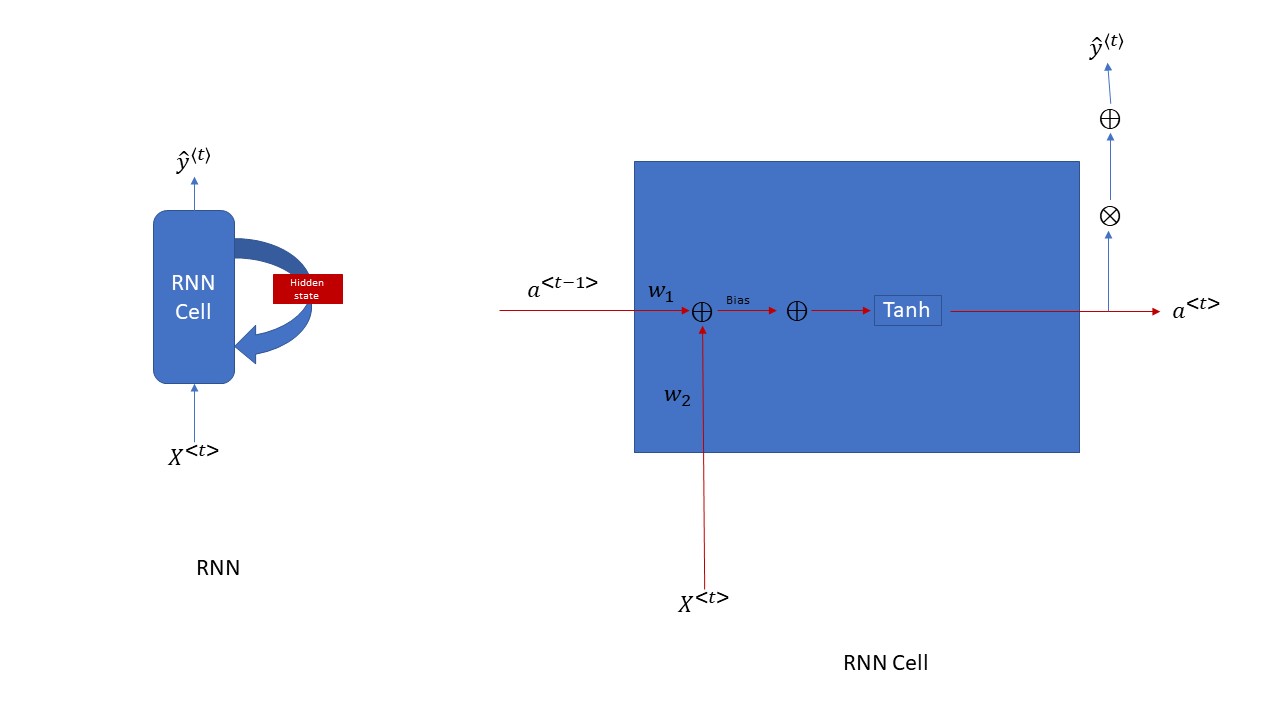
上图中左边的图是一个RNN网络结构中总体的图,右边的图片是一个RNN Cell里面的具体细节; 从上面的左边的图咱们可以看出,一个RNN的网络结构中,无论RNNcell循环多少次,它的weights都是share的,即一个weights只有一份copy, 而每一步的Hidden state(即右图中的a<t>和a<t-1>)是不同的,每一个time step它都有一份hidden state的copy。从上面的图片分析来看, RNN的每一步的输入不单单是有X<t>, 而且还有有前面的time step中学习来的hidden state - a<t-1>。这就实现了咱们前面的需求了,让每一步的输出不仅仅跟当前的输入有关,还得跟前面的输入有关。具体的代码实现这个RNN cell的方法,你们可以参考下面的代码来加深对RNN的理解,实际在TensorFlow中来应用RNN的话,其实非常简单,就是一句代码就搞定了,但是,这里我还是贴出RNN cell创建的源码方便大家理解
def rnn_cell(xt, a_prev, parameters):

    """

    Implements a single forward step of the RNN-cell as described

    Arguments:

    xt -- your input data at timestep "t", numpy array of shape (n_x, m).

    a_prev -- Hidden state at timestep "t-1", numpy array of shape (n_a, m)

    parameters -- python dictionary containing:

                        Wax -- Weight matrix multiplying the input, numpy array of shape (n_a, n_x)

                        Waa -- Weight matrix multiplying the hidden state, numpy array of shape (n_a, n_a)

                        Wya -- Weight matrix relating the hidden-state to the output, numpy array of shape (n_y, n_a)

                        ba --  Bias, numpy array of shape (n_a, 1)

                        by -- Bias relating the hidden-state to the output, numpy array of shape (n_y, 1)

    Returns:

    a_next -- next hidden state, of shape (n_a, m)

    yt_pred -- prediction at timestep "t", numpy array of shape (n_y, m)

    cache -- tuple of values needed for the backward pass, contains (a_next, a_prev, xt, parameters)

    """

    # Retrieve parameters from "parameters"

    Wax = parameters["Wax"]

    Waa = parameters["Waa"]

    Wya = parameters["Wya"]

    ba = parameters["ba"]

    by = parameters["by"]

    # compute next activation state using the formula given above

    a_next = np.tanh(Wax.dot(xt)+Waa.dot(a_prev)+ba)

    # compute output of the current cell using the formula given above

    yt_pred = softmax(Wya.dot(a_next)+by)

    # store values you need for backward propagation in cache

    cache = (a_next, a_prev, xt, parameters)

    return a_next, yt_pred, cache

np.random.seed(1)

xt_tmp = np.random.randn(3,10)

a_prev_tmp = np.random.randn(5,10)

parameters_tmp = {}

parameters_tmp['Waa'] = np.random.randn(5,5)

parameters_tmp['Wax'] = np.random.randn(5,3)

parameters_tmp['Wya'] = np.random.randn(2,5)

parameters_tmp['ba'] = np.random.randn(5,1)

parameters_tmp['by'] = np.random.randn(2,1)

a_next_tmp, yt_pred_tmp, cache_tmp = rnn_cell_forward(xt_tmp, a_prev_tmp, parameters_tmp)

print("a_next[4] = ", a_next_tmp[4])

print("a_next.shape = ", a_next_tmp.shape)

print("yt_pred[1] =", yt_pred_tmp[1])

print("yt_pred.shape = ", yt_pred_tmp.shape)

print( a_next_tmp[:,:])

print( a_next_tmp[:,0])
- LSTM解析
根据上面的RNN的结构图片,你们仔细的看一下有没有什么缺点。如果怎么的RNN需要循环很多次的话,咱们可能会有丢失信息的可能,就是gradient vanishing的情况发生,如果gradient vanishing的情况发生的话,它就不会继续学习咱们的信息了,就变成了standard neuro network了,RNN就失去了意义了。而且,咱们的sequence越长(即:循环的次数越多),gradient vanishing的可能性就越大。这个时候,咱们就有必要优化咱们的RNN了,让优化了的结构不但能够不断的学习能力,还能够有记忆功能,能把咱们学习的主要的东西能够记住,这就让咱们的RNN进化到了LSTM(Long short term memory)阶段了。为了能够更好的解释LSTM的网络结构,咱们还是先来看一些它就结构图片,然后再来解释一下吧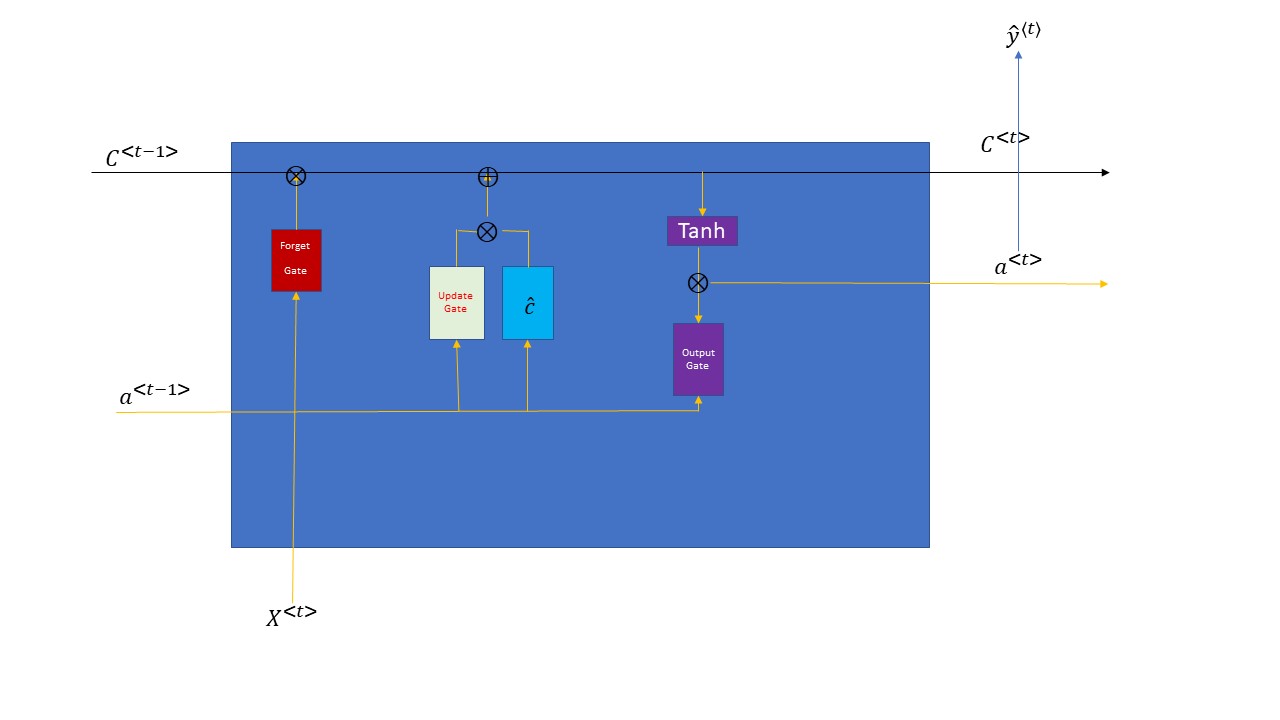
上图是一个LSTM cell的基本结构,这个图有有些不重要的元素,我都省略了,主要留下了一些最重要的信息。首先对比RNN, 咱们可以看出咱们多了3个gate和一个memory cell - C<t>。这个memory cell也称作internal hidden state。那么咱们来看看这个三个gate到底是干什么的。第一个gate是forget gate,它是帮助咱们的memory cell删除(或者称之为过滤)掉一些不重要的信息的,这个gate的值是在[0,1]这个区间,一般咱们用sigmoid函数来运算了,然后再和C来做element-wise的乘法运算,如果forget gate中的值趋向于0就删除掉相应的信息,如果forget gate中的值趋向于1则保留相应的值。第二个gate是update gate; 这个gate要跟咱们candidate memory cell来共同作用来产生新的信息,它们两个进行element-wise的相乘运算后,再跟咱们经过forget gate后的memory cell来进行element-wise的相加匀速,相当于把咱们从当前time step中学习到的信息添加到咱们的memory cell中。第三个gate就是output gate了;顾名思义就是过滤咱们输出的hidden state的, 这个gate也是sigmoid函数,根据前一个hidden state a<t-1> 和当前time step的输入 X<t>来共同决定的,它跟经过forget gate和update gate处理后的memory cell 的tanh值进行element-wise相乘过后,得到了了咱们当前time step的hidden state-a<t>,同时还得到了咱们当前time step的memory cell值;从这里咱们也可以看出output hidden state-a<t>和internal hidden state(memory cell)的dimension是一样的。上面解释了一下一个LSTM Cell中具体的结构跟功能。为了能够更好的加深大家对于LSTM的理解,我还是用代码演示一下如何构建一个LSTM cell, 代码如下所示:
def lstm_cell(xt, a_prev, c_prev, parameters):

    """

    Implement a single forward step of the LSTM-cell as described in Figure (4)

    Arguments:

    xt -- your input data at timestep "t", numpy array of shape (n_x, m).

    a_prev -- Hidden state at timestep "t-1", numpy array of shape (n_a, m)

    c_prev -- Memory state at timestep "t-1", numpy array of shape (n_a, m)

    parameters -- python dictionary containing:

                        Wf -- Weight matrix of the forget gate, numpy array of shape (n_a, n_a + n_x)

                        bf -- Bias of the forget gate, numpy array of shape (n_a, 1)

                        Wi -- Weight matrix of the update gate, numpy array of shape (n_a, n_a + n_x)

                        bi -- Bias of the update gate, numpy array of shape (n_a, 1)

                        Wc -- Weight matrix of the first "tanh", numpy array of shape (n_a, n_a + n_x)

                        bc --  Bias of the first "tanh", numpy array of shape (n_a, 1)

                        Wo -- Weight matrix of the output gate, numpy array of shape (n_a, n_a + n_x)

                        bo --  Bias of the output gate, numpy array of shape (n_a, 1)

                        Wy -- Weight matrix relating the hidden-state to the output, numpy array of shape (n_y, n_a)

                        by -- Bias relating the hidden-state to the output, numpy array of shape (n_y, 1)

    Returns:

    a_next -- next hidden state, of shape (n_a, m)

    c_next -- next memory state, of shape (n_a, m)

    yt_pred -- prediction at timestep "t", numpy array of shape (n_y, m)

    cache -- tuple of values needed for the backward pass, contains (a_next, c_next, a_prev, c_prev, xt, parameters)

    Note: ft/it/ot stand for the forget/update/output gates, cct stands for the candidate value (c tilde),

          c stands for the cell state (memory)

    """

    # Retrieve parameters from "parameters"

    Wf = parameters["Wf"] # forget gate weight

    bf = parameters["bf"]

    Wi = parameters["Wi"] # update gate weight (notice the variable name)

    bi = parameters["bi"] # (notice the variable name)

    Wc = parameters["Wc"] # candidate value weight

    bc = parameters["bc"]

    Wo = parameters["Wo"] # output gate weight

    bo = parameters["bo"]

    Wy = parameters["Wy"] # prediction weight

    by = parameters["by"]

    # Retrieve dimensions from shapes of xt and Wy

    n_x, m = xt.shape

    n_y, n_a = Wy.shape

    ### START CODE HERE ###

    # Concatenate a_prev and xt

    concat = np.concatenate((a_prev, xt), axis=0)

    # Compute values for ft (forget gate), it (update gate),

    # cct (candidate value), c_next (cell state),

    # ot (output gate), a_next (hidden state)

    ft = sigmoid(Wf.dot(concat)+bf)        # forget gate

    it = sigmoid(Wi.dot(concat)+bi)        # update gate

    cct = np.tanh(Wc.dot(concat)+bc)       # candidate value

    c_next = c_prev*ft + cct*it   # cell state

    ot = sigmoid(Wo.dot(concat)+bo)        # output gate

    a_next = ot*np.tanh(c_next)    # hidden state

    # Compute prediction of the LSTM cell

    yt_pred = softmax(Wy.dot(a_next)+by)

    ### END CODE HERE ###

    # store values needed for backward propagation in cache

    cache = (a_next, c_next, a_prev, c_prev, ft, it, cct, ot, xt, parameters)

    return a_next, c_next, yt_pred, cache

np.random.seed(1)

xt_tmp = np.random.randn(3,10)

a_prev_tmp = np.random.randn(5,10)

c_prev_tmp = np.random.randn(5,10)

parameters_tmp = {}

parameters_tmp['Wf'] = np.random.randn(5, 5+3)

parameters_tmp['bf'] = np.random.randn(5,1)

parameters_tmp['Wi'] = np.random.randn(5, 5+3)

parameters_tmp['bi'] = np.random.randn(5,1)

parameters_tmp['Wo'] = np.random.randn(5, 5+3)

parameters_tmp['bo'] = np.random.randn(5,1)

parameters_tmp['Wc'] = np.random.randn(5, 5+3)

parameters_tmp['bc'] = np.random.randn(5,1)

parameters_tmp['Wy'] = np.random.randn(2,5)

parameters_tmp['by'] = np.random.randn(2,1)

a_next_tmp, c_next_tmp, yt_tmp, cache_tmp = lstm_cell_forward(xt_tmp, a_prev_tmp, c_prev_tmp, parameters_tmp)

print("a_next[4] = \n", a_next_tmp[4])

print("a_next.shape = ", c_next_tmp.shape)

print("c_next[2] = \n", c_next_tmp[2])

print("c_next.shape = ", c_next_tmp.shape)

print("yt[1] =", yt_tmp[1])

print("yt.shape = ", yt_tmp.shape)

print("cache[1][3] =\n", cache_tmp[1][3])

print("len(cache) = ", len(cache_tmp))
- 总结
上面的两个部分主要介绍了RNN和LSTM的结构,以及分析了它们结构内部的功能和流程。并且分别在每一个cell后面都用Python展示了如何用代码去构建一个RNN cell和LSTM cell。咱们可以理解LSTM是对RNN的一种优化,同时要明白为什么要进行这样的优化;其次最重要的是理解RNN的这样一种新的解决问题的方法和思路,这跟咱们之前见过的standard neuro network最明显的一个区别就是,之前在神经网络,regressor 或者classfier中,每一个输出只跟咱们的输入features相关, 而RNN的思路则是不仅仅跟当前的输入有关,还跟前面的输入有关,这在以前sequence model中是非常常见的,例如Language modeling, machine translation等等的应用中,都是要用到RNN的思想的。
机器学习- RNN以及LSTM的原理分析的更多相关文章
- RNN 与 LSTM 的原理详解
原文地址:https://blog.csdn.net/happyrocking/article/details/83657993 RNN(Recurrent Neural Network)是一类用于处 ...
- 图机器学习(GML)&图神经网络(GNN)原理和代码实现(前置学习系列二)
项目链接:https://aistudio.baidu.com/aistudio/projectdetail/4990947?contributionType=1 欢迎fork欢迎三连!文章篇幅有限, ...
- RNN 与 LSTM 的应用
之前已经介绍过关于 Recurrent Neural Nnetwork 与 Long Short-Trem Memory 的网络结构与参数求解算法( 递归神经网络(Recurrent Neural N ...
- 浅谈RNN、LSTM + Kreas实现及应用
本文主要针对RNN与LSTM的结构及其原理进行详细的介绍,了解什么是RNN,RNN的1对N.N对1的结构,什么是LSTM,以及LSTM中的三门(input.ouput.forget),后续将利用深度学 ...
- Apache Flink:特性、概念、组件栈、架构及原理分析
2016-04-30 22:24:39 Yanjun Apache Flink是一个面向分布式数据流处理和批量数据处理的开源计算平台,它能够基于同一个Flink运行时(Flink Runtim ...
- 3. RNN神经网络-LSTM模型结构
1. RNN神经网络模型原理 2. RNN神经网络模型的不同结构 3. RNN神经网络-LSTM模型结构 1. 前言 之前我们对RNN模型做了总结.由于RNN也有梯度消失的问题,因此很难处理长序列的数 ...
- 深度学习:浅谈RNN、LSTM+Kreas实现与应用
主要针对RNN与LSTM的结构及其原理进行详细的介绍,了解什么是RNN,RNN的1对N.N对1的结构,什么是LSTM,以及LSTM中的三门(input.ouput.forget),后续将利用深度学习框 ...
- 深度学习--RNN,LSTM
一.RNN 1.定义 递归神经网络(RNN)是两种人工神经网络的总称.一种是时间递归神经网络(recurrent neural network),另一种是结构递归神经网络(recursive neur ...
- GOCR v0.50 原理分析
一,简介: GOCR是一个c写的开源OCR库,GNU Public License,作者:Joerg Schulenburg 项目主页:http://jocr.sourceforge.net/inde ...
随机推荐
- 基于Redis的Service缓存实现
项目中有使用到缓存,每次需要将缓存代码和业务代码杂糅在一起,以及分散各处的key,严重影响代码的可读性.以下是使用AOP对其简单尝试.直接上代码: 1.定义缓存注解: @Target(ElementT ...
- 极简配置,业务上云只需 3min
为了简化账号配置环节,实现本地一键开发部署,Serverless Framework 发布了微信扫码一键登录能力,支持用户在 Serverless Framework 环境扫码注册登陆,用户无需登录控 ...
- python语法基础-网络编程-HTTP协议
############### HTTP协议 ############## """ 当你在浏览器地址栏敲入“http://www.cnblogs.com/”, ...
- TCP、UDP、HTTP与HTTPS
TCP.UDP.HTTP与HTTPS都是通信协议,在这里首先先介绍一下什么是通信协议. 什么是通信协议? 通信协议(communications protocol)是指双方实体完成通信或服务所必须遵循 ...
- MOOC(13) - 连接数据库
散装代码 # -*- coding: utf-8 -*- # @Time : 2020/2/18 9:00 # @File : connect_db_21.py # @Author: Hero Liu ...
- EmguCV从位图(Bitmap)加载Image<Gray,byte>速度慢的问题
先说背景.最近在用C#+EmguCV(其实就是用P/Invoke封闭了OpecCV,与OpenCVDotNet差不多) 做一个视频的东西.视频是由摄像头采集回来的1f/s,2048X1000大小,其实 ...
- 学会使用数据讲故事——Excel研究网络研讨会
编者按:在数据密集型研究的新时代,Excel将成为研究者讲故事的强大工具.在即将举行的Excel研究网络研讨会中,我们将与你探讨如何用新的方式来寻找.查询.分析数据并实现数据可视化.Office 36 ...
- 瑞星发布Linux系统安全报告:Linux病毒或将大面积爆发
近半年来,由于中央推荐使用国产Linux操作系统,国产Linux操作系统开始受到政府机关及大型企事业机关单位的高度重视.很多人都认为,以Linux系统为基础的国产操作系统最符合国家.政府和企业信息安全 ...
- maven依赖找不到,快速解决
以微信支付依赖为例子 wxpay-sdk-3.0.9.jar1.阿里云仓库搜索地址https://maven.aliyun.com/mvn/search 2.搜索你要找的依赖,对号入座 3.确保mav ...
- python django 模板语言循环字典
urls.py from django.conf.urls import url from django.contrib import admin from cmdb import views url ...