
spark sortShuffleWriter源码学习
查看的源码为spark2.3
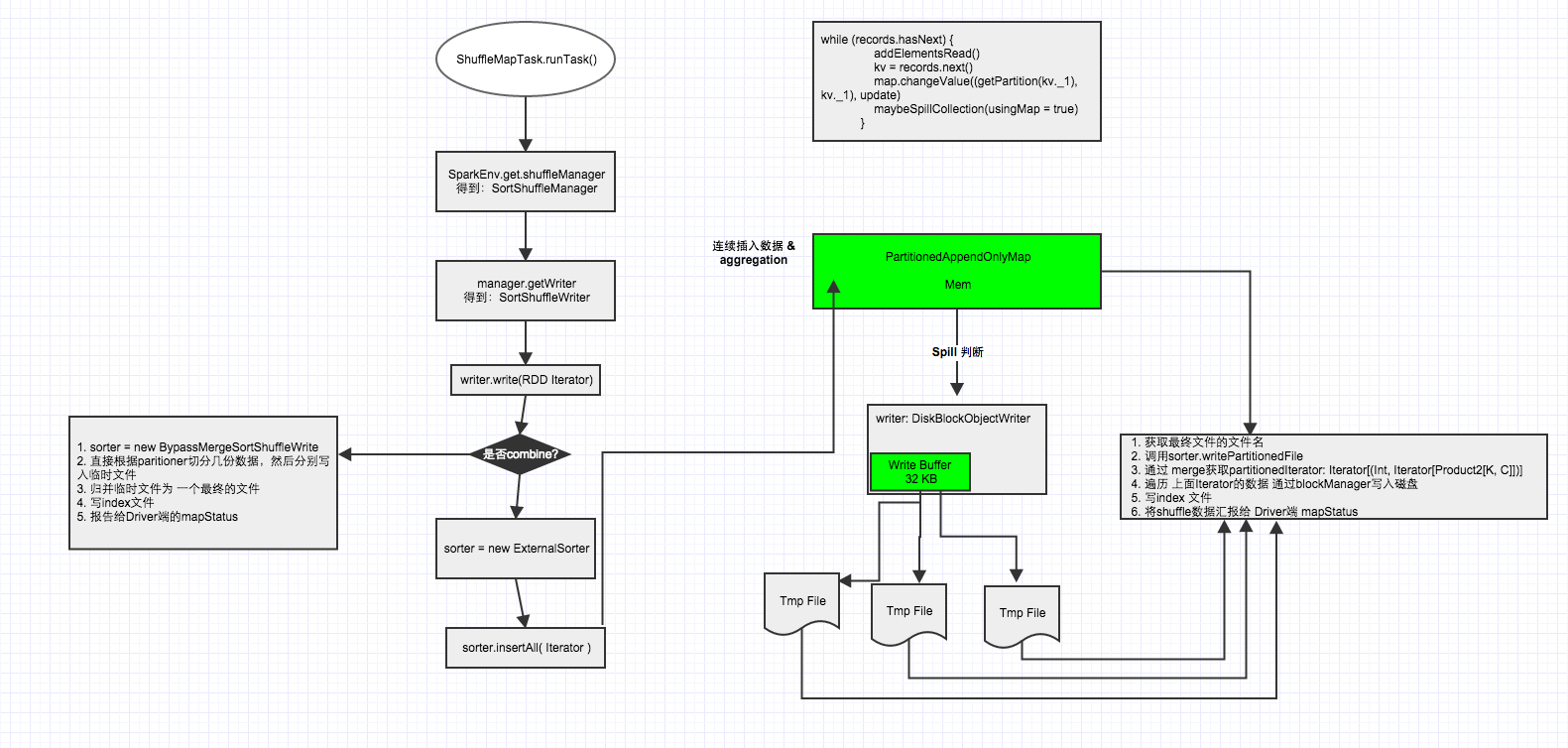
调用ShuffleMapTask的runTask方法
org.apache.spark.scheduler.ShuffleMapTask#runTask
ShuffleMapTask继承了org.apache.spark.scheduler.Task,重写了Task的runTask方法,在该方法中关于shuffle部分主要是获取shuffleManager,然后得到sortShuffleManager,然后再通过manager获取writer,得到sortShuffleWriter,然后调用writer方法
  override def runTask(context: TaskContext): MapStatus = {

    // Deserialize the RDD using the broadcast variable.

    val threadMXBean = ManagementFactory.getThreadMXBean

    val deserializeStartTime = System.currentTimeMillis()

    val deserializeStartCpuTime = if (threadMXBean.isCurrentThreadCpuTimeSupported) {

      threadMXBean.getCurrentThreadCpuTime

    } else 0L

    val ser = SparkEnv.get.closureSerializer.newInstance()

    val (rdd, dep) = ser.deserialize[(RDD[_], ShuffleDependency[_, _, _])](

      ByteBuffer.wrap(taskBinary.value), Thread.currentThread.getContextClassLoader)

    _executorDeserializeTime = System.currentTimeMillis() - deserializeStartTime

    _executorDeserializeCpuTime = if (threadMXBean.isCurrentThreadCpuTimeSupported) {

      threadMXBean.getCurrentThreadCpuTime - deserializeStartCpuTime

    } else 0L

//定义writer对象

    var writer: ShuffleWriter[Any, Any] = null

    try {
//获取shuffleManager

      val manager = SparkEnv.get.shuffleManager
//通过shuffleManager获取Writer对象,这里的partitionId传入的其实是mapId,每个map有个mapId

      writer = manager.getWriter[Any, Any](dep.shuffleHandle, partitionId, context)
//调用write方法。write方法如下

      writer.write(rdd.iterator(partition, context).asInstanceOf[Iterator[_ <: Product2[Any, Any]]])

      writer.stop(success = true).get

    } catch {

      case e: Exception =>

        try {

          if (writer != null) {

            writer.stop(success = false)

          }

        } catch {

          case e: Exception =>

            log.debug("Could not stop writer", e)

        }

        throw e

    }

  }
调用SortShuffleWriter的write方法
org.apache.spark.shuffle.sort.SortShuffleWriter#write
SortShuffleWriter继承了org.apache.spark.shuffle.ShuffleWriter并重写了其write方法
  /** Write a bunch of records to this task's output */

  override def write(records: Iterator[Product2[K, V]]): Unit = {

//根据是否存在map端聚合获取ExternalSorter对象(sorter)

    sorter = if (dep.mapSideCombine) {

      require(dep.aggregator.isDefined, "Map-side combine without Aggregator specified!")

      new ExternalSorter[K, V, C](

        context, dep.aggregator, Some(dep.partitioner), dep.keyOrdering, dep.serializer)

    } else {

      // In this case we pass neither an aggregator nor an ordering to the sorter, because we don't

      // care whether the keys get sorted in each partition; that will be done on the reduce side

      // if the operation being run is sortByKey.如果没有map-side聚合,那么创建sorter对象时候,aggregator和ordering将不传入对应的值

      new ExternalSorter[K, V, V](

        context, aggregator = None, Some(dep.partitioner), ordering = None, dep.serializer)

    }
//通过insertAll方法先写数据到buffer

    sorter.insertAll(records)

    // Don't bother including the time to open the merged output file in the shuffle write time,

    // because it just opens a single file, so is typically too fast to measure accurately

    // (see SPARK-3570).

//通过blockManager获取对应mapId.shuffleId的文件输出路径

    val output = shuffleBlockResolver.getDataFile(dep.shuffleId, mapId)
//返回与“path”位于同一目录中的临时文件的路径。

    val tmp = Utils.tempFileWith(output)

    try {

      val blockId = ShuffleBlockId(dep.shuffleId, mapId, IndexShuffleBlockResolver.NOOP_REDUCE_ID)
//将所有的数据合并到一个文件中

      val partitionLengths = sorter.writePartitionedFile(blockId, tmp)
//生成index文件,也就是每个reduce通过该index文件得知它哪些是属于它的数据

      shuffleBlockResolver.writeIndexFileAndCommit(dep.shuffleId, mapId, partitionLengths, tmp)

      mapStatus = MapStatus(blockManager.shuffleServerId, partitionLengths)

    } finally {

      if (tmp.exists() && !tmp.delete()) {

        logError(s"Error while deleting temp file ${tmp.getAbsolutePath}")

      }

    }

  }
ExternalSorter类
创建ExternalSorter对象时,各参数对应的意思。
class ExternalSorter[K, V, C](

    context: TaskContext,

    aggregator: Option[Aggregator[K, V, C]] = None,

    partitioner: Option[Partitioner] = None,

    ordering: Option[Ordering[K]] = None,

    serializer: Serializer = SparkEnv.get.serializer)

aggregator:在RDD shuffle时,map/reduce-side使用的aggregator

partitioner:对shuffle的输出,使用哪种partitioner对数据做分区,比如hashPartitioner或者rangePartitioner

ordering:根据哪个key做排序

serializer:使用哪种序列化,如果没有显示指定,默认使用spark.serializer参数值
从一个high level的角度看ExternalSorter到底做了什么?
第一:反复的将数据填充到内存buffer中(如果需要通过key做map-side聚合,则使用PartitionedAppendOnlyMap;如果不需要,则使用PartitionedPairBuffer),如下
// Data structures to store in-memory objects before we spill. Depending on whether we have an

  // Aggregator set, we either put objects into an AppendOnlyMap where we combine them, or we

  // store them in an array buffer.

  @volatile private var map = new PartitionedAppendOnlyMap[K, C]

  @volatile private var buffer = new PartitionedPairBuffer[K, C]
第二:在buffer中,通过key计算partition ID,通过partition ID对数据进行排序(partition ID可以理解为reduce ID,意思就是数据被分给了哪个reduce),为了避免对key调用多次partitioner,spark会将partition ID跟每一条数据一起存储。
第三:当buffer达到内存限制时(buffer默认大小32k,由spark.shuffle.file.buffer参数决定),会将buffer中的数据spill到文件中(每次spill都会生成一个文件),如果我们需要做map-side聚合,该文件生成时会通过partition ID先做排序,然后通过key或者key的hashcode值做二次排序。
第四:将spill形成的多个文件合并包括还在内存中的数据,文件合并时候将会排序,排序方式跟上面一样,生成数据文件dataFile以及索引文件indexFile
第五:最后调用stop方法,删除所有中间文件
结合下图更好理解

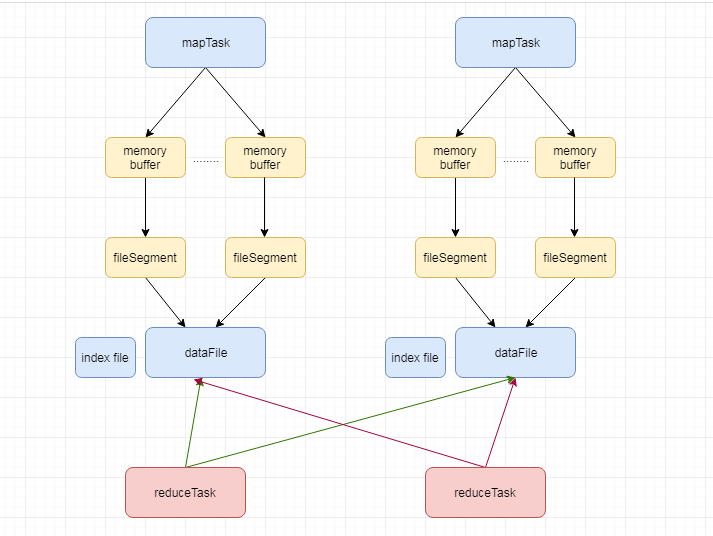
mapTask通过externalSorter生成多个文件,也就是fileSegment,最后每个map任务的所有filesegment将会合并成一个file
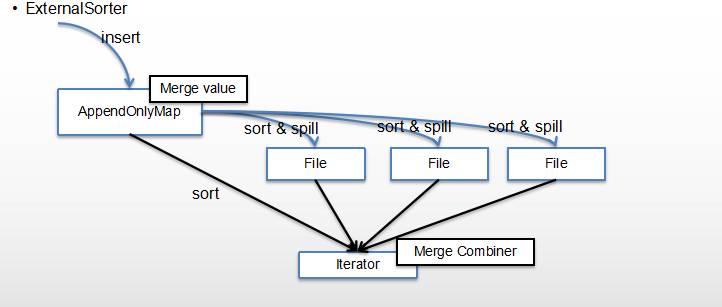
上图数据插入的是appendOnlyMap,也就是使用了map-side聚合,所以有merger value,appendOnlyMap在满了以后(默认32k)将spill成文件,多次spill生成多个文件,最后merge所有文件包括还在内存buffer中的数据。
调用ExternalSorter的insertAll方法
这一步主要是往buffer写数据,对数据分partition ID,buffer满了spill数据到磁盘且对数据排序
def insertAll(records: Iterator[Product2[K, V]]): Unit = {

    // TODO: stop combining if we find that the reduction factor isn't high如果合并比例不高的话,就不会继续合并了

    // 通过创建ExternalSorter对象时传入的aggregator获取是否存在合并

    val shouldCombine = aggregator.isDefined

    if (shouldCombine) {

      // Combine values in-memory first using our AppendOnlyMap

      val mergeValue = aggregator.get.mergeValue

      val createCombiner = aggregator.get.createCombiner

      var kv: Product2[K, V] = null

      val update = (hadValue: Boolean, oldValue: C) => {

          //合并值方式

        if (hadValue) mergeValue(oldValue, kv._2) else createCombiner(kv._2)

      }

      while (records.hasNext) {

        addElementsRead()

        kv = records.next()

        //这个map就是该类中定义的PartitionedAppendOnlyMap,getPartition方法通过key获取所属Partition ID(hashPartitioner)

        map.changeValue((getPartition(kv._1), kv._1), update)

        // buffer满的话将内存中的数据spill成文件

        maybeSpillCollection(usingMap = true)

      }

    } else {

      // Stick values into our buffer

      while (records.hasNext) {

        addElementsRead()

        val kv = records.next()

        //这个buffer就是该类中定义的PartitionedPairBuffer

        buffer.insert(getPartition(kv._1), kv._1, kv._2.asInstanceOf[C])

        maybeSpillCollection(usingMap = false)

      }

    }

  }
insertAll方法中调用maybeSpillCollection方法
  /**

   * Spill the current in-memory collection to disk if needed.

   *

   * @param usingMap whether we're using a map or buffer as our current in-memory collection

   * 不同的数据结构(也就是buffer)调用不同的方法

   */

  private def maybeSpillCollection(usingMap: Boolean): Unit = {

    var estimatedSize = 0L

    if (usingMap) {

      estimatedSize = map.estimateSize()
//maybeSpill方法会尝试申请buffer内存,如果申请到内存,则spill且返回false。否则true

      if (maybeSpill(map, estimatedSize)) {
//appendOnlyMap的数据spill以后,创建一个新的appendOnlyMap

        map = new PartitionedAppendOnlyMap[K, C]

      }

    } else {

      estimatedSize = buffer.estimateSize()

      if (maybeSpill(buffer, estimatedSize)) {

        buffer = new PartitionedPairBuffer[K, C]

      }

    }

    if (estimatedSize > _peakMemoryUsedBytes) {

      _peakMemoryUsedBytes = estimatedSize

    }

  }
maybeSpillCollection方法中调用maybeSpill方法,判断是否应该执行spill
  /**

   * Spills the current in-memory collection to disk if needed. Attempts to acquire more

   * memory before spilling.

   *    在spill之前会尝试申请内存,最后才判断是否真正执行spill

   * @param collection collection to spill to disk

   * @param currentMemory estimated size of the collection in bytes

   * @return true if `collection` was spilled to disk; false otherwise

   */

  protected def maybeSpill(collection: C, currentMemory: Long): Boolean = {

    var shouldSpill = false

    if (elementsRead % 32 == 0 && currentMemory >= myMemoryThreshold) {

      // Claim up to double our current memory from the shuffle memory pool;从上次spill以后,每读取32个元素判断一次,声明申请额外内存

      val amountToRequest = 2 * currentMemory - myMemoryThreshold

      val granted = acquireMemory(amountToRequest)

      myMemoryThreshold += granted

      // If we were granted too little memory to grow further (either tryToAcquire returned 0,

      // or we already had more memory than myMemoryThreshold), spill the current collection

      shouldSpill = currentMemory >= myMemoryThreshold

    }

    shouldSpill = shouldSpill || _elementsRead > numElementsForceSpillThreshold

    // Actually spill

    if (shouldSpill) {

      _spillCount += 1

      logSpillage(currentMemory)

      spill(collection)

      _elementsRead = 0

      _memoryBytesSpilled += currentMemory

      releaseMemory()

    }

    shouldSpill

  }
1
spark sortShuffleWriter源码学习的更多相关文章
- Spark源码学习1.1——DAGScheduler.scala
本文以Spark1.1.0版本为基础. 经过前一段时间的学习,基本上能够对Spark的工作流程有一个了解,但是具体的细节还是需要阅读源码,而且后续的科研过程中也肯定要修改源码的,所以最近开始Spark ...
- 【Spark2.0源码学习】-1.概述
Spark作为当前主流的分布式计算框架,其高效性.通用性.易用性使其得到广泛的关注,本系列博客不会介绍其原理.安装与使用相关知识,将会从源码角度进行深度分析,理解其背后的设计精髓,以便后续 ...
- 使用 IntelliJ IDEA 导入 Spark 最新源码及编译 Spark 源代码(博主强烈推荐)
前言 其实啊,无论你是初学者还是具备了有一定spark编程经验,都需要对spark源码足够重视起来. 本人,肺腑之己见,想要成为大数据的大牛和顶尖专家,多结合源码和操练编程. 准备工作 1.sca ...
- 【Spark SQL 源码分析系列文章】
从决定写Spark SQL源码分析的文章,到现在一个月的时间里,陆陆续续差不多快完成了,这里也做一个整合和索引,方便大家阅读,这里给出阅读顺序 :) 第一篇 Spark SQL源码分析之核心流程 第二 ...
- Spark SQL源码解析(二)Antlr4解析Sql并生成树
Spark SQL原理解析前言: Spark SQL源码剖析(一)SQL解析框架Catalyst流程概述 这一次要开始真正介绍Spark解析SQL的流程,首先是从Sql Parse阶段开始,简单点说, ...
- Java集合专题总结(1):HashMap 和 HashTable 源码学习和面试总结
2017年的秋招彻底结束了,感觉Java上面的最常见的集合相关的问题就是hash--系列和一些常用并发集合和队列,堆等结合算法一起考察,不完全统计,本人经历:先后百度.唯品会.58同城.新浪微博.趣分 ...
- jQuery源码学习感想
还记得去年(2015)九月份的时候,作为一个大四的学生去参加美团霸面,结果被美团技术总监教育了一番,那次问了我很多jQuery源码的知识点,以前虽然喜欢研究框架,但水平还不足够来研究jQuery源码, ...
- MVC系列——MVC源码学习:打造自己的MVC框架(四:了解神奇的视图引擎)
前言:通过之前的三篇介绍,我们基本上完成了从请求发出到路由匹配.再到控制器的激活,再到Action的执行这些个过程.今天还是趁热打铁,将我们的View也来完善下,也让整个系列相对完整,博主不希望烂尾. ...
- MVC系列——MVC源码学习:打造自己的MVC框架(三:自定义路由规则)
前言:上篇介绍了下自己的MVC框架前两个版本,经过两天的整理,版本三基本已经完成,今天还是发出来供大家参考和学习.虽然微软的Routing功能已经非常强大,完全没有必要再“重复造轮子”了,但博主还是觉 ...
随机推荐
- Java Juc学习笔记
Java JUC 简介 在 Java 5.0 提供了 java.util.concurrent (简称JUC )包,在此包中增加了在并发编程中很常用的实用工具类,用于定义类似于线程的自定义子系统,包括 ...
- vs2010 c++中内嵌汇编代码
在研究汇编时,需要自己写点汇编代码测试,用Ollydbg写每次加载程序就没了,不是很方便. 可以考虑直接在程序中写入汇编代码,只需要加上关键字“_asm”宏(C++代码中). 如下示例 编写环境 :v ...
- Linux环境查看Java应用消耗资源情况
linux线上资源耗时定位 https://www.cnblogs.com/wuchanming/p/7766994.html 1. jps -ml 查看服务器上运行的Java程序 2. jmap 查 ...
- springboot 模板
参考:https://blog.csdn.net/wangb_java/article/details/71775637
- Codeforces Round #586 (Div. 1 + Div. 2)E(拓扑排序,思维)
#include<bits/stdc++.h>using namespace std;int n,m,s; vector<int>edge[200007];queue<i ...
- jsoup教学系列
http://my.oschina.net/flashsword/blog?catalog=390084
- ubuntu 中怎么安装 jdk 7
Jdk1.7 安装包的下载地址是: http://www.oracle.com/technetwork/java/javase/downloads/jdk-7u4-downloads-1591156. ...
- keep-alive的使用
<keep-alive>是Vue的内置组件,能在组件切换过程中将状态保留在内存中,防止重复渲染DOM. <router-view>中间为组件</router-view&g ...
- c-指针的理解
c-指针的理解 最近在学习MFC,其中的代码有点看的不是很深刻,究其原因还是对c语言中的指针理解的不是很好,下面详细的给大家介绍一下指针,如有不当之处,欢迎各位读者指正. 一.指针的概念 C语言里,变 ...
- 【转】干货分享-100个shell脚本
本文用于记录学习和日常中使用过的shell脚本 [脚本1]打印形状 打印等腰三角形.直角三角形.倒直角三角形.菱形 #!/bin/bash # 等腰三角形 read -p "Please i ...