
Object-oriented features
Python is an object-oriented programing language, which means that it provides features that support object-oriented programming. It is easy to define object-oriented programming, but we have already seen some of its characteristics:
- Programs are made up of object definitions and function definitions, and most of the computation is expressed in terms of operations on objects.
- Each object definition corresponds to some object or concept in the real world, and the functions that operate on that object correspond to the ways real-world objects interact.
For example, the Time class defined to the way people record the time of day, and the functions we defined correspond to the kinds of things people do with times. Similarly, the Point and Rectangle classes correspond to the mathematical concepts of a point and a rectangle.
So far, we have not taken advantage of the features Python provides to support object-oriented programming. Strictly speaking, these features are not necessary. For the most part, they provide an alternative syntax for things we have already done, but in many cases, the alternative is more concise and more accurately conveys the structure of the program.
For example, in the Time program, there is no obvious connection between the class definition and the function definitions that follow. With some examination, it is apparent that every function takes at least one Time object as an argument. This observation is the motivation for methods; a method is a function that is associated with a particular class. For example, we have seen methods for strings, lists, dictionaries and tuples. We will define methods for user-defined types.
Methods are semantically the same as functions, but there are two syntactic differences:
- Methods are defined inside a class definition in order to make the relationship between the class and the method explicit.
- The syntax for invoking a method is different from the syntax for calling a function.
Example:
class Time:

    """ represents the time of day

        attributes: hour, minute, second

        method: print_time, increment, int_to_time

                time_to_int, after """

    def print_time(self):

        print('%.2d:%.2d:%.2d' % (self.hour,self.minute,self.second))

    @staticmethod

    def int_to_time(seconds):

        time = Time()

        minute,time.second = divmod(seconds,60)

        time.hour,time.minute = divmod(minute,60)

        return time

    def time_to_int(self):

        return self.second + self.minute*60 + self.hour*3600

    def increment(self,t):

        t1 = self.time_to_int()

        t2 = t.time_to_int()

        time = Time()

        time = Time.int_to_time(t1+t2)

        return time

    def after(self,t):

        return self.time_to_int() > t.time_to_int()

time = Time()

time.hour = 9

time.minute = 4

time.second = 0
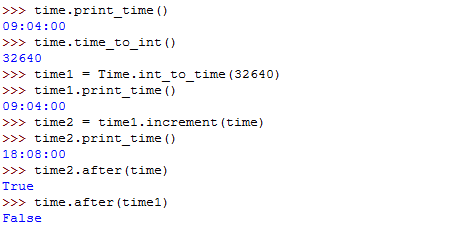
from Thinking in Python
Object-oriented features的更多相关文章
- Object Oriented Programming python
Object Oriented Programming python new concepts of the object oriented programming : class encapsula ...
- What is Object Oriented Design? (OOD)
Object Oriented Design is the concept that forces programmers to plan out their code in order to hav ...
- CSharpGL - Object Oriented OpenGL in C#
Object Oriented OpenGL in C#
- Java - 面向对象(object oriented)计划 详细解释
面向对象(object oriented)计划 详细解释 本文地址: http://blog.csdn.net/caroline_wendy/article/details/24058107 程序包括 ...
- OO开发思想:面向对象的开发方法(Object oriented,OO)
面向对象的开发方法(Object oriented,OO)认为是好文章吧,拿来分享一下(转载) 面向对象的开发方法(Object oriented,OO) 从事软件开发的工程 师们常常有这样 的体会: ...
- JavaScript: Constructor and Object Oriented Programming
Constructor : Grammar: object.constructor Example: Javascript code: 1 function obj1() { this.number ...
- 面对对象编程(OOP, Object Oriented Programming)及其三个基本特性
一千个读者,一千个哈姆雷特.对于面对对象编程,书上都会告诉我们它有三个基本特性,封装,继承,多态,但谈起对这三点的见解,又是仁者见仁智者见智,感觉还是得多去编程中体验把 . 面向对象编程(OOP, O ...
- Python学习札记(三十) 面向对象编程 Object Oriented Program 1
参考:OOP NOTE 1.面向对象编程--Object Oriented Programming,简称OOP,是一种程序设计思想.OOP把对象作为程序的基本单元,一个对象包含了数据和操作数据的函数. ...
- 使用一个数组存储一个英文句子"java is an object oriented programing language"
class fun { public static void main(String[] args) { String str="java is an object oriented pro ...
- 《Using Databases with Python》Week1 Object Oriented Python 课堂笔记
Coursera课程<Using Databases with Python> 密歇根大学 Charles Severance Week1 Object Oriented Python U ...
随机推荐
- (ORA-12899) 10g数据库导入到11g数据库时报错
问题: 10g数据库导入到11g数据库时,部分表的字段会出现ORA-12899的报错,如下: IMP-00019: 由于 ORACLE 错误 12899 而拒绝行 IMP-00003: 遇 ...
- 【Linux】系统 之 Load
一.查看系统负荷 在Linux系统中,我们一般使用uptime命令查看(w命令和top命令也行).你在终端窗口键入uptime,系统会返回一行信息.这行信息的后半部分,显示"load ave ...
- Builder模式(建造者模式)
在设计模式中对Builder模式的定义是用于构建复杂对象的一种模式,所构建的对象往往需要多步初始化或赋值才能完成.那么,在实际的开发过程中,我们哪些地方适合用到Builder模式呢?其中使用Build ...
- Redis 内存使用优化与存储
Redis 常用数据类型 Redis 最为常用的数据类型主要有以下五种: • String • Hash • List • Set • Sorted set 在具体描述这几种数据类型之前,我们先通过一 ...
- DBA_Oracle Erp中某个Form需进行升级Patch详解(案例)
2014-06-21 Created By BaoXinjian
- apache重写规则自动追加查询参数QSA
看好多大网站上的搜索都是以.html?keyword=手机&page=abc这个样子表现, 如: search_goods.html?q=%BF%D5%C6%F8%BE%BB%BB%AF%C6 ...
- Category的使用
1.创建一个objective-c file , 可以选择 category, extension ,protocol, empty 文件.选category 就能建立类别. category机制,它 ...
- Bug 是改不完滴
- Decorator装饰模式
动态地给一个对象增加一些额外的职责.就增加功能而言,Decorator模式比生成子类更为灵活. ——<设计模式>GoF 作用:在不影响其他对象的情况下,以动态.透明的方式给单个对象添加职责 ...
- vim扩展配置
在用户根目录下新建 “.vimrc”文件,键入一下代码: set syntax=on "高亮语法 set fenc=utf- "设定默认解码 set fencs=utf-,usc- ...