
Stream Processing for Everyone with SQL and Apache Flink
Where did we come from?
With the 0.9.0-milestone1 release, Apache Flink added an API to process relational data with SQL-like expressions called the Table API. The central concept of this API is a Table, a structured data set or stream on which relational operations can be applied. The Table API is tightly integrated with the DataSet and DataStream API. A Table can be easily created from a DataSet or DataStream and can also be converted back into a DataSet or DataStream as the following example shows
从0.9开始,引入Table API来支持关系型操作,
val execEnv = ExecutionEnvironment.getExecutionEnvironment

val tableEnv = TableEnvironment.getTableEnvironment(execEnv)

// obtain a DataSet from somewhere

val tempData: DataSet[(String, Long, Double)] =

// convert the DataSet to a Table

val tempTable: Table = tempData.toTable(tableEnv, 'location, 'time, 'tempF)

// compute your result

val avgTempCTable: Table = tempTable

 .where('location.like("room%"))

 .select(

   ('time / (3600 * 24)) as 'day,

   'Location as 'room,

   (('tempF - 32) * 0.556) as 'tempC

  )

 .groupBy('day, 'room)

 .select('day, 'room, 'tempC.avg as 'avgTempC)

// convert result Table back into a DataSet and print it

avgTempCTable.toDataSet[Row].print()
可以看到可以很简单的把dataset转换为Table,指定其元数据即可
然后对于table就可以进行各种关系型操作,
最后还可以把Table再转换回dataset
Although the example shows Scala code, there is also an equivalent Java version of the Table API. The following picture depicts the original architecture of the Table API.
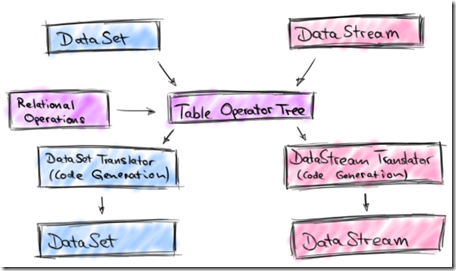
对于table的关系型操作,最终通过code generation还是会转换为dataset的逻辑
Table API joining forces with SQL
the community was also well aware of the multitude of dedicated “SQL-on-Hadoop” solutions in the open source landscape (Apache Hive, Apache Drill,Apache Impala, Apache Tajo, just to name a few).
Given these alternatives, we figured that time would be better spent improving Flink in other ways than implementing yet another SQL-on-Hadoop solution.
What we came up with was a revised architecture for a Table API that supports SQL (and Table API) queries on streaming and static data sources.
We did not want to reinvent the wheel and decided to build the new Table API on top of Apache Calcite, a popular SQL parser and optimizer framework. Apache Calcite is used by many projects including Apache Hive, Apache Drill, Cascading, and many more. Moreover, the Calcite community put SQL on streams on their roadmap which makes it a perfect fit for Flink’s SQL interface.
虽然社区已经有很多的Sql-on-Hadoop方案,flink希望把时间花在更有价值的地方,而不是再实现一套
但是当前这样的需要非常强烈,所以在revise Table API的基础上实现对SQL的支持
对于SQL的支持,借助于Calcite,并且Calcite已经把SQL on streams放在roadmap上,有希望成为streaming sql的标准
Calcite is central in the new design as the following architecture sketch shows:
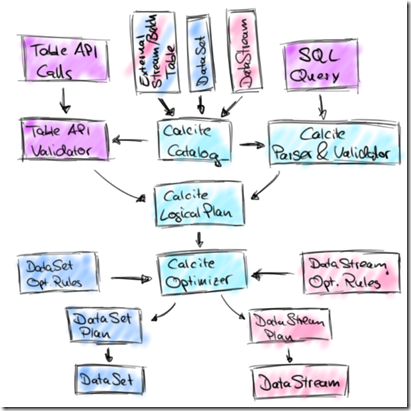
The new architecture features two integrated APIs to specify relational queries, the Table API and SQL.
Queries of both APIs are validated against a catalog of registered tables and converted into Calcite’s representation for logical plans.
In this representation, stream and batch queries look exactly the same.
Next, Calcite’s cost-based optimizer applies transformation rules and optimizes the logical plans.
Depending on the nature of the sources (streaming or static) we use different rule sets.
Finally, the optimized plan is translated into a regular Flink DataStream or DataSet program. This step involves again code generation to compile relational expressions into Flink functions.
这里Table API和SQL都统一的转换为Calcite的逻辑plans,然后再通过Calcite Optimizer进行优化,最终通过code generation转换为Flink的函数
With this effort, we are adding SQL support for both streaming and static data to Flink.
However, we do not want to see this as a competing solution to dedicated, high-performance SQL-on-Hadoop solutions, such as Impala, Drill, and Hive.
Instead, we see the sweet spot of Flink’s SQL integration primarily in providing access to streaming analytics to a wider audience.
In addition, it will facilitate integrated applications that use Flink’s API’s as well as SQL while being executed on a single runtime engine
再次说明,支持SQL并不是为了再造一个专用的SQL-on-Hadoop solutions;而是为了让更多的人可以来使用Flink,说白了,这块不是当前的战略重点
How will Flink’s SQL on streams look like?
So far we discussed the motivation for and architecture of Flink’s stream SQL interface, but how will it actually look like?
// get environments

val execEnv = StreamExecutionEnvironment.getExecutionEnvironment

val tableEnv = TableEnvironment.getTableEnvironment(execEnv)

// configure Kafka connection

val kafkaProps = ...

// define a JSON encoded Kafka topic as external table

val sensorSource = new KafkaJsonSource[(String, Long, Double)](

    "sensorTopic",

    kafkaProps,

    ("location", "time", "tempF"))

// register external table

tableEnv.registerTableSource("sensorData", sensorSource)

// define query in external table

val roomSensors: Table = tableEnv.sql(

    "SELECT STREAM time, location AS room, (tempF - 32) * 0.556 AS tempC " +

    "FROM sensorData " +

    "WHERE location LIKE 'room%'"

  )

// define a JSON encoded Kafka topic as external sink

val roomSensorSink = new KafkaJsonSink(...)

// define sink for room sensor data and execute query

roomSensors.toSink(roomSensorSink)

execEnv.execute()
跟Table API相比,可以通过纯粹的SQL来做相应的操作
当前SQL不支持,windows aggregation,
但是Calcite的Streaming SQL是支持的,比如,
SELECT STREAM

  TUMBLE_END(time, INTERVAL '1' DAY) AS day,

  location AS room,

  AVG((tempF - 32) * 0.556) AS avgTempC

FROM sensorData

WHERE location LIKE 'room%'

GROUP BY TUMBLE(time, INTERVAL '1' DAY), location
可以用Table API实现,
val avgRoomTemp: Table = tableEnv.ingest("sensorData")

  .where('location.like("room%"))

  .partitionBy('location)

  .window(Tumbling every Days(1) on 'time as 'w)

  .select('w.end, 'location, , (('tempF - 32) * 0.556).avg as 'avgTempCs)
What’s up next?
The Flink community is actively working on SQL support for the next minor version Flink 1.1.0. In the first version, SQL (and Table API) queries on streams will be limited to selection, filter, and union operators. Compared to Flink 1.0.0, the revised Table API will support many more scalar functions and be able to read tables from external sources and write them back to external sinks. A lot of work went into reworking the architecture of the Table API and integrating Apache Calcite.
In Flink 1.2.0, the feature set of SQL on streams will be significantly extended. Among other things, we plan to support different types of window aggregates and maybe also streaming joins. For this effort, we want to closely collaborate with the Apache Calcite community and help extending Calcite’s support for relational operations on streaming data when necessary.
1.2会有window aggregates和streaming joins,值得期待。。。
Stream Processing for Everyone with SQL and Apache Flink的更多相关文章
- Building real-time dashboard applications with Apache Flink, Elasticsearch, and Kibana
https://www.elastic.co/cn/blog/building-real-time-dashboard-applications-with-apache-flink-elasticse ...
- Apache Flink 为什么能够成为新一代大数据计算引擎?
众所周知,Apache Flink(以下简称 Flink)最早诞生于欧洲,2014 年由其创始团队捐赠给 Apache 基金会.如同其他诞生之初的项目,它新鲜,它开源,它适应了快速转的世界中更重视的速 ...
- 腾讯大数据平台Oceanus: A one-stop platform for real time stream processing powered by Apache Flink
January 25, 2019Use Cases, Apache Flink The Big Data Team at Tencent In recent years, the increa ...
- Stream Processing 101: From SQL to Streaming SQL in 10 Minutes
转自:https://wso2.com/library/articles/2018/02/stream-processing-101-from-sql-to-streaming-sql-in-ten- ...
- Stream processing with Apache Flink and Minio
转自:https://blog.minio.io/stream-processing-with-apache-flink-and-minio-10da85590787 Modern technolog ...
- Apache Samza - Reliable Stream Processing atop Apache Kafka and Hadoop YARN
http://engineering.linkedin.com/data-streams/apache-samza-linkedins-real-time-stream-processing-fram ...
- 13 Stream Processing Patterns for building Streaming and Realtime Applications
原文:https://iwringer.wordpress.com/2015/08/03/patterns-for-streaming-realtime-analytics/ Introduction ...
- Introducing KSQL: Streaming SQL for Apache Kafka
Update: KSQL is now available as a component of the Confluent Platform. I’m really excited to announ ...
- Storm(2) - Log Stream Processing
Introduction This chapter will present an implementation recipe for an enterprise log storage and a ...
随机推荐
- HDU4307 Matrix(最小割)
题目 Source http://acm.hdu.edu.cn/showproblem.php?pid=4307 Description Let A be a 1*N matrix, and each ...
- [ JS 进阶 ] test, exec, match, replace
https://segmentfault.com/a/1190000003497780 对了,这篇文章可能会涉及到正则表达式相关知识,所以推荐没有正则基础的去看看这篇入门文章:正则表达式30分钟入门教 ...
- HDU 2222 & ac自动机模板
题意: 求n个模板串在匹配串中出现了几个. SOL: 反正就是模板啦...似乎比KMP都简单----这么说似乎有点不道德...毕竟先看的KMP而他们并没有什么不同... 貌似自己的理解和他们画的图还是 ...
- ACM 喷水装置(一)
喷水装置(一) 时间限制:3000 ms | 内存限制:65535 KB 难度:3 描述 现有一块草坪,长为20米,宽为2米,要在横中心线上放置半径为Ri的喷水装置,每个喷水装置的效果都会让以 ...
- Google测试分享-测试经理
首先大家可以思考下,google的测试经理角色必须具备什么样的能力.据不完全统计,google的测试经理,超过一半之前都做过TE的角色(大家可以想想为啥):对于与被测产品相关的任何使用问题,测试经理都 ...
- CF 22B. Bargaining Table
水题.好久没有写过优化搜索题了. #include <cstdio> #include <cstring> #include <iostream> #include ...
- URAL 1427. SMS(DP+单调队列)
题目链接 我用的比较传统的办法...单调队列优化了一下,写的有点搓,不管怎样过了...两个单调队列,存两个东西,预处理一个标记数组存... #include <iostream> #inc ...
- iphone H5 input type="search" 不显示搜索 解决办法
H5 input type="search" 不显示搜索 解决办法 H5 input type="search" 不显示搜索 解决方法 在IOS(ipad iP ...
- C#项目打开/保存文件夹/指定类型文件,获取路径
C#项目打开/保存文件夹/指定类型文件,获取路径 转:http://q1q2q363.xiaoxiang.blog.163.com/blog/static/1106963682011722424325 ...
- 【软件工程实践一】git使用心得
第一次软工实践,我们需要做的是学习如何使用github,并将本地库的文件添加到远程库中,以下是我进行实践的工程. [一.git的安装及准备工作] 首先从http://msysgit.github.io ...