
Tensorflow 的Word2vec demo解析
简单demo的代码路径在tensorflow\tensorflow\g3doc\tutorials\word2vec\word2vec_basic.py
Sikp gram方式的model思路
http://tensorflow.org/tutorials/word2vec/index.md
另外可以参考cs224d课程的课件。
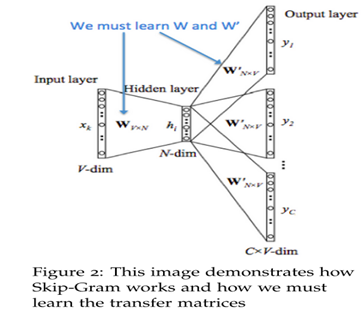

窗口设置为左右1个词

对应skip gram模型
就是一个单词预测其周围单词(cbow模型是
输入一系列context词,预测一个中心词)

Quick -> the quick -> brown
Skip gram的训练目标cost function是
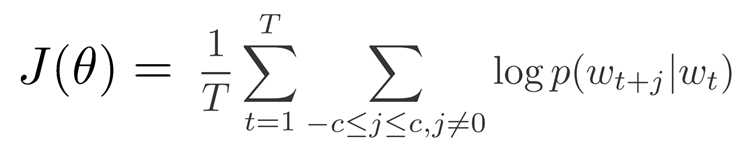
对应

但是这样太耗时了
每一步训练时间代价都是O(VocabularySize)
于是我们采用了 nce(noise-contrastive estimation)的方式,也就是负样本采样,采用某种方式随机生成词作为负样本,比如 quick -> sheep ,sheep作为负样本,假设我们就取一个负样本

- 输入数据
这里是
分隔好的单词 - 读入单词存储到list中
- 统计词频 0号位置给 unknown, 其余按照频次由高到低排列,unknown的获取按照预设词典大小
比如50000,则频次排序靠后于50000的都视为unknown建立好 key->id id->key的双向索引map
4. 产生一组training batch
batch_size = 128
embedding_size = 128 # Dimension of the embedding vector.
skip_window = 1 # How many words to consider left and right.
num_skips = 2 # How many times to reuse an input to generate a label.
Batch_size每次sgd训练时候扫描的数据大小, embedding_size 词向量的大小,skip_window 窗口大小,
Num_skips = 2 表示input用了产生label的次数限制
demo中默认是2,
可以设置为1 对比下
默认2的时候
batch, labels = generate_batch(batch_size=8, num_skips=2, skip_window=1)
for i in range(8):
print(batch[i], '->', labels[i, 0])
print(reverse_dictionary[batch[i]], '->', reverse_dictionary[labels[i, 0]])
Sample data [5239, 3084, 12, 6, 195, 2, 3137, 46, 59, 156]
-> 5239
originated -> anarchism
-> 12
originated -> as
12 -> 6
as -> a
12 -> 3084
as -> originated
6 -> 195
a -> term
6 -> 12
a -> as
195 -> 2
term -> of
195 -> 6
term -> a
3084左侧出现2次,对应窗口左右各1
设置1的时候
batch, labels = generate_batch(batch_size=8, num_skips=1, skip_window=1)
for i in range(8):
print(batch[i], '->', labels[i, 0])
print(reverse_dictionary[batch[i]], '->', reverse_dictionary[labels[i, 0]])
Sample data [5239, 3084, 12, 6, 195, 2, 3137, 46, 59, 156]
-> 12
originated -> as
12 -> 3084
as -> originated
6 -> 12
a -> as
195 -> 2
term -> of
2 -> 3137
of -> abuse
3137 -> 46
abuse -> first
46 -> 59
first -> used
59 -> 156
3084左侧只出现1次
# Step 4: Function to generate a training batch for the skip-gram model.
def generate_batch(batch_size, num_skips, skip_window):
global data_index
assert batch_size % num_skips == 0
assert num_skips <= 2 * skip_window
batch = np.ndarray(shape=(batch_size), dtype=np.int32)
labels = np.ndarray(shape=(batch_size, 1), dtype=np.int32)
span = 2 * skip_window + 1 # [ skip_window target skip_window ]
buffer = collections.deque(maxlen=span)
for _ in range(span):
buffer.append(data[data_index])
data_index = (data_index + 1) % len(data)
for i in range(batch_size // num_skips):
target = skip_window # target label at the center of the buffer
targets_to_avoid = [ skip_window ]
for j in range(num_skips):
while target in targets_to_avoid:
target = random.randint(0, span - 1)
targets_to_avoid.append(target)
batch[i * num_skips + j] = buffer[skip_window]
labels[i * num_skips + j, 0] = buffer[target]
buffer.append(data[data_index])
data_index = (data_index + 1) % len(data)
return batch, labels
batch, labels = generate_batch(batch_size=8, num_skips=2, skip_window=1)
for i in range(8):
print(batch[i], '->', labels[i, 0])
print(reverse_dictionary[batch[i]], '->', reverse_dictionary[labels[i, 0]])
就是对于一个中心词
在window范围
随机选取 num_skips个词,产生一系列的
(input_id, output_id) 作为(batch_instance, label)
这些都是正样本
训练准备,
Input embedding W

Output embedding W^
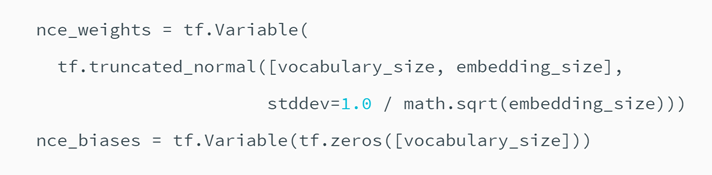
后面code都比较容易理解,tf定义了nce_loss来自动处理,每次会自动添加随机负样本
num_sampled = 64 # Number of negative examples to sample.
graph = tf.Graph()
with graph.as_default():
# Input data.
train_inputs = tf.placeholder(tf.int32, shape=[batch_size])
train_labels = tf.placeholder(tf.int32, shape=[batch_size, 1])
valid_dataset = tf.constant(valid_examples, dtype=tf.int32)
# Construct the variables.
embeddings = tf.Variable(
tf.random_uniform([vocabulary_size, embedding_size], -1.0, 1.0))
nce_weights = tf.Variable(
tf.truncated_normal([vocabulary_size, embedding_size],
stddev=1.0 / math.sqrt(embedding_size)))
nce_biases = tf.Variable(tf.zeros([vocabulary_size]))
# Look up embeddings for inputs.
embed = tf.nn.embedding_lookup(embeddings, train_inputs)
# Compute the average NCE loss for the batch.
# tf.nce_loss automatically draws a new sample of the negative labels each
# time we evaluate the loss.
loss = tf.reduce_mean(
tf.nn.nce_loss(nce_weights, nce_biases, embed, train_labels,
num_sampled, vocabulary_size))
# Construct the SGD optimizer using a learning rate of 1.0.
optimizer = tf.train.GradientDescentOptimizer(1.0).minimize(loss)
训练过程利用embedding矩阵的乘法计算了不同词向量的欧式距离
并计算了高频几个词对应的距离最近的词展示
最后调用 skitlearn的TSNE模块
进行降维到2元,绘图展示。
Tensorflow 的Word2vec demo解析的更多相关文章
- IOS CoreData 多表查询demo解析
在IOS CoreData中,多表查询上相对来说,没有SQL直观,但CoreData的功能还是可以完成相关操作的. 下面使用CoreData进行关系数据库的表与表之间的关系演示.生成CoreData和 ...
- Ionic Demo 解析
Ionic Demo 解析 index.html 解析 1.引入所需要的类库 <link rel="manifest" href="manifest.json&qu ...
- 文本分布式表示(二):用tensorflow和word2vec训练词向量
看了几天word2vec的理论,终于是懂了一些.理论部分我推荐以下几篇教程,有博客也有视频: 1.<word2vec中的数学原理>:http://www.cnblogs.com/pegho ...
- word2vec源代码解析之word2vec.c
word2vec源代码解析之word2vec.c 近期研究了一下google的开源项目word2vector,http://code.google.com/p/word2vec/. 事实上这玩意算是神 ...
- 利用 TensorFlow 入门 Word2Vec
利用 TensorFlow 入门 Word2Vec 原创 2017-10-14 chen_h coderpai 博客地址:http://www.jianshu.com/p/4e16ae0aad25 或 ...
- 转:RealThinClient LinkedObjects Demo解析
这个Demo源码实现比较怪,有点拗脑,原因估是作者想把控件的使用做得简单,而封装太多. 这里说是解析,其实是粗析,俺没有耐心每个实现点都查实清楚,看源码一般也就连读带猜的. 这个Demo表达出的意义, ...
- android报表图形引擎(AChartEngine)demo解析与源码
AchartEngine支持多种图表样式,本文介绍两种:线状表和柱状表. AchartEngine有两种启动的方式:一种是通过ChartFactory.get***View()方式来直接获取到view ...
- Tensorflow的CNN教程解析
之前的博客我们已经对RNN模型有了个粗略的了解.作为一个时序性模型,RNN的强大不需要我在这里重复了.今天,让我们来看看除了RNN外另一个特殊的,同时也是广为人知的强大的神经网络模型,即CNN模型.今 ...
- tensorflow lite的demo在android studio上环境搭建
由于很久没有接触过Android开发,而且最早用的是eclipse,所以这个demo在android studio上的搭建过程,真的是踩了不少坑.记录这篇文章,纯粹是给自己一点收获. 环境搭建的过程, ...
随机推荐
- [POJ2892]Tunnel Warfare
[POJ2892]Tunnel Warfare 试题描述 During the War of Resistance Against Japan, tunnel warfare was carried ...
- sql server2008 字符串的替换
DECLARE @TSql VARCHAR(MAX) SET @TSql =REPLACE(@TSql,'#PrimaryKey','0'); 1,@TSql将要替换的完整字符串 2,#Primary ...
- ubuntu下ssh使用proxy:corkscrew
1,安装corkscrew: sudo apt-get install corkscrew 2, 配置 vim ~/.ssh/config 写入如下: Host 10.1.*.* ProxyComma ...
- Ubuntu里面软件的安装与卸载
在Ubuntu里面,有时候碰到软件配置错了,这是重新再安装的话,会检测到已安装,系统不会再重新安装,就需要卸载之后重装 1.通过deb包安装的情况: 安装.deb包: 代码:sudo dpkg -i ...
- iOS drawRect 和 awakeFromNib
今天想在一个view上绘制一个虚线边框,百度到的代码如下: CAShapeLayer *borderLayer = [CAShapeLayer layer]; borderLayer.frame = ...
- WPF三大模板简介
WPF支持以下类型的模板: (1) 控件模板.控件模板可以将自定义模板应用到某一特定类型的所有控件,或是控件的某一实例.决定控件外观的是ControlTemplate,它决定了控件“长成什么样子”,因 ...
- CentOS基础指令备忘
功能 指令 可用参数 示例 说明 新建文件夹 mkdir mkdir etc/temp 在当前目录的etc文件夹下新建temp文件夹 新建文件 vi vi abc.sh 新建名为abc.sh的 ...
- mysql-5.6.23-winx64.zip版本安装记录
*操作系统:Win7 64位旗舰版 一.解压至任意目录,此处以“E:\mysql-5.6.23-winx64”为例: 二.设置环境变量:新建变量名 MYSQL_HOME,值为解压的路径 E:\mysq ...
- codeforces 496B. Secret Combination 解题报告
题目链接:http://codeforces.com/problemset/problem/496/B 题目意思:给出 n 位数你,有两种操作:1.将每一位数字加一(当某一位 > 9 时只保存个 ...
- 我刚知道的WAP app中meta的属性(转载)
之前我一直做的都是WEB前端开发,来北京以后面试了一个移动前端开发,WAP前端开发. 其实在原来公司的时候也做过这方面的开发,可面试的时候面试官问我,要想强制让文档与设备的宽度保持1:1,mate标签 ...