
What the 80/20 Rule Tells Us about Reducing HTTP Requests
Performance Research, Part 1: What the 80/20 Rule Tells Us about Reducing HTTP Requests https://yuiblog.com/blog/2006/11/28/performance-research-part-1/
Performance Research, Part 1: What the 80/20 Rule Tells Us about Reducing HTTP Requests

This is the first in a series of articles describing experiments conducted to learn more about optimizing web page performance. You may be wondering why you're reading a performance article on the YUI Blog. It turns out that most of web page performance is affected by front-end engineering, that is, the user interface design and development.
It's no secret that users prefer faster web sites. I work in a dedicated team focused on quantifying and improving the performance of Yahoo! products worldwide. As part of our work, we conduct experiments related to web page performance. We are sharing our findings so that other front-end engineers join us in accelerating the user experience on the web.
The 80/20 Performance Rule
Vilfredo Pareto, an economist in the early 1900s, made a famous observation where 80% of the nation's wealth belonged to 20% of the population. This was later generalized into what's commonly referred to as the Pareto principle (also known as the 80-20 rule), which states for any phenomenon, 80% of the consequences come from 20% of the causes. We see this phenomenon in software engineering where 80% of the time is spent in only 20% of the code. When we optimize our applications, we know to focus on that 20% of the code. This same technique should also be applied when optimizing web pages. Most performance optimization today are made on the parts that generate the HTML document (apache, C++, databases, etc.), but those parts only contribute to about 20% of the user's response time. It's better to focus on optimizing the parts that contribute to the other 80%.
Using a packet sniffer, we discover what takes place in that other 80%. Figure 1 is a graphical view of where the time is spent loading http://www.yahoo.com with an empty cache. Each bar represents a specific component and is shown in the order started by the browser. The first bar is the time spent for the browser to retrieve just the HTML document. Notice only 10% of the time is spent here for the browser to request the HTML page, and for apache to stitch together the HTML and return the response back to the browser. The other 90% of the time is spent fetching other components in the page including images, scripts and stylesheets.
Figure 1. Loading http://www.yahoo.com
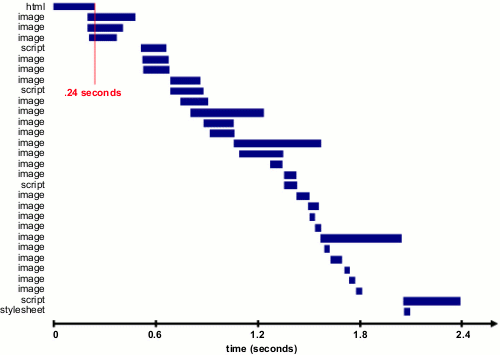
Table 1 shows popular web sites spending between 5% and 38% of the time downloading the HTML document. The other 62% to 95% of the time is spent making HTTP requests to fetch all the components in that HTML document (i.e. images, scripts, and stylesheets). The impact of having many components in the page is exacerbated by the fact that browsers download only two or four components in parallel per hostname, depending on the HTTP version of the response and the user's browser. Our experience shows that reducing the number of HTTP requests has the biggest impact on reducing response time and is often the easiest performance improvement to make.
Table 1. Time spent loading popular web site
Time Retrieving HTML Time Elsewhere
Yahoo! 10% 90%
Google 25% 75%
MySpace 9% 91%
MSN 5% 95%
ebay 5% 95%
Amazon 38% 62%
YouTube 9% 91%
CNN 15% 85%
Note: Times are for page loads with an empty cache over Comcast cable modem (~2.5 mbps).
Shouldn't everything be saved in the browser's cache anyway?
The conclusion is the same: Reducing the number of HTTP requests has the biggest impact on reducing response time and is often the easiest performance improvement to make. In the next article we'll look at the impact of caching, and some surprising real-world findings.
Disclaimer: Design imperatives dictating visual richness need to be weighed against this request-reduction goal. When you need visual richness, additional steps can be taken -- aggregating JS files, using CSS sprites, etc. -- but visual richness does tend to run counter to a slender HTTP request pipeline.
What the 80/20 Rule Tells Us about Reducing HTTP Requests的更多相关文章
- 二八法则(The 80/20 Principle)
二八法则的定义:在任何一组事物中,最重要的只占其中一小部分,约20%,其余80%尽管占多数,却是次要的. 二八法则的例子:社会上20%的人占有80%的社会财富 20%的工厂有80%的产出 80%的利润 ...
- Code Complete阅读笔记(二)
2015-03-06 328 Unusual Data Types ——You can carry this technique to extremes,putting all the ...
- How do I learn mathematics for machine learning?
https://www.quora.com/How-do-I-learn-mathematics-for-machine-learning How do I learn mathematics f ...
- software quality assurance 常见问题收录
1. What is Quality? Quality means, “meeting requirements.” ..Whether or not the product or service d ...
- [SinGuLaRiTy] COCI 2016~2017 #5
[SinGuLaRiTy-1012] Copyright (c) SinGuLaRiTy 2017. All Rights Reserved. 最近神犇喜欢考COCI...... 测试题目 对于所有的 ...
- EOS多节点组网:商业场景分析以及节点启动时序
区块链公链都是基于p2p网络,本篇文章将建立一个多节点不同职责参与的EOS的测试网络,根据路上发现的可做文章的技术点大做文章. 关键字:EOS组网,全节点,交易确认,boot sequence,sta ...
- 【Agile123】Automated Test in Agile
https://www.infoq.com/articles/thoughts-on-test-automation-in-agile Start Small Balance the cost vs. ...
- 从理论到实践,全方位认识DNS
从理论到实践,全方位认识DNS 2015-11-23 程序员之家 作者:selfboot 原文:http://segmentfault.com/a/1190000003956853 对于 DNS(Do ...
- 从理论到实践,全方位认识DNS(理论篇)
对于 DNS(Domain Name System) 大家肯定不陌生,不就是用来将一个网站的域名转换为对应的IP吗.当我们发现可以上QQ但不能浏览网页时,我们会想到可能是域名服务器挂掉了:当我们用别人 ...
随机推荐
- jquery 日期插件
<!DOCTYPE html> <html> <head> <meta charset="UTF-8"> <title> ...
- 标准C程序设计七---32
Linux应用 编程深入 语言编程 标准C程序设计七---经典C11程序设计 以下内容为阅读: <标准C程序设计>(第7版) 作者 ...
- 反汇编->C++内联
C/C++提供了内联函数机制 内联函数就是向编译器建议:编译这个函数的时候.直接把函数展开,而不是进行函数调用call.当然编译器并不接受这个建议.仍然把他当做普通函数进行编译 使用内联函数的优点:减 ...
- linux 目标文件调试
前言如果普通编程不需要了解这些东西,如果想精确控制你的对象文件的格式或者你想查看一下文件对象里的内容以便作出某种判断,刚你可以看一下下面的工具:objdump, nm, ar.当然,本文不可能非常详细 ...
- C++对象
- [CQOI2018] 社交网络
题目背景 当今社会,在社交网络上看朋友的消息已经成为许多人生活的一部分.通常,一个用户在社交网络上发布一条消息(例如微博.状态.Tweet等) 后,他的好友们也可以看见这条消息,并可能转发.转发的消息 ...
- mac 安装opencv-python
Mac下安装opencv-python 项目中使用的是opencv 2的版本,因此下面说一下opencv2的一些安装流程. 安装方法 1:如果没有homebrew的话,需要先安装 安装命令: ruby ...
- 获取非行间样式getComputedStyle
有如下代码: 1 2 3 div { width: 200px; } 1 2 3 <div id="aa" style="height: 100px;&qu ...
- 分布式文件系统 FastDFS 5.0.8 & Linux CentOS 6.7 安装配置
原文:http://blog.csdn.net/wlwlwlwl015/article/details/52619851 前言 项目中用到文件服务器,有朋友推荐用fastdfs,所以就了解学习了一番, ...
- IDG | 四则运算表达式计算
分析 首先将中缀表达式转换为后缀表达式(逆波兰式),然后使用栈进行计算. 没有考虑括号.小数. 代码 import java.util.LinkedList; import java.util.Lis ...