
201871010106-丁宣元 《面向对象程序设计(java)》第七周学习总结
201871010106-丁宣元 《面向对象程序设计(java)》第七周学习总结
正文开头:
|
项目 |
内容 |
|
这个作业属于哪个课程 |
https://home.cnblogs.com/u/nwnu-daizh/ |
|
这个作业的要求在哪里 |
https://www.cnblogs.com/nwnu-daizh/p/11654436.html |
|
作业学习目标 |
|
正文内容:
实验内容和步骤:
实验1:在“System.out.println(...);”语句处按注释要求设计代码替换...,观察代码录入中IDE提示,以验证四种权限修饰符的用法。
代码:
class Parent {

    private String p1 = "这是Parent的私有属性";

    public String p2 = "这是Parent的公有属性";

    protected String p3 = "这是Parent受保护的属性";

    String p4 = "这是Parent的默认属性";

    private void pMethod1() {

        System.out.println("我是Parent用private修饰符修饰的方法");

    }

    public void pMethod2() {

        System.out.println("我是Parent用public修饰符修饰的方法");

    }

    protected void pMethod3() {

        System.out.println("我是Parent用protected修饰符修饰的方法");

    }

    void pMethod4() {

        System.out.println("我是Parent无修饰符修饰的方法");

    }

}

class Son extends Parent{

    private String s1 = "这是Son的私有属性";

    public String s2 = "这是Son的公有属性";

    protected String s3 = "这是Son受保护的属性";

    String s4 = "这是Son的默认属性";

    public void sMethod1() {

        System.out.println(p2);//p1无法打印,因为是私有属性

        System.out.println(p3);

        System.out.println(p4);//分别尝试显示Parent类的p1、p2、p3、p4值

        System.out.println("我是Son用public修饰符修饰的方法");

    }

    private void sMethod2() {

        System.out.println("我是Son用private修饰符修饰的方法");

    }

    protected void sMethod() {

        System.out.println("我是Son用protected修饰符修饰的方法");

    }

    void sMethod4() {

        System.out.println("我是Son无修饰符修饰的方法");

    }

}

public class Demo {

    public static void main(String[] args) {

        Parent parent=new Parent();

        Son son=new Son();

        parent.pMethod2();

        parent.pMethod3();

        parent.pMethod4();//分别尝试用parent调用Parent类的方法

        son.sMethod();//用son调用Son类的方法

        son.sMethod1();

        son.sMethod4();//son.sMethod2()是private,只能在son类中使用

    }

}
结果:
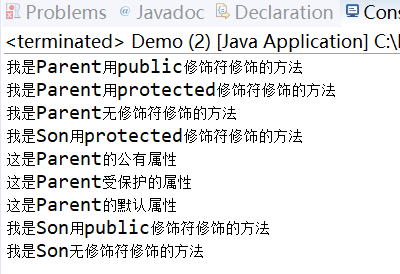
注:protected和friendly都只能访问同一个包中的,但protected权限更大些,可访问不同包,但必须是子类继承父类。
实验2:导入第5章以下示例程序,测试并进行代码注释。
测试程序1:运行教材程序5-8、5-9、5-10,结合程序运行结果理解程序(教材174页-177页);
删除程序中Employee类、Manager类中的equals()、hasCode()、toString()方法,背录删除方法,在代码录入中理解类中重写Object父类方法的技术要点。
1.程序代码
5-8EqualsTest.java
package equals;

/**

 * This program demonstrates the equals method.

 * @version 1.12 2012-01-26

 * @author Cay Horstmann

 */

public class EqualsTest  //主类

{

   public static void main(String[] args)

   {

      var alice1 = new Employee("Alice Adams", 75000, 1987, 12, 15);

      var alice2 = alice1;

      var alice3 = new Employee("Alice Adams", 75000, 1987, 12, 15);

      var bob = new Employee("Bob Brandson", 50000, 1989, 10, 1);

      System.out.println("alice1 == alice2: " + (alice1 == alice2));

      System.out.println("alice1 == alice3: " + (alice1 == alice3));

      System.out.println("alice1.equals(alice3): " + alice1.equals(alice3));

      System.out.println("alice1.equals(bob): " + alice1.equals(bob));

      System.out.println("bob.toString(): " + bob);

      var carl = new Manager("Carl Cracker", 80000, 1987, 12, 15);

      var boss = new Manager("Carl Cracker", 80000, 1987, 12, 15);

      boss.setBonus(5000);

      System.out.println("boss.toString(): " + boss);

      System.out.println("carl.equals(boss): " + carl.equals(boss));

      System.out.println("alice1.hashCode(): " + alice1.hashCode());

      System.out.println("alice3.hashCode(): " + alice3.hashCode());

      System.out.println("bob.hashCode(): " + bob.hashCode());

      System.out.println("carl.hashCode(): " + carl.hashCode());

   }

}
5-9Empolyee.java
package equals;

import java.time.*;

import java.util.Objects;

public class Employee //用户自定义类

{

   private String name; //三个私有属性

   private double salary;

   private LocalDate hireDay;

   public Employee(String name, double salary, int year, int month, int day)

   {

      this.name = name;

      this.salary = salary;

      hireDay = LocalDate.of(year, month, day);

   }

   public String getName()

   {

      return name;

   }

   public double getSalary()

   {

      return salary;

   }

   public LocalDate getHireDay()

   {

      return hireDay;

   }

   public void raiseSalary(double byPercent)//访问器

   {

      double raise = salary * byPercent / 100;

      salary += raise;

   }

   public boolean equals(Object otherObject)

   {

      // a quick test to see if the objects are identical 测试几个类是否相同,若引用同一个,则相等

      if (this == otherObject) return true;

      // must return false if the explicit parameter is null 若显式参数为空必须返回false

      if (otherObject == null) return false;

      // if the classes don't match, they can't be equal若几个类不匹配,则它们不相等

      if (getClass() != otherObject.getClass()) return false;

      // now we know otherObject is a non-null Employee  已知otherObject是一个非空雇员

      var other = (Employee) otherObject;

      // test whether the fields have identical values 检测是否具有相同的值

      return Objects.equals(name, other.name)

         && salary == other.salary && Objects.equals(hireDay, other.hireDay);

   }

   public int hashCode()//重写hashcode方法,使得相等的两个对象获取的HashCode相等

   {

      return Objects.hash(name, salary, hireDay);

   }

   public String toString()   //其他类型数据转为字符串型的数据

   {

      return getClass().getName() + "[name=" + name + ",salary=" + salary + ",hireDay="

         + hireDay + "]";

   }

}
5-10Manager.java
package equals;

public class Manager extends Employee//子类Manager继承Employee

{

   private double bonus;

   public Manager(String name, double salary, int year, int month, int day)

   {

      super(name, salary, year, month, day);//子类调用超类中的属性

      bonus = 0;

   }

   public double getSalary()//访问器

   {

      double baseSalary = super.getSalary();

      return baseSalary + bonus;

   }

   public void setBonus(double bonus)

   {

      this.bonus = bonus;

   }

   public boolean equals(Object otherObject)

   {

      if (!super.equals(otherObject)) return false;

      var other = (Manager) otherObject;

      // super.equals checked that this and other belong to the same class  使用super.equals检查这个类和其他的是否属于同一个类

      return bonus == other.bonus;

   }

   public int hashCode()

   {

      return java.util.Objects.hash(super.hashCode(), bonus);

   }

   public String toString()// toString()方法,可自动生成

   {

      return super.toString() + "[bonus=" + bonus + "]";

   }

}

结果:
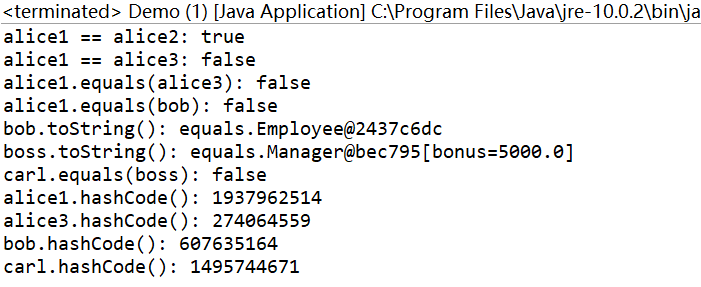
删除程序中Employee类、Manager类中的equals()、hasCode()、toString()方法,背录删除方法
代码:
Employee.java
package equals;

import java.time.*;
import java.util.Objects;

public class Employee
{
   private String name;
   private double salary;
   private LocalDate hireDay;

   public Employee(String name, double salary, int year, int month, int day)
   {
      this.name = name;
      this.salary = salary;
      hireDay = LocalDate.of(year, month, day);
   }

   public String getName()
   {
      return name;
   }

   public double getSalary()
   {
      return salary;
   }

   public LocalDate getHireDay()
   {
      return hireDay;
   }

   public void raiseSalary(double byPercent)
   {
      double raise = salary * byPercent / 100;
      salary += raise;
   }

@Override
public boolean equals(Object otherObject) {  //重写equals方法
    // TODO Auto-generated method stub
    if(this==otherObject) return true;
    if(this==null) return false;
    if(getClass() != otherObject.getClass()) return false;
    Employee other=(Employee)otherObject;
    return Objects.equals(name,other.name)&&salary == other.salary&&Objects.equals(hireDay,other.hireDay);
}

@Override
public int hashCode() {   //重写hashCode方法
    // TODO Auto-generated method stub
    return Objects.hash(name,salary,hireDay);
}

@Override
public String toString() {  //重写toString方法
    // TODO Auto-generated method stub
    return getClass().getName()+"[name="+name+",salary="+salary+",hireday="+hireDay+"]";
}
}
Manager.java
package equals;

public class Manager extends Employee  //Manager类(子类)继承Employee类(父类)
{
   private double bonus;//私有属性

   public Manager(String name, double salary, int year, int month, int day)
   {
      super(name, salary, year, month, day);  //
      bonus = 0;
   }

   public double getSalary()
   {
      double baseSalary = super.getSalary();
      return baseSalary + bonus;
   }

   public void setBonus(double bonus)
   {
      this.bonus = bonus;
   }

@Override
public boolean equals(Object otherObject) {
    // TODO Auto-generated method stub
    if(!super.equals(otherObject)) return false;
    Manager other=(Manager)otherObject;
    return bonus==other.bonus;
}

@Override
public int hashCode() {
    // TODO Auto-generated method stub
    return super.hashCode()+17*new Double(bonus).hashCode();
}

@Override
public String toString() {
    // TODO Auto-generated method stub
     return super.toString()+"[bonus="+bonus+"]";
}

}
EqualsTest.java
package equals;

/**

 * This program demonstrates the equals method.

 * @version 1.12 2012-01-26

 * @author Cay Horstmann

 */

public class EqualsTest

{

   public static void main(String[] args)

   {

      var alice1 = new Employee("Alice Adams", 75000, 1987, 12, 15);

      var alice2 = alice1;

      var alice3 = new Employee("Alice Adams", 75000, 1987, 12, 15);

      var bob = new Employee("Bob Brandson", 50000, 1989, 10, 1);

      System.out.println("alice1 == alice2: " + (alice1 == alice2));

      System.out.println("alice1 == alice3: " + (alice1 == alice3));

      System.out.println("alice1.equals(alice3): " + alice1.equals(alice3));

      System.out.println("alice1.equals(bob): " + alice1.equals(bob));

      System.out.println("bob.toString(): " + bob);

      var carl = new Manager("Carl Cracker", 80000, 1987, 12, 15);

      var boss = new Manager("Carl Cracker", 80000, 1987, 12, 15);

      boss.setBonus(5000);

      System.out.println("boss.toString(): " + boss);

      System.out.println("carl.equals(boss): " + carl.equals(boss));

      System.out.println("alice1.hashCode(): " + alice1.hashCode());

      System.out.println("alice3.hashCode(): " + alice3.hashCode());

      System.out.println("bob.hashCode(): " + bob.hashCode());

      System.out.println("carl.hashCode(): " + carl.hashCode());

   }

}
结果:
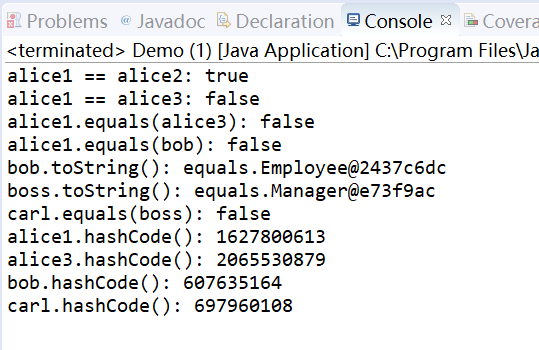
测试程序2:
在elipse IDE中调试运行程序5-11(教材182页),结合程序运行结果理解程序;
掌握ArrayList类的定义及用法;
在程序中相关代码处添加新知识的注释;
设计适当的代码,测试ArrayList类的set()、get()、remove()、size()等方法的用法。
5-11代码:
package arrayList;

import java.util.*;

/**

 * This program demonstrates the ArrayList class.

 * @version 1.11 2012-01-26

 * @author Cay Horstmann

 */

public class ArrayListTest

{

   public static void main(String[] args)

   {

      // fill the staff array list with three Employee objects用三个Employee类填充staff数组列表

      var staff = new ArrayList<Employee>();//动态数组,可以灵活设置数组的大小

      staff.add(new Employee("Carl Cracker", 75000, 1987, 12, 15));//在列表中插入元素,

      staff.add(new Employee("Harry Hacker", 50000, 1989, 10, 1));

      staff.add(new Employee("Tony Tester", 40000, 1990, 3, 15));

      // raise everyone's salary by 5%每个人的薪水提高5%

      for (Employee e : staff)

         e.raiseSalary(5);

      // print out information about all Employee objects

      for (Employee e : staff)//for each循环,遍历数组列表

         System.out.println("name=" + e.getName() + ",salary=" + e.getSalary() + ",hireDay="

            + e.getHireDay());

   }

}
Employee.java
package arrayList;

import java.time.*;

public class Employee

{

   private String name;//私有属性

   private double salary;//私有属性

   private LocalDate hireDay;//私有属性

   public Employee(String name, double salary, int year, int month, int day)//构造器

   {

      this.name = name;

      this.salary = salary;

      hireDay = LocalDate.of(year, month, day);

   }

   public String getName()

   {

      return name;

   }

   public double getSalary()

   {

      return salary;

   }

   public LocalDate getHireDay()

   {

      return hireDay;

   }

   public void raiseSalary(double byPercent)//访问器

   {

      double raise = salary * byPercent / 100;

      salary += raise;

   }

}
结果:
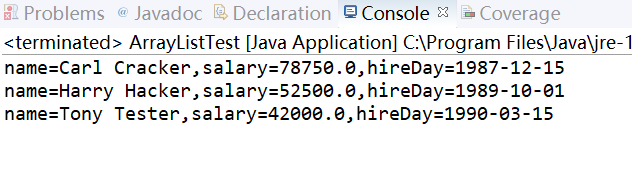
注:ArrayList :动态数组,可以动态增加和减少元素,灵活设置数组的大小。
三个构造器: public ArrayList();默认构造器 public ArrayList(ICollection);
public ArrayList(int); 指定大小来初始化内部的数组
设计适当的代码,测试ArrayList类的set()、get()、remove()、size()等方法的用法。
package arrayList;

import java.util.*;

/**

 * This program demonstrates the ArrayList class.

 * @version 1.11 2012-01-26

 * @author Cay Horstmann

 */

public class ArrayListTest

{

   public static void main(String[] args)

   {

      // fill the staff array list with three Employee objects

      var staff = new ArrayList<Employee>();

      staff.add(new Employee("Carl Cracker", 75000, 1987, 12, 15));//在列表中插入元素,

      staff.add(new Employee("Harry Hacker", 50000, 1989, 10, 1));

      staff.add(new Employee("Tony Tester", 40000, 1990, 3, 15));

      System.out.println(staff.get(1));

      staff.set(2, new Employee("DXY", 1000, 1999, 7, 21));

      System.out.println(staff.size());

      staff.remove(0);

      // raise everyone's salary by 5%

      for (Employee e : staff)

         e.raiseSalary(5);

      // print out information about all Employee objects

      for (Employee e : staff)//for each循环,遍历数组列表

         System.out.println("name=" + e.getName() + ",salary=" + e.getSalary() + ",hireDay="

            + e.getHireDay());

   }

}

注:get()方法获得下标的储存位置
set()方法修改ArrayList<>并添加new Employee("DXY", 1000, 1999, 7, 21)
get()方法获得元素输出
remove()方法删除数组元素
size()方法得到长度。
测试程序3:
编辑、编译、调试运行程序5-12(教材189页),结合运行结果理解程序;
掌握枚举类的定义及用法;
在程序中相关代码处添加新知识的注释;
删除程序中Size枚举类,背录删除代码,在代码录入中掌握枚举类的定义要求。
5-12:
package enums;

import java.util.*;

/**

 * This program demonstrates enumerated types.

 * @version 1.0 2004-05-24

 * @author Cay Horstmann

 */

public class EnumTest//主类

{

   public static void main(String[] args)

   {

      var in = new Scanner(System.in);

      System.out.print("Enter a size: (SMALL, MEDIUM, LARGE, EXTRA_LARGE) ");

      String input = in.next().toUpperCase();  //字符串转换为大写

      Size size = Enum.valueOf(Size.class, input);

      System.out.println("size=" + size);

      System.out.println("abbreviation=" + size.getAbbreviation());

      if (size == Size.EXTRA_LARGE)

         System.out.println("Good job--you paid attention to the _.");

   }

}

enum Size//枚举类型,是enum的子类

{

   SMALL("S"), MEDIUM("M"), LARGE("L"), EXTRA_LARGE("XL");//需传入参数

   private Size(String abbreviation) { this.abbreviation = abbreviation; }

   public String getAbbreviation() { return abbreviation; }

   private String abbreviation;

}
结果:

删除程序中Size枚举类,背录删除代码
代码:
package equals;

public class Manager extends Employee  //Manager类(子类)继承Employee类(父类)

{

   private double bonus;//私有属性

   public Manager(String name, double salary, int year, int month, int day)

   {

      super(name, salary, year, month, day);  //

      bonus = 0;

   }

   public double getSalary()

   {

      double baseSalary = super.getSalary();

      return baseSalary + bonus;

   }

   public void setBonus(double bonus)

   {

      this.bonus = bonus;

   }

@Override

public boolean equals(Object otherObject) {

    // TODO Auto-generated method stub

    if(!super.equals(otherObject)) return false;

    Manager other=(Manager)otherObject;

    return bonus==other.bonus;

}

@Override

public int hashCode() {

    // TODO Auto-generated method stub

    return super.hashCode()+17*new Double(bonus).hashCode();

}

@Override

public String toString() {

    // TODO Auto-generated method stub

     return super.toString()+"[bonus="+bonus+"]";

}

}
测试程序4:录入以下代码,结合程序运行结果了解方法的可变参数(…)用法
代码:
public class TestVarArgus {

    public static void dealArray(int... intArray){

        for (int i : intArray)

            System.out.print(i +" ");

        System.out.println();

    }

    public static void main(String args[]){

        dealArray();

        dealArray(1);

        dealArray(1, 2, 3);

    }

}
结果:
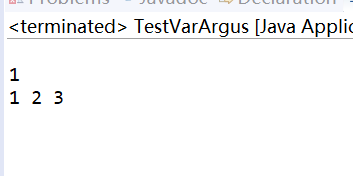
注:int... intArray,...是可变参数,是int型,也可以改为其他型的 eg:String...StringArray
实验3:编程练习:参照输出样例补全程序,使程序输出结果与输出样例一致。
public class Demo {

    public static void main(String[] args) {

        Son son = new Son();

        son.method();

    }

}

class Parent {

    Parent() {

        System.out.println("Parent's Constructor without parameter");

    }

    Parent(boolean b) {

        System.out.println("Parent's Constructor with a boolean parameter");

    }

    public void method() {

        System.out.println("Parent's method()");

    }

}

class Son extends Parent {

//补全本类定义

}

程序运行结果如下:

Parent's Constructor with a boolean parameter

Son's Constructor without parameter

Son's method()

Parent's method()
代码:
public class Demo1 {

      public static void main(String[] args) {

          Son son = new Son();

         son.method();

     }

 }

 class Parent {

     Parent() {

         System.out.println("Parent's Constructor without parameter");

         }

     Parent(boolean b) {

         System.out.println("Parent's Constructor with a boolean parameter");

     }

     public void method() {

         System.out.println("Parent's method()");

     }

 }

 class Son extends Parent {     //补全本类定义

     Son(){

         super(false);

         System.out.println("Son's Constructor without parameter");

     }

     public void method() {

         System.out.println("Son's method()");

         super.method();

     }

 }
结果:

3. 实验总结:
通过本次实验,我学习到了:1.四种访问权限修饰符的使用特点 2.Object类 3.ArrayList类的方法 4.枚举类定义方法及用途
通过本次实验,加深了我对java继承特点的理解,并在助教讲解后对四种访问权限修饰符有了更深层面的认识,掌握了ArrayList类,枚举类,对java的学习有了更深的了解。通过线上线下学习,及实验课的练习,我对继承这一章的知识有了明确的把握,但在知识掌握上还是不足。在实验中遇到了许多问题,归根结底是知识掌握的不熟,在同学的帮助下基本解决了问题。在课余时间还是要加强对知识的理解,多练习。
201871010106-丁宣元 《面向对象程序设计(java)》第七周学习总结的更多相关文章
- 201771010134杨其菊《面向对象程序设计java》第九周学习总结
第九周学习总结 第一部分:理论知识 异常.断言和调试.日志 1.捕获 ...
- 201871010132-张潇潇《面向对象程序设计(java)》第一周学习总结
面向对象程序设计(Java) 博文正文开头 项目 内容 这个作业属于哪个课程 https://www.cnblogs.com/nwnu-daizh/ 这个作业的要求在哪里 https://www.cn ...
- 扎西平措 201571030332《面向对象程序设计 Java 》第一周学习总结
<面向对象程序设计(java)>第一周学习总结 正文开头: 项目 内容 这个作业属于哪个课程 https://www.cnblogs.com/nwnu-daizh/ 这个作业的要求在哪里 ...
- 杨其菊201771010134《面向对象程序设计Java》第二周学习总结
第三章 Java基本程序设计结构 第一部分:(理论知识部分) 本章主要学习:基本内容:数据类型:变量:运算符:类型转换,字符串,输入输出,控制流程,大数值以及数组. 1.基本概念: 1)标识符:由字母 ...
- 201871010124 王生涛《面向对象程序设计JAVA》第一周学习总结
项目 内容 这个作业属于哪个课程 https://www.cnblogs.com/nwnu-daizh/ 这个作业的要求在哪里 https://edu.cnblogs.com/campus/xbsf/ ...
- 201871010115——马北《面向对象程序设计JAVA》第二周学习总结
项目 内容 这个作业属于哪个课程 https://www.cnblogs.com/nwnu-daizh/ 这个作业的要求在哪里 https://www.cnblogs.com/nwnu-daizh/p ...
- 201777010217-金云馨《面向对象程序设计(Java)》第二周学习总结
项目 内容 这个作业属于哪个课程 https://www.cnblogs.com/nwnu-daizh/ 这个作业的要求在哪里 https://www.cnblogs.com/nwnu-daizh/p ...
- 201871010132——张潇潇《面向对象程序设计JAVA》第二周学习总结
项目 内容 这个作业属于哪个课程 https://www.cnblogs.com/nwnu-daizh/ 这个作业的要求在哪里 https://www.cnblogs.com/nwnu-daizh/p ...
- 201771010123汪慧和《面向对象程序设计Java》第二周学习总结
一.理论知识部分 1.标识符由字母.下划线.美元符号和数字组成, 且第一个符号不能为数字.标识符可用作: 类名.变量名.方法名.数组名.文件名等.第二部分:理论知识学习部分 2.关键字就是Java语言 ...
- 201521123061 《Java程序设计》第七周学习总结
201521123061 <Java程序设计>第七周学习总结 1. 本周学习总结 2. 书面作业 ArrayList代码分析 1.1 解释ArrayList的contains源代码 贴上源 ...
随机推荐
- win10,anconda, python3.6安装dlib19.17
目的和经验: 几个月前在笔记本上安过一次,按着教程用cmake编译其实也蛮简单的,不过当初忘了收藏了.现在换了台机子需要重新安装一遍,奈何之前的帖子找不到了. pypi 网站上有19.8.whl,如果 ...
- 执行flutter doctor后,无任何反应
flutter运行需要联网,并且由于qiang,会导致访问缓慢,解决办法 export PUB_HOSTED_URL=https://pub.flutter-io.cn export FLUTTER_ ...
- Paper | Making a "Completely Blind" Image Quality Analyzer
目录 1. 技术细节 1.1 NSS特征 1.2 选择锐利块来计算NSS 1.3 一张图像得到36个特征 1.4 用MVG建模这36个特征 1.5 NIQE指标 2. 实验 质量评估大佬AC Bovi ...
- [NewLife.XCode]导入导出(实体对象百变魔君)
NewLife.XCode是一个有10多年历史的开源数据中间件,支持nfx/netcore,由新生命团队(2002~2019)开发完成并维护至今,以下简称XCode. 整个系列教程会大量结合示例代码和 ...
- 1+x 证书 Web 前端开发 JavaScript 专项练习
官方QQ群 1+x 证书 Web 前端开发 JavaScript 专项练习 http://blog.zh66.club/index.php/archives/198/
- snappy 安装
1 下载snappywget https://kojipkgs.fedoraproject.org//vol/fedora_koji_archive00/packages/snappy/1.1.0/1 ...
- 成都,我们来啦 | Dubbo 社区开发者日
[关注 阿里巴巴云原生 公众号,回复关键词"报名",即可参与抽奖!] 活动时间:10 月 26 日 13:00 - 18:00 活动地点:成都市高新区交子大道中海国际中心 233 ...
- F#周报2019年第23期
新闻 支持社区的WF与WCF开源项目 视频及幻灯片 F# MonoGame平台游戏系列:摄像头 Xamarin.Forms的F#与Fabulous ML.NET端到端之二:构建Web API 使用F# ...
- 【java】【guava】Google Guava的splitter用法
Google Guava的splitter,分割字符串的用法 package com.sxd.swapping.guava; import com.google.common.base.CharMat ...
- Java生鲜电商平台-会员积分系统的设计与架构
Java生鲜电商平台-会员积分系统的设计与架构 说明:互联网平台积分体系主要用于激励和回馈用户在平台的消费行为和活动行为,一个良好的积分体系可以很好的提升用户的粘性及活跃度. 一.互联网平台积分体系设 ...