
day 7 __new___
1 __new__方法 创建对象
实质是:调用父类的__new__方法创建的对象
class Dog(object):

    def __init__(self):

        print("---init方法")

    def __str__(self):

        print("---str方法")

    def __del__(self):

        print("---init方法")

    def __new__(cls):

        print("---new方法")

dog1 = Dog()
---new方法 #只是创建了类对象,没有初始化,没有实例化对象
2)版本2: cls此时是Dog指向的那个类对象
class Dog(object):

    def __init__(self):

        print("---init方法")

    def __str__(self):

        print("---str方法")

    def __del__(self):

        print("---init方法")

    def __new__(cls):

        print("---new方法")

        print(id(cls))

print(id(Dog))

dog1 = Dog()
38097176

---new方法

38097176
3)版本3:调用 被重写的方法__new__ 创建对象
class Dog(object):

    def __init__(self):

        print("---init方法")

    def __str__(self):

        print("---str方法")

    def __del__(self):

        print("---del方法")

    def __new__(cls):

        print("---new方法")          #对父类的方法重写

       # print(id(cls))

        object.__new__(cls)    #继续调用 被重写的方法  创建对象

#print(id(Dog))

dog1 = Dog()
---new方法

---del方法      #没有执行初始化
4)版本4 __init__ 只负责初始化
class Dog(object):

    def __init__(self):

        print("---init方法")

    def __str__(self):

        print("---str方法")

    def __del__(self):

        print("---del方法")

    def __new__(cls):   #cls此时是Dog指向的那个类对象

        print("---new方法")

       # print(id(cls))

        return object.__new__(cls)

#print(id(Dog))

dog1 = Dog()
---new方法

---init方法

---del方法
5)版本5:优化版
class Dog(object):

    #初始化  对象一创建开始执行

    def __init__(self):

        print("---init方法")

    def __str__(self):

        print("---str方法")

        return "返回对象的描述信息"

    #对象内存销毁时执行

    def __del__(self):

        print("---del方法")

    #通过父类的__new__方法创建对象

    def __new__(cls):   #cls此时是Dog指向的那个类对象

        print("---new方法")

       # print(id(cls))

        return object.__new__(cls)

#print(id(Dog))

dog1 = Dog()
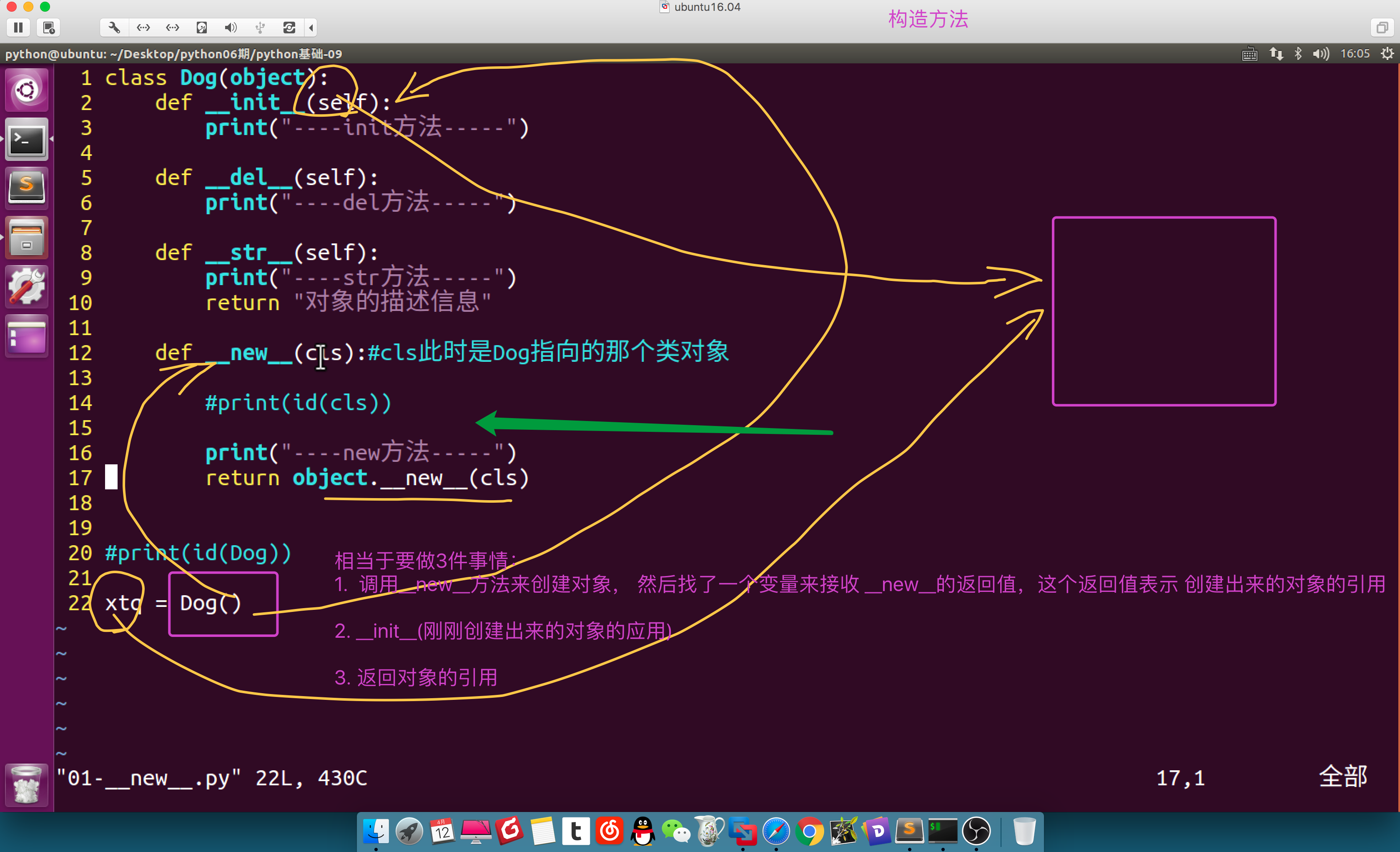
相当于做了3件事情

1.调用__new__方法来创建对象,然后找了一个变量来接受__new__的返回值,这个返回值表示创建出来的对象的引用

2. __init__(刚刚创建出来的对象的引用)

3. 返回对象的引用
构造方法
__new__只负责创建

__init__ 只负责初始化

__new__   和 __init__相当于C语言的构造方法
2. 创建单例对象
1)什么是单例

class Dog(object):

    pass

dog1 = Dog()

dog2 = Dog()

print(id(dog1))

print(id(dog2))
139888234067784        #不是同一块内存  不是同一个对象

139888234068008
2)版本2:
class Dog(object):

    def __new__(cls):

        if xxx :

            return object.__new__(cls)

        else:

            return 上一次创建的对象的引用

dog1 = Dog()

dog2 = Dog()
3)版本3:flag标志
class Dog(object):

    __flag = 0

    def __new__(cls):

        if flag == 0:

            flag = 1

            return object.__new__(cls)

        else:

            xxxxx

dog1 = Dog()

dog2 = Dog()
4)版本4:类属性 实现
class Dog(object):

    __flag = 0          #类属性  当做标志位         类属性是公有的

    __instance = 0   #类属性  存储 上一次创建对象的引用

    def __new__(cls):      #这是一个类方法,cls指向类对象cls

        if cls.__flag == 0:

            cls.__flag = 1

            cls.__instance = object.__new__(cls)

            return cls.__instance

        else:

            return cls.__instance

dog1 = Dog()

dog2 = Dog()
     #类方法

     @classmethod

     def add_num(cls):  #cls指向类对象

         cls.num += 1
     #实例方法

     def __init__(self,new_name):

         self.name = new_name  #self.name 是实例属性 ,实例对象独有的

         #对类属性 +1

         Dog.num += 1
5)版本5:__instance = None
class Dog(object):

    __instance = None

    def __new__(cls):

        if cls.__instance == None:

            cls.__instance = object.__new__(cls)

            return cls.__instance

        else:

            return cls.__instance

dog1 = Dog()

dog2 = Dog()
6)版本6:查看对应的内存id
class Dog(object):

    __instance = None

    def __new__(cls):

        if cls.__instance == None:

            cls.__instance = object.__new__(cls)

            return cls.__instance

        else:

            return cls.__instance

dog1 = Dog()

dog2 = Dog()

print(dog1)

print(dog2)
python@ubuntu:~/pythonS6/python基础092$ python3 08-单例对象.py

<__main__.Dog object at 0x7f46d4584828>

<__main__.Dog object at 0x7f46d4584828>
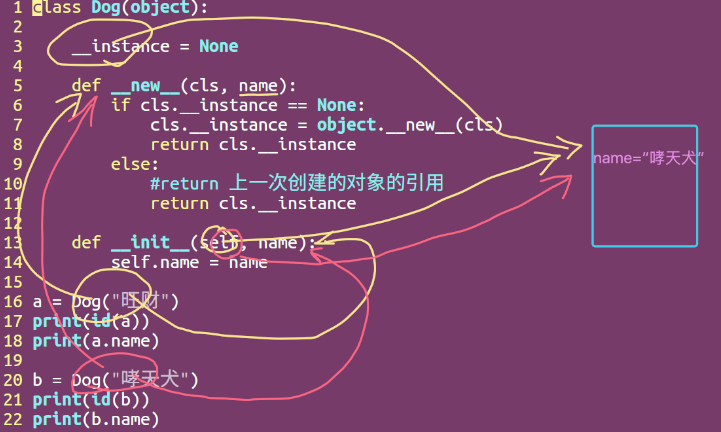
7)版本7:只初始化一次对象
 class Dog(object):

     __instance = None

     def __new__(cls,name):

         if cls.__instance == None:

             cls.__instance = object.__new__(cls)

             return cls.__instance

         else:

             return cls.__instance

     def __init__(self,new_name):

         self.name = new_name

 dog1 = Dog("tom")        #单例对象   name='tom'

 print(id(dog1))

 print(dog1.name)

 dog2 = Dog("jack")     #同一对象  令name='jack'

 print(id(dog2))

 print(dog2.name)
140546425677920

tom

140546425677920

jack                #如何让对象都是tom
8)版本8:添加flag
class Dog(object):

    __instance = None

    __flag = False

    def __new__(cls,name):

        if cls.__instance == None:

            cls.__instance = object.__new__(cls)

            return cls.__instance

        else:

            return cls.__instance

    def __init__(self,new_name):

        if Dog.__flag == False:

            self.name = new_name

            Dog.__flag = True

dog1 = Dog("tom")

print(id(dog1))

print(dog1.name)            #对象里面name = “tom”

dog2 = Dog("jack")

print(id(dog2))

print(dog2.name)
139813073586272

tom

139813073586272

tom                 #只初始化了一次对象
day 7 __new___的更多相关文章
- 面向对象的封装、继承和多态特性_python
一.面向对象的几个特点 面向对象也称为类,拥有下面几个特点 1.封装特性:利用类的__init__(self)构造方法封装对象 构造方法:__init__(self):在生成对象的时候会自动调用 例子 ...
随机推荐
- BZOJ1259:[CQOI2007]矩形rect(DFS)
Description 给一个a*b矩形,由a*b个单位正方形组成.你需要沿着网格线把它分成分空的两部分,每部分所有格子连通,且至少有一个格子在原矩形的边界上.“连通”是指任两个格子都可以通过水平或者 ...
- Tomcat的免安装配置
Tomcat免安装配置 以下配置说明全部针对免安装版本 基于tomcat的安装目录和运行目录是可以不同的,本文都会进行说明 首先简单介绍一下tomcat的目录结构,一般情况下,tomcat包括以下子目 ...
- ajax几种请求几种类型
jquery向服务器发送一个ajax请求后,可以返回多种类型的数据格式,包括:html,xml,json,text等. 首先说一下jquery中ajax标准的格式. $.ajax({ url: &qu ...
- Monkeyrunner命令
1.使用Monkeyrunner脚本命令时,需要导入模块才能使用模块的脚本命令,Monkeyrunner的常用模块有 MonkeyRunner,MonkeyDevice,MonkeyImage,Mon ...
- VC++使用socket进行TCP、UDP通信实例总结
1. 两台计算机通信需要协议,通信的两台计算机IP必须唯一 2. 同一个计算机可以进行多个应用程序与其他计算机通信,IP地址唯一,而端口号是区别同一计算机(同一IP)的唯一 ...
- sqoop导数据到hive报错
[root@hadoop1 conf]# sqoop import --connect jdbc:mysql://192.168.122.15:3306/company --username sqoo ...
- shell脚本排坑
jenkins用来输出日志: tail -f /tmp/i.log & { sleep 15; eval 'kill -9 $!' &> /dev/null; } 去时间秒 ...
- 【Mybatis】参数处理
单个参数:mybatis不会做特殊处理, #{参数名/任意名}:取出参数值. 多个参数:mybatis会做特殊处理. 多个参数会被封装成 一个map, key:param1...paramN,或者参数 ...
- String系列01 - String 60%
1.String简介 String类实现CharSequence接口.(同时,实现Serializable, Comparable 接口). String类使用final修饰符,为final类,不可被 ...
- git 从远程仓克隆到本地新分支
克隆远程仓代码到本地 git clone http://******:8080/DEV1-WMALL_DQ/WMALL_DQ_Front.git // git 库地址 当前分支是master ...