
mybatis13--2级缓存
验证内置的2级缓存
Ehcache缓存的配置
01.引入需要的ehcache 和mybatis-ehcache 两个jar包
02.在mapper文件中增加 <cache type="org.mybatis.caches.ehcache.EhcacheCache"/> <!-- 配置Ehcache缓存 -->
org.mybatis.caches.ehcache.EhcacheCache就是在mybatis-ehcache这个jar包中
03.引入需要的ecache.xml文件 就在ecache.jar中
创建对应的dao

public interface StudentDao {

    /**

     *  验证mybatis2级缓存!

     */

    Student selectStudentById(Integer sId);

}
创建对应的mapper文件
<?xml version="1.0" encoding="UTF-8"?>

<!DOCTYPE mapper

PUBLIC "-//mybatis.org//DTD Mapper 3.0//EN"

"http://mybatis.org/dtd/mybatis-3-Mapper.dtd">

<mapper namespace="cn.bdqn.dao.StudentDao">

  <cache/> <!-- 配置2级缓存 -->

     <select id="selectStudentById" resultType="Student">

      select  sid,sname from  student where sid=#{xxx}

    </select>

</mapper>
实体类实现Serializable序列化接口
/**

 *学生对应的实体类

 */

public class Student  implements Serializable {

    private  Integer sId;

    private  String sName;

    public Integer getsId() {

        return sId;

    }

    public void setsId(Integer sId) {

        this.sId = sId;

    }

    public String getsName() {

        return sName;

    }

    public void setsName(String sName) {

        this.sName = sName;

    }

    public Student(Integer sId, String sName) {

        super();

        this.sId = sId;

        this.sName = sName;

    }

    public Student() {

        super();

    }

    @Override

    public String toString() {

        return "Student [sId=" + sId + ", sName=" + sName +"]";

    }

}
把log4j的配置文件中的显示改成

增加测试类代码
package cn.bdqn.test;

import java.util.ArrayList;

import java.util.HashMap;

import java.util.List;

import java.util.Map;

import org.apache.ibatis.session.SqlSession;

import org.junit.After;

import org.junit.Before;

import org.junit.Test;

import cn.bdqn.bean.Student;

import cn.bdqn.dao.StudentDao;

import cn.bdqn.util.SessionUtil;

public class TeacherTest {

    StudentDao dao;

    SqlSession session;

    @Before

    public void before() {

        // 因为需要关闭session 需要把session提取出去

        session = SessionUtil.getSession();

        dao = session.getMapper(StudentDao.class);

    }

    @After

    public void after() {

        if (session != null) {

            session.close();

        }

    }

/**

 * 验证2级缓存

 *

 * 开启内置2级缓存的步骤

 * 01.实体类对象 要实现serializable 序列化接口

 * 02.在mapper文件中 增加  <cache/>节点

 */

    @Test

    public void test1() {

        Student student = dao.selectStudentById(1);

        System.out.println(student);

        session.close(); //关闭了session   一级缓存中的数据肯定清空了

        session = SessionUtil.getSession();  //再次获取session 查询数据

        dao = session.getMapper(StudentDao.class);

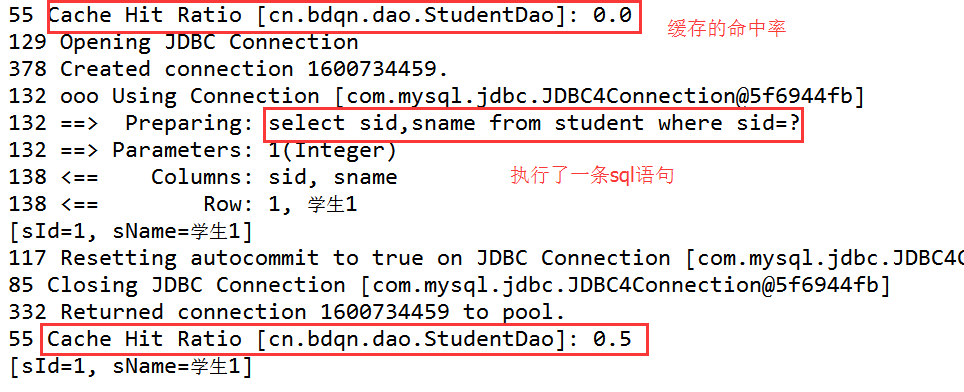
        //这时候不会再有sql语句了  因为2级缓存中存在相同的查询(mapper文件中sql的id)和相同的sql语句

        Student student2 = dao.selectStudentById(1);

        System.out.println(student2);

    }

}
查看运行的结果
验证增删改对2级缓存的影响
在dao中新增方法
public interface StudentDao {

    /**

     *  验证mybatis2级缓存!

     */

    Student selectStudentById(Integer sId);

    /**

     * 验证增删改查对2级缓存的影响!

     */

    void addStudent(Student student);

}
在mapper文件中新增
<?xml version="1.0" encoding="UTF-8"?>

<!DOCTYPE mapper

PUBLIC "-//mybatis.org//DTD Mapper 3.0//EN"

"http://mybatis.org/dtd/mybatis-3-Mapper.dtd">

<mapper namespace="cn.bdqn.dao.StudentDao">

  <cache/> <!-- 配置2级缓存 -->

     <select id="selectStudentById" resultType="Student">

      select  sid,sname from  student where sid=#{xxx}

    </select>

    <!-- 新增一个学生   验证对2级缓存的影响  标签中 增加 flushCache="false" 可以设置在新增数据的时候不刷新2级缓存
但是一级缓存不能配置 也就是 只要是一级缓存的增删改 都会刷新 -->

<insert id="addStudent"> insert into student values(#{sId},#{sName}) <!--#{sId},#{sName} 对应的是实体类中的属性 --></insert></mapper>
在测试类中新增
    /**

     * 验证增删改对2级缓存的影响

     */

    @Test

    public void test2() {

        Student student = dao.selectStudentById(1);

        System.out.println(student);

        session.close(); //关闭了session   一级缓存中的数据肯定清空了

        session = SessionUtil.getSession();  //再次获取session 查询数据

        dao = session.getMapper(StudentDao.class);

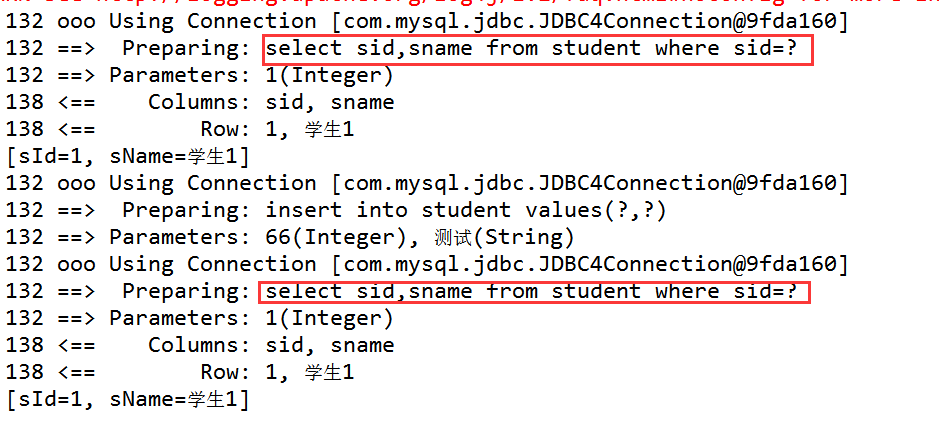
        //新增学生信息  看看对2级缓存的影响

        dao.addStudent(new Student(66,"测试"));

        Student student2 = dao.selectStudentById(1);

        System.out.println(student2);

    }
得到的结果:
2级缓存的关闭
/**

     *  2级缓存的关闭

     *  01.局部关闭

     * 在mapper文件中修改

     * <select id="selectStudentById"  useCache="false" resultType="Student">

     * 增加了useCache="false"  相当于 局部关闭 2级缓存  useCache默认值为true===》把查询放入2级缓存

     * 02.全局关闭

     *   在mybatis.xml文件中增加

     *   <settings>

     *         <!--全局关闭2级缓存  -->

     *          <setting name="cacheEnabled" value="false"/>

     *   </settings>

     */

    @Test

    public void test3() {

        Student student = dao.selectStudentById(1);

        System.out.println(student);

        session.close(); //关闭了session   一级缓存中的数据肯定清空了

        session = SessionUtil.getSession();  //再次获取session 查询数据

        dao = session.getMapper(StudentDao.class);

        //这时候不会再有sql语句了  因为2级缓存中存在相同的查询(mapper文件中sql的id)和相同的sql语句

        Student student2 = dao.selectStudentById(1);

        System.out.println(student2);

    }

    /**

     * 2级缓存的使用原则:

     * 01. 很少被修改的数据

     * 02. 不是很重要的数据,允许出现偶尔并发的数据

     * 03. 不会被并发访问的数据

     * 04.多个namespace不能操作同一张表

     * 05.不能在关联关系表上执行增删改操作

     */
mybatis13--2级缓存的更多相关文章
- 缓存篇(Cache)~第三回 HttpModule实现网页的文件级缓存
返回目录 再写完缓存篇第一回之后,得到了很多朋友的好评和来信,所以,决定加快步伐,尽快把剩下的文章写完,本篇是第三回,主要介绍使用HttpModule实现的文件级缓存,在看本文之前,大家需要限度Htt ...
- Hibernate-二级缓存策略
二级缓存的策略 当多个并发的事务同时访问持久化层的缓存中的相同数据时,会引起并发问题,必须采用必要的事务隔离措施. 在进程范围或集群范围的缓存,即第二级缓存,会出现并发问题.因此可以设定以下4种类型的 ...
- Hibernate-一级缓存session
hibernate提供的一级缓存 hibernate是一个线程对应一个session,一个线程可以看成一个用户.也就是说session级缓存(一级缓存)只能给一个线程用,别的线程用不了,一级缓存就是和 ...
- Spring+ehcache+redis两级缓存
问题描述 场景:我们的应用系统是分布式集群的,可横向扩展的.应用中某个接口操作满足以下一个或多个条件: 1. 接口运行复杂代价大, 2. 接口返回数据量大, 3. 接口的数据基本不会更改, 4. 接口 ...
- mybatis学习笔记(14)-查询缓存之中的一个级缓存
mybatis学习笔记(14)-查询缓存之中的一个级缓存 标签: mybatis mybatis学习笔记14-查询缓存之中的一个级缓存 查询缓存 一级缓存 一级缓存工作原理 一级缓存測试 一级缓存应用 ...
- 用guava快速打造两级缓存能力
首先,咱们都有一共识,即可以使用缓存来提升系统的访问速度! 现如今,分布式缓存这么强大,所以,大部分时候,我们可能都不会去关注本地缓存了! 而在一起高并发的场景,如果我们一味使用nosql式的缓存,如 ...
- Redis+Caffeine两级缓存,让访问速度纵享丝滑
原创:微信公众号 码农参上,欢迎分享,转载请保留出处. 在高性能的服务架构设计中,缓存是一个不可或缺的环节.在实际的项目中,我们通常会将一些热点数据存储到Redis或MemCache这类缓存中间件中, ...
- 基于Spring接口,集成Caffeine+Redis两级缓存
原创:微信公众号 码农参上,欢迎分享,转载请保留出处. 在上一篇文章Redis+Caffeine两级缓存,让访问速度纵享丝滑中,我们介绍了3种整合Caffeine和Redis作为两级缓存使用的方法,虽 ...
- Spring的3级缓存和循环引用的理解
此处是我自己的一个理解,防止以后忘记,如若那个地方理解不对,欢迎指出. 一.背景 在我们写代码的过程中一般会使用 @Autowired 来注入另外的一个对象,但有些时候发生了 循环依赖,但是我们的代码 ...
随机推荐
- Java知识回顾 (9) 同步、异步IO
一.基本概念 同步和异步: 同步和异步是针对应用程序和内核的交互而言的. 同步指的是用户进程触发IO 操作并等待或者轮询的去查看IO 操作是否就绪: 而异步是指用户进程触发IO 操作以后便开始做自己的 ...
- Guava-Objects使用
前言 Java中的Object提供了很多方法供所有的类使用,特别是toString.hashCode.equals.getClass等方法,在日常开发中作用很大,Guava中包含Objects类,其提 ...
- spring拦截器中使用spring的自动注入
需要在spring的拦截器中使用自定义的服务,这要就设计到将服务注入到拦截器中.网上看的情况有两种: 1. @Configuration public class OptPermissionHandl ...
- [转]正则表达式的先行断言(lookahead)和后行断言(lookbehind)
正则表达式的先行断言和后行断言一共有4种形式: (?=pattern) 零宽正向先行断言(zero-width positive lookahead assertion) (?!pattern) 零宽 ...
- Python操作redis学习系列之(集合)set,redis set详解 (六)
# -*- coding: utf-8 -*- import redis r = redis.Redis(host=") 1. Sadd 命令将一个或多个成员元素加入到集合中,已经存在于集合 ...
- 基于Kafka的生产者消费者消息处理本地调试
(尊重劳动成果,转载请注明出处:http://blog.csdn.net/qq_25827845/article/details/68174111冷血之心的博客) Kafka下载地址:http://d ...
- 在Java路上,我看过的一些书、源码和框架(转)
原文地址:http://www.jianshu.com/p/4a41ee88bd82 物有本末,事有终始,知所先后,则近道矣 面试经历 关于Java面试,你应该准备这些知识点关于Java面试,你应该准 ...
- SQLServer截取字符串常用函数
SQL Server中一共提供了三个字符串截取函数:LEFT().RIGHT().SUBSTRING(). 一.LEFT()函数 函数说明如下: 语法:LEFT(character,integer). ...
- Laravel-mix 中文文档
镜像地址 : https://segmentfault.com/a/1190000015049847原文地址: Laravel Mix Docs 概览 基本示例 larave-mix 是位于w ...
- unicode、utf8、字符串字面值
发现好多新人都不明白,或者说没有直观的感受,其实很简单. 简单的说,unicode是一种将全球文字都涵盖的字典 - 可以认为每个字符都有一个数字索引. 比如可以这样(假设):'a' 的索引是13,'我 ...