
HDU 6304 Chiaki Sequence Revisited
Chiaki is interested in an infinite sequence a1,a2,a3,..., which is defined as follows:
Chiaki would like to know the sum of the first n terms of the sequence, i.e. ∑i=1nai. As this number may be very large, Chiaki is only interested in its remainder modulo (109+7).
The first line contains an integer n (1≤n≤1018).
For each test case, output an integer denoting the answer.
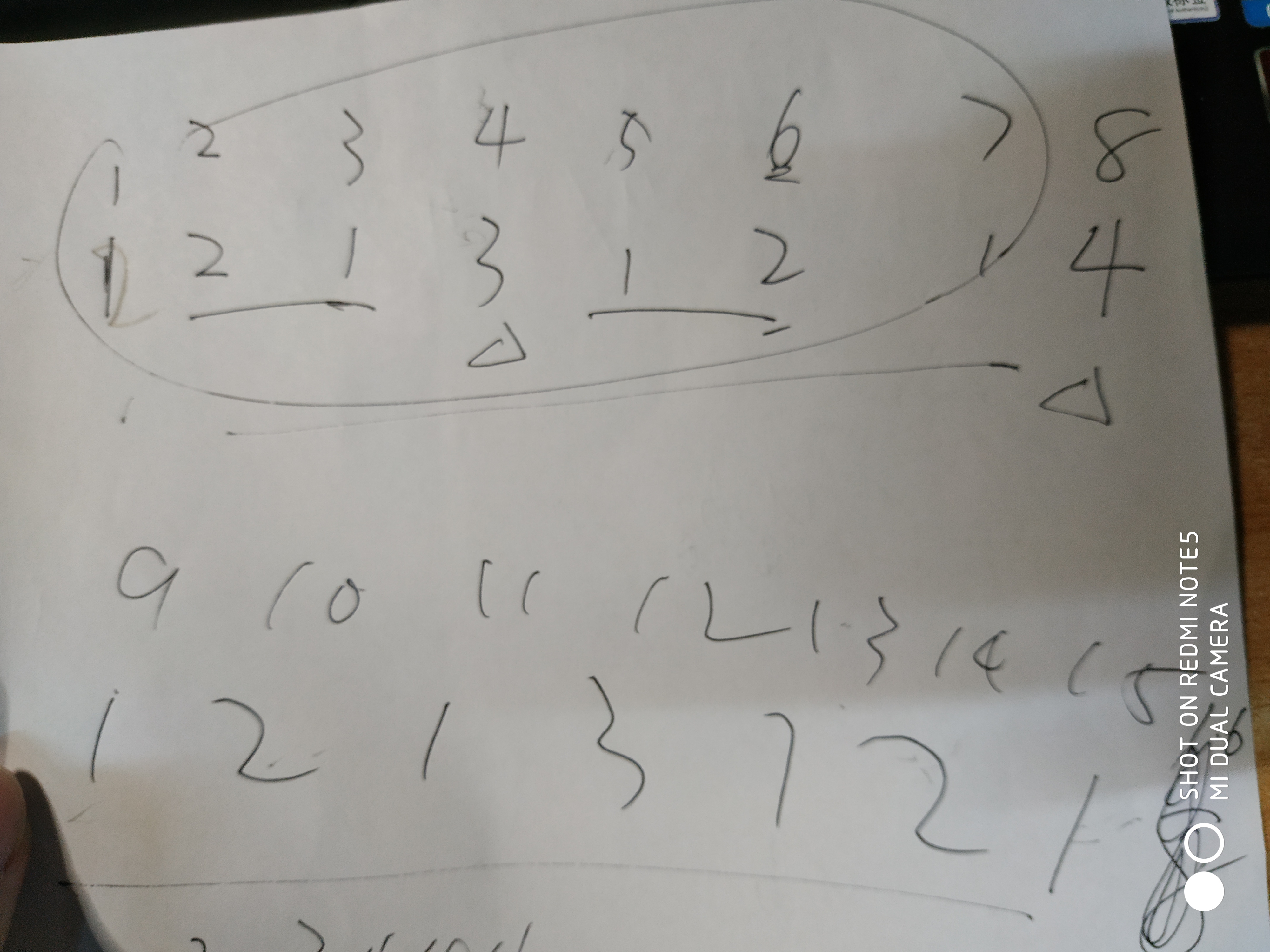
 void init(){

     P[]=;P[]=;

     nP[]=;nP[]=;

     for(int i=;i<=;++i){

         P[i]=*P[i-];

         nP[i]=P[i]-;

     }

 }

 ll getbound(ll N){

     ll bound=;

     for(int i=;i>=;--i){

         while(N>=nP[i]){

             N-=nP[i];

             bound+=P[i-];

         }

     }

     return bound;

 }
第二种 完全参照二进制,可知N(自减一后)所落在的数字最近的次数填满数字,后来计算时很方便。
 void init(){

     P[]=;P[]=;

     nP[]=;nP[]=;

     for(int i=;i<=;++i){

         P[i]=*P[i-];

         nP[i]=P[i]-;

     }

 }

 ll getbound(ll& N){

     ll bound=;

     for(int i=;i>=;--i){

         if(N>=nP[i]){

             N-=nP[i];

             bound+=P[i-];

         }

     }

     return bound;

 }
计算时可以可利用每个数字出现的次数,是1(2^0)的倍数的出现过一次,是2(2^1)的倍数的额外出现过一次,是4(2^2)的倍数的又额外出现一次,,,(这也恰恰是后缀0的意义)
在这里贴两份按照上述两种方法写的代码。
 #include <bits/stdc++.h>

 using namespace std;

 typedef long long ll;

 const ll MOD=1e9+;

 ll P[];

 ll nP[];

 ll a[];

 ll arr[];

 ll lowbit(ll x){

     ll low=x&(-x);

     ll cnt=;

     while(low>>=){

         cnt++;

     }

     return cnt;

 }

 void init(){

     P[]=;P[]=;

     nP[]=;nP[]=;

     for(int i=;i<=;++i){

         P[i]=*P[i-];

         nP[i]=P[i]-;

     }

     //a[1]=1;a[2]=1;

     //arr[1]=1;arr[2]=2;

     //for(int i=3;i<101;i++){

     //    a[i]=a[i-a[i-1]]+a[i-1-a[i-2]];

     //    arr[i]=arr[i-1]+a[i];

     //}

     //for(int i=1;i<101;++i) printf("%lld\n",arr[i]);

 }

 ll inv(ll a,ll m){

     if(a==) return ;

     return inv(m%a,m)*(m-m/a)%m;

 }

 ll getbound(ll N){

     ll bound=;

     for(int i=;i>=;--i){

         while(N>=nP[i]){

             N-=nP[i];

             bound+=P[i-];

         }

     }

     return bound;

 }

 int main(){

     //freopen("data.in","r",stdin);

     //freopen("data1.out","w",stdout);

     init();

     int T;

     scanf("%d",&T);

     while(T--){

         ll N;

         scanf("%lld",&N);

         if(N==) puts("");

         else{

             ll ans=;

             N-=1ll;

             ll bound=;

             bound=getbound(N);

             //printf("bound = %lld\n",bound);

             ll cnt=lowbit(bound)+1ll;

             ll tot=N;

             for(ll i=;i<=cnt;++i){

                 if(bound==getbound(N+i)) tot++;

                 else break;

             }

             ll _m2=inv(,MOD);

             //printf("%lld\n",_m2);

             for(int i=;i<=;++i){

                 if(P[i]<=bound){

                     ll M=bound/P[i];

                     ans=(ans+(P[i]%MOD)*(M%MOD)%MOD*((M+1ll)%MOD)%MOD*_m2%MOD)%MOD;

                 }

                 else break;

             }

             //printf("1:%lld\n",(ans+1)%MOD);

             ans=(ans-(bound)*(tot-N)%MOD+MOD)%MOD;

             printf("%lld\n",(ans+1ll)%MOD);

             //printf("%I64d %I64d\n",(ans+1ll)%MOD,arr[N+1]);

             //最后加一

         }

     }

     return ;

 }
 #include <bits/stdc++.h>

 using namespace std;

 typedef long long ll;

 const ll MOD=1e9+;

 ll P[];

 ll nP[];

 ll a[];

 ll arr[];

 ll lowbit(ll x){

     ll low=x&(-x);

     ll cnt=;

     while(low>>=){

         cnt++;

     }

     return cnt;

 }

 void init(){

     P[]=;P[]=;

     nP[]=;nP[]=;

     for(int i=;i<=;++i){

         P[i]=*P[i-];

         nP[i]=P[i]-;

     }

     //a[1]=1;a[2]=1;

     //arr[1]=1;arr[2]=2;

     //for(int i=3;i<101;i++){

     //    a[i]=a[i-a[i-1]]+a[i-1-a[i-2]];

     //    arr[i]=arr[i-1]+a[i];

     //}

     //for(int i=1;i<101;++i) printf("%lld\n",arr[i]);

 }

 ll inv(ll a,ll m){

     if(a==) return ;

     return inv(m%a,m)*(m-m/a)%m;

 }

 ll getbound(ll& N){

     ll bound=;

     for(int i=;i>=;--i){

         if(N>=nP[i]){

             N-=nP[i];

             bound+=P[i-];

         }

     }

     return bound;

 }

 int main(){

     //freopen("data.in","r",stdin);

     //freopen("data1.out","w",stdout);

     init();

     int T;

     scanf("%d",&T);

     while(T--){

         ll N;

         scanf("%lld",&N);

         if(N==) puts("");

         else{

             ll ans=;

             N-=1ll;

             ll bound=;

             bound=getbound(N);

             //printf("bound = %lld\n",bound);

             //ll cnt=lowbit(bound)+1ll;

             //ll tot=N;

             //for(ll i=1;i<=cnt;++i){

             //    if(bound==getbound(N+i)) tot++;

             //    else break;

             //}

             ll _m2=inv(,MOD);

             for(int i=;i<=;++i){

                 if(P[i]<=bound){

                     ll M=bound/P[i];

                     ans=(ans+(P[i]%MOD)*(M%MOD)%MOD*((M+1ll)%MOD)%MOD*_m2%MOD)%MOD;

                 }

                 else break;

             }

             //printf("1:%lld\n",(ans+1)%MOD);

             ans=(ans+(bound+)*N%MOD)%MOD;

             printf("%lld\n",(ans+1ll)%MOD);

             //printf("%I64d %I64d\n",(ans+1ll)%MOD,arr[N+1]);

             //最后加一

         }

     }

     return ;

 }
然后,比赛时WA了两发,其实规律找到了,但错在了计算,算总和时,第一个错误处是没用逆元,第二个错误处是P[i]在N为1e18时奇大,应该先mod在相乘。
血的教训。
Chiaki would like to know the sum of the first n terms of the sequence, i.e. ∑i=1nai. As this number may be very large, Chiaki is only interested in its remainder modulo (109+7).
HDU 6304 Chiaki Sequence Revisited的更多相关文章
- 2018 杭电多校1 - Chiaki Sequence Revisited
题目链接 Problem Description Chiaki is interested in an infinite sequence $$$a_1,a_2,a_3,...,$$$ which i ...
- HDU - 6304(2018 Multi-University Training Contest 1) Chiaki Sequence Revisited(数学+思维)
http://acm.hdu.edu.cn/showproblem.php?pid=6304 题意 给出一个数列的定义,a[1]=a[2]=1,a[n]=a[n-a[n-1]]+a[n-1-a[n-2 ...
- Chiaki Sequence Revisited HDU - 6304 lowbit找规律法
Problem Description Chiaki is interested in an infinite sequence a1,a2,a3,..., which is defined as f ...
- 【HDOJ6304】Chiaki Sequence Revisited(数学)
题意:给定一个序列a,定义a[1]=a[2]=1,a[n]=a[n-a[n-1]]+a[n-1-a[n-2]](n>=3),求该序列的前n项和是多少,结果对 1e9+7 取模 n<=1e1 ...
- [HDU6304][数学] Chiaki Sequence Revisited-杭电多校2018第一场G
[HDU6304][数学] Chiaki Sequence Revisited -杭电多校2018第一场G 题目描述 现在抛给你一个数列\(A\) \[ a_n=\begin{cases}1 & ...
- HDU 5860 Death Sequence(死亡序列)
p.MsoNormal { margin: 0pt; margin-bottom: .0001pt; text-align: justify; font-family: Calibri; font-s ...
- HDU 1711 Number Sequence(数列)
HDU 1711 Number Sequence(数列) Time Limit: 10000/5000 MS (Java/Others) Memory Limit: 32768/32768 K (Ja ...
- HDU 1005 Number Sequence(数列)
HDU 1005 Number Sequence(数列) Time Limit: 2000/1000 MS (Java/Others) Memory Limit: 65536/32768 K (Jav ...
- HDU 5860 Death Sequence(递推)
HDU 5860 Death Sequence(递推) 题目链接http://acm.split.hdu.edu.cn/showproblem.php?pid=5860 Description You ...
随机推荐
- 创建java类并实例化类对象
创建java类并实例化类对象例一1.面向对象的编程关注于类的设计2.设计类实际上就是设计类的成员3.基本的类的成员,属性(成员变量)&方法 面向对象思想的落地法则一:1.设计类,并设计类的成员 ...
- pycharm 在线激活
1.在pycharm过期页面选择 enter License 2.激活界面的License server输入:http://idea.liyang.io 然后点击激活 (确保电脑能上网,亲测有效)
- 洋葱第4场C和D题解……
只是记录一下: 我们机房讨论的结果……(当然有一个au爷一开始就秒掉了……首先先n^2或随机枚举出一对点根据抽屉原理可得枚举(n/2)^2+1次后至少有一对点全是对的然后对于两个对的点,首先考虑缩放比 ...
- websocket 11
1. websocket 回顾: - 什么是轮训? - 通过定时器让程序每隔n秒执行一次操作. - 什么是长轮训? - 浏览器向后端发起请求,后端会将请求 hang 住,最多hang 30s. 如果一 ...
- MySQL Point in Time Recovery the Right Way
In this blog, I’ll look at how to do MySQL point in time recovery (PITR) correctly. Sometimes we nee ...
- 简析Colorspace
最近Colorspace成为了一个很高频的问题,很多Compositor为这个概念感到纠结,其实这是很正常的,因为Colorspace发展了很多年,也有很多种标准,最后还要落地到合成软件中,中间自然就 ...
- MySQL创建数据库与用户
root远程访问授权 mysql> SHOW DATABASES; +--------------------+ | Database | +---------------- ...
- SpringSecurity-UsernamePasswordAuthenticationFilter的作用
UsernamePasswordAuthenticationFilter应该是我们最关注的Filter,因为它实现了我们最常用的基于用户名和密码的认证逻辑. 先看一下一个常用的form-login配置 ...
- 理解OpenShift(1):网络之 Router 和 Route
理解OpenShift(1):网络之 Router 和 Route 理解OpenShift(2):网络之 DNS(域名服务) 理解OpenShift(3):网络之 SDN 理解OpenShift(4) ...
- [UE4]Menu Anchor,菜单锚点
一.想要弹出某个菜单的时候,Menu Anchor可以做为菜单弹出的位置. 二.Menu Anchor本身不显示任何东西 三.Menu Class:选择要弹出的UI,可以是任意的UserWidget ...