
数据结构5_java---二叉树,树的建立,树的先序、中序、后序遍历(递归和非递归算法),层次遍历(广度优先遍历),深度优先遍历,树的深度(递归算法)
1、二叉树的建立
首先,定义数组存储树的data,然后使用list集合将所有的二叉树结点都包含进去,最后给每个父亲结点赋予左右孩子。
需要注意的是:最后一个父亲结点需要单独处理
 public static TreeNode root;

     //建立二叉树内部类

     class TreeNode{

         public Object data;                    //携带变量

         public TreeNode lchild,rchild;         //左右孩子

         public TreeNode() {

             data = null;

             lchild = null;

             rchild = null;

         }

         public TreeNode(Object data) {

             this.data = data;

         }

         public void setLeft(TreeNode left)

         {

             this.lchild = left;

         }

         public void setRight(TreeNode right)

         {

             this.rchild = right;

         }

     }

             //建立二叉树,通过List作为中间过渡量

         public void CreatBinTree(int []datas,List<TreeNode> nodelist) {

             for(int i=0;i<datas.length;i++)

             {

                 TreeNode aNode = new TreeNode(datas[i]);

                 nodelist.add(aNode);

             }

             //给所有父亲结点设定子节点

             for(int index = 0;index<nodelist.size()/2-1;index++)

             {

                 //在起始结点为0时,为N的父亲结点他的左孩子为2*N+1,右孩子为2*N+2

                 nodelist.get(index).lchild = nodelist.get(2*index+1);

                 nodelist.get(index).rchild = nodelist.get(2*index+2);

             }

             //单独处理最后一个父亲结点

             int index = nodelist.size()/2-1;

             nodelist.get(index).lchild = nodelist.get(2*index+1);

             if(nodelist.size()%2==1)

                 nodelist.get(index).rchild = nodelist.get(2*index+2);

         }
2、先序遍历
2.1 递归方法
//先序遍历,递归操作

        public void PreOrder(TreeNode root)

        {

            if(root == null)

                return ;

            System.out.print(root.data+" ");

            PreOrder(root.lchild);

            PreOrder(root.rchild);

        }
2.2 非递归操作,使用栈(两种方法)
本人认为第一种方法相对容易理解,较为简单
方法一:
思想:
(1)若栈非空或者结点非空,则进入循环
(2)若结点非空,读取该节点,并将结点压入栈中,结点向左孩子移动,移到最左孩子
(3)若栈非空,取出栈顶元素,此时父节点已读,所以移向右孩子
****************核心为:边读取左结点变将其压入栈中,左孩子对下一级来说上也代表父亲结点,所以之后可以直接读取右孩子。*******************
         /*

         * 方法一:先序遍历,使用栈操作,相对较简单

         * 思想:

         * (1)若栈非空或者结点非空,则进入循环

         * (2)若结点非空,读取该节点,并将结点压入栈中,结点向左孩子移动,移到最左孩子

         * (3)若栈非空,取出栈顶元素,此时父节点已读,所以移向右孩子

         * 核心为:边读取左结点变将其压入栈中,左孩子对下一级来说上也代表父亲结点,所以之后可以直接读取右孩子。

         */

        public void preOrder1()

        {

            Stack<TreeNode> stack = new Stack<>();

            TreeNode node = root;

            while(!stack.isEmpty()||node!=null)

            {

                while(node!=null)

                {

                    System.out.print(node.data+" "); //访问该节点

                    stack.push(node);

                    node = node.lchild;

                }

                if(!stack.isEmpty())

                {

                    node = stack.pop();

                    node = node.rchild;

                }

            }

        }
方法二:
思想:
(1)首先将根节点入栈
(2)判断非空,将结点从栈中取出并访问
(3)依次访问栈中的左孩子,并将右孩子放入栈中,结点不断往左孩子移动
(4)重复步骤(2)(3),直到栈为空
          /*

         * 方法二:先序遍历,使用栈操作,相对较麻烦

         * 思想:

         * (1)首先将根节点入栈

         * (2)判断非空,将结点从栈中取出并访问

         * (3)依次访问栈中的左孩子,并将右孩子放入栈中,结点不断往左孩子移动

         * (4)重复步骤(2)(3),直到栈为空

         */

        public void preOrder2() throws Exception

        {

            TreeNode pNode = root;

            if(pNode!=null)       //首先判断根结点是否为空

            {

                Stack<TreeNode> astack = new Stack<>();     //构造栈操作

                astack.push(pNode);            //将根节点压入栈中

                while(!astack.isEmpty())        //循环操作直到栈中没有结点存在,即最右结点访问完毕

                {

                    pNode = astack.pop();               //首先将结点从栈中取出

                    System.out.print(pNode.data+" "); //访问该节点

                    while(pNode!=null)                  //若该结点不为空

                    {

                        if(pNode.lchild!=null)         //访问左子树

                            System.out.print(pNode.lchild.data+" ");

                        if(pNode.rchild!=null)         //将右子树压入栈中

                            astack.push(pNode.rchild);

                        pNode = pNode.lchild;          //进入到下一个左子树中

                    }

                }

            }

        }
3、中序遍历
3.1 递归操作
//中序遍历,递归操作

        public void inOrder(TreeNode root)

        {

            if(root==null)

                return ;

            inOrder(root.lchild);

            System.out.print(root.data+" ");

            inOrder(root.rchild);

        }
3.2 非递归操作,栈
思想:
* (1)若栈非空或者结点非空,则进入循环
* (2)若结点非空,则将结点压入栈中,结点向左孩子移动,一直到最左边
* (3)若栈非空,则取出栈顶元素,并读取访问数据,而后结点向右孩子移动
/*

         * 中序遍历,使用栈操作

         * 思想:

         * (1)若栈非空或者结点非空,则进入循环

         * (2)若结点非空,则将结点压入栈中,结点向左孩子移动,一直到最左边

         * (3)若栈非空,则取出栈顶元素,并读取访问数据,而后结点向右孩子移动

         */

        public void inOrder1() throws Exception

        {

            TreeNode node = root;

            Stack<TreeNode> stack = new Stack<>();

            while(node!=null||!stack.isEmpty())

            {

                while(node!=null)

                {

                    stack.push(node);

                    node = node.lchild;

                }

                if(stack!=null)

                {

                    node = stack.pop();

                    System.out.print(node.data+" ");

                    node = node.rchild;

                }

            }

        }
4、后序遍历
4.1 递归操作
//后序遍历,递归操作

        public void postOrder(TreeNode root)

        {

            if(root==null)

                return ;

            postOrder(root.lchild);

            postOrder(root.rchild);

            System.out.print(root.data+" ");

        }
4.2 非递归操作
前提:设置标志结点pre,指示是否访问过某结点
思想:
* (1)若栈非空或者结点非空,则进入循环
* (2)若结点非空,则将结点压入栈中,结点向左孩子移动,一直到最左边
* (3)若栈非空,首先取出栈顶元素的右孩子赋给tmp
1、若栈顶元素的右孩子为空或者等于pre(即已访问过),则弹出元素并访问,将该结点赋值给pre,并将当前结点赋值为null
2、否则的话将右孩子赋值给当前结点
/*

         * 后序遍历,栈操作

         * 前提:设置标志结点pre,指示是否访问过某结点

         * 思想:

         * (1)若栈非空或者结点非空,则进入循环

         * (2)若结点非空,则将结点压入栈中,结点向左孩子移动,一直到最左边

         * (3)若栈非空,首先取出栈顶元素的右孩子赋给tmp

         *         1、若栈顶元素的右孩子为空或者等于pre(即已访问过),则弹出元素并访问,将该结点赋值给pre,并将当前结点赋值为null

         *      2、否则的话将右孩子赋值给当前结点

         */

        public void postOrder1()

        {

            Stack<TreeNode> stack = new Stack<>();

            TreeNode node = root,pre = root;

            while(!stack.isEmpty()||node!=null)

            {

                while(node!=null)

                {

                    stack.push(node);

                    node = node.lchild;

                }

                if(!stack.isEmpty())

                {

                    TreeNode tmp = stack.peek().rchild;

                    if(tmp==null||tmp==pre)

                    {

                        node = stack.pop();

                        System.out.print(node.data+" ");

                        pre = node;

                        node = null;

                    }else {

                        node = tmp;

                    }

                }

            }

        }
5、层次遍历(广度优先遍历)使用队列
思想:
* (1)读取根节点,并将其压入队列中
* (2)以队列的长度作为循环的判断条件,取出队收元素并访问,访问后将其弹出
* (3)判断是否有左右孩子,若有则加入队列中。
public void bfs()

        {

            Queue<TreeNode> queue = new LinkedList();

            if(root==null)

                return ;

            queue.offer(root);

            while(queue.size()>0) {

                TreeNode node = queue.peek();

                queue.poll();

                System.out.print(node.data+" ");

                if(node.lchild!=null)

                {

                    queue.offer(node.lchild);

                }

                if(node.rchild!=null)

                {

                    queue.offer(node.rchild);

                }

            }

        }
6、深度优先遍历
此部分相对较难理解,自行琢磨
public void dfs(TreeNode node,List<List<Integer>> nList,List<Integer>  list)

        {

            if(node==null)

                return ;

            if(node.lchild==null&node.rchild==null)

            {

                list.add((Integer) node.data);

                nList.add(new ArrayList<>(list));

                list.remove(list.size()-1);

            }

            list.add((Integer) node.data);

            dfs(node.lchild, nList, list);

            dfs(node.rchild, nList, list);

            list.remove(list.size()-1);

        }
7、求树的深度
(1)若二叉树为空,则返回0
(2)若二叉树非空,求左子树的深度,求右子树的深度
(3)比较左右子树的深度,求最大值加1,即为二叉树的深度
//求二叉树的深度

        public int Depth(TreeNode node)

        {

            if(node==null)

                return 0;

            else {

                int ldepth = Depth(node.lchild);

                System.out.println("node'data:"+node.data+"ldepth: "+ldepth);

                int rdepth = Depth(node.rchild);

                System.out.println("node'data:"+node.data+"rdepth: "+rdepth+" ");

                if(ldepth<rdepth)

                    return rdepth+1;

                else

                    return ldepth+1;

            }

        }
7、应用及全部代码展示
 package Main;

 import java.util.ArrayList;

 import java.util.Collection;

 import java.util.Iterator;

 import java.util.LinkedList;

 import java.util.List;

 import java.util.Queue;

 import java.util.Scanner;

 import java.util.Stack;

 import javax.naming.directory.SearchControls;

 public class Main{

     public static TreeNode root;

     //建立二叉树内部类

     class TreeNode{

         public Object data;                    //携带变量

         public TreeNode lchild,rchild;         //左右孩子

         public TreeNode() {

             data = null;

             lchild = null;

             rchild = null;

         }

         public TreeNode(Object data) {

             this.data = data;

         }

         public void setLeft(TreeNode left)

         {

             this.lchild = left;

         }

         public void setRight(TreeNode right)

         {

             this.rchild = right;

         }

     }

     //建立二叉树,通过List作为中间过渡量

         public void CreatBinTree(int []datas,List<TreeNode> nodelist) {

             for(int i=0;i<datas.length;i++)

             {

                 TreeNode aNode = new TreeNode(datas[i]);

                 nodelist.add(aNode);

             }

             //给所有父亲结点设定子节点

             for(int index = 0;index<nodelist.size()/2-1;index++)

             {

                 //在起始结点为0时,为N的父亲结点他的左孩子为2*N+1,右孩子为2*N+2

                 nodelist.get(index).lchild = nodelist.get(2*index+1);

                 nodelist.get(index).rchild = nodelist.get(2*index+2);

             }

             //单独处理最后一个父亲结点

             int index = nodelist.size()/2-1;

             nodelist.get(index).lchild = nodelist.get(2*index+1);

             if(nodelist.size()%2==1)

                 nodelist.get(index).rchild = nodelist.get(2*index+2);

         }

         //先序遍历,递归操作

         public void PreOrder(TreeNode root)

         {

             if(root == null)

                 return ;

             System.out.print(root.data+" ");

             PreOrder(root.lchild);

             PreOrder(root.rchild);

         }

         /*

          * 方法一:先序遍历,使用栈操作,相对较简单

          * 思想:

          * (1)若栈非空或者结点非空,则进入循环

          * (2)若结点非空,读取该节点,并将结点压入栈中,结点向左孩子移动,移到最左孩子

          * (3)若栈非空,取出栈顶元素,此时父节点已读,所以移向右孩子

          * 核心为:边读取左结点变将其压入栈中,左孩子对下一级来说上也代表父亲结点,所以之后可以直接读取右孩子。

          */

         public void preOrder1()

         {

             Stack<TreeNode> stack = new Stack<>();

             TreeNode node = root;

             while(!stack.isEmpty()||node!=null)

             {

                 while(node!=null)

                 {

                     System.out.print(node.data+" "); //访问该节点

                     stack.push(node);

                     node = node.lchild;

                 }

                 if(!stack.isEmpty())

                 {

                     node = stack.pop();

                     node = node.rchild;

                 }

             }

         }

         /*

          * 方法二:先序遍历,使用栈操作,相对较麻烦

          * 思想:

          * (1)首先将根节点入栈

          * (2)判断非空,将结点从栈中取出并访问

          * (3)依次访问栈中的左孩子,并将右孩子放入栈中,结点不断往左孩子移动

          * (4)重复步骤(2)(3),直到栈为空

          */

         public void preOrder2() throws Exception

         {

             TreeNode pNode = root;

             if(pNode!=null)       //首先判断根结点是否为空

             {

                 Stack<TreeNode> astack = new Stack<>();     //构造栈操作

                 astack.push(pNode);            //将根节点压入栈中

                 while(!astack.isEmpty())        //循环操作直到栈中没有结点存在,即最右结点访问完毕

                 {

                     pNode = astack.pop();               //首先将结点从栈中取出

                     System.out.print(pNode.data+" "); //访问该节点

                     while(pNode!=null)                  //若该结点不为空

                     {

                         if(pNode.lchild!=null)         //访问左子树

                             System.out.print(pNode.lchild.data+" ");

                         if(pNode.rchild!=null)         //将右子树压入栈中

                             astack.push(pNode.rchild);

                         pNode = pNode.lchild;          //进入到下一个左子树中

                     }

                 }

             }

         }

         //中序遍历,递归操作

         public void inOrder(TreeNode root)

         {

             if(root==null)

                 return ;

             inOrder(root.lchild);

             System.out.print(root.data+" ");

             inOrder(root.rchild);

         }

         /*

          * 中序遍历,使用栈操作

          * 思想:

          * (1)若栈非空或者结点非空,则进入循环

          * (2)若结点非空,则将结点压入栈中,结点向左孩子移动,一直到最左边

          * (3)若栈非空,则取出栈顶元素,并读取访问数据,而后结点向右孩子移动

          */

         public void inOrder1() throws Exception

         {

             TreeNode node = root;

             Stack<TreeNode> stack = new Stack<>();

             while(node!=null||!stack.isEmpty())

             {

                 while(node!=null)

                 {

                     stack.push(node);

                     node = node.lchild;

                 }

                 if(stack!=null)

                 {

                     node = stack.pop();

                     System.out.print(node.data+" ");

                     node = node.rchild;

                 }

             }

         }

         //后序遍历,递归操作

         public void postOrder(TreeNode root)

         {

             if(root==null)

                 return ;

             postOrder(root.lchild);

             postOrder(root.rchild);

             System.out.print(root.data+" ");

         }

         /*

          * 后序遍历,栈操作

          * 前提:设置标志结点pre,指示是否访问过某结点

          * 思想:

          * (1)若栈非空或者结点非空,则进入循环

          * (2)若结点非空,则将结点压入栈中,结点向左孩子移动,一直到最左边

          * (3)若栈非空,首先取出栈顶元素的右孩子赋给tmp

          *         1、若栈顶元素的右孩子为空或者等于pre(即已访问过),则弹出元素并访问,将该结点赋值给pre,并将当前结点赋值为null

          *      2、否则的话将右孩子赋值给当前结点

          */

         public void postOrder1()

         {

             Stack<TreeNode> stack = new Stack<>();

             TreeNode node = root,pre = root;

             while(!stack.isEmpty()||node!=null)

             {

                 while(node!=null)

                 {

                     stack.push(node);

                     node = node.lchild;

                 }

                 if(!stack.isEmpty())

                 {

                     TreeNode tmp = stack.peek().rchild;

                     if(tmp==null||tmp==pre)

                     {

                         node = stack.pop();

                         System.out.print(node.data+" ");

                         pre = node;

                         node = null;

                     }else {

                         node = tmp;

                     }

                 }

             }

         }

         /*层次遍历,即广度优先遍历,从上到下遍历二叉树

          * 思想:

          * (1)读取根节点,并将其压入队列中

          * (2)以队列的长度作为循环的判断条件,取出队收元素并访问,访问后将其弹出

          * (3)判断是否有左右孩子,若有则加入队列中。

          * */

         public void bfs()

         {

             Queue<TreeNode> queue = new LinkedList();

             if(root==null)

                 return ;

             queue.offer(root);

             while(queue.size()>0) {

                 TreeNode node = queue.peek();

                 queue.poll();

                 System.out.print(node.data+" ");

                 if(node.lchild!=null)

                 {

                     queue.offer(node.lchild);

                 }

                 if(node.rchild!=null)

                 {

                     queue.offer(node.rchild);

                 }

             }

         }

         /*

          * 深度优先遍历,从左到右遍历二叉树

          * */

         public void dfs(TreeNode node,List<List<Integer>> nList,List<Integer>  list)

         {

             if(node==null)

                 return ;

             if(node.lchild==null&node.rchild==null)

             {

                 list.add((Integer) node.data);

                 nList.add(new ArrayList<>(list));

                 list.remove(list.size()-1);

             }

             list.add((Integer) node.data);

             dfs(node.lchild, nList, list);

             dfs(node.rchild, nList, list);

             list.remove(list.size()-1);

         }

         //查找算法

         public static TreeNode Searchparameter(TreeNode root,int x)

         {

             TreeNode node = root;

             if(root==null)

                 return null;

             else {

                 if(node.data.equals(x))

                     return node;

                 else {

                     TreeNode aNode = Searchparameter(node.lchild, x);

                     if(aNode==null)

                         return Searchparameter(node.rchild, x);

                     else

                         return aNode;

                 }

             }

         }

         //求二叉树的深度

         public int Depth(TreeNode node)

         {

             if(node==null)

                 return 0;

             else {

                 int ldepth = Depth(node.lchild);

                 int rdepth = Depth(node.rchild);

                 if(ldepth<rdepth)

                     return rdepth+1;

                 else

                     return ldepth+1;

             }

         }

         public static void main(String[] args) throws Exception {

             int datas[] = {1,2,3,4,5,6,7,8,9,10};

             List<TreeNode> nodelist = new LinkedList<>();

             Main aMain = new Main();

             aMain.CreatBinTree(datas,nodelist);

             root = nodelist.get(0);

             System.out.println("First order traversal(recursive):");

             aMain.PreOrder(root);

             System.out.println();

             System.out.println("First order traversal(stack--1):");

             aMain.preOrder1();

             System.out.println();

             System.out.println("First order traversal(stack--2):");

             aMain.preOrder2();

             System.out.println();

             System.out.println("Inorder traversal(recursive):");

             aMain.inOrder(root);

             System.out.println();

             System.out.println("Inorder traversal(stack--1):");

             aMain.inOrder1();

             System.out.println();

             System.out.println("Postorder traversal(recursive):");

             aMain.postOrder(root);

             System.out.println();

             System.out.println("Postorder traversal(stack--1):");

             aMain.postOrder1();

             System.out.println();

             System.out.println("Level traversal(queue--1):");

             aMain.bfs();

             List<List<Integer>> rst = new ArrayList<>();

             List<Integer> list = new ArrayList<>();

             System.out.println();

             System.out.println("Depth first traversal(queue--1):");

             aMain.dfs(root,rst,list);

             System.out.println(rst);

             int x = 6;

             TreeNode aNode = Searchparameter(root,x);

             System.out.println(aNode.data);

             int depth = aMain.Depth(root);

             System.out.println("the depth of the tree is :"+depth);

         }

 }
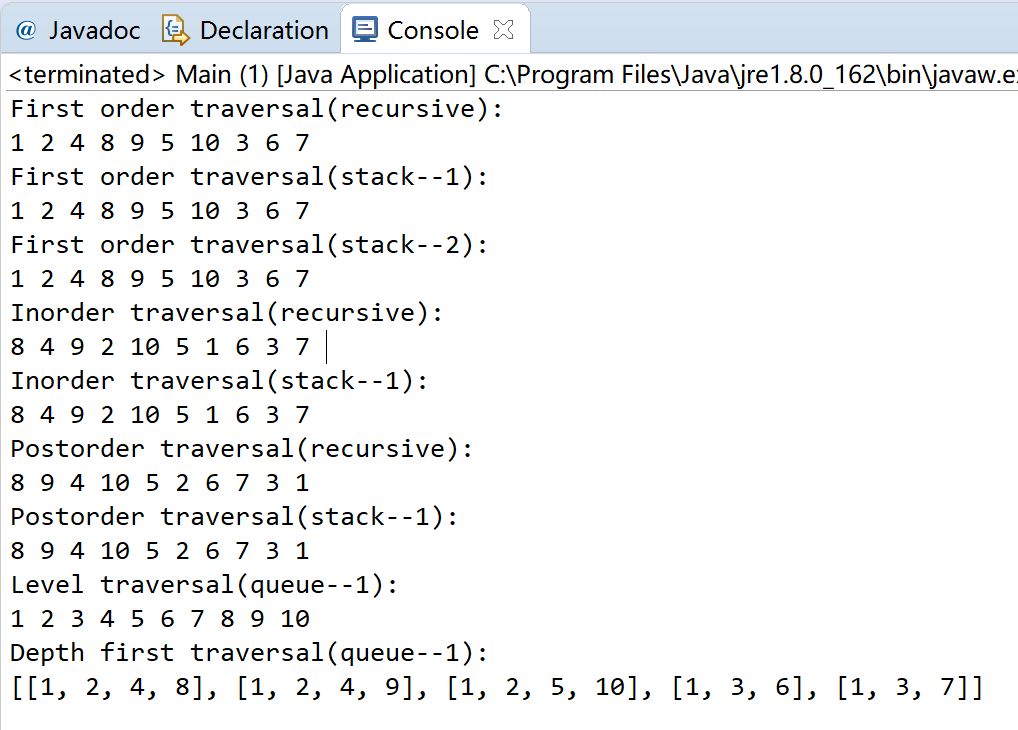
结果展示:
数据结构5_java---二叉树,树的建立,树的先序、中序、后序遍历(递归和非递归算法),层次遍历(广度优先遍历),深度优先遍历,树的深度(递归算法)的更多相关文章
- 【图数据结构的遍历】java实现广度优先和深度优先遍历
[图数据结构的遍历]java实现广度优先和深度优先遍历 宽度优先搜索(BFS)遍历图需要使用队列queue数据结构: 深度优先搜索(DFS, Depth First Search)的实现 需要使用到栈 ...
- 【数据结构】二叉树的遍历(前、中、后序及层次遍历)及leetcode107题python实现
文章目录 二叉树及遍历 二叉树概念 二叉树的遍历及python实现 二叉树的遍历 python实现 leetcode107题python实现 题目描述 python实现 二叉树及遍历 二叉树概念 二叉 ...
- 二叉树的创建、遍历(递归和非递归实现)、交换左右子数、求高度(c++实现)
要求:以左右孩子表示法实现链式方式存储的二叉树(lson—rson),以菜单方式设计并完成功能任务:建立并存储树.输出前序遍历结果.输出中序遍历结果.输出后序遍历结果.交换左右子树.统计高度,其中对于 ...
- 前、中、后序遍历随意两种是否能确定一个二叉树?理由? && 栈和队列的特点和区别
前序和后序不能确定二叉树理由:前序和后序在本质上都是将父节点与子结点进行分离,但并没有指明左子树和右子树的能力,因此得到这两个序列只能明确父子关系,而不能确定一个二叉树. 由二叉树的中序和前序遍历序列 ...
- 如何求先序排列和后序排列——hihocoder1049+洛谷1030+HDU1710+POJ2255+UVA548【二叉树递归搜索】
[已知先序.中序求后序排列]--字符串类型 #1049 : 后序遍历 时间限制:10000ms 单点时限:1000ms 内存限制:256MB 描述 小Ho在这一周遇到的问题便是:给出一棵二叉树的前序和 ...
- 分别求二叉树前、中、后序的第k个节点
一.求二叉树的前序遍历中的第k个节点 //求先序遍历中的第k个节点的值 ; elemType preNode(BTNode *root,int k){ if(root==NULL) return ' ...
- HDU 1710 (二叉树的前序和中序,求后序)
题目链接 题目大意: 输入二叉树的前序.中序遍历,请输出它的后序遍历 #include <stdio.h> #include <string.h> ; // 长度为n s1 前 ...
- hdu1710-Binary Tree Traversals (由二叉树的先序序列和中序序列求后序序列)
http://acm.hdu.edu.cn/showproblem.php?pid=1710 Binary Tree Traversals Time Limit: 1000/1000 MS (Java ...
- LeetCode:二叉树的前、中、后序遍历
描述: ------------------------------------------------------- 前序遍历: Given a binary tree, return the pr ...
随机推荐
- Spring Boot (四): Druid 连接池密码加密与监控
在上一篇文章<Spring Boot (三): ORM 框架 JPA 与连接池 Hikari> 我们介绍了 JPA 与连接池 Hikari 的整合使用,在国内使用比较多的连接池还有一个是阿 ...
- kubernetes实战(二十六):kubeadm 安装 高可用 k8s v1.16.x dashboard 2.x
1.基本配置 基本配置.内核升级.基本服务安装参考https://www.cnblogs.com/dukuan/p/10278637.html,或者参考<再也不踩坑的Kubernetes实战指南 ...
- 要不要学习Git(分布式版本控制系统)
做技术的人,要不要学一学Git呢? 提出这个问题,是因为很多小伙伴还不会使用Git. 对于任何新一代的技术工具,它在业界普及都有一个过程,Git的阻碍是:学习成本.工具迭代的成本. SVN诞生于200 ...
- 【求赐教】VMware workstation 转VSphere
首先我从其他电脑拷贝过来一台虚拟机(这个说法不知道准不准确,就是把所有文件夹都拷贝过来了),然后打开VMware,通过"打开虚拟机"这个操作,直接找到本地的.vmx文件,如下图所示 ...
- html标签和css基础语法与浏览器兼容性等相关基础学习
<!-- table的使用 --> <h3>前端日常</h3> <form action="https://www.baidu.com"& ...
- Spring框架学习笔记(3)——SpringMVC框架
SpringMVC框架是基于Spring框架,可以让我们更为方便的进行Web的开发,实现前后端分离 思路和原理 我们之前仿照SpringMVC定义了一个自定义MVC框架,两者的思路其实都是一样的. 建 ...
- mysql 5.7 Expression #1 of ORDER BY clause is not in GROUP BY clause and contains nonaggregated column ...报错
使用mysql在执行一条插入语句时 , ', "hhh"); 报错:Expression #1 of ORDER BY clause is not in GROUP BY clau ...
- jQuery九大选择器和jQuery对ajax的支持
一.jQuery九大选择器 1)基本选择器: <body> <div id="div1ID">div1</div> <div id=&qu ...
- 【ADO.NET基础】后台获取前台控件
C# 后台获取前台 input 文本框值.string aa=Request.Form[headself]; 那么要是后台给前台input文本框赋值呢? 后台 public string Headse ...
- C语言I—2019秋作业02
1.[新增内容] 这个作业属于那个课程 C语言程序设计 这个作业要求在哪里 <C语言I-2019秋作业02> 我在这个课程的目标是 这个作业在那个具体方面帮助我实现目标 <实现一些基 ...