
简单工厂(三)——JDK源码中的简单工厂
private static Calendar createCalendar(TimeZone zone,Locale aLocale)

            {

                CalendarProvider provider =

                    LocaleProviderAdapter.getAdapter(CalendarProvider.class, aLocale)

                                         .getCalendarProvider();

                if (provider != null) {

                    try {

                        return provider.getInstance(zone, aLocale);

                    } catch (IllegalArgumentException iae) {

                        // fall back to the default instantiation

                    }

                }

                Calendar cal = null;

            /*根据不同的地区来创建不同的日历对象,就好比日历这个工厂,生产着世界上各地区的日历,我需要这个地区日历,我只需要传参数告诉工厂即可,不需要知道日历制作过程和实例的过程*/

                if (aLocale.hasExtensions()) {

                    String caltype = aLocale.getUnicodeLocaleType("ca");

                    if (caltype != null) {

                        switch (caltype) {

                        case "buddhist":

                        cal = new BuddhistCalendar(zone, aLocale);

                            break;

                        case "japanese":

                            cal = new JapaneseImperialCalendar(zone, aLocale);

                            break;

                        case "gregory":

                            cal = new GregorianCalendar(zone, aLocale);

                            break;

                        }

                    }

                }

                if (cal == null) {

                    // If no known calendar type is explicitly specified,

                    // perform the traditional way to create a Calendar:

                    // create a BuddhistCalendar for th_TH locale,

                    // a JapaneseImperialCalendar for ja_JP_JP locale, or

                    // a GregorianCalendar for any other locales.

                    // NOTE: The language, country and variant strings are interned.

                    if (aLocale.getLanguage() == "th" && aLocale.getCountry() == "TH") {

                        cal = new BuddhistCalendar(zone, aLocale);

                    } else if (aLocale.getVariant() == "JP" && aLocale.getLanguage() == "ja"

                               && aLocale.getCountry() == "JP") {

                        cal = new JapaneseImperialCalendar(zone, aLocale);

                    } else {

                        cal = new GregorianCalendar(zone, aLocale);

                    }

                }

                return cal;

            }
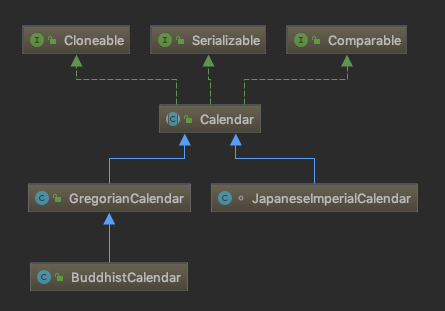
Calendar类图
Class.forName("com.mysql.jdbc.Driver");
      @CallerSensitive

      public static Connection getConnection(String url)

          throws SQLException {

          java.util.Properties info = new java.util.Properties();

          return (getConnection(url, info,Reflection.getCallerClass()));

     }
      //  Worker method called by the public getConnection() methods.

    private static Connection getConnection(

        String url, java.util.Properties info, Class<?> caller) throws SQLException {

        /*

         * When callerCl is null, we should check the application's

         * (which is invoking this class indirectly)

         * classloader, so that the JDBC driver class outside rt.jar

         * can be loaded from here.

         */

        ClassLoader callerCL = caller != null ? caller.getClassLoader() : null;

        synchronized(DriverManager.class) {

            // synchronize loading of the correct classloader.

            if (callerCL == null) {

                callerCL = Thread.currentThread().getContextClassLoader();

            }

        }

        if(url == null) {

            throw new SQLException("The url cannot be null", "08001");

        }

        println("DriverManager.getConnection(\"" + url + "\")");

        // Walk through the loaded registeredDrivers attempting to make a connection.

        // Remember the first exception that gets raised so we can reraise it.

        SQLException reason = null;

        for(DriverInfo aDriver : registeredDrivers) {

            // If the caller does not have permission to load the driver then

            // skip it.

            if(isDriverAllowed(aDriver.driver, callerCL)) {

                try {

                    println("    trying " + aDriver.driver.getClass().getName());

                    Connection con = aDriver.driver.connect(url, info);

                    if (con != null) {

                        // Success!

                        println("getConnection returning " + aDriver.driver.getClass().getName());

                        return (con);

                    }

                } catch (SQLException ex) {

                    if (reason == null) {

                        reason = ex;

                    }

                }

            } else {

                println("    skipping: " + aDriver.getClass().getName());

            }

        }

        // if we got here nobody could connect.

        if (reason != null)    {

            println("getConnection failed: " + reason);

            throw reason;

        }

        println("getConnection: no suitable driver found for "+ url);

        throw new SQLException("No suitable driver found for "+ url, "08001");

    }
        // Walk through the loaded registeredDrivers attempting to locate someone

        // who understands the given URL.

        for (DriverInfo aDriver : registeredDrivers) {

            // If the caller does not have permission to load the driver then

            // skip it.

            if(isDriverAllowed(aDriver.driver, callerClass)) {

                try {

                    if(aDriver.driver.acceptsURL(url)) {

                        // Success!

                        println("getDriver returning " + aDriver.driver.getClass().getName());

                    return (aDriver.driver);

                    }

                } catch(SQLException sqe) {

                    // Drop through and try the next driver.

                }

            } else {

                println("    skipping: " + aDriver.driver.getClass().getName());

            }

        }
因为这个可以看出来它是一个for循环,在遍历注册的一个驱动,
private final static CopyOnWriteArrayList<DriverInfo> registeredDrivers = new CopyOnWriteArrayList<>();
并且它是CopyOnWriteArrayList,里面是DriverInfo,初始化的时候他是一个空的,具体是什么时候完成注册的呢,
static {

    try {

        java.sql.DriverManager.registerDriver(new Driver());

    } catch (SQLException E) {

        throw new RuntimeException("Can't register driver!");

    }

}
public static synchronized void registerDriver(java.sql.Driver driver,

            DriverAction da)

        throws SQLException {

        /* Register the driver if it has not already been added to our list */

        if(driver != null) {

            registeredDrivers.addIfAbsent(new DriverInfo(driver, da));

        } else {

            // This is for compatibility with the original DriverManager

            throw new NullPointerException();

        }

        println("registerDriver: " + driver);

}
如果不存在就往里放
if(driver != null) {

registeredDrivers.addIfAbsent(new DriverInfo(driver, da));

}
此外,logback中也有简单工厂的影子。
public final class LoggerFactory

public static ILoggerFactory getILoggerFactory() {

}
最里面有一个getLogger方法,
public static Logger getLogger(Class clazz) {

return getLogger(clazz.getName());

}

public static Logger getLogger(String name) {

ILoggerFactory iLoggerFactory = getILoggerFactory();

return iLoggerFactory.getLogger(name);

}
这个还有个重载,一个是String name,还有一个是Class clazz,clazz是干嘛的,是clazz.getName(),
首先getLogger根据我们传来的name,从iLoggerFactory里面getLogger,先看一下
public interface ILoggerFactory

  package org.slf4j;

  //抽象产品工厂

  public interface ILoggerFactory {

     //抽象工厂方法

      public Logger getLogger(String name);

 }
很明显ILoggerFactory它是一个接口,下面有一个方法,那这个呢是工厂方法,那在后面我们也会讲,这里先过去,
后面我们学习工厂方法的时候,再单独来说,然后通过iLoggerFactory.getLogger,因为它是一个接口,肯定有多个实现,
  LoggerContext

  //具体工厂实现类

  public class LoggerContext extends ContextBase implements ILoggerFactory, LifeCycle {

  ...

      //具体工厂方法

      @Override

      public final Logger getLogger(final String name) {

       ...

      }
这里面我们看一下,传入的一个name,这里面要返回Logger,这里面对name进行了判断,很明显这个方法就是一个简单工厂方法,
根据传入的入参进行选择哪个Logger,那这个还是非常简单的,刚刚也说了,在我们的LoggerFactory里面,既存在了工厂方法,
又存在了简单工厂,所以设计模式在使用的时候,不一定要局限在使用一种,例如这里就是一个组合的使用,这个简单工厂比较简单,
在很多源码中也能够找到他的影子,在前面的JDK,Logback开源框架的,对于学习设计模式的讲解呢,我们在阅读源码的时候呢,
还可以以设计模式的角度,去聚焦源码,这样对我们理解源码也是有益处的 。
简单工厂(三)——JDK源码中的简单工厂的更多相关文章
- 结合JDK源码看设计模式——简单工厂、工厂方法、抽象工厂
三种工厂模式的详解: 简单工厂模式: 适用场景:工厂类负责创建的对象较少,客户端只关心传入工厂类的参数,对于如何创建对象的逻辑不关心 缺点:如果要新加产品,就需要修改工厂类的判断逻辑,违背软件设计中的 ...
- 设计模式-简单工厂Coding+jdk源码解析
感谢慕课geely老师的设计模式课程,本套设计模式的所有内容均以课程为参考. 前面的软件设计七大原则,目前只有理论这块,因为最近参与项目重构,暂时没有时间把Coding的代码按照设计思路一点点写出来. ...
- JDK源码中,都有哪些NB的设计模式?
转载:https://mp.weixin.qq.com/s/h88UxB9F2MkTbHqck3KQiQ 一.结构性模式: 1.适配器模式: 常用于将一个新接口适配旧接口 肥朝小声逼逼:在我们业务代码 ...
- Java1.8 JDK源码中,对两个类进行 按位与 操作是什么意思
Java容器类库中的Map接口(java\util\Map.java)中有一个Entry接口(java\util\Map.java),其中有几个接口方法用到了类和类的按位与操作,即类和类之间有 &am ...
- JDK源码中使用的设计模式
结构型模式: 适配器模式: 用来把一个接口转化成另一个接口. java.util.Arrays#asList() javax.swing.JTable(TableModel) java.io.Inpu ...
- JDK源码中的英文注释翻译(Enum<E extends Enum<E>>)
public abstract class Enum<E extends Enum<E>> implements Comparable<E>, Serializab ...
- JDK源码中的英文注释翻译(Class)
public final class Class<T> implements java.io.Serializable, GenericDeclaration, Type, Annotat ...
- 关于JDK源码:我想聊聊如何更高效地阅读
简介 大家好,我是彤哥,今天我想和大家再聊聊JDK源码的几个问题: 为什么要看JDK源码 JDK源码的阅读顺序 JDK源码的阅读方法 为什么要看JDK源码 一,JDK源码是其它所有源码的基础,看懂了J ...
- Java设计模式:23种设计模式全面解析(超级详细)以及在源码中的应用
从网络上找的设计模式, 很全面,只要把UML类图看懂了, 照着类图将代码实现是很容易的事情. 步骤: 先看懂类图, 然后将代码实现, 之后再看文字 http://c.biancheng.net/des ...
随机推荐
- 如何显示隐藏的文件在win7系统中
点左下角“开始”菜单,再点击“计算机”. 点击窗口顶部靠左位置的“组织”菜单,选择其中的“文件夹和搜索选项”. 在弹出的窗口里点击切换到“查看”选项卡. 在窗口中部位置下拉滚动条,找到“显示隐藏的 ...
- vue router 中,children 中 path 为空字符串的路由,是默认打开的路由(包括在 el-tabs 中嵌套路由的情况)
详见该页面的最后一个代码块:https://router.vuejs.org/zh/guide/essentials/nested-routes.html#%E5%B5%8C%E5%A5%97%E8% ...
- 题解:[HAOI2008]下落的圆盘
时空限制:1000ms / 128MB 原题链接: 洛谷 bzoj Description 有n个圆盘从天而降,后面落下的可以盖住前面的.求最后形成的封闭区域的周长.看下面这副图, 所有的红 色线条的 ...
- Java Excel 导入导出(一)
本文主要描述通过java实现Excel导入导出 一.读写Excel三种常用方式 1.JXL——Java Excel开放源码项目:读取,创建,更新 2.POI——Apache POI ,提供API给Ja ...
- JSP中EL表达式的比较符号、字符串比较
在EL表达式中我们可以使用运算符以达到我们想要的结果,运算符按作用分为以下几种: 1.算术运算符 + 例如:${6+6} .注意:在EL表达式中的‘+’只有数学运算的功能,没有连接符的功能,它会试着 ...
- bind的模拟实现
bind 一句话介绍 bind: bind() 方法会创建一个新函数.当这个新函数被调用时,bind() 的第一个参数将作为它运行时的 this,之后的一序列参数将会在传递的实参前传入作为它的参数.( ...
- vscode React编程配置
2.添加RN开发插件 React Native Tools:微软官方出的ReactNative插件,非常好用Reactjs code snippets:react的代码提示,如componentWil ...
- ava js 测试框架基本试用
随着js 越来越强大,日常使用中关于js 的问题也就越突出了,我们需要关注的点也就不能只像以前那样 只编写简单的功能实现,我们同时也需要关注js 的健壮性,测试就是其中一个比较重要的环节,以下 是av ...
- 使用s3-sftp-proxy 暴露minio s3 数据为sftp 访问
尽管s3 很不错,但是ftp 也有自己存在的价值,以下是一个简单的通过s3-sftp-proxy 暴露minio s3 数据为ftp 的访问方式 环境准备 docker-compose 文件 vers ...
- 关于读取Com口数据时,Com口的名字的两种读法。
1,直接调用SerialPort类中的GetPortNames()方法. string[] portList = System.IO.Ports.SerialPort.GetPortNames(); ...