
Iris Classification on Tensorflow
Iris Classification on Tensorflow
Neural Network
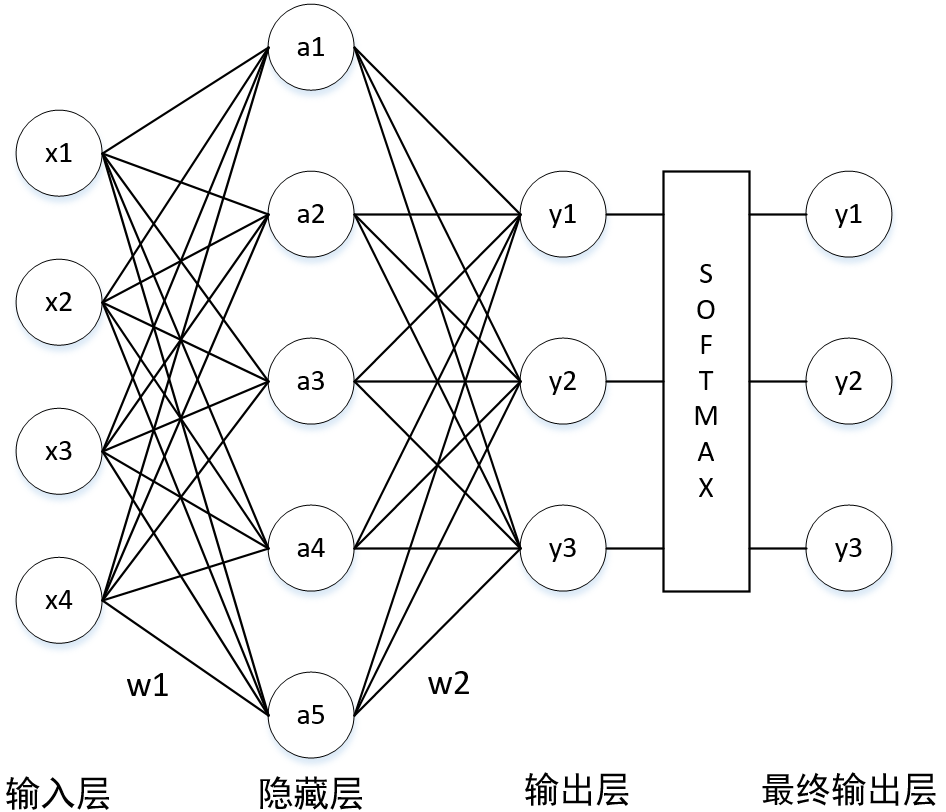
formula derivation
a & = x \cdot w_1 \\
y & = a \cdot w_2 \\
& = x \cdot w_1 \cdot w_2 \\
y & = softmax(y)
\end{align}
\]
code (training only)
y = a \cdot w_2
\]
w1 = tf.Variable(tf.random_normal([4,5], stddev=1, seed=1))

w2 = tf.Variable(tf.random_normal([5,3], stddev=1, seed=1))

x = tf.placeholder(tf.float32, shape=(None, 4), name='x-input')

a = tf.matmul(x, w1)

y = tf.matmul(a, w2)
既然是有监督学习,那就在训练阶段必须要给出 label,以此来计算交叉熵
# 用来存储数据的标签

y_ = tf.placeholder(tf.float32, shape=(None, 3), name='y-input')
隐藏层的激活函数是 sigmoid
y = tf.sigmoid(y)
softmax 与 交叉熵(corss entropy) 的组合函数,损失函数是交叉熵的均值
# softmax & corss_entropy

cross_entropy = tf.nn.softmax_cross_entropy_with_logits_v2(labels=y_, logits=y)

# mean

cross_entropy_mean = tf.reduce_mean(cross_entropy)
为了防止神经网络过拟合,需加入正则化项,一般选取 “L2 正则化”
loss = cross_entropy_mean + \

    tf.contrib.layers.l2_regularizer(regulation_lamda)(w1) + \

    tf.contrib.layers.l2_regularizer(regulation_lamda)(w2)
为了加速神经网络的训练过程,需加入“指数衰减”技术
表示训练过程的计算图,优化方法选择了 Adam 算法,本质是反向传播算法。还可以选择“梯度下降法”(GradientDescentOptimizer)
train_step = tf.train.AdamOptimizer(learning_rate=learning_rate).minimize(loss)
训练阶段
with tf.Session() as sess:  # Session 最好在“上下文机制”中开启,以防资源泄露

    init_op = tf.global_variables_initializer()  # 初始化网络中节点的参数,主要是 w1,w2

    sess.run(init_op)

    steps = 10000

    for i in range(steps):

        beg = (i * batch_size) % dataset_size    # 计算 batch

        end = min(beg+batch_size, dataset_size)  # 计算 batch

        sess.run(train_step, feed_dict={x:X[beg:end], y_:Y[beg:end]})  # 反向传播,训练网络

        if i % 1000 == 0:

            total_corss_entropy = sess.run(  # 计算交叉熵

                cross_entropy_mean,          # 计算交叉熵

                feed_dict={x:X, y_:Y}        # 计算交叉熵

            )

            print("After %d training steps, cross entropy on all data is %g" % (i, total_corss_entropy))
在训练阶段中,需要引入“滑动平均模型”来提高模型在测试数据上的健壮性(这是书上的说法,而我认为是泛化能力)
全部代码
# -*- encoding=utf8 -*-

from sklearn.datasets import load_iris

import tensorflow as tf

def label_convert(Y):

    l = list()

    for y in Y:

        if y == 0:

            l.append([1,0,0])

        elif y == 1:

            l.append([0, 1, 0])

        elif y == 2:

            l.append([0, 0, 1])

    return l

def load_data():

    iris = load_iris()

    X = iris.data

    Y = label_convert(iris.target)

    return (X,Y)

if __name__ == '__main__':

    X,Y = load_data()

    learning_rate = 0.001

    batch_size = 10

    dataset_size = 150

    regulation_lamda = 0.001

    w1 = tf.Variable(tf.random_normal([4,5], stddev=1, seed=1))

    w2 = tf.Variable(tf.random_normal([5,3], stddev=1, seed=1))

    x = tf.placeholder(tf.float32, shape=(None, 4), name='x-input')

    y_ = tf.placeholder(tf.float32, shape=(None, 3), name='y-input')

    a = tf.matmul(x, w1)

    y = tf.matmul(a, w2)

    y = tf.sigmoid(y)

    cross_entropy = tf.nn.softmax_cross_entropy_with_logits_v2(labels=y_, logits=y)

    cross_entropy_mean = tf.reduce_mean(cross_entropy)

    loss = cross_entropy_mean + \

           tf.contrib.layers.l2_regularizer(regulation_lamda)(w1) + \

           tf.contrib.layers.l2_regularizer(regulation_lamda)(w2)

    train_step = tf.train.AdamOptimizer(learning_rate=learning_rate).minimize(loss)

    with tf.Session() as sess:

        init_op = tf.global_variables_initializer()

        sess.run(init_op)

        steps = 10000

        for i in range(steps):

            beg = (i * batch_size) % dataset_size

            end = min(beg+batch_size, dataset_size)

            sess.run(train_step, feed_dict={x:X[beg:end], y_:Y[beg:end]})

            if i % 1000 == 0:

                total_corss_entropy = sess.run(

                    cross_entropy_mean,

                    feed_dict={x:X, y_:Y}

                )

                print("After %d training steps, cross entropy on all data is %g" % (i, total_corss_entropy))

        print(sess.run(w1))

        print(sess.run(w2))
Experiment Result
random split cross validation
Iris Classification on Tensorflow的更多相关文章
- Iris Classification on Keras
Iris Classification on Keras Installation Python3 版本为 3.6.4 : : Anaconda conda install tensorflow==1 ...
- Implementing a CNN for Text Classification in TensorFlow
参考: 1.Understanding Convolutional Neural Networks for NLP 2.Implementing a CNN for Text Classificati ...
- [转] Implementing a CNN for Text Classification in TensorFlow
Github上的一个开源项目,文档讲得极清晰 Github - https://github.com/dennybritz/cnn-text-classification-tf 原文- http:// ...
- Iris Classification on PyTorch
Iris Classification on PyTorch code # -*- coding:utf8 -*- from sklearn.datasets import load_iris fro ...
- CNN tensorflow text classification CNN文本分类的例子
from:http://deeplearning.lipingyang.org/tensorflow-examples-text/ TensorFlow examples (text-based) T ...
- python tensorflow model
step01_formula # -*- coding: utf-8 -*- """ 단순 선형회귀방정식 : x(1) -> y - y = a*X + b (a ...
- Chinese-Text-Classification,用卷积神经网络基于 Tensorflow 实现的中文文本分类。
用卷积神经网络基于 Tensorflow 实现的中文文本分类 项目地址: https://github.com/fendouai/Chinese-Text-Classification 欢迎提问:ht ...
- TensorFlow 中文资源全集,官方网站,安装教程,入门教程,实战项目,学习路径。
Awesome-TensorFlow-Chinese TensorFlow 中文资源全集,学习路径推荐: 官方网站,初步了解. 安装教程,安装之后跑起来. 入门教程,简单的模型学习和运行. 实战项目, ...
- 在 TensorFlow 中实现文本分类的卷积神经网络
在TensorFlow中实现文本分类的卷积神经网络 Github提供了完整的代码: https://github.com/dennybritz/cnn-text-classification-tf 在 ...
随机推荐
- CentOS6.5下实现R绘图
1.首先安装R的绘图包Cairo 下载地址:http://www.rforge.net/Cairo/files/ [root@Hadoop-NN-01 mysofts]# R CMD INSTALL ...
- web.xml文件的简单说明
在javaEE提供的tutorial中的hello1中的web.xml文件写到: <?xml version="1.0" encoding="UTF-8" ...
- 配置hdfs之后发现9000端口未被监听[玄学]
1. 按照apache的官网的文档配置hdfs 2. 在 core-site.xml 中配置了 fs.defaultFS 的值为 hdfs://0.0.0.0:9000 3. 执行 start-dfs ...
- 如何运行ruby代码
第一种,ruby -e 在命令行中运行下面命令,-e的意思是,把后面的字符串当作脚本执行 ruby -e "print 'hello'" 使用irb交互控制台 在命令行输入irb ...
- HDU 1087 最长不下降子序列 LIS DP
Nowadays, a kind of chess game called “Super Jumping! Jumping! Jumping!” is very popular in HDU. May ...
- Fantasia (点强连通分量建图 + 树形DP)
简化一下题意,我们先看成一副强连通的图,这时候应该是最简单了,去点任意点都是其他的乘积.那再加强一点难度,改为两个强连通图连接的非强连通图呢?那应该就是找出关键的那个点,并求出两边的乘积.但是一个一个 ...
- MQ的使用场景
一.消息队列概述消息队列中间件是分布式系统中重要的组件,主要解决应用解耦,异步消息,流量削锋等问题,实现高性能,高可用,可伸缩和最终一致性架构.目前使用较多的消息队列有ActiveMQ,RabbitM ...
- Hive中变量的使用
1.Hive配置属性 (1)命令行方式 Hive配置属性存储于 hiveconf 命名空间中,该命名空间中的属性是可读写的.在查询语句中插入 '${hiveconf:变量名}',就可以通过 hive ...
- CRM 权限设置 ss
表结构的设计 权限表 url -url地址的正则表达式 ^$ title - 标题 角色表 name - 角色名称 permissions 多对多关联权限表 (权限和角色的关系表) 用户表 name ...
- 51Nod 1072 威佐夫游戏
题目链接:https://www.51nod.com/onlineJudge/questionCode.html#!problemId=1072 有2堆石子.A B两个人轮流拿,A先拿.每次可以从一堆 ...