
Redis(三):set/get 命令解析
经过前两篇的介绍,我们对整个redis的动作流程已经有比较清晰的认识。
接下来就是到具体的命令处理方式的理解了,想来我们用这些工具的意义也是在此。虽然没有人觉得,一个set/get方法会有难度,但是我们毕竟不是很清楚,否则也不至于在谈到深处就懵逼了。
我觉得本文的一个重要意义就是: 让set/get还原成它本来样子,和写"hello world"一样简单。
框架性质的东西,我们前面已经讲解,就直接进入主题: set/get 的操作。
set/get 对应的两个处理函数 (redisCommand) 定义是这样的:
    // rF 代表 getCommand 是只读命令,又快又准,时间复杂度 O(1)或者O(log(n))

    // wm 代表 setCommand 是个写命令,当心空间问题

    {"get",getCommand,,"rF",,NULL,,,,,}

    {"set",setCommand,-,"wm",,NULL,,,,,}
所以,我们只要理解了, setCommand,getCommand 之后,就可以完全自信的说,set/get 就是和 "hello world" 一样简单了。
零、hash 算法
很显然,kv型的存储一定是hash相关算法的实现。那么redis中如何使用这个hash算法的呢?
redis 中许多不同场景的hash算法,其原型是在 dictType 中定义的。
typedef struct dictType {

    // hash 算法原型

    unsigned int (*hashFunction)(const void *key);

    void *(*keyDup)(void *privdata, const void *key);

    void *(*valDup)(void *privdata, const void *obj);

    int (*keyCompare)(void *privdata, const void *key1, const void *key2);

    void (*keyDestructor)(void *privdata, void *key);

    void (*valDestructor)(void *privdata, void *obj);

} dictType;
针对大部分场景,我们的key一般都是 string 类型的,但是还是会稍微有不一样的。这里我们就两个场景来说明下:
1. 命令集构建的hash算法
即是 server.commands 中的key的hash算法,这里元素是有限的。其定义如下:
/* Command table. sds string -> command struct pointer. */

dictType commandTableDictType = {

    // 即 dictSdsCaseHash 是 command 的hash算法实现

    dictSdsCaseHash,            /* hash function */

    NULL,                       /* key dup */

    NULL,                       /* val dup */

    dictSdsKeyCaseCompare,      /* key compare */

    dictSdsDestructor,          /* key destructor */

    NULL                        /* val destructor */

};

// server.c, 不区分大小写的key hash

unsigned int dictSdsCaseHash(const void *key) {

    return dictGenCaseHashFunction((unsigned char*)key, sdslen((char*)key));

}

// dict.c, 不区分大小写的key-hash算法: hash * 33 + c

/* And a case insensitive hash function (based on djb hash) */

unsigned int dictGenCaseHashFunction(const unsigned char *buf, int len) {

    // static uint32_t dict_hash_function_seed = 5381;

    unsigned int hash = (unsigned int)dict_hash_function_seed;

    while (len--)

        hash = ((hash << ) + hash) + (tolower(*buf++)); /* hash * 33 + c */

    return hash;

}
2. 针对普通kv查询的hash算法
整个nosql就是kv的增删改查,所以这是个重要的算法。
/* Db->dict, keys are sds strings, vals are Redis objects. */

dictType dbDictType = {

    // k 的hash算法实现

    dictSdsHash,                /* hash function */

    NULL,                       /* key dup */

    NULL,                       /* val dup */

    dictSdsKeyCompare,          /* key compare */

    dictSdsDestructor,          /* key destructor */

    dictObjectDestructor   /* val destructor */

};

// server.c, 调用 dict 的实现

unsigned int dictSdsHash(const void *key) {

    return dictGenHashFunction((unsigned char*)key, sdslen((char*)key));

}

// dict.c, 数据key的hash算法,或者通用的 string 的hashCode 算法

/* MurmurHash2, by Austin Appleby

 * Note - This code makes a few assumptions about how your machine behaves -

 * 1. We can read a 4-byte value from any address without crashing

 * 2. sizeof(int) == 4

 *

 * And it has a few limitations -

 *

 * 1. It will not work incrementally.

 * 2. It will not produce the same results on little-endian and big-endian

 *    machines.

 */

unsigned int dictGenHashFunction(const void *key, int len) {

    /* 'm' and 'r' are mixing constants generated offline.

     They're not really 'magic', they just happen to work well.  */

    uint32_t seed = dict_hash_function_seed;

    const uint32_t m = 0x5bd1e995;

    const int r = ;

    /* Initialize the hash to a 'random' value */

    uint32_t h = seed ^ len;

    /* Mix 4 bytes at a time into the hash */

    const unsigned char *data = (const unsigned char *)key;

    // 核心算法: step1. *m, ^k>>r, *m, *m, ^k, 每4位做一次运算

    while(len >= ) {

        uint32_t k = *(uint32_t*)data;

        k *= m;

        k ^= k >> r;

        k *= m;

        h *= m;

        h ^= k;

        data += ;

        len -= ;

    }

    /* Handle the last few bytes of the input array  */

    // step2. 倒数第三位 ^<<16, 第二位 ^<<8, 第一位 ^, 然后 *m

    switch(len) {

        case : h ^= data[] << ;

        case : h ^= data[] << ;

        case : h ^= data[]; h *= m;

    };

    /* Do a few final mixes of the hash to ensure the last few

     * bytes are well-incorporated. */

    // step3. 再混合 ^>>13, *m, ^>>15

    h ^= h >> ;

    h *= m;

    h ^= h >> ;

    return (unsigned int)h;

}
可以看到,针对普通的字符串的hash可是要复杂许多呢,因为这里数据远比 command 的数据多,情况更复杂,这样的算法唯一的目标就是尽量避免hash冲突。(虽然不知道为啥这么干,但它就是牛逼)
redis中还有其他的hash算法,比如dictObjHash,dictEncObjHash, 后续有接触我们再聊。
接下来,我们正式来看看 set/get 到底如何?
一、getCommand 解析
很显然,get 会是个最简单的命令,自然要检软柿子捏了。
// t_string.c

void getCommand(client *c) {

    getGenericCommand(c);

}

int getGenericCommand(client *c) {

    robj *o;

    // 如果在kv里找不到,则直接响应空,shared.nullbulk 作为全局常量的优势就体现出来了

    // shared.nullbulk = createObject(OBJ_STRING,sdsnew("$-1\r\n"));

    if ((o = lookupKeyReadOrReply(c,c->argv[],shared.nullbulk)) == NULL)

        return C_OK;

    // 找到对应的数据,但是类型不匹配,说明不能使用 get 命令,响应错误信息

    // shared.wrongtypeerr = "-WRONGTYPE Operation against a key holding the wrong kind of value\r\n"

    if (o->type != OBJ_STRING) {

        addReply(c,shared.wrongtypeerr);

        return C_ERR;

    } else {

        // 正常情况则直接响应结果即可

        addReplyBulk(c,o);

        return C_OK;

    }

}
整个处理流程果然是异常简单,感觉人生已经达到了巅峰!但是,我们还没有看到关键,那就是查找 key 的过程。我们通过之前的介绍,知道有个叫做 redisDb 的东西,看起来它是负责所有的数据管理。它应该不会因为简单而不存储某些数据吧。
// db.c, 查找某个key对应的元素或者直接响应客户端

robj *lookupKeyReadOrReply(client *c, robj *key, robj *reply) {

    // 使用 c->db 对应的数据库进行查询,所以要求客户端必须针对某db进行操作,且不能跨库操作是原理决定

    robj *o = lookupKeyRead(c->db, key);

    // 如果没有查到数据就直接使用默认的 reply, 响应客户端了

    if (!o) addReply(c,reply);

    return o;

}

// db.c, 读取key 对应值

robj *lookupKeyRead(redisDb *db, robj *key) {

    robj *val;

    // 检查过期情况,如果过期,则不用再查了

    if (expireIfNeeded(db,key) == ) {

        /* Key expired. If we are in the context of a master, expireIfNeeded()

         * returns 0 only when the key does not exist at all, so it's save

         * to return NULL ASAP. */

        if (server.masterhost == NULL) return NULL;

        /* However if we are in the context of a slave, expireIfNeeded() will

         * not really try to expire the key, it only returns information

         * about the "logical" status of the key: key expiring is up to the

         * master in order to have a consistent view of master's data set.

         *

         * However, if the command caller is not the master, and as additional

         * safety measure, the command invoked is a read-only command, we can

         * safely return NULL here, and provide a more consistent behavior

         * to clients accessign expired values in a read-only fashion, that

         * will say the key as non exisitng.

         *

         * Notably this covers GETs when slaves are used to scale reads. */

        if (server.current_client &&

            server.current_client != server.master &&

            server.current_client->cmd &&

            server.current_client->cmd->flags & CMD_READONLY)

        {

            return NULL;

        }

    }

    // 然后从db中查找对应的key值,其实就是一个 hash 查找

    // 缓存命中统计

    val = lookupKey(db,key);

    if (val == NULL)

        server.stat_keyspace_misses++;

    else

        server.stat_keyspace_hits++;

    return val;

}

// db.c, 过期的处理有点复杂,我们稍后再看,先看 db 的查找key过程

robj *lookupKey(redisDb *db, robj *key) {

    // 直接在 db->dict 中进行hash查找即可,前面已经介绍完成,关键优化点在增量rehash

    dictEntry *de = dictFind(db->dict,key->ptr);

    if (de) {

        robj *val = dictGetVal(de);

        /* Update the access time for the ageing algorithm.

         * Don't do it if we have a saving child, as this will trigger

         * a copy on write madness. */

        if (server.rdb_child_pid == - && server.aof_child_pid == -)

            val->lru = LRU_CLOCK();

        return val;

    } else {

        return NULL;

    }

}

// db.c, 接下来看下,检查过期情况

int expireIfNeeded(redisDb *db, robj *key) {

    mstime_t when = getExpire(db,key);

    mstime_t now;

    if (when < ) return ; /* No expire for this key */

    /* Don't expire anything while loading. It will be done later. */

    if (server.loading) return ;

    /* If we are in the context of a Lua script, we claim that time is

     * blocked to when the Lua script started. This way a key can expire

     * only the first time it is accessed and not in the middle of the

     * script execution, making propagation to slaves / AOF consistent.

     * See issue #1525 on Github for more information. */

    now = server.lua_caller ? server.lua_time_start : mstime();

    /* If we are running in the context of a slave, return ASAP:

     * the slave key expiration is controlled by the master that will

     * send us synthesized DEL operations for expired keys.

     *

     * Still we try to return the right information to the caller,

     * that is, 0 if we think the key should be still valid, 1 if

     * we think the key is expired at this time. */

    if (server.masterhost != NULL) return now > when;

    /* Return when this key has not expired */

    // 如果还没到期就直接返回

    if (now <= when) return ;

    /* Delete the key */

    server.stat_expiredkeys++;

    // key过期,是一个写动作,需要传播到 AOF 或者 slaves...

    propagateExpire(db,key,server.lazyfree_lazy_expire);

    // pub/sub 监控通知

    notifyKeyspaceEvent(NOTIFY_EXPIRED,

        "expired",key,db->id);

    // 同步删除或者异步删除, 稍后讨论

    return server.lazyfree_lazy_expire ? dbAsyncDelete(db,key) :

                                         dbSyncDelete(db,key);

}

/* Return the expire time of the specified key, or -1 if no expire

 * is associated with this key (i.e. the key is non volatile) */

long long getExpire(redisDb *db, robj *key) {

    dictEntry *de;

    /* No expire? return ASAP */

    // 查找过期队列, 数据量小

    if (dictSize(db->expires) ==  ||

       (de = dictFind(db->expires,key->ptr)) == NULL) return -;

    /* The entry was found in the expire dict, this means it should also

     * be present in the main dict (safety check). */

    serverAssertWithInfo(NULL,key,dictFind(db->dict,key->ptr) != NULL);

    // 返回到期时间戳, union 的应用

    return dictGetSignedIntegerVal(de);

}

// 删除过期数据key的两种方式,同步+异步

// db.c, 同步删除, 删除 expires 队列和 dict 数据

/* Delete a key, value, and associated expiration entry if any, from the DB */

int dbSyncDelete(redisDb *db, robj *key) {

    /* Deleting an entry from the expires dict will not free the sds of

     * the key, because it is shared with the main dictionary. */

    if (dictSize(db->expires) > ) dictDelete(db->expires,key->ptr);

    if (dictDelete(db->dict,key->ptr) == DICT_OK) {

        if (server.cluster_enabled) slotToKeyDel(key);

        return ;

    } else {

        return ;

    }

}

// lazyfree.c, 异步删除过期数据, 一看就很复杂

/* Delete a key, value, and associated expiration entry if any, from the DB.

 * If there are enough allocations to free the value object may be put into

 * a lazy free list instead of being freed synchronously. The lazy free list

 * will be reclaimed in a different bio.c thread. */

#define LAZYFREE_THRESHOLD 64

int dbAsyncDelete(redisDb *db, robj *key) {

    /* Deleting an entry from the expires dict will not free the sds of

     * the key, because it is shared with the main dictionary. */

    if (dictSize(db->expires) > ) dictDelete(db->expires,key->ptr);

    /* If the value is composed of a few allocations, to free in a lazy way

     * is actually just slower... So under a certain limit we just free

     * the object synchronously. */

    dictEntry *de = dictFind(db->dict,key->ptr);

    if (de) {

        robj *val = dictGetVal(de);

        // 判断删除的数据的影响范围,与 数据类型有关,string为1,hash/set则计算count,list计算length

        size_t free_effort = lazyfreeGetFreeEffort(val);

        /* If releasing the object is too much work, let's put it into the

         * lazy free list. */

        if (free_effort > LAZYFREE_THRESHOLD) {

            // 将相关的数据放入队列中,后台任务慢慢删除

            atomicIncr(lazyfree_objects,,&lazyfree_objects_mutex);

            bioCreateBackgroundJob(BIO_LAZY_FREE,val,NULL,NULL);

            // 自身则立即设置为 NULL

            dictSetVal(db->dict,de,NULL);

        }

    }

    /* Release the key-val pair, or just the key if we set the val

     * field to NULL in order to lazy free it later. */

    if (dictDelete(db->dict,key->ptr) == DICT_OK) {

        if (server.cluster_enabled) slotToKeyDel(key);

        return ;

    } else {

        return ;

    }

}
怎么样?是不是有一首歌叫凉凉~
可以说,get操作本身是相当简单的,在无hash冲突前提下,O(1)的复杂度搞定。然而它还要处理过期的数据问题,就不那么简单了。
我们用一个时序图整体体会下get的流程:

二、setCommand 解析
setCommand 是个写操作,就不是 get 那么简单了。
// t_string.c, set 的所有用法都统一 setCommand, 多个参数共同解析为 flags

/* SET key value [NX] [XX] [EX <seconds>] [PX <milliseconds>] */

void setCommand(client *c) {

    int j;

    robj *expire = NULL;

    int unit = UNIT_SECONDS;

    int flags = OBJ_SET_NO_FLAGS;

    for (j = ; j < c->argc; j++) {

        char *a = c->argv[j]->ptr;

        robj *next = (j == c->argc-) ? NULL : c->argv[j+];

        // NX 与 XX 互斥

        if ((a[] == 'n' || a[] == 'N') &&

            (a[] == 'x' || a[] == 'X') && a[] == '\0' &&

            !(flags & OBJ_SET_XX))

        {

            flags |= OBJ_SET_NX;

        } else if ((a[] == 'x' || a[] == 'X') &&

                   (a[] == 'x' || a[] == 'X') && a[] == '\0' &&

                   !(flags & OBJ_SET_NX))

        {

            flags |= OBJ_SET_XX;

        }

        // PX 与 EX 互斥

        else if ((a[] == 'e' || a[] == 'E') &&

                   (a[] == 'x' || a[] == 'X') && a[] == '\0' &&

                   !(flags & OBJ_SET_PX) && next)

        {

            flags |= OBJ_SET_EX;

            unit = UNIT_SECONDS;

            expire = next;

            j++;

        } else if ((a[] == 'p' || a[] == 'P') &&

                   (a[] == 'x' || a[] == 'X') && a[] == '\0' &&

                   !(flags & OBJ_SET_EX) && next)

        {

            flags |= OBJ_SET_PX;

            unit = UNIT_MILLISECONDS;

            expire = next;

            j++;

        } else {

            addReply(c,shared.syntaxerr);

            return;

        }

    }

    // 尝试压缩 value 值以节省空间 (原始命令: set key value)

    c->argv[] = tryObjectEncoding(c->argv[]);

    setGenericCommand(c,flags,c->argv[],c->argv[],expire,unit,NULL,NULL);

}

// object.c, 压缩字符串

/* Try to encode a string object in order to save space */

robj *tryObjectEncoding(robj *o) {

    long value;

    sds s = o->ptr;

    size_t len;

    /* Make sure this is a string object, the only type we encode

     * in this function. Other types use encoded memory efficient

     * representations but are handled by the commands implementing

     * the type. */

    serverAssertWithInfo(NULL,o,o->type == OBJ_STRING);

    /* We try some specialized encoding only for objects that are

     * RAW or EMBSTR encoded, in other words objects that are still

     * in represented by an actually array of chars. */

    if (!sdsEncodedObject(o)) return o;

    /* It's not safe to encode shared objects: shared objects can be shared

     * everywhere in the "object space" of Redis and may end in places where

     * they are not handled. We handle them only as values in the keyspace. */

     if (o->refcount > ) return o;

    /* Check if we can represent this string as a long integer.

     * Note that we are sure that a string larger than 21 chars is not

     * representable as a 32 nor 64 bit integer. */

    len = sdslen(s);

    // 针对小于21个字符串的字符,尝试转为 long 型

    if (len <=  && string2l(s,len,&value)) {

        /* This object is encodable as a long. Try to use a shared object.

         * Note that we avoid using shared integers when maxmemory is used

         * because every object needs to have a private LRU field for the LRU

         * algorithm to work well. */

        if ((server.maxmemory ==  ||

             (server.maxmemory_policy != MAXMEMORY_VOLATILE_LRU &&

              server.maxmemory_policy != MAXMEMORY_ALLKEYS_LRU)) &&

            value >=  &&

            value < OBJ_SHARED_INTEGERS)

        {

            decrRefCount(o);

            incrRefCount(shared.integers[value]);

            return shared.integers[value];

        } else {

            if (o->encoding == OBJ_ENCODING_RAW) sdsfree(o->ptr);

            o->encoding = OBJ_ENCODING_INT;

            o->ptr = (void*) value;

            return o;

        }

    }

    /* If the string is small and is still RAW encoded,

     * try the EMBSTR encoding which is more efficient.

     * In this representation the object and the SDS string are allocated

     * in the same chunk of memory to save space and cache misses. */

    //

    if (len <= OBJ_ENCODING_EMBSTR_SIZE_LIMIT) {

        robj *emb;

        if (o->encoding == OBJ_ENCODING_EMBSTR) return o;

        // 使用 EMBSTR 编码转换,实际就是同一个 s 返回

        emb = createEmbeddedStringObject(s,sdslen(s));

        decrRefCount(o);

        return emb;

    }

    /* We can't encode the object...

     *

     * Do the last try, and at least optimize the SDS string inside

     * the string object to require little space, in case there

     * is more than 10% of free space at the end of the SDS string.

     *

     * We do that only for relatively large strings as this branch

     * is only entered if the length of the string is greater than

     * OBJ_ENCODING_EMBSTR_SIZE_LIMIT. */

    if (o->encoding == OBJ_ENCODING_RAW &&

        sdsavail(s) > len/)

    {

        o->ptr = sdsRemoveFreeSpace(o->ptr);

    }

    /* Return the original object. */

    return o;

}

// sds.c, 去除无用空间占用

/* Reallocate the sds string so that it has no free space at the end. The

 * contained string remains not altered, but next concatenation operations

 * will require a reallocation.

 *

 * After the call, the passed sds string is no longer valid and all the

 * references must be substituted with the new pointer returned by the call. */

sds sdsRemoveFreeSpace(sds s) {

    void *sh, *newsh;

    // s[-1] 指针不越界, 它是在新建一个 sds 对象时,在该指针前一位写入的值,确定sds类型

    char type, oldtype = s[-] & SDS_TYPE_MASK;

    int hdrlen;

    size_t len = sdslen(s);

    // sdsHdrSize: sds头部大小

    sh = (char*)s-sdsHdrSize(oldtype);

    type = sdsReqType(len);

    hdrlen = sdsHdrSize(type);

    if (oldtype==type) {

        newsh = s_realloc(sh, hdrlen+len+);

        if (newsh == NULL) return NULL;

        s = (char*)newsh+hdrlen;

    } else {

        newsh = s_malloc(hdrlen+len+);

        if (newsh == NULL) return NULL;

        memcpy((char*)newsh+hdrlen, s, len+);

        s_free(sh);

        s = (char*)newsh+hdrlen;

        s[-] = type;

        sdssetlen(s, len);

    }

    sdssetalloc(s, len);

    return s;

}

// t_string.c, expire 为超时时间设置

void setGenericCommand(client *c, int flags, robj *key, robj *val, robj *expire, int unit, robj *ok_reply, robj *abort_reply) {

    long long milliseconds = ; /* initialized to avoid any harmness warning */

    if (expire) {

        // 解析 expire 到 milliseconds 中

        if (getLongLongFromObjectOrReply(c, expire, &milliseconds, NULL) != C_OK)

            return;

        if (milliseconds <= ) {

            addReplyErrorFormat(c,"invalid expire time in %s",c->cmd->name);

            return;

        }

        if (unit == UNIT_SECONDS) milliseconds *= ;

    }

    // 语法限制检测, NX 要求不存在, XX 要求存在

    if ((flags & OBJ_SET_NX && lookupKeyWrite(c->db,key) != NULL) ||

        (flags & OBJ_SET_XX && lookupKeyWrite(c->db,key) == NULL))

    {

        addReply(c, abort_reply ? abort_reply : shared.nullbulk);

        return;

    }

    // 切实存储 kv

    setKey(c->db,key,val);

    server.dirty++;

    // 设置超时

    if (expire) setExpire(c->db,key,mstime()+milliseconds);

    // 通知pub/sub变更

    notifyKeyspaceEvent(NOTIFY_STRING,"set",key,c->db->id);

    // 通知expire事件

    if (expire) notifyKeyspaceEvent(NOTIFY_GENERIC,

        "expire",key,c->db->id);

    addReply(c, ok_reply ? ok_reply : shared.ok);

}

// object.c,

int getLongLongFromObjectOrReply(client *c, robj *o, long long *target, const char *msg) {

    long long value;

    if (getLongLongFromObject(o, &value) != C_OK) {

        if (msg != NULL) {

            addReplyError(c,(char*)msg);

        } else {

            addReplyError(c,"value is not an integer or out of range");

        }

        return C_ERR;

    }

    *target = value;

    return C_OK;

}

// object.c,

int getLongLongFromObject(robj *o, long long *target) {

    long long value;

    if (o == NULL) {

        value = ;

    } else {

        serverAssertWithInfo(NULL,o,o->type == OBJ_STRING);

        // 将字符串转换为 long 型,得到超时时间

        if (sdsEncodedObject(o)) {

            if (strict_strtoll(o->ptr,&value) == C_ERR) return C_ERR;

        } else if (o->encoding == OBJ_ENCODING_INT) {

            value = (long)o->ptr;

        } else {

            serverPanic("Unknown string encoding");

        }

    }

    if (target) *target = value;

    return C_OK;

}
看完了超时及各标识位的解析,及set框架流程,我们来看下具体核心的kv存储: setKey(), setExpire();
// db.c, set kv

/* High level Set operation. This function can be used in order to set

 * a key, whatever it was existing or not, to a new object.

 *

 * 1) The ref count of the value object is incremented.

 * 2) clients WATCHing for the destination key notified.

 * 3) The expire time of the key is reset (the key is made persistent). */

void setKey(redisDb *db, robj *key, robj *val) {

    // 先查找,再更新

    if (lookupKeyWrite(db,key) == NULL) {

        // 新增 kv

        dbAdd(db,key,val);

    } else {

        // 覆盖 kv

        dbOverwrite(db,key,val);

    }

    // 增加 value 的引用计数

    incrRefCount(val);

    // 新增的元素,移出过期队列

    removeExpire(db,key);

    signalModifiedKey(db,key);

}

robj *lookupKeyWrite(redisDb *db, robj *key) {

    // 先尝试过期处理,再查找db (hash 查找 db->dic)

    expireIfNeeded(db,key);

    return lookupKey(db,key);

}

// db.c, 添加kv

/* Add the key to the DB. It's up to the caller to increment the reference

 * counter of the value if needed.

 *

 * The program is aborted if the key already exists. */

void dbAdd(redisDb *db, robj *key, robj *val) {

    sds copy = sdsdup(key->ptr);

    // 添加到 db->dict 中

    int retval = dictAdd(db->dict, copy, val);

    serverAssertWithInfo(NULL,key,retval == C_OK);

    // list 类型的数据,进行特殊处理(阻塞)

    if (val->type == OBJ_LIST) signalListAsReady(db, key);

    // 集群添加

    if (server.cluster_enabled) slotToKeyAdd(key);

 }

// db.c

/* Slot to Key API. This is used by Redis Cluster in order to obtain in

 * a fast way a key that belongs to a specified hash slot. This is useful

 * while rehashing the cluster. */

void slotToKeyAdd(robj *key) {

    // hash 定位 slot, 下面我们简单看下该算法

    unsigned int hashslot = keyHashSlot(key->ptr,sdslen(key->ptr));

    sds sdskey = sdsdup(key->ptr);

    // 添加key 到 server.cluster->slots_to_keys 的 跳表中

    zslInsert(server.cluster->slots_to_keys,hashslot,sdskey);

}

// cluster.c, slot 定位算法, 其实就是 crc16算法与上 0x3FFF,该算法决定了 slot 最多只能有 16383 个

/* We have 16384 hash slots. The hash slot of a given key is obtained

 * as the least significant 14 bits of the crc16 of the key.

 *

 * However if the key contains the {...} pattern, only the part between

 * { and } is hashed. This may be useful in the future to force certain

 * keys to be in the same node (assuming no resharding is in progress). */

unsigned int keyHashSlot(char *key, int keylen) {

    int s, e; /* start-end indexes of { and } */

    for (s = ; s < keylen; s++)

        if (key[s] == '{') break;

    /* No '{' ? Hash the whole key. This is the base case. */

    if (s == keylen) return crc16(key,keylen) & 0x3FFF;

    /* '{' found? Check if we have the corresponding '}'. */

    for (e = s+; e < keylen; e++)

        if (key[e] == '}') break;

    /* No '}' or nothing betweeen {} ? Hash the whole key. */

    if (e == keylen || e == s+) return crc16(key,keylen) & 0x3FFF;

    /* If we are here there is both a { and a } on its right. Hash

     * what is in the middle between { and }. */

    return crc16(key+s+,e-s-) & 0x3FFF;

}

// db.c, 设置key的超时标识

void setExpire(redisDb *db, robj *key, long long when) {

    dictEntry *kde, *de;

    /* Reuse the sds from the main dict in the expire dict */

    kde = dictFind(db->dict,key->ptr);

    serverAssertWithInfo(NULL,key,kde != NULL);

    // 将需要超时检测的 key 添加到 db->expires 队列中

    de = dictReplaceRaw(db->expires,dictGetKey(kde));

    // 设置超时时间为 when

    dictSetSignedIntegerVal(de,when);

}

// dict.h

#define dictSetSignedIntegerVal(entry, _val_) \

    do { entry->v.s64 = _val_; } while()
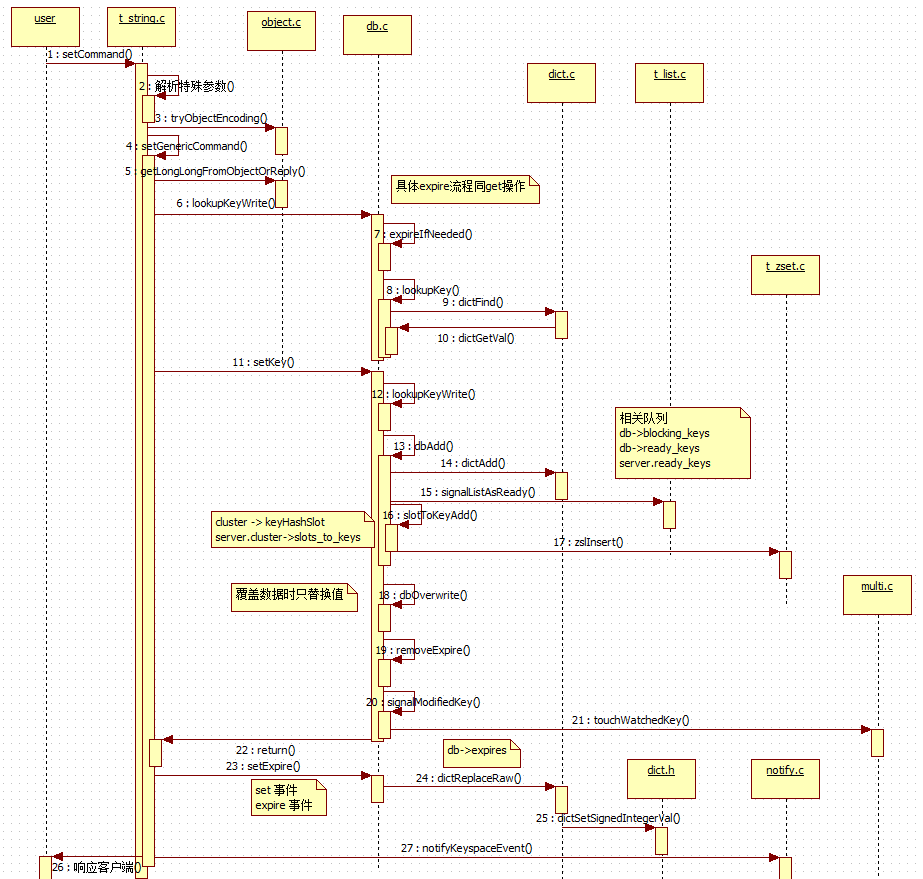
总体来说,set操作会分为几步:
1. 判断出多重参数,如是否是NX/EX/PX/XX, 是否超时设置;
2. 编码转换数据, 如将字符串转换为long型;
3. 解析超时字段;
4. set kv, 添加或者覆盖数据库值, 同时清理过期队列;
5. 设置超时时间;
6. 触发事件监听;
7. 响应客户端;
最后,我们以set的整个时序图作为结尾,也让我们明白一点,不是每个hello world 都很简单:
Redis(三):set/get 命令解析的更多相关文章
- memcached源码分析三-libevent与命令解析
转载请注明出处https://www.cnblogs.com/yang-zd/p/11352833.html,谢谢合作! 前面已经分析了memcached中的slabs内存管理及缓存对象如何利用ite ...
- 一个基于JRTPLIB的轻量级RTSP客户端(myRTSPClient)——收流篇:(三)RTSP命令解析
一.RTSP命令简述 RTSP是用来控制实时流媒体“播放”.“暂停”.“停止”.“录像”等行为的传输协议.该协议规定了一系列命令以及这些命令的发送格式,RTSP客户端可以通过发送这些指定的命令,从而控 ...
- Redis中info all命令解析
127.0.0.1:8376> info all# Server --- 服务器信息redis_version:2.8.20 -- redis服务器版本redis_git_sha1:000 ...
- 03 redis之string类型命令解析
Redis字符串类型的操作 set key value [ex 秒数] / [px 毫秒数] [nx] /[xx] 如: set a 1 ex 10 , 10秒有效 Set a 1 px 9000 , ...
- Redis 使用指南:深度解析 info 命令
Redis 是一个使用 ANSI C 编写的开源.基于内存.可选持久性的键值对存储数据库,被广泛应用于大型电商网站.视频网站和游戏应用等场景,能够有效减少数据库磁盘 IO, 提高数据查询效率,减轻管 ...
- 《闲扯Redis三》Redis五种数据类型之List型
一.前言 Redis 提供了5种数据类型:String(字符串).Hash(哈希).List(列表).Set(集合).Zset(有序集合),理解每种数据类型的特点对于redis的开发和运维非常重要. ...
- Redis学习笔记(3) Redis基础类型及命令之二
1. 集合类型 集合类型与列表类型有很多相似之处,但二者的区别在于:前者具有唯一性,但不具有有序性:后者具有有序性,但不具有唯一性.集合类型的常用操作是向集合中加入或删除元素.判断某个元素是否存在等, ...
- VMWare12安装CentOS7以及redis安装和常用命令
一.vmware安装centos7后没有网卡 VMWare 12版本不提供32位安装程序,只有64位安装程序,如果在安装CentOS时,选择的是CentOS而不是CentOS 64位,则会出现Cent ...
- redis笔记总结之redis数据类型及常用命令
三.常用命令 3.1 字符串类型(string) 字符串类型是Redis中最基本的数据类型,一个字符串类型的键允许存储的数据的最大容量为512MB. 3.1.1 赋值与取值: SET key valu ...
- redis的pub/sub命令
Redis 发布订阅 Redis 发布订阅(pub/sub)是一种消息通信模式:发送者(pub)发送消息,订阅者(sub)接收消息. Redis 客户端可以订阅任意数量的频道. 下图展示了频道 cha ...
随机推荐
- eclipse中maven报错--Dmaven.multiModuleProjectDirectory system propery is not set. Check $M2_HOME environment variable and mvn script match.
-Dmaven.multiModuleProjectDirectory system propery is not set. Check $M2_HOME environment variable a ...
- java编译器优化和运行期优化
概述 最近在看jvm优化,总结一下学习的相关知识 (一)javac编译器 编译过程 1.解析与填充符号表过程 1).词法.语法分析 词法分析将源代码的字符流转变为标记集合,单个字符是程序编 ...
- js实现bind
Function.prototype.bind=function(ctx,...lastArgs){ let self=this return (...laterArgs)=>self.appl ...
- dotnet 控制台读写 Sqlite 提示 no such table 找不到文件
在使用 dotnet 读写 Sqlite 可以通过 EF Core 的方法,但是在 EF Core 创建的数据库可能和读写的数据库不是相同的文件 在我运行代码的时候发现在通过迁移创建数据库,创建的文件 ...
- VisualStudio 2019 新特性
很多小伙伴都好奇 VisualStudio 2019 有哪些功能,下面让我介绍一些好玩的特性 在安装完成之后会看到创新的欢迎界面,这个欢迎界面支持输入关键字搜项目,同时支持选择语言平台 很多小伙伴都说 ...
- 为什么我们要使用DTO
基础结构解释 UI-表现层-与控制器打交道(UI向Controller 传递数据时使用DTO(数据传输对象)) Service-应用服务层 Domain 领域对象 DTO 数据传输对象,一般只包含基础 ...
- Java 学习笔记(11)——多线程
Java内部提供了针对多线程的支持,线程是CPU执行的最小单位,在多核CPU中使用多线程,能够做到多个任务并行执行,提高效率. 使用多线程的方法 创建Thread类的子类,并重写run方法,在需要启动 ...
- 什么是激励函数 (Activation Function)
relu sigmoid tanh 激励函数. 可以创立自己的激励函数解决自己的问题,只要保证这些激励函数是可以微分的. 只有两三层的神经网络,随便使用哪个激励函数都可以. 多层的不能随便选择,涉及梯 ...
- select * from user 这条 SQL 语句,背后藏着哪些不可告人的秘密?
作为一名 Java开发人员,写 SQL 语句是常有的事,但是你知道 SQL 语句背后的处理逻辑吗?比如下面这条 SQL 语句: select * from user where id=1 执行完这条语 ...
- 曹工杂谈--使用mybatis的同学,进来看看怎么在日志打印完整sql吧,在数据库可执行那种
前言 今天新年第一天,给大家拜个年,祝大家新的一年里,技术突突突,头发长长长! 咱们搞技术的,比较直接,那就开始吧.我给大家看看我demo工程的效果(代码下边会给大家的): 技术栈是mybatis/m ...