
跟我学算法-Logistic回归
虽然Logistic回归叫回归,但是其实它是一个二分类或者多分类问题
这里的话我们使用信用诈骗的数据进行分析
第一步:导入数据,Amount的数值较大,后续将进行(-1,1)的归一化
data = pd.read_csv('creditcard.csv')  #读取数据

#查看前5行数据

print(data.head())
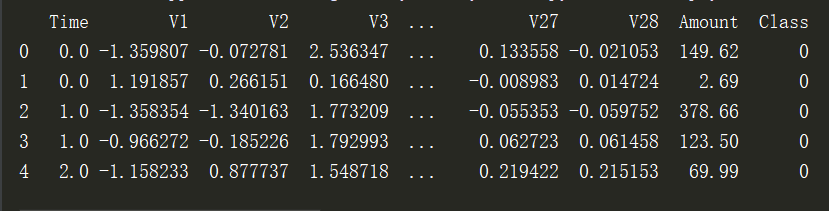
第二步: 对正常和欺诈的数目进行查看,正常样本的数目远大于欺诈样本,这个时候可以使用下采样或者过采样
# 画图查看

count_data = pd.value_counts(data['Class'], sort=True).sort_index()  #统计样本数

count_data.plot(kind='bar')  #画条形图

plt.title("Fraud class histogram")  #标题

plt.xlabel('Classes')

plt.ylabel('Frequency')

plt.show()
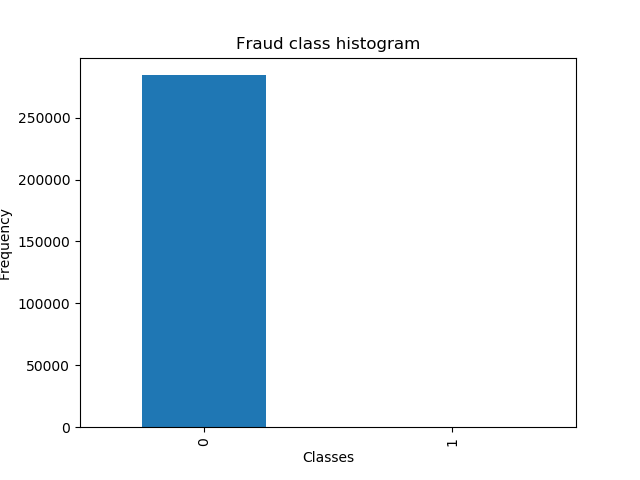
第三步:将amount进行归一化形成amountNorm,并且去除time和amount项
#把amount数据标准化到-1, 1

from sklearn.preprocessing import StandardScaler

#reshape 需要转换到的数值范围

data['NormAmount'] = StandardScaler().fit_transform(data['Amount'].values.reshape(-1, 1),)

data = data.drop(['Time', 'Amount'], axis=1)   # 去除两列

#进行分组

X = data.ix[:, data.columns != 'Class']

y = data.ix[:, data.columns == 'Class']
第四步,使用随机挑选来生成下采样数据
number_record_fraud = len(data[data.Class==1])

#找出其索引,组成数组

fraud_indices = np.array(data[data.Class == 1].index)

norm_indices = data[data.Class == 0 ].index

#从Class=0中任意挑选500个组成正常的类别

random_norm_indices = np.random.choice(norm_indices, 500, replace=False)

random_norm_indices = np.array(random_norm_indices)

#把正常的类别和欺诈类别进行组合

under_sample_indices = np.concatenate([fraud_indices, random_norm_indices])

#根据重组索引重新取值

under_sample_datas = data.iloc[under_sample_indices,:]

#选择出属性和结果

X_undersample = under_sample_datas.ix[:, under_sample_datas.columns != 'Class']
第5步,交叉验证选择权重,这里采用的加权方法为|L* w|
from sklearn.linear_model import LogisticRegression

from sklearn.cross_validation import KFold, cross_val_score

from sklearn.metrics import confusion_matrix,recall_score,classification_report

def printing_Kfold_socres(x_train_data, y_train_data):

    fold = KFold(len(y_train_data), 5, shuffle=False)

    c_param_range = [0.01, 0.1, 1, 10, 100]

    #创建一个空的列表用来存储Mean recall score的值

    results_table = pd.DataFrame(index=range(len(c_param_range), 2), columns=['C_parameter', 'Mean recall score'])

    results_table['C_parameter'] = c_param_range

    j = 0

    for c_param in c_param_range:

        print('-----------------------')

        print('C paramter:', c_param)

        print('-----------------------')

        print('')

        recall_accs = []

        for iteration, indices in enumerate(fold, start=1):

            lr = LogisticRegression(C = c_param, penalty='l1')  #放入参数,权重模式为l1

            print('indices', indices)

            #建立模型并训练

            lr.fit(x_train_data.iloc[indices[0], :], y_train_data.iloc[indices[0], :].values.ravel())

            y_pred_undersample = lr.predict(x_train_data.iloc[indices[1], :].values)

            print(y_pred_undersample)

            #计算回归得分

            recall_acc = recall_score(y_train_data.iloc[indices[1],:].values, y_pred_undersample)

            recall_accs.append(recall_acc)

            print('Iteration', iteration, ': recall score=', recall_acc)

        #求得平均的值

        results_table.ix[j, 'Mean recall score'] = np.mean(recall_accs)

        j += 1

        print('')

        print('Mean recall score', np.mean(recall_accs))

        print('')

    # 数据类型进行转换

    results_table['Mean recall score'] = results_table['Mean recall score'].astype('float64')

    # 求得Mean recall score 对应的最大的C_parameter值

    best_c = results_table.loc[results_table['Mean recall score'].idxmax()]['C_parameter']

    print('*********************************************************************************')

    print('Best model to choose from cross validation is with C parameter = ', best_c)

    print('*********************************************************************************')

    return best_c

#执行程序
best_c = printing_Kfold_socres(X_train_undersample, y_train_undersample)
跟我学算法-Logistic回归的更多相关文章
- 【机器学习】分类算法——Logistic回归
一.LR分类器(Logistic Regression Classifier) 在分类情形下,经过学习后的LR分类器是一组权值w0,w1, -, wn,当测试样本的数据输入时,这组权值与测试数据按照线 ...
- 机器学习算法-logistic回归算法
Logistic回归算法调试 一.算法原理 Logistic回归算法是一种优化算法,主要用用于只有两种标签的分类问题.其原理为对一些数据点用一条直线去拟合,对数据集进行划分.从广义上来讲这也是一种多元 ...
- Logistic回归(逻辑回归)和softmax回归
一.Logistic回归 Logistic回归(Logistic Regression,简称LR)是一种常用的处理二类分类问题的模型. 在二类分类问题中,把因变量y可能属于的两个类分别称为负类和正类, ...
- 《机器学习实战》-逻辑(Logistic)回归
目录 Logistic 回归 本章内容 回归算法 Logistic 回归的一般过程 Logistic的优缺点 基于 Logistic 回归和 Sigmoid 函数的分类 Sigmoid 函数 Logi ...
- 常见算法(logistic回归,随机森林,GBDT和xgboost)
常见算法(logistic回归,随机森林,GBDT和xgboost) 9.25r早上面网易数据挖掘工程师岗位,第一次面数据挖掘的岗位,只想着能够去多准备一些,体验面这个岗位的感觉,虽然最好心有不甘告终 ...
- 神经网络、logistic回归等分类算法简单实现
最近在github上看到一个很有趣的项目,通过文本训练可以让计算机写出特定风格的文章,有人就专门写了一个小项目生成汪峰风格的歌词.看完后有一些自己的小想法,也想做一个玩儿一玩儿.用到的原理是深度学习里 ...
- Logistic回归分类算法原理分析与代码实现
前言 本文将介绍机器学习分类算法中的Logistic回归分类算法并给出伪代码,Python代码实现. (说明:从本文开始,将接触到最优化算法相关的学习.旨在将这些最优化的算法用于训练出一个非线性的函数 ...
- 第三集 欠拟合与过拟合的概念、局部加权回归、logistic回归、感知器算法
课程大纲 欠拟合的概念(非正式):数据中某些非常明显的模式没有成功的被拟合出来.如图所示,更适合这组数据的应该是而不是一条直线. 过拟合的概念(非正式):算法拟合出的结果仅仅反映了所给的特定数据的特质 ...
- 机器学习之Logistic 回归算法
1 Logistic 回归算法的原理 1.1 需要的数学基础 我在看机器学习实战时对其中的代码非常费解,说好的利用偏导数求最值怎么代码中没有体现啊,就一个简单的式子:θ= θ - α Σ [( hθ( ...
随机推荐
- erl_0016 《硝烟中的erlang》 读书笔记003 “error_logger 爆炸”
error_logger 爆炸 具有讽刺意味的是,负责错误日志的进程竟然是最为脆弱的之一.在Erlang的缺省安装中,error_logger39负责记录日志(写入磁盘或者发送到网络上),它的速度要比 ...
- const in C/C++
1.const 对象必须初始化,因为一旦创建后值不能改变. Eg: const int i = GetSize(); //正确:运行时初始化 const int j = 42; //正确:编译时初 ...
- BZOJ1345 Baltic2007 序列问题Sequence 【思维题】*
BZOJ1345 Baltic2007 序列问题Sequence Description 对于一个给定的序列a1,…,an,我们对它进行一个操作reduce(i),该操作将数列中的元素ai和ai+1用 ...
- 用Eclipse进行java学习的步骤
用Eclipse进行java学习的步骤(1)File,new,File Project->在New Java Project页面的Project name文本框中填入名称,点击finish(2) ...
- 【转】一步一步教你在Ubuntu12.04搭建gstreamer开发环境
原文网址:http://blog.csdn.net/xsl1990/article/details/8333062 闲得蛋疼 无聊寂寞冷 随便写写弄弄 看到网上蛮多搭建gstreamer开 ...
- bzoj 4552 [Tjoi2016&Heoi2016]排序——二分答案
题目:https://www.lydsy.com/JudgeOnline/problem.php?id=4552 二分答案,把 >= mid 的设成1.< mid 的设成0,之后排序就变成 ...
- STM32之中断
在STM32(Cortex-M3)中没有显示的代码拷贝,只有启动代码进行了向量的初始化,一直以为是编译器在程序影像中自己完成了相关向量的拷贝,即,拷贝到固定的NVIC区,事实上并不是这样,cortex ...
- Java Scanner 类,获取用户输入的值
Scanner 类使用步骤 1.导入java.util.Scanner import java.util.Scanner; 2.创建Scanner对象 Scanner scan = new Scann ...
- 一、Jetty介绍
简介: Jetty 是一个用 Java 实现.开源.基于标准的,并且具有丰富功能的 Http 服务器和 Web 容器,可以免费的用于商业行为.Jetty 这个项目成立于 1995 年,现在已经有非常多 ...
- Condition分析
Condition中提供了一组类似于Object中的监视器方法.与Lock配合可以完成等待通知模式. Condition只能通过Lock#newCondition()方法获取,所以Condition是 ...