
Linux系统磁盘
所有有系统都一样,都是一种软件被安装于某个硬件之上,这个硬件无外非是一种存储设备,通常操作系统都是安装在磁盘中,所以Linux系统也是一样,都是安装在磁盘中,但是它与Windows系统不一样,因为Linux都是需要创建文件系统才可以使用。
1、 磁盘分类
目前市场上的磁盘分类有:IDE磁盘(多用于PC机)、SATA磁盘、SAS磁盘、SSD磁盘等这么几种分类,企业中服务器大多为后面的两种,SATA磁盘多用于企业内部的一些业务、SAS磁盘多用于对外的业务(一些业务平台)。
SATA磁盘目前容量最大为4T、SAS磁盘一般都在300G--600G居多,企业生产环境中使用也最多的是这种容量的,实际生产中磁盘的使用主要是看性能需求,也就是磁盘的读写速度。
2、 磁盘的体系结构
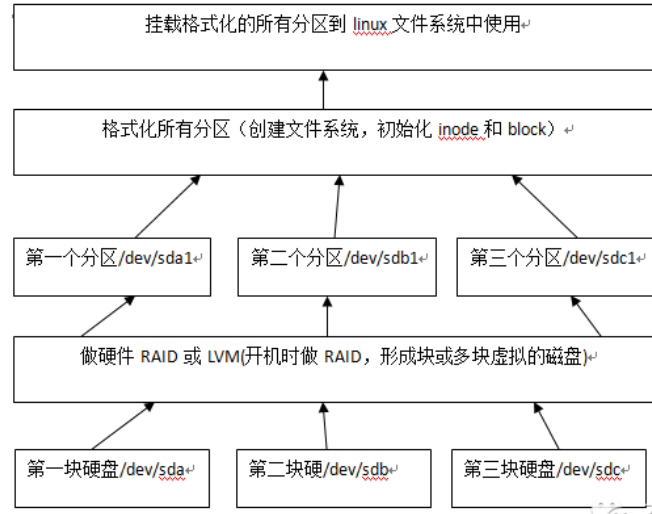
企业级服务器多块磁盘的情况
3、 磁盘容量的计算
磁盘的结构一般包括磁道、盘面、扇区、碰头等
一个磁道的大小=512 字节*扇区数
一个盘面的大小=磁道的大小*磁道数
一个磁盘的大小=盘面大小*磁头数
因此
一个磁盘的容量=512 字节*扇区数*磁道数*磁头数
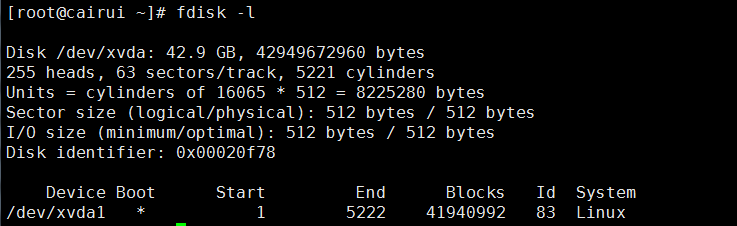
4、 磁盘分区
所有磁盘的分区信息都是存储在分区表中,Linux系统仅支持4个分区表信息(主分区+扩展分区),一个分区表的大小在64bytes
Linux一般分为三个分区分别是:boot分区、swap分区、/根分区
Linux的分区编号:主分区1-4,逻辑分区从5开始计算
实际生产环境分区要求
1、 最少要有/和swap两个分区
2、 swap(虚拟内存)=1.5*物理内存大小,一般大小于或等于16G的物理内存的服务器,swap分区一般都直接设置为16G大小
3、 建议设置/boot分区,Linux引导分区,如内核文件等,一般所有文件一共才几十M的大小,因此这个分区就设置为100-200M即可
5、 磁盘分区工具fdisk
fdisk是针对磁盘容量小于2T
[root@cairui ~]# fdisk --help

fdisk: invalid option -- '-'

fdisk: Usage:

 fdisk [options] <disk>    change partition table

 fdisk [options] -l <disk> list partition table(s)

 fdisk -s <partition>      give partition size(s) in blocks

Options:

 -b <size>                 sector size (, ,  or )

 -c                        switch off DOS-compatible mode

 -h                        print help

 -u <size>                 give sizes in sectors instead of cylinders

 -v                        print version

 -C <number>               specify the number of cylinders

 -H <number>               specify the number of heads

 -S <number>               specify the number of sectors per track

: Success
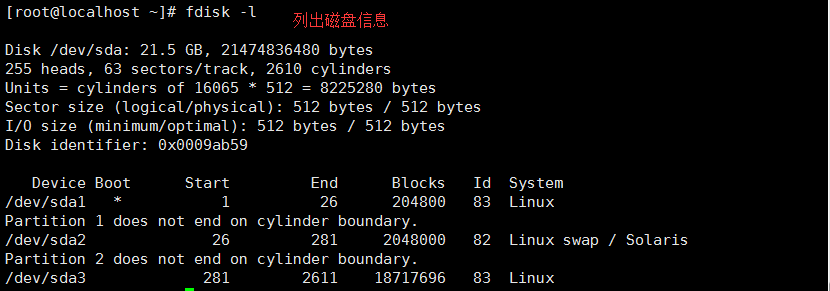
[root@localhost ~]# fdisk /dev/sda1  #对/dev/sda1进行分区操作

Device contains neither a valid DOS partition table, nor Sun, SGI or OSF disklabel

Building a new DOS disklabel with disk identifier 0x02fadd9c.

Changes will remain in memory only, until you decide to write them.

After that, of course, the previous content won't be recoverable.

Warning: invalid flag 0x0000 of partition table  will be corrected by w(rite)

WARNING: DOS-compatible mode is deprecated. It's strongly recommended to

         switch off the mode (command 'c') and change display units to

         sectors (command 'u').

Command (m for help): m

Command action

   a   toggle a bootable flag

   b   edit bsd disklabel

   c   toggle the dos compatibility flag

   d   delete a partition  #删除一个分区

   l   list known partition types

   m   print this menu

   n   add a new partition  #新建一个分区

   o   create a new empty DOS partition table

   p   print the partition table  #打印出分区表信息

   q   quit without saving changes  #不保存退出

   s   create a new empty Sun disklabel

   t   change a partition's system id

   u   change display/entry units

   v   verify the partition table

   w   write table to disk and exit  #将分区信息写入分区表并退出程序

   x   extra functionality (experts only)
Command action

e extended

p primary partition (-)

p

Partition number (-):

First cylinder (-, default ): 设置起始柱面

Using default value

Last cylinder, +cylinders or +size{K,M,G} (-, default ):

设置大小或柱面

Using default value

Command (m for help): m

Command action

a toggle a bootable flag

b edit bsd disklabel

c toggle the dos compatibility flag

d delete a partition

l list known partition types

m print this menu

n add a new partition

o create a new empty DOS partition table

p print the partition table

q quit without saving changes

s create a new empty Sun disklabel

t change a partition's system id

u change display/entry units

v verify the partition table

w write table to disk and exit

x extra functionality (experts only)

Command (m for help): w

The partition table has been altered!

Calling ioctl() to re-read partition table.

Syncing disks.

Command (m for help): p 打印分区表信息

Disk /dev/sdb: 21.5 GB,  bytes

 heads,  sectors/track,  cylinders

Units = cylinders of  *  =  bytes

Sector size (logical/physical):  bytes /  bytes

 /

I/O size (minimum/optimal):  bytes /  bytes

Disk identifier: 0xb712cc55

Device Boot Start End Blocks Id System

/dev/sdb1   +  Linux

分区完成后执行 partprobe 通知系统分区表发生改变

接下来进行格式化分区

[root@Centos ~]# mkfs.ext3 /dev/sdb1

mke2fs 1.41. (-May-)

Filesystem label=

OS type: Linux

Block size= (log=)

Fragment size= (log=)

Stride= blocks, Stripe width= blocks

 inodes,  blocks

 blocks (5.00%) reserved for the super user

First data block=

Maximum filesystem blocks=

 block groups

 blocks per group,  fragments per group

 inodes per group

Superblock backups stored on blocks:

, , , , , , , , ,

Writing inode tables: done

Creating journal ( blocks): done

Writing superblocks and filesystem accounting information: done

This filesystem will be automatically checked every  mounts or

 days, whichever comes first. Use tune2fs -c or -i to override.

[root@Centos ~]# tune2fs -c - /dev/sdb1

tune2fs 1.41. (-May-)

Setting maximal mount count to -

[root@Centos ~]# mount /dev/sdb1 /mnt 挂载分区至/mnt 下

[root@Centos ~]# df -h

Filesystem Size Used Avail Use% Mounted on

/dev/mapper/VolGroup-lv_root 50G .5G 44G % /

tmpfs 932M  932M % /dev/shm

/dev/sda1 485M 39M 421M % /boot

 /

/dev/mapper/VolGroup-lv_home 26G 215M 24G % /home

/dev/sdb1 20G 172M 19G % /mnt
6、 磁盘分区工具parted
由于环境限制无法有2T或者以上大小的磁盘,只能模拟环境来使用parted分区工具来进行分区
[root@Centos ~]# parted /dev/sdb mklabel gpt

将磁盘转换成 gpt 的格式

[root@Centos ~]# parted /dev/sdb mkpart primary  (200M)

Warning: The resulting partition is not properly aligned for best

performance.

Ignore/Cancel? Ignore

[root@Centos ~]# parted /dev/sdb p 打印分区表信息

Model: VMware, VMware Virtual S (scsi)

Disk /dev/sdb: 1074MB

Sector size (logical/physical): 512B/512B

Partition Table: gpt

Number Start End Size File system Name Flags

 .4kB 200MB 200MB primary

[root@Centos ~]# parted /dev/sdb mkpart primary

分区并设置大小

Information: You may need to update /etc/fstab.

[root@Centos ~]# parted /dev/sdb p 打印分区表信息

Model: VMware, VMware Virtual S (scsi)

Disk /dev/sdb: 1074MB

Sector size (logical/physical): 512B/512B

Partition Table: gpt

Number Start End Size File system Name Flags

 .4kB 200MB 200MB primary

 201MB 1073MB 871MB primary

[root@Centos ~]# mkfs.ext4 /dev/sdb1

mke2fs 1.41. (-May-)

Filesystem label=

OS type: Linux

Block size= (log=)

Fragment size= (log=)

 /

Stride= blocks, Stripe width= blocks

 inodes,  blocks

 blocks (5.00%) reserved for the super user

First data block=

Maximum filesystem blocks=

 block groups

 blocks per group,  fragments per group

 inodes per group

Superblock backups stored on blocks:

, , , ,

Writing inode tables: done

Creating journal ( blocks): done

Writing superblocks and filesystem accounting information: done

This filesystem will be automatically checked every  mounts or

 days, whichever comes first. Use tune2fs -c or -i to override.

[root@Centos ~]# tune2fs -c - /dev/sdb1

tune2fs 1.41. (-May-)

Setting maximal mount count to -

[root@Centos ~]# mount /dev/sdb1 /mnt

[root@Centos ~]# df -h

Filesystem Size Used Avail Use% Mounted on

/dev/mapper/VolGroup-lv_root 50G .5G 44G % /

tmpfs 932M  932M % /dev/shm

/dev/sda1 485M 39M 421M % /boot

/dev/mapper/VolGroup-lv_home 26G 215M 24G % /home

/dev/sdb1 185M 5.6M 170M % /mnt
[root@cairui ~]# parted --help

Usage: parted [OPTION]... [DEVICE [COMMAND [PARAMETERS]...]...]

Apply COMMANDs with PARAMETERS to DEVICE.  If no COMMAND(s) are given, run in

interactive mode.

OPTIONs:

  -h, --help                      displays this help message

  -l, --list                      lists partition layout on all block devices

  -m, --machine                   displays machine parseable output

  -s, --script                    never prompts for user intervention

  -v, --version                   displays the version

  -a, --align=[none|cyl|min|opt]  alignment for new partitions

COMMANDs:

  align-check TYPE N                        check partition N for TYPE(min|opt)

        alignment

  check NUMBER                             do a simple check on the file system

  cp [FROM-DEVICE] FROM-NUMBER TO-NUMBER   copy file system to another partition

  help [COMMAND]                           print general help, or help on

        COMMAND

  mklabel,mktable LABEL-TYPE               create a new disklabel (partition

        table)

  mkfs NUMBER FS-TYPE                      make a FS-TYPE file system on

        partition NUMBER

  mkpart PART-TYPE [FS-TYPE] START END     make a partition

  mkpartfs PART-TYPE FS-TYPE START END     make a partition with a file system

  move NUMBER START END                    move partition NUMBER

  name NUMBER NAME                         name partition NUMBER as NAME

  print [devices|free|list,all|NUMBER]     display the partition table,

        available devices, free space, all found partitions, or a particular

        partition

  quit                                     exit program

  rescue START END                         rescue a lost partition near START

        and END

  resize NUMBER START END                  resize partition NUMBER and its file

        system

  rm NUMBER                                delete partition NUMBER

  select DEVICE                            choose the device to edit

  set NUMBER FLAG STATE                    change the FLAG on partition NUMBER

  toggle [NUMBER [FLAG]]                   toggle the state of FLAG on partition

        NUMBER

  unit UNIT                                set the default unit to UNIT

  version                                  display the version number and

        copyright information of GNU Parted
Linux系统磁盘的更多相关文章
- linux 系统磁盘管理体系
目录 linux 系统磁盘管理体系 一.磁盘的基本概念 二.磁盘的内部结构 三.磁盘的外部结构 四.磁盘的接口及类型 五.fdisk磁盘分区实践 六.gdisk 分区 七.parted 高级分区工具. ...
- Linux系统磁盘分区、删除分区、格式化、挂载、卸载、开机自动挂载的方法总结
Linux系统按照MBR(Master Boot Record)传统分区模式: 注意:传统的MBR(Master Boot Record)分区方式最大只能分2T容量的硬盘,超过2T的硬盘一般采用GPT ...
- linux 系统磁盘管理(主分区和逻辑分区)
摘要:linux系统磁盘管理主分区和逻辑分区 1.linux系统分区应了解的常识 硬盘分区实质上是对硬盘的一种格式化,然后才能使用硬盘保存各种信息,在创建分区时,就已经设置好了硬盘的各项物理参数,指定 ...
- windows系统c盘占满/linux系统磁盘block、inode占满处理
windows系统 下载c盘清理.bat到服务器,双击bat文件将自动清理 linux系统 先远程ssh登录上服务器,登录教程:http://www.west263.com/faq/list.asp? ...
- Linux系统磁盘与分区管理(7)
Linux最传统的磁盘文件系统(filesystem)使用的是EXT4格式,所以要了解文件系统就得要由认识EXT4开始,而文件系统是创建在硬盘上面的,因此我们得了解硬盘的物理组成才行,下面我们回来详细 ...
- Linux系统——磁盘管理
磁盘结构 (1)硬盘的物理结构 磁头:每面一个磁盘 盘片:硬盘有多个盘片,每个盘片2面 (2)硬盘的数据结构 扇区:盘片被分为多个扇形区域,每个扇形区存放512字节的数据 磁道:统一盘片不同半径的同心 ...
- Linux 系统磁盘空间占满,df 和 du 结果不一致
服务器运行一段时间后df查看磁盘剩余空间不足,通过du统计发现被几个文件占用,遂删除之.过了一段时间磁盘空间再次不足,通过du统计却找不到那么多大文件.搜索后才得知原因:文件删除后空间没有释放,du统 ...
- Linux系统磁盘管理(lvm逻辑卷管理)
linux系统用户常遇到的一个问题就是如何精准的评估分区的大小,已分配合适的磁盘空间:普通的磁盘分区管理方式在逻辑分区划分好之后就无法改变其大小,当一个逻辑分区存放不下某个文件时,这个文件因为受上层文 ...
- Linux系统 磁盘IO过高排查总结
最近做的一个电商网站因为磁盘 I/O 过高导致访问速度奇慢,问题存在两个月有余未得到解决办法.此次排查原因的经验可以作下次问题的参考. 1.会看懂 top 系统命令出来的各项参数.此次是无意中发现 u ...
随机推荐
- Cassandra 学习三 数据模型
Cassandra如何存储数据的概述. 集群(Cluster) ·Cassandra数据库分布在几个一起操作的机器上.最外层容器被称为集群.对于故障处理,每个节点包含一个副本,如果发生故障,副本 ...
- Oracle 在约束中使用正则表达式
ALTER TABLE mytest ADD CONSTRAINT CK_REG CHECK(REGEXP_LIKE(TEST, '^[0-9]{1,3}(\.[0-9]){0,1}$'));
- oracle sql 函数
(7)查询日期之间的数据 例如查询student表中出生日期(birthday)在’2016-01-01’ 和’2017-01-01’之间的数据: select * from student wher ...
- vsftpd 被动模式与主动模式
vsftpd 被动模式与主动模式 VSFTP文件与目录/usr/sbin/vsftp vsftp的主程序/etc/rc.d/init.d/vsftp vsftp的启动脚本/etc/vsftpd/vsf ...
- oracle——基础知识(二)未完
1.select 查询 单独的一条 select 语句 可以一次查询多条记录:但是在 pl/sql 块中,select语句只能 使用INTO子句:必须并且只能返回一行 2.EXECUTE IMMEDI ...
- DAY11-MYSQL之ORM框架SQLAlchemy
一 介绍 SQLAlchemy是Python编程语言下的一款ORM框架,该框架建立在数据库API之上,使用关系对象映射进行数据库操作,简言之便是:将对象转换成SQL,然后使用数据API执行SQL并获取 ...
- 万恶的mysql deadlocks
https://github.com/aneasystone/mysql-deadlocks/blob/master/11.md https://blog.csdn.net/dhfzhishi/art ...
- jdbc.properties 文件的配置
jdbc.properties文件的配置 使用配置文件访问数据库的优点是: 一次编写随时调用,数据库类型发生变化只需要修改配置文件. 配置文件的设置: 在配置文件中,key-value对应的方式编 ...
- 给Activity切换过程添加动画效果
首先,在资源文件中定义一些动画效果 例如: <scale android:duration="@android:integer/config_mediumAnimTime" ...
- KNN算法实现
import csvimport randomimport mathimport operatorimport numpy as np def loadDataset(filename,split,t ...