
[Redux] Normalizing the State Shape
We will learn how to normalize the state shape to ensure data consistency that is important in real-world applications.
We currently represent the todos in the state free as an array of todo object. However, in the real app, we probably have more than a single array and then todos with the same IDs in different arrays might get out of sync.
const byIds = (state = {}, action) => {

  switch (action.type) {

    case 'ADD_TODO':

    case 'TOGGLE_TODO':

      return {

        ...state,

        [action.id]: todo(state[action.id], action),

      };

    default:

      return state;

  }

};
For using object spread, we need to include plugins:
// .baberc

{

  "presets": ["es2015", "react"],

  "plugins": ["transform-object-rest-spread"]

}
Anytime the ByID reducer receives an action, it's going to return the copy of its mapping between the IDs and the actual todos with updated todo for the current action. I will let another reducer that keeps track of all the added IDs.
const allIds = (state = [], action) => {

  switch(action.type){

    case 'ADD_TODO':

      return [...state, action.id];

    default:

      return state;

  }

};
the only action I care about is a todo because if a new todo is added, I want to return a new array of IDs with that ID as the last item. For any other actions, I just need to return the current state.
Finally, I still need to export the single reducer from the todos file, so I'm going to use combined reducers again to combine the ByID and the AllIDs reducers.
const todos = combineReducers({

  allIds,

  byIds

});

export default todos;
Now that we have changed the state shape in reducers, we also need to update the selectors that rely on it. The state object then get visible todos is now going to contain ByID and AllIDs fields, because it corresponds to the state of the combined reducer.
const getAllTodos = (state) => {

  return state.allIds.map( (id) => {

    return state.byIds[id];

  })

};

export const getVisibleTodos = (state, filter) => {

  const allTodos = getAllTodos(state);

  console.log(allTodos);

  switch (filter) {

    case 'all':

      return allTodos;

    case 'completed':

      return allTodos.filter(t => t.completed);

    case 'active':

      return allTodos.filter(t => !t.completed);

    default:

      throw new Error(`Unknown filter: ${filter}.`);

  }

};
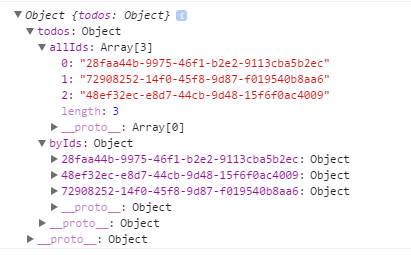
My todos file has grown quite a bit so it's a good time to extract the todo reducer that manages just when you go todo into a separate file of its own. I created a file called todo in the same folder and I will paste my implementation right there so that I can import it from the todos file.
// reducers/todo.js
const todo = (state, action) => {

  switch (action.type) {

    case 'ADD_TODO':

      return {

        id: action.id,

        text: action.text,

        completed: false,

      };

    case 'TOGGLE_TODO':

      if (state.id !== action.id) {

        return state;

      }

      return {

        ...state,

        completed: !state.completed,

      };

    default:

      return state;

  }

};
------------------
//todos.js

import { combineReducers } from 'redux';

import  todo  from './todo';

const byIds = (state = {}, action) => {

  switch (action.type) {

    case 'ADD_TODO':

    case 'TOGGLE_TODO':

      return {

        ...state,

        [action.id]: todo(state[action.id], action),

      };

    default:

      return state;

  }

};

const allIds = (state = [], action) => {

  switch(action.type){

    case 'ADD_TODO':

      return [...state, action.id];

    default:

      return state;

  }

};

const todos = combineReducers({

  allIds,

  byIds

});

export default todos;

const getAllTodos = (state) => {

  return state.allIds.map( (id) => {

    return state.byIds[id];

  })

};

export const getVisibleTodos = (state, filter) => {

  const allTodos = getAllTodos(state);

  console.log(allTodos);

  switch (filter) {

    case 'all':

      return allTodos;

    case 'completed':

      return allTodos.filter(t => t.completed);

    case 'active':

      return allTodos.filter(t => !t.completed);

    default:

      throw new Error(`Unknown filter: ${filter}.`);

  }

};
//todo.js

const todo = (state, action) => {

    switch (action.type) {

        case 'ADD_TODO':

            return {

                id: action.id,

                text: action.text,

                completed: false,

            };

        case 'TOGGLE_TODO':

            if (state.id !== action.id) {

                return state;

            }

            return {

                ...state,

                completed: !state.completed,

            };

        default:

            return state;

    }

};

export default todo;
[Redux] Normalizing the State Shape的更多相关文章
- 关于props和state以及redux中的state
React的数据模型分为共有数据和私有数据,共有数据可以在组件间进行传递,私有数据为当前组件私有.共有数据在React中使用props对象来调用,它包含标签所有的属性名称和属性值,props对象有三个 ...
- [Redux] Persisting the State to the Local Storage
We will learn how to use store.subscribe() to efficiently persist some of the app’s state to localSt ...
- [Functional Programming ADT] Create a Redux Store for Use with a State ADT Based Reducer
With a well defined demarcation point between Redux and our State ADT based model, hooking up to a R ...
- 前端(十一):props、state及redux关系梳理
所谓状态机,是一种抽象的数据模型,是“事物发展的趋势”,其原理是事件驱动.广泛地讲,世界万物都是状态机. 一.状态机是一种抽象的数据模型 在react中,props和state都可以用来传递数据.这里 ...
- Redux的State不应该全部放在Store里
使用了redux管理应用的状态,应用的状态不应该全部放在Store里面. 前端状态主要有一下两种: 1. Domain data 2. UI State 1. Domain data 来自于服务端对领 ...
- [Redux] Colocating Selectors with Reducers
We will learn how to encapsulate the knowledge about the state shape in the reducer files, so that t ...
- 详解 Node + Redux + MongoDB 实现 Todolist
前言 为什么要使用 Redux? 组件化的开发思想解放了繁琐低效的 DOM 操作,以 React 来说,一切皆为状态,通过状态可以控制视图的变化,然后随着应用项目的规模的不断扩大和应用功能的不断丰富, ...
- redux的源码解析
一. redux出现的动机 1. Javascript 需要管理比任何时候都要多的state2. state 在什么时候,由于什么原因,如何变化已然不受控制.3. 来自前端开发领域的新需求4. 我们总 ...
- [Redux] Important things in Redux
Root Smart component can be overloaded, divide 'smart' component wisely & using Provider. Proble ...
随机推荐
- Oracle XE修改默认HTTP端口8080
打开SQL*Plus控制台.用sys或者system登陆.然后运行: begin dbms_xdb.sethttpport('9999'); end; / 搞定.
- Python读写Redis数据库
import redis class Database: def __init__(self): self.host = 'localhost' self.port = 6379 def write( ...
- Google 发布 Android 性能优化典范
2015年伊始,Google发布了关于Android性能优化典范的专题, 一共16个短视频,每个3-5分钟,帮助开发者创建更快更优秀的Android App.课程专题不仅仅介绍了Android系统中有 ...
- 翻译文章“AST 模块:用 Python 修改 Python 代码”---!!注意ironpathyon未实现此功能
https://github.com/upsuper/blog/commit/0214fdd084c4adf2de2ed9912d644fb59ce13a1c +Title: [翻译] AST 模块: ...
- bzoj2257
不难发现其实这个捣鼓过程就是一个辗转相减所以最小燃料是瓶容量的最小公约数然后穷举约数即可 ..] of longint; n,k,x,i,m,j,t:longint; procedure sort(l ...
- HDU 5936 Difference 【中途相遇法】(2016年中国大学生程序设计竞赛(杭州))
Difference Time Limit: 6000/3000 MS (Java/Others) Memory Limit: 65536/65536 K (Java/Others)Total ...
- HDU-1540 Tunnel Warfare
Tunnel Warfare Time Limit: 4000/2000 MS (Java/Others) Memory Limit: 65536/32768 K (Java/Others)To ...
- HDU-1390 Binary Numbers
http://acm.hdu.edu.cn/showproblem.php?pid=1390 Binary Numbers Time Limit: 2000/1000 MS (Java/Others) ...
- Robot Framework+appium集成安装
appium(中文教程,源码)是一款开源跨平台测试自动化工具,用于测试原生.移动web和混合应用,支持 iOS, Android和FirefoxOS平台. appium集成以下框架驱动自动化测试: i ...
- JS链接页面
window.location.href = "index.php?op=xx&extend_op=xxc" 这样是在本页打开链接 window.open("ht ...