
The Doors(几何+最短路,好题)
The Doors
http://poj.org/problem?id=1556
| Time Limit: 1000MS | Memory Limit: 10000K | |
| Total Submissions: 10466 | Accepted: 3891 |
Description
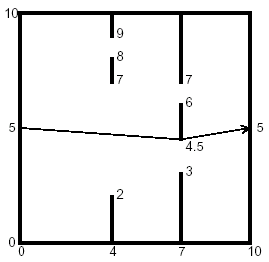
Input
2
4 2 7 8 9
7 3 4.5 6 7
The first line contains the number of interior walls. Then there is a line for each such wall, containing five real numbers. The first number is the x coordinate of the wall (0 < x < 10), and the remaining four are the y coordinates of the ends of the doorways in that wall. The x coordinates of the walls are in increasing order, and within each line the y coordinates are in increasing order. The input file will contain at least one such set of data. The end of the data comes when the number of walls is -1.
Output
Sample Input
1

5 4 6 7 8

2

4 2 7 8 9

7 3 4.5 6 7

-1
Sample Output
10.00

10.06
Source
有18堵墙!!!因为没看清这个疯狂爆RE
poj上交C++会CE,要自己写hypot函数
double hypot(double x,double y){

    return sqrt(x*x+y*y);

}
 #include<cstdio>

 #include<iostream>

 #include<cstring>

 #include<cmath>

 #include<vector>

 #include<algorithm>

 using namespace std;

 const double eps=1e-;

 const double INF=1e20;

 const double PI=acos(-1.0);

 const int maxp=;

 int sgn(double x){

     if(fabs(x)<eps) return ;

     if(x<) return -;

     else return ;

 }

 inline double sqr(double x){return x*x;}

 struct Point{

     double x,y;

     Point(){}

     Point(double _x,double _y){

         x=_x;

         y=_y;

     }

     void input(){

         scanf("%lf %lf",&x,&y);

     }

     void output(){

         printf("%.2f %.2f\n",x,y);

     }

     bool operator == (const Point &b)const{

         return sgn(x-b.x) ==  && sgn(y-b.y)== ;

     }

     bool operator < (const Point &b)const{

         return sgn(x-b.x)==?sgn(y-b.y)<:x<b.x;

     }

     Point operator - (const Point &b)const{

         return Point(x-b.x,y-b.y);

     }

     //叉积

     double operator ^ (const Point &b)const{

         return x*b.y-y*b.x;

     }

     //点积

     double operator * (const Point &b)const{

         return x*b.x+y*b.y;

     }

     //返回长度

     double len(){

         return hypot(x,y);

     }

     //返回长度的平方

     double len2(){

         return x*x+y*y;

     }

     //返回两点的距离

     double distance(Point p){

         return hypot(x-p.x,y-p.y);

     }

     Point operator + (const Point &b)const{

         return Point(x+b.x,y+b.y);

     }

     Point operator * (const double &k)const{

         return Point(x*k,y*k);

     }

     Point operator / (const double &k)const{

         return Point(x/k,y/k);

     }

     //计算pa和pb的夹角

     //就是求这个点看a,b所成的夹角

     ///LightOJ1202

     double rad(Point a,Point b){

         Point p=*this;

         return fabs(atan2(fabs((a-p)^(b-p)),(a-p)*(b-p)));

     }

     //化为长度为r的向量

     Point trunc(double r){

         double l=len();

         if(!sgn(l)) return *this;

         r/=l;

         return Point(x*r,y*r);

     }

     //逆时针转90度

     Point rotleft(){

         return Point(-y,x);

     }

     //顺时针转90度

     Point rotright(){

         return Point(y,-x);

     }

     //绕着p点逆时针旋转angle

     Point rotate(Point p,double angle){

         Point v=(*this) -p;

         double c=cos(angle),s=sin(angle);

         return Point(p.x+v.x*c-v.y*s,p.y+v.x*s+v.y*c);

     }

 };

 struct Line{

     Point s,e;

     Line(){}

     Line(Point _s,Point _e){

         s=_s;

         e=_e;

     }

     bool operator==(Line v){

         return (s==v.s)&&(e==v.e);

     }

     //根据一个点和倾斜角angle确定直线,0<=angle<pi

     Line(Point p,double angle){

         s=p;

         if(sgn(angle-PI/)==){

             e=(s+Point(,));

         }

         else{

             e=(s+Point(,tan(angle)));

         }

     }

     //ax+by+c=0;

     Line(double a,double b,double c){

         if(sgn(a)==){

             s=Point(,-c/b);

             e=Point(,-c/b);

         }

         else if(sgn(b)==){

             s=Point(-c/a,);

             e=Point(-c/a,);

         }

         else{

             s=Point(,-c/b);

             e=Point(,(-c-a)/b);

         }

     }

     void input(){

         s.input();

         e.input();

     }

     void adjust(){

         if(e<s) swap(s,e);

     }

     //求线段长度

     double length(){

         return s.distance(e);

     }

     //返回直线倾斜角 0<=angle<pi

     double angle(){

         double k=atan2(e.y-s.y,e.x-s.x);

         if(sgn(k)<) k+=PI;

         if(sgn(k-PI)==) k-=PI;

         return k;

     }

     //点和直线的关系

     //1 在左侧

     //2 在右侧

     //3 在直线上

     int relation(Point p){

         int c=sgn((p-s)^(e-s));

         if(c<) return ;

         else if(c>) return ;

         else return ;

     }

     //点在线段上的判断

     bool pointonseg(Point p){

         return sgn((p-s)^(e-s))==&&sgn((p-s)*(p-e))<=;

     }

     //两向量平行(对应直线平行或重合)

     bool parallel(Line v){

         return sgn((e-s)^(v.e-v.s))==;

     }

     //两线段相交判断

     //2 规范相交

     //1 非规范相交

     //0 不相交

     int segcrossseg(Line v){

         int d1=sgn((e-s)^(v.s-s));

         int d2=sgn((e-s)^(v.e-s));

         int d3=sgn((v.e-v.s)^(s-v.s));

         int d4=sgn((v.e-v.s)^(e-v.s));

         if((d1^d2)==-&&(d3^d4)==-) return ;

         return (d1==&&sgn((v.s-s)*(v.s-e))<=||

                 d2==&&sgn((v.e-s)*(v.e-e))<=||

                 d3==&&sgn((s-v.s)*(s-v.e))<=||

                 d4==&&sgn((e-v.s)*(e-v.e))<=);

     }

     //直线和线段相交判断

     //-*this line -v seg

     //2 规范相交

     //1 非规范相交

     //0 不相交

     int linecrossseg(Line v){

         int d1=sgn((e-s)^(v.s-s));

         int d2=sgn((e-s)^(v.e-s));

         if((d1^d2)==-) return ;

         return (d1==||d2==);

     }

     //两直线关系

     //0 平行

     //1 重合

     //2 相交

     int linecrossline(Line v){

         if((*this).parallel(v))

             return v.relation(s)==;

         return ;

     }

     //求两直线的交点

     //要保证两直线不平行或重合

     Point crosspoint(Line v){

         double a1=(v.e-v.s)^(s-v.s);

         double a2=(v.e-v.s)^(e-v.s);

         return Point((s.x*a2-e.x*a1)/(a2-a1),(s.y*a2-e.y*a1)/(a2-a1));

     }

     //点到直线的距离

     double dispointtoline(Point p){

         return fabs((p-s)^(e-s))/length();

     }

     //点到线段的距离

     double dispointtoseg(Point p){

         if(sgn((p-s)*(e-s))<||sgn((p-e)*(s-e))<)

             return min(p.distance(s),p.distance(e));

         return dispointtoline(p);

     }

     //返回线段到线段的距离

     //前提是两线段不相交,相交距离就是0了

     double dissegtoseg(Line v){

         return min(min(dispointtoseg(v.s),dispointtoseg(v.e)),min(v.dispointtoseg(s),v.dispointtoseg(e)));

     }

     //返回点P在直线上的投影

     Point lineprog(Point p){

         return s+(((e-s)*((e-s)*(p-s)))/((e-s).len2()));

     }

     //返回点P关于直线的对称点

     Point symmetrypoint(Point p){

         Point q=lineprog(p);

         return Point(*q.x-p.x,*q.y-p.y);

     }

 };

 Line L[];

 int n;

 bool Check(Line a,Line b){

     if(sgn((a.s-a.e)^(b.s-a.e))*sgn((a.s-a.e)^(b.e-a.e))>) return false;

     if(sgn((b.s-b.e)^(a.s-b.e))*sgn((b.s-b.e)^(a.e-b.e))>) return false;

     if(sgn(max(a.s.x,a.e.x)-min(b.s.x,b.e.x))>=&&sgn(max(b.s.x,b.e.x)-min(a.s.x,a.e.x))>=

      &&sgn(max(a.s.y,a.e.y)-min(b.s.y,b.e.y))>=&&sgn(max(b.s.y,b.e.y)-min(a.s.y,a.e.y))>=)

         return true;

     else return false;

 }

 double mp[][];

 int co;

 void panduan(Line a,int xx,int yy){

     if(a.s.y==||a.s.y==||a.e.y==||a.e.y==) return;

     for(int i=;i<co;i++){

         if(i!=(xx+)/&&i!=(yy+)/){

             if(Check(a,L[i])){

                 return;

             }

         }

     }

     //cout<<xx<<" "<<yy<<" "<<a.length()<<endl;

     mp[xx][yy]=mp[yy][xx]=a.length();

 }

 int main(){

     while(~scanf("%d",&n)){

         if(n==-) break;

         double x,y1,y2,y3,y4;

         co=;

         for(int i=;i<;i++){

             for(int j=;j<;j++){

                 mp[i][j]=INF;

             }

         }

         Point s,e;

         s.x=,s.y=;

         e.x=,e.y=;

         //起点为0,终点为co

         for(int i=;i<=n;i++){

             scanf("%lf %lf %lf %lf %lf",&x,&y1,&y2,&y3,&y4);

             L[co].s.x=x,L[co].s.y=,L[co].e.x=x,L[co++].e.y=y1;

             L[co].s.x=x,L[co].s.y=y2,L[co].e.x=x,L[co++].e.y=y3;

             L[co].s.x=x,L[co].s.y=y4,L[co].e.x=x,L[co++].e.y=;

         }

         Line tmp;

         int j;

         //不包括起点和终点的建图

         for(int i=;i<co;i++){

             for(int j=i+;j<co;j++){

                 tmp.s=L[i].s,tmp.e=L[j].s;

                 panduan(tmp,(i-)*+,(j-)*+);

                 tmp.s=L[i].s,tmp.e=L[j].e;

                 panduan(tmp,(i-)*+,(j-)*+);

                 tmp.s=L[i].e,tmp.e=L[j].s;

                 panduan(tmp,(i-)*+,(j-)*+);

                 tmp.s=L[i].e,tmp.e=L[j].e;

                 panduan(tmp,(i-)*+,(j-)*+);

             }

         }

         //加上起点和终点

         for(int i=;i<co;i++){

             tmp.s=s,tmp.e=L[i].s;

             panduan(tmp,,(i-)*+);

             tmp.s=s,tmp.e=L[i].e;

             panduan(tmp,,(i-)*+);

             tmp.s=e,tmp.e=L[i].s;

             panduan(tmp,(i-)*+,);

             tmp.s=e,tmp.e=L[i].e;

             panduan(tmp,(i-)*+,);

         }

         tmp.s=s,tmp.e=e;

         panduan(tmp,,);

         for(int k=;k<=;k++)

             for(int i=;i<=;i++)

                 for(int j=;j<=;j++)

                     if(mp[i][j]>mp[i][k]+mp[k][j]+eps)

                          mp[i][j]=mp[i][k]+mp[k][j];

         printf("%.2f\n",mp[][]);

     }

     return ;

 }
The Doors(几何+最短路,好题)的更多相关文章
- poj1511/zoj2008 Invitation Cards(最短路模板题)
转载请注明出处: http://www.cnblogs.com/fraud/ ——by fraud Invitation Cards Time Limit: 5 Seconds ...
- HDU 5521.Meeting 最短路模板题
Meeting Time Limit: 12000/6000 MS (Java/Others) Memory Limit: 262144/262144 K (Java/Others)Total ...
- hdu-3790最短路刷题
title: hdu-3790最短路刷题 date: 2018-10-20 14:50:31 tags: acm 刷题 categories: ACM-最短路 概述 一道最短路的水题,,,尽量不看以前 ...
- [poj2449]Remmarguts' Date(K短路模板题,A*算法)
解题关键:k短路模板题,A*算法解决. #include<cstdio> #include<cstring> #include<algorithm> #includ ...
- 牛客小白月赛6 I 公交线路 最短路 模板题
链接:https://www.nowcoder.com/acm/contest/136/I来源:牛客网 题目描述 P市有n个公交站,之间连接着m条道路.P市计划新开设一条公交线路,该线路从城市的东站( ...
- POJ 1556 The Doors --几何,最短路
题意: 给一个正方形,从左边界的中点走到右边界的中点,中间有一些墙,问最短的距离是多少. 解法: 将起点,终点和所有墙的接触到空地的点存下来,然后两两之间如果没有线段(墙)阻隔,就建边,最后跑一个最短 ...
- 2018.07.06 POJ1556 The Doors(最短路)
The Doors Time Limit: 1000MS Memory Limit: 10000K Description You are to find the length of the shor ...
- POJ 4046 Sightseeing 枚举+最短路 好题
有n个节点的m条无向边的图,节点编号为1~n 然后有点权和边权,给出q个询问,每一个询问给出2点u,v 输出u,v的最短距离 这里的最短距离规定为: u到v的路径的所有边权+u到v路径上最大的一个点权 ...
- POJ 1556 The Doors(计算几何+最短路)
这题就是,处理出没两个点.假设能够到达,就连一条边,推断可不能够到达,利用线段相交去推断就可以.最后求个最短路就可以 代码: #include <cstdio> #include < ...
随机推荐
- Robot常用Library安装
Python-Library: yum install -y mysql-devel python-devel python-setuptools pip install MySQL-python p ...
- 查找占用CPU高线程
1.根据进程号查看线程 ps -mp pid -o THREAD,tid,time 2 把tid值转成16进制 printf "%x\n" tid 3.根据上面获取到的16进制数据 ...
- 使用Golang进行性能分析(Profiling)
转自:http://www.cppblog.com/sunicdavy/archive/2015/04/11/210308.html 本文介绍游戏服务器的性能分析, web服务器性能分析不在本文分析范 ...
- CentOS 7.3 CDH 5.10.0 Druid0.12.4安装记录
CentOS 7.3 CDH 5.10.0安装记录 0. 集群规划192.167.1.247 realtime247 realtime+hadoopdata192.167.1.248 broker24 ...
- django路由初识
静态文件配置 1.项目下面新建一个文件夹static settings.py中最后添加 STATICFILES_DIRS = [ os.path.join(BASE_DIR, "static ...
- SparkStreaming 运行原理与核心概念
SparkStreaming 运行原理 sparkstreaming 的高层抽象DStream Dstream与RDD的关系 Batch duration
- python实现列表页数据的批量抓取练手练手的
python实现列表页数据的批量抓取,练手的,下回带分页的 #!/usr/bin/env python # coding=utf-8 import requests from bs4 import B ...
- jquery函数写法
普通jquery函数写法 <script src="http://code.jquery.com/jquery-1.11.1.min.js"></script&g ...
- leetcode412
public class Solution { public IList<string> FizzBuzz(int n) { var list = new List<string&g ...
- 1.HTML编码解码URL替换--代码整理
public class HtmlCode { public static String encode(String str){ String s = ""; if (str.le ...