
[转]Mac's and serial TTY's
Mac's are excellent tools for accessing serial device TTY ports (to console into PBX's, switches, and routers). You just need a serial to USB adapter, the right driver, and some Terminal software.
You can use screen, although ZTerm, goSerial, or Minicom offer more features and functionality.
Drivers
Most Serial-to-USB adapters will work on a Mac with one of the following OS X drivers:
Prolific PL2303:
PL2303_MacOSX_v1_5_1.zip FTDI_MacOSX_v2.2.18.zip
If your adapter doesn't work with either of these, try the following sources:
- Silicon Labs - CP210x USB to UART Bridge Virtual COM Port (VCP) drivers.
- Belkin - USB Serial Adapters: F5U257, F5U103, F5U003 (poor OS X support).
- Keyspan serial-USB adapter drivers can be found in their Support Section.
NOTE: It may be necessary to remove any previous driver before installing a newer one, eg:
$ sudo rm -rf /System/Library/Extensions/ProlificUsbSerial.kext
After installing the correct driver, plug in your USB-Serial adapter, and open a Terminal session (Applications/Utilities).
Enter the command ls /dev/cu.*, and look for something like usbserial (or similar):
$ ls /dev/cu.*

/dev/cu.Bluetooth-Modem		/dev/cu.iPhone-WirelessiAP

/dev/cu.Bluetooth-PDA-Sync	/dev/cu.usbserial
This indicates the USB-Serial driver is working. Select this port name in a terminal program.
Note: Check your adapter still works after a Mac OS Update, as you may have to re-install the driver.
You might notice that each serial device shows up twice in /dev, once as a tty.* and once as a cu.*. So, what's the difference? Well, TTY devices are for calling into UNIX systems, whereas CU (Call-Up) devices are for calling out from them (eg, modems). We want to call-out from our Mac, so /dev/cu.* is the correct device to use.
The technical difference is that /dev/tty.* devices will wait (or listen) for DCD (data-carrier-detect), eg, someone calling in, before responding. /dev/cu.* devices do not assert DCD, so they will always connect (respond or succeed) immediately.
Software
Having installed the right driver, our USB-Serial adapter will show up in /dev/cu.* (as shown above). We now need some terminal emulation software before we can connect to anything. Here are some Mac OS X terminal emulation programs:
GUI apps: Zterm

Terminal apps:
I use and (highly) recommend minicom, but there are several alternatives.
* screen is built-in to Mac OS X, the alternatives require downloading and installing.
ZTerm
ZTerm is a well known terminal emulation program thats been around for years, updated for Intel Macs. It supports VT100 emulation, which means it sorta kinda works with Meridian Mail (Function keys on a MacBook: fn + f-key). Shareware, but registration is $20.
To configure ZTerm, open Settings > Modem Preferences and select your USB-Serial device as the default modem (Serial Port). Then edit your connection in Settings > Connection. Remember to connect the USB-Serial cable before launching ZTerm. The following pictures explain the steps:
 |
 |
goSerial
goSerial can open multiple connections simultaneously, send and receive files, log sessions, and it supports scripting. There is no terminal emulation (VT100) support. goSerial is Donation ware.
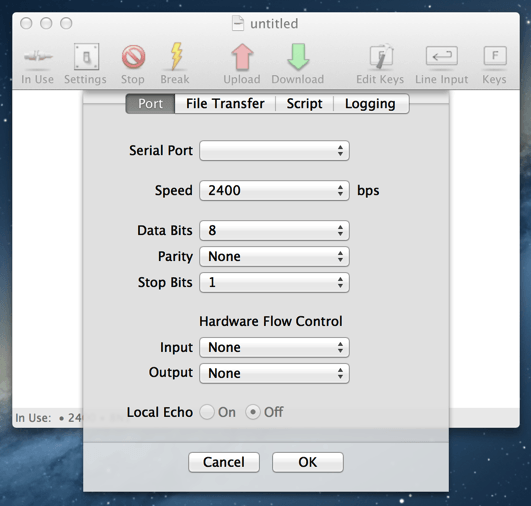
To configure goSerial, click the light switch in the Toolbar and select your USB-Serial device as the Serial Port. The communication settings are set in the same window. The serial ports dynamically updates if devices are added or removed. The following picture shows the settings window:
 |
screen
You can also use the Mac OS X built in Terminal program and screen, there's no extra software needed:
- Open an OS X terminal session (window)
- Find the right TTY device. Type:
ls /dev/cu.*With the USB-Serial adapter plugged in, you'll get a list, including something like this:
$ ls /dev/cu.*

/dev/cu.Bluetooth-Modem		/dev/cu.iPhone-WirelessiAP

/dev/cu.Bluetooth-PDA-Sync /dev/cu.usbserial - Then type:
screen /dev/cu.usbserial 9600
The 9600 at the end is the baud rate. You can use any standard rate, eg, 9600, or 19200 for a Sig Server! - To quit the screen app, type CTRL-A, then CTRL-\.
Type man screen in Terminal for further information on screen commands.
minicom
Alternatively, if you'd like a few more features, and a retro feel, you can install minicom 2.2  which is also my program of choice.
The linked version works under OS X 10.7 Lion, and 10.8 Mountain Lion. Minicom supports VT100 emulation, which means it sorta kinda works with Meridian Mail (Function keys on a MacBook: fn + f-key).
Download and run the minicom package installer, then manually edit your $PATH with sudo nano /private/etc/paths.
Add the following line to the bottom of the file: /opt/minicom/2.2/bin, save and exit - then relaunch the terminal.
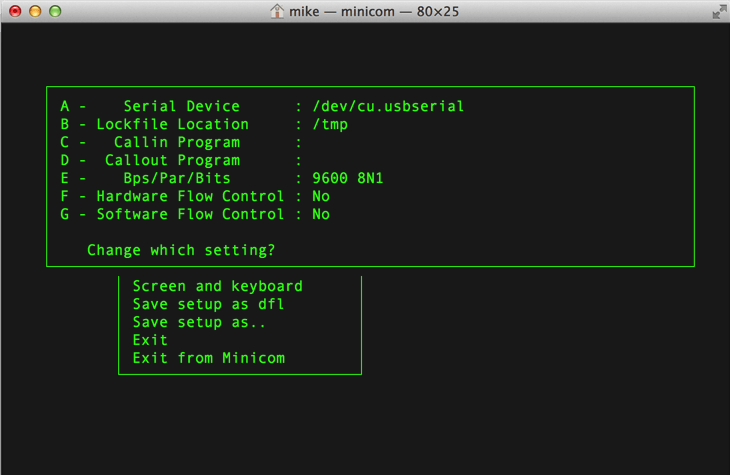
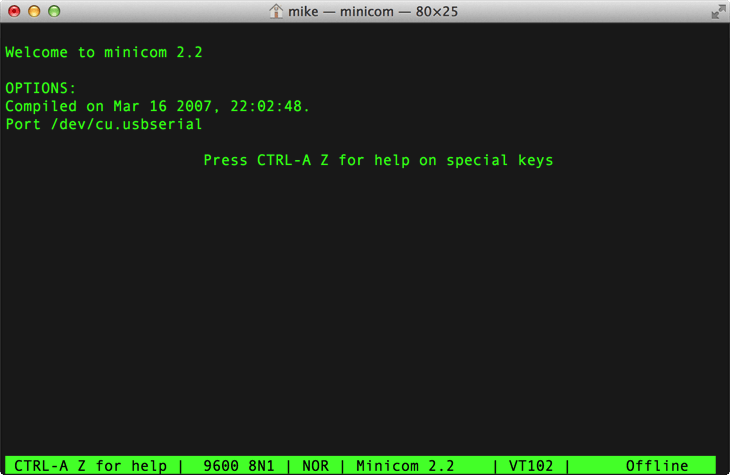
Run minicom -s first to configure your serial interface device name, and other options. Then, Save setup as dfl (default) and Exit. Your serial interface device name is found with ls /dev/cu.* (as shown above). Always launch minicom, with your selected serial adapter plugged in and available to avoid an error. In the example below, the serial device is configured as /dev/cu.KeySerial1:
 |
 |
|
| Click image to view, or right-click and Open Link in a new window/tab | ||
In minicom, commands can be called by CTRL-A <key>, for example, change your serial port settings with CTRL-A P
Press CTRL-A Z for a Command Summary, and help on special keys. Enter CTRL-A X to quit.
HINT: Change your OS X terminal window size to 80x25 (1 line more) so you can see the bottom Minicom status bar.
(Terminal Preferences -> Settings -> Window). Open a new window for this change to take effect.
 |
Note, the minicom installer creates /opt, and its not hidden in the OS X finder. Rectify this with: sudo chflags hidden /opt
[转]Mac's and serial TTY's的更多相关文章
- esp8266 免费wifi强推广告神器(4) 发现当前WIFI下的用户数目,IP,MAC请求http信息 在用户请求跳转后跳转
需求: 1 获取当前连接客户端的HTTP请求各种信息 方法 get http 请求路径 例如 /index.html / /pic.jpg 请求版本 HTTP/1.0 HT ...
- 获取与esp8266连接的客户端的Mac地址 IP 端口 控制停止等问题
两个关键的库 ESP8266WebServer.h WiFiClient.h ESP8266WiFiAP.cpp C:\Users\dongdong\Desktop\Arduino-master\li ...
- virsh console配置
If you're trying to get to the console, you can either use virt-viewer for the graphical console or ...
- pppd - 点对点协议守护进程
总览 SYNOPSIS pppd [ tty_name ] [ speed ] [ options ] 描述 点对点协议 (PPP) 提供一种在点对点串列线路上传输资料流 (datagrams)的方法 ...
- devices-list
转自:https://www.kernel.org/pub/linux/docs/lanana/device-list/devices-2.6.txt LINUX ALLOCATED DEVICES ...
- Linux procfs详解
1.0 proc文件系统总览在类Unix系统中体现了一种良好的抽象哲学,就是几乎所有的数据实体都被抽象成一个统一的接口--文件来看待,这样我们就可以用一些简单的基本工具完成大量复杂的操作.在Linux ...
- 微信客户端+微信公众平台+新浪云SAE+Arduino+WS100(控制LED)
第一步:准备 1.智能手机微信客户端或微信电脑版 2.注册微信公众平台 https://mp.weixin.qq.com 3.注册新浪账号 http://www.sinacloud.com 4.拥有一 ...
- 微信客户端+微信公众平台+新浪云SAE+Arduino+WS100(控制LED)
第一步:准备 1.智能手机微信客户端或微信电脑版 2.注册微信公众平台 https://mp.weixin.qq.com 3.注册新浪账号 http://www.sinacloud.com 4.拥有一 ...
- android获取设备唯一标示
概述 有时需要对用户设备进行标识,所以希望能够得到一个稳定可靠并且唯一的识别码.虽然Android系统中提供了这样设备识别码,但是由于Android系统版本.厂商定制系统中的Bug等限制,稳定性和唯一 ...
随机推荐
- 3.集--LinkedTransferQueue得知
近期在阅读开源项目里,发现有几个project都不尽同样地使用LinkedTransferQueue这个数据结构.比方netty,grizzly,xmemcache,Bonecp. Bonecp还扩展 ...
- 【翻译自mos文章】v$undostat视图没有依照每10分钟进行更新,v$undostat仅仅有1行(one rows)
v$undostat视图没有依照每10分钟进行更新,v$undostat仅仅有1行(one rows) 參考原文: The V$UNDOSTAT view is not getting updated ...
- [CLR via C#]1.6 Framework类库~1.9与非托管代码的互操作性
原文:[CLR via C#]1.6 Framework类库~1.9与非托管代码的互操作性 1.6 Framework类库 1. .NET Framework中包含了Framework类库(Frame ...
- iOS_22自定义键盘工具栏
最后效果图: Main.storyboard KeyboardTool.xib watermark/2/text/aHR0cDovL2Jsb2cuY3Nkbi5uZXQvcHJlX2VtaW5lbnQ ...
- ZOJ 2675 Little Mammoth(计算几何)
圆形与矩形截面的面积 三角仍然可以做到这一点 代码: #include<stdio.h> #include<string.h> #include<stdlib.h> ...
- Linux httpd 跳转简单方法一
直接在httpd.conf中添加以下代码即可: NameVirtualHost *:80 <VirtualHost *:80> ServerName localhost ##访问域名 Re ...
- MFC 界面编程 可参考资料
http://www.codeproject.com/Articles/26887/A-user-draw-button-that-supports-PNG-files-with-tr http:// ...
- 原生js写的一个弧形菜单插件
弧形菜单是一种半弧式或者全弧形菜单,是一种不同于传统横向或者竖向菜单形式的菜单.最近在网上看到好多人写出了这种效果,于是也尝试自己写了一个. 实现方式:原生态js 主要结构: 1.参数合并 var d ...
- python向mysql中存储JSON及Nodejs取出
虽然把JSON数据存入mysql也是比较蛋疼,但是相比使用Nodejs嵌套处理多个mysql查询并拼接返回数据也算是没mongo时的一个折中方案了. 我使用python拼接了一个json格式的字符串, ...
- atitit.ajax bp dwr 3.该票据安排使用的流量汇总 VO9o.....
atitit.ajax bp dwr 3.该票据安排使用的流量汇总 VO9o..... 1. 安装配置 1 1.1. 下载 dwr.jar 1M 1 1.2. 配置注解方式..web.xml 1 2 ...