
Java [Leetcode 204]Count Primes
题目描述:
Description:
Count the number of prime numbers less than a non-negative number, n.
解题思路:
Let's start with a isPrime function. To determine if a number is prime, we need to check if it is not divisible by any number less than n. The runtime complexity of isPrimefunction would be O(n) and hence counting the total prime numbers up to n would be O(n2). Could we do better?
As we know the number must not be divisible by any number > n / 2, we can immediately cut the total iterations half by dividing only up to n / 2. Could we still do better?
Let's write down all of 12's factors:
2 × 6 = 12

3 × 4 = 12

4 × 3 = 12

6 × 2 = 12
As you can see, calculations of 4 × 3 and 6 × 2 are not necessary. Therefore, we only need to consider factors up to √n because, if n is divisible by some number p, then n= p × q and since p ≤ q, we could derive that p ≤ √n.
Our total runtime has now improved to O(n1.5), which is slightly better. Is there a faster approach?
The Sieve of Eratosthenes is one of the most efficient ways to find all prime numbers up to n. But don't let that name scare you, I promise that the concept is surprisingly simple.
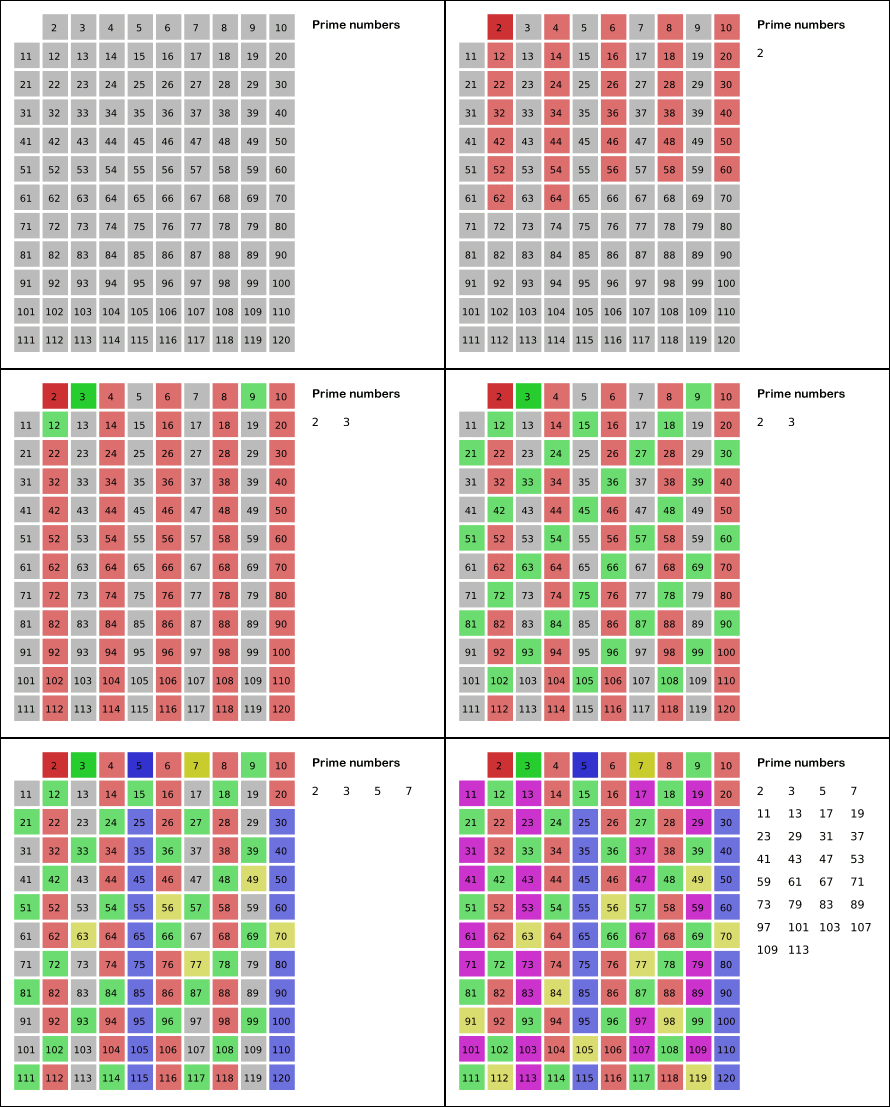
Sieve of Eratosthenes: algorithm steps for primes below 121. "Sieve of Eratosthenes Animation" by SKopp is licensed under CC BY 2.0.We start off with a table of n numbers. Let's look at the first number, 2. We know all multiples of 2 must not be primes, so we mark them off as non-primes. Then we look at the next number, 3. Similarly, all multiples of 3 such as 3 × 2 = 6, 3 × 3 = 9, ... must not be primes, so we mark them off as well. Now we look at the next number, 4, which was already marked off. What does this tell you? Should you mark off all multiples of 4 as well?
4 is not a prime because it is divisible by 2, which means all multiples of 4 must also be divisible by 2 and were already marked off. So we can skip 4 immediately and go to the next number, 5. Now, all multiples of 5 such as 5 × 2 = 10, 5 × 3 = 15, 5 × 4 = 20, 5 × 5 = 25, ... can be marked off. There is a slight optimization here, we do not need to start from 5 × 2 = 10. Where should we start marking off?
In fact, we can mark off multiples of 5 starting at 5 × 5 = 25, because 5 × 2 = 10 was already marked off by multiple of 2, similarly 5 × 3 = 15 was already marked off by multiple of 3. Therefore, if the current number is p, we can always mark off multiples of p starting at p2, then in increments of p: p2 + p, p2 + 2p, ... Now what should be the terminating loop condition?
It is easy to say that the terminating loop condition is p < n, which is certainly correct but not efficient. Do you still remember Hint #3?
Yes, the terminating loop condition can be p < √n, as all non-primes ≥ √n must have already been marked off. When the loop terminates, all the numbers in the table that are non-marked are prime.
The Sieve of Eratosthenes uses an extra O(n) memory and its runtime complexity is O(n log log n). For the more mathematically inclined readers, you can read more about its algorithm complexity on Wikipedia.

代码如下:
public class Solution {

    public int countPrimes(int n) {

    	boolean[] isPrime = new boolean[n];

    	int count = 0;

    	for(int i = 2; i < n; i++)

    		isPrime[i] = true;

    	for(int i = 2; i * i < n; i++){

    		if(!isPrime[i])

    			continue;

    		for(int j = i * i; j < n; j += i){

    			isPrime[j] = false;

    		}

    	}

    	for(int i = 2; i < n; i++){

    		if(isPrime[i])

    			count++;

    	}

    	return count;

    }

}
Java [Leetcode 204]Count Primes的更多相关文章
- [leetcode] 204. Count Primes 统计小于非负整数n的素数的个数
题目大意 https://leetcode.com/problems/count-primes/description/ 204. Count Primes Count the number of p ...
- Java for LeetCode 204 Count Primes
Description: Count the number of prime numbers less than a non-negative number, n. 解题思路: 空间换时间,开一个空间 ...
- [LeetCode] 204. Count Primes 质数的个数
Count the number of prime numbers less than a non-negative number, n. Example: Input: 10 Output: 4 E ...
- [LeetCode] 204. Count Primes 计数质数
Description: Count the number of prime numbers less than a non-negative number, n click to show more ...
- LeetCode 204. Count Primes (质数的个数)
Description: Count the number of prime numbers less than a non-negative number, n. 题目标签:Hash Table 题 ...
- LeetCode 204 Count Primes
Problem: Count the number of prime numbers less than a non-negative number, n. Summary: 判断小于某非负数n的质数 ...
- (easy)LeetCode 204.Count Primes
Description: Count the number of prime numbers less than a non-negative number, n. Credits:Special t ...
- [LeetCode] 204. Count Primes 解题思路
Count the number of prime numbers less than a non-negative number, n. 问题:找出所有小于 n 的素数. 题目很简洁,但是算法实现的 ...
- LeetCode - 204. Count Primes - 埃拉托斯特尼筛法 95.12% - (C++) - Sieve of Eratosthenes
原题 原题链接 Description: Count the number of prime numbers less than a non-negative number, n. 计算小于非负数n的 ...
随机推荐
- MVC3中在同一解决方案的不同项目中实现Area功能
1.背景 微软在MVC中引入了Area概念,用于复杂项目的分工开发.如一个MVC项目中Controller过多时,就会导致项目中包含大量的Controller+View+Model,无论是查 ...
- [设计模式] 18 备忘录模式Memento Pattern
在GOF的<设计模式:可复用面向对象软件的基础>一书中对备忘录模式是这样说的:在不破坏封装性的前提下,捕获一个对象的内部状态,并在该对象之外保存这个状态.这样以后就可将该对象恢复到原先保存 ...
- 【锋利的JQuery-学习笔记】广告栏
效果图: html: <div id="jnImageroll"> <a href="#nogo" id="JS_imgWrap&q ...
- POJ 2253 Frogger (求某两点之间所有路径中最大边的最小值)
题意:有两只青蛙,a在第一个石头,b在第二个石头,a要到b那里去,每种a到b的路径中都有最大边,求所有这些最大边的最小值.思路:将所有边长存起来,排好序后,二分枚举答案. 时间复杂度比较高,344ms ...
- 暑假集训单切赛第一场 CF 191A Dynasty Puzzles
题意不说了,看原题吧,思路见代码: #include <iostream> #include <stdio.h> #include <string.h> #incl ...
- 【nginx网站性能优化篇(2)】反向代理实现Apache与Nginx的动静分离(LNMPA)
为什么要使用反向代理 具体请参考这篇博文:[Linux常识篇(1)]所谓的正向代理与反向代理 在虚拟机上配置反向代理的步骤 首先假设你已经假设好了LNMP架构了,这时我们还要安装Apache和php, ...
- 几种USB控制器类型:OHCI,UHCI,EHCI,xHCI
http://smilejay.com/2012/10/usb_controller_xhci/ 遇到过一些关于USB的东西(如下),一直没搞明白什么USB1.0/1.1/2.0/3.0之类的,当然我 ...
- HTML5入门4---HTML5 与 HTML4 同一网页的不同写法
HTML4写法 css: body { font-family: "Lucida Sans Unicode", "Lucida Grande", Verdana ...
- 在Htmel中添加flash
> >
- 在PowerDesigner中设计物理模型1——表和主外键
原文:在PowerDesigner中设计物理模型1--表和主外键 在PD中建立物理模型由以下几种办法: 直接新建物理模型. 设计好概念模型,然后由概念模型生成物理模型. 设计好逻辑模型,然后由逻辑模型 ...