
Optimal binary search trees
问题
该问题的实际应用
Suppose that we are designing a program to translate text from English to French. For each occurrence of each English word in the text, we need to look up its French equivalent. We could perform these lookup operations by building a binary search tree with n English words as keys and their French equivalents as satellite data.
Because we will search the tree for each individual word in the text, we want the total time spent searching to be as low as possible. We could ensure an O(lg n) search time per occurrence by using a red-black tree or any other balanced binary search tree.
Words appear with different frequencies, however, and a frequently used word such as the may appear far from the root while a rarely used word such as machicolation appears near the root. Such an organization would slow down the translation, since the number of nodes visited when searching for a key in a binary search tree equals one plus the depth of the node containing the key. We want words that occur frequently in the text to be placed nearer the root.
Moreover, some words in the text might have no French translation, and such words would not appear in the binary search tree at all. How do we organize a binary search tree so as to minimize the number of nodes visited in all searches, given that we know how often each word occurs?(被给定时间相同)
该问题涉及的概念以及特点
an optimal binary search tree,其概念如下:
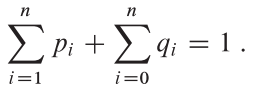
we are given a sequence K = { k1, k2, ... , kn } of n distinct keys in sorted order (so that k1< k2< ... < kn), and we wish to build a binary search tree from these keys. For each key ki , we have a probability pi that a search will be for ki.
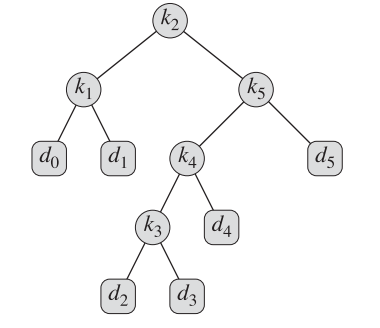
Some searches may be for values not in K, and so we also have n + 1 “dummy keys” d0, d1, ... , dn representing values not in K. For each dummy key di , we have a probability qi that a search will correspond to di .
In particular, d0 represents all values less than k1, dn represents all values greater than kn,and for i = 1, 2, ... , n-1, the dummy key di represents all values between ki and ki+1.
Each key ki is an internal node, and each dummy key di is a leaf.
the expected cost of a search in an binary search tree T is:

问题形式化定义
Input:
{ k1, k2, ... , kn } && { p1, p2, ... , pn }
{ d0, d1, ... , dn } && { q0, q1, ... , qn }
Output
- an optimal binary search tree
暴力算法或其他可行算法分析
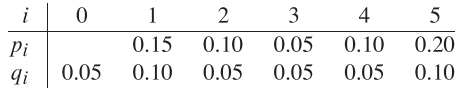
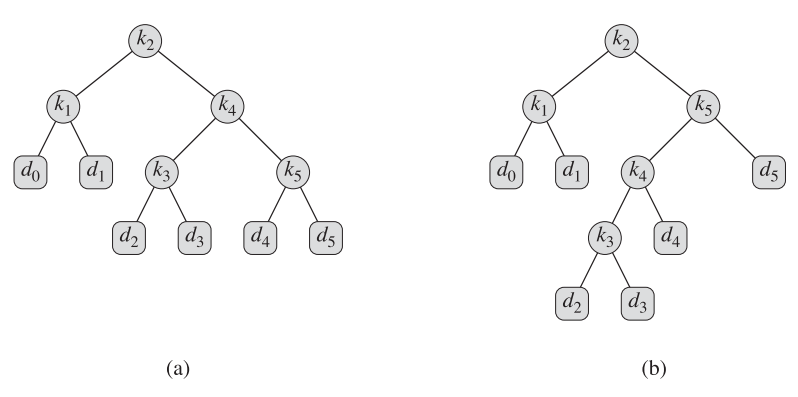
Figure 15.9(b) shows an optimal binary search tree for the probabilities given in the figure caption; its expected cost is 2.75. Figure 15.9(b)'s cost is 2.80
This example shows that an optimal binary search tree is not necessarily a tree whose overall height is smallest. Nor can we necessarily construct an optimal binary search tree by always putting the key with the greatest probability at the root.
We can label the nodes of any n-node binary tree with the keys k1;k2; :::; kn to construct a binary search tree, and then add in the dummy keys as leaves. In Problem 12-4, we saw that the number of binary trees with n nodes is Ω(4n/n3/2), and so we would have to examine an exponential number of binary search trees in an exhaustive search. Not surprisingly, we shall solve this problem with dynamic programming.
动态规划解法
优化子结构
Theorem (Optimal substructure of Optimal binary search trees)
if an optimal binary search tree T has a subtree T' containing keys ki ... kj , then this subtree T' must be optimal as well for the subproblem with keys ki ... kj and dummy keys di-1 ... dj.
Proof
If there were a subtree T00 whose expected cost is lower than that of T0, then we could cut T0 out of T and paste in T00, resulting in a binary search tree of lower expected cost than T, thus contradicting the optimality of T.
DETAIL
There is one detail worth noting about “empty” subtrees. Suppose that in a subtree with keys ki ... kj , we select ki as the root. By the above argument, ki ’s left subtree contains the keys ki ... ki-1. We interpret this sequence as containing no keys. Bear in mind, however, that subtrees also contain dummy keys. We adopt the convention that a subtree containing keys ki ... ki-1 has no actual keys but does contain the single dummy key di-1. Symmetrically, if we select kj as the root, then kj ’s right subtree contains the keys kj-1 ,..., kj ; this right subtree contains no actual keys, but it does contain the dummy key dj .
子问题重叠性
We need to use the optimal substructure to show that we can construct an optimal solution to the problem from optimal solutions to subproblems. Given keys ki ... kj , one of these keys, say kr (i <= r <= j ), is the root of an optimal subtree containing these keys. The left subtree of the root kr contains the keys ki ,..., kr-1 (and dummy keys di-1 ,..., dr-1), and the right subtree contains the keys kr+1 ,..., kj (and dummy keys dr ,.., dj ). As long as we examine all candidate roots kr,where i <= r <= j , and we determine all optimal binary search trees containing ki ,..., kr-1 and those containing kr+1 ,.., kj , we are guaranteed that we will find an optimal binary search tree.
以上文字说明了此问题的最优解构建其实与矩阵链乘问题的最优解的构建基本类似。那么自然可以论证其子问题优化解的存在。
递归的定义优化解的代价
Let us define e[i, j] as the expected cost of searching an optimal binary search tree containing the keys ki ... kj .
基准情况十分简单:
- The easy case occurs when j = i - 1. Then we have just the dummy key di-1. The expected search cost is e[i, i - 1] = qi-1.
其他情况的论述:
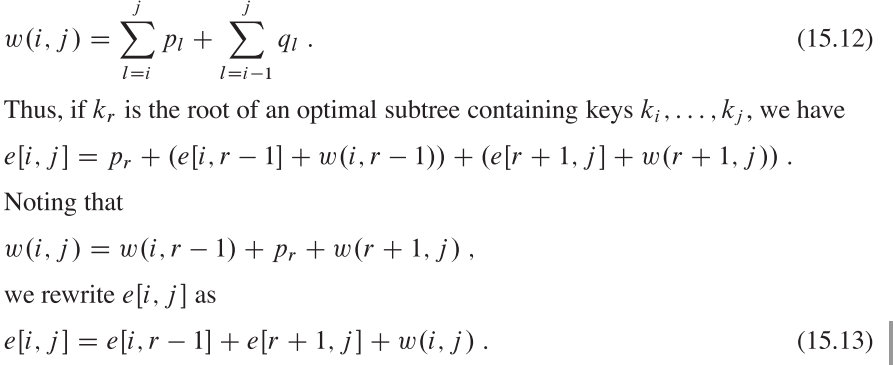
When j >= i , we need to select a root kr from among ki ... kj and then make an optimal binary search tree with keys ki ,..., kr-1 as its left subtree and an optimal binary search tree with keys kr+1 ,..., kj as its right subtree.
What happens to the expected search cost of a subtree when it becomes a subtree of a node? The depth of each node in the subtree increases by 1. So:
最后的递归解的表示:

计算优化解的代价算法
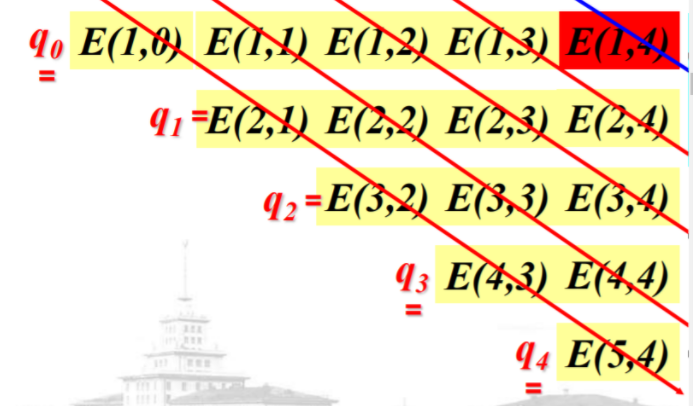
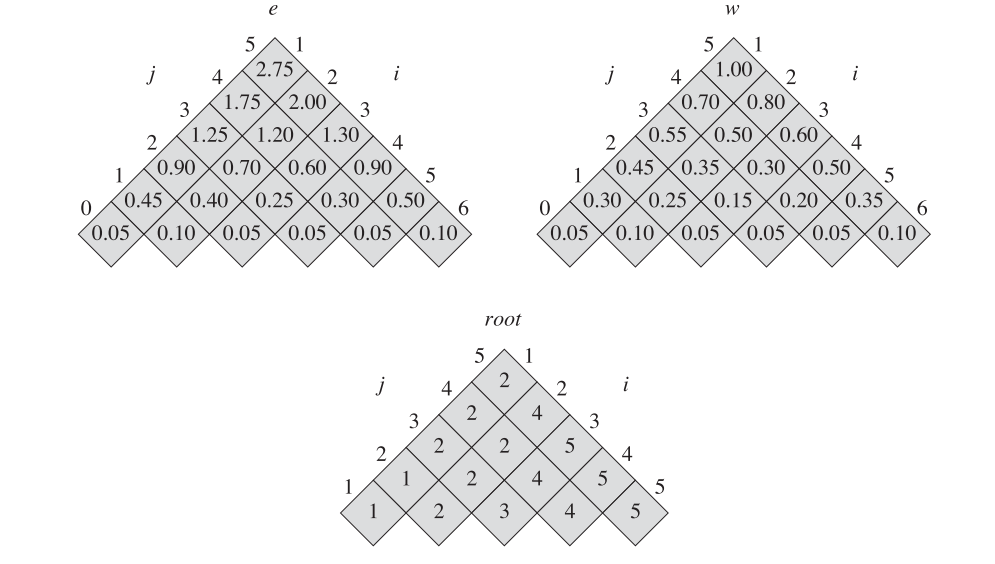
we store the e[i, j] values in a table e[1...n+1 , 0...n]. The first index needs to run to n-1 rather than n because in order to have a subtree containing only the dummy key dn, we need to compute and store e[n + 1, n]. The second index needs to start from 0 because in order to have a subtree containing only the dummy key d0, we need to compute and store e[1, 0].
这里对于矩阵边界的理解,十分精辟,建议结合图示进行观看,可以帮助理解。
下面将说明 w[i, j]的构建以及递归方程。
We will need one other table for efficiency. Rather than compute the value of w[i, j] from scratch every time we are computing e[i, j] —which would take Θ(j - i) additions—we store these values in a table w[1 .. n + 1, 0 ... n].
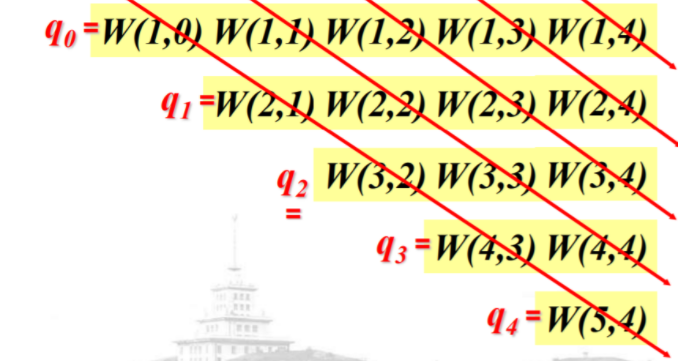
- For the base case, we compute w[i, i - 1] = qi-1 for 1 <= i <= n + 1.
- For j >= i,we compute : w[i, j] = w[i, j - 1] + pj + qj.
空间结构:

M[1:n+1; 0:n]: 存储优化解搜索代价

W[1: n+1; 0:n]: 存储代价增量Wm(i, j)

Root[1:n; 1:n]: root(i, j)记录子问题{ki, …, kj}优化解的根
Optimal-BST(p, q, n)

 For  i=1  To  n+1   Do

      E(i, i-1) = qi-1;

      W(i, i-1) = qi-1;

 For  l=1  To  n   Do

      For   i=1   To   n-l+1   Do

            j=i+l-1;

            E(i, j)=正无穷;

            W(i, j)=W(i, j-1)+pj+qj;

            For  r=i  To  j   Do

                 t=E(i, r-1)+E(r+1, j)+W(i, j);

                 If    t<E(i, j)

                 Then  E(i, j)=t;

                          Root(i, j)=r;

 Return  E and  Root
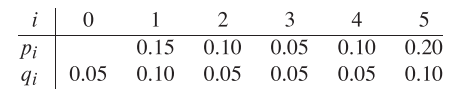
Eg:
构造最优解的算法
最终的最优解将采用如下形式进行输出,其形式对应于上面所给例子。
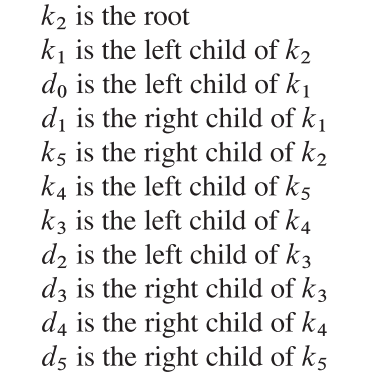
伪代码为:
CONSTRUCT-OPTIMAL-BST(root)

n = root[0].length

print K {root[1,n]} is the root

Print-BST(root,1,n)

Print-BST(root,i,j)

if (i <= root[i,j]-1)

   print k {root[i,root[i,j]-1]} is the left child of k {root[i,j]}

   print-BST(root,i,root[i,j]-1)

else

   print d {root[i,j]-1} is the left child of k {root[i,j]}

if (j >= root[i,j]+1)

   print K {root[root[i,j]+1,j]} is the right child of K {root[i,j]}

   print-BST(root,root[i,j]+1,j)

else

   print d {j} is the right child of k {root[i,j]}
算法复杂度说明
时间复杂度:
- 计算代价的时间:O(n3).
The OPTIMAL-BST procedure takes O(n3) time, just like MATRIX-CHAINORDER. We can easily see that its running time is O(n3), since its for loops are nested three deep and each loop index takes on at most n values.
The loop indices in OPTIMAL-BST do not have exactly the same bounds as those in MATRIX-CHAINORDER, but they are within at most 1 in all directions. Thus, like MATRIX-CHAINORDER, the OPTIMAL-BST procedure takes Ω(n3) time.
算法代码
#include<stdio.h>

#include<string.h>

#define N 5

#define MAX_FLOAT 10.0

void OPTIMAL_BEST(float* p, float* q, int n);

void CONSTRUCT_OPTIMAL_BST(int root[N + 1][N + 1]);

void Print_BST(int root[N + 1][N + 1], int i, int j);

void main() {

	float p[N + 1] = { 0.0,0.15,0.10,0.05,0.10,0.20 };

	float q[N + 1] = { 0.05,0.10,0.05,0.05,0.05,0.10 };

	OPTIMAL_BEST(p, q, N);

}

void OPTIMAL_BEST(float* p, float* q, int n) {

	float e[N + 2][N + 1];

	float w[N + 2][N + 1];

	int root[N + 1][N + 1];

	memset(e, 0.0, sizeof(float) * (N + 2) * (N + 1));

	memset(w, 0.0, sizeof(float) * (N + 2) * (N + 1));

	memset(root, 0, sizeof(int) * (N + 1) * (N + 1));

	for (int i = 1; i <= n + 1; i++) {

		e[i][i - 1] = q[i - 1];

		w[i][i - 1] = q[i - 1];

	}

	for (int l = 1; l <= n; l++) {

		for (int i = 1; i <= n - l + 1; i++) {

			int j = i + l - 1;

			e[i][j] = MAX_FLOAT;

			w[i][j] = w[i][j - 1] + p[j] + q[j];

			for (int r = i; r <= j; r++) {

				float t = e[i][r - 1] + e[r + 1][j] + w[i][j];

				if (t < e[i][j]){

					e[i][j] = t;

					root[i][j] = r;

				}

			}

		}

	}

	for (int i = 1; i <= n + 1; i++) {

		for (int j = 0; j <= n; j++) {

			printf("%.2f	", e[i][j]);

		}

		printf("\n");

	}

	printf("\n");

	printf("\n");

	printf("\n");

	for (int i = 1; i <= n + 1; i++) {

		for (int j = 0; j <= n; j++) {

			printf("%.2f	", w[i][j]);

		}

		printf("\n");

	}

	printf("\n");

	printf("\n");

	printf("\n");

	for (int i = 1; i <= n; i++) {

		for (int j = 1; j <= n; j++) {

			printf("%d	", root[i][j]);

		}

		printf("\n");

	}

	printf("\n");

	printf("\n");

	printf("\n");

	CONSTRUCT_OPTIMAL_BST(root);

}

void CONSTRUCT_OPTIMAL_BST(int root[N + 1][N + 1]) {

	printf("K %d is the root\n", root[1][N]);

	Print_BST(root, 1, N);

}

void Print_BST(int root[N + 1][N + 1], int i, int j) {

	if (i <= (root[i][j] - 1)) {

		printf("k %d is the left child of k %d\n", root[i][root[i][j] - 1], root[i][j]);

		Print_BST(root, i, root[i][j] - 1);

	}

	else {

		printf("d %d is the left child of k %d\n", root[i][j] - 1, root[i][j]);

	}

	if (j >= root[i][j] + 1) {

		printf("k %d is the rightchild of k %d\n", root[root[i][j] + 1][j], root[i][j]);

		Print_BST(root, root[i][j] + 1, j);

	}

	else {

		printf("d %d is the right child of k %d\n", j, root[i][j]);

	}

}
Optimal binary search trees的更多相关文章
- ITA 15.5 Optimal binary search trees
p400 页最后一段 When j >= i , we need to select a root kr from among ki ... kj and then make an optima ...
- [LeetCode] Unique Binary Search Trees 独一无二的二叉搜索树
Given n, how many structurally unique BST's (binary search trees) that store values 1...n? For examp ...
- [LeetCode] Unique Binary Search Trees II 独一无二的二叉搜索树之二
Given n, generate all structurally unique BST's (binary search trees) that store values 1...n. For e ...
- 2 Unique Binary Search Trees II_Leetcode
Given n, generate all structurally unique BST's (binary search trees) that store values 1...n. For e ...
- 【leetcode】Unique Binary Search Trees (#96)
Given n, how many structurally unique BST's (binary search trees) that store values 1...n? For examp ...
- LEETCODE —— Unique Binary Search Trees [动态规划]
Given n, how many structurally unique BST's (binary search trees) that store values 1...n? For examp ...
- 【LeetCode】95. Unique Binary Search Trees II
Unique Binary Search Trees II Given n, generate all structurally unique BST's (binary search trees) ...
- Leetcode 86. Unique Binary Search Trees
本题利用BST的特性来用DP求解.由于BST的性质,所以root左子树的node全部<root.而右子树的node全部>root. 左子树 = [1, j-1], root = j, 右子 ...
- Print Common Nodes in Two Binary Search Trees
Given two Binary Search Trees, find common nodes in them. In other words, find intersection of two B ...
随机推荐
- tomcat在linux下安装
1.下载地址: https://tomcat.apache.org/download-90.cgi 2.上传linux 3.查看是否上传成功 4.解压: 5.进入后,查看README.md文件,可以查 ...
- JUC并发编程--AQS
转自: https://www.jianshu.com/p/d8eeb31bee5c 前言 在java.util.concurrent.locks包中有很多Lock的实现类,常用的有Reentrant ...
- Linux下安装ZooKeeper-3.5.6
下载 官网下载地址是https://www.apache.org/dyn/closer.cgi/zookeeper,下载apache-zookeeper-3.5.6-bin.tar.gz. sta ...
- 使用Ajax新闻系统管理需求分析
新闻系统管理需求分析 1.1项目背景 新闻发布系统(News Release System or Content Management System),是一个基于新闻和内容管理的全站管理系统,本系 ...
- python-格式化(%,format,f-string)输出+输入
1-格式化输出: % 1.print('我的姓名是%s,身高%s cm'%(name,height)) 2.%s -str() ; %d–十进制3.传入值的时候一定是个元组,不是列表4.当指定长度时: ...
- C/C++的二分查找
假设有一种温度传感器,已经测得它的电压和温度的对应关系,将电压值以ADC转换后的数字量的值表示,形成温度-AD值的对照表,如下. 大致成一条反比关系的曲线. ADC的底层驱动已经写好,对外有一个接口可 ...
- STM32F103C8T6-CubeMx串口收发程序详细设计与测试(2)——程序规划、代码编写及测试
摘要:演示程序的功能:通过中断接收串口数据,在1750us时间内没有收到新的字节的话,将收到的数据原封不动地发送出去,以测试串口的完整收发流程.对使用到的函数进行了说明,阐述了各个函数的调用顺序和调用 ...
- .NET Standard SDK 样式项目中的目标框架
系列目录 [已更新最新开发文章,点击查看详细] 包表示形式 .NET Standard 引用程序集的主要分发载体是 NuGet 包. 实现会以适用于每个 .NET 实现的各种方式提供. NuG ...
- SpringBoot-06-模板引擎Thymeleaf
6. 模板引擎 Thymeleaf Thyme leaf 英译为 百里香的叶子. 模板引擎 以前开发中使用的jsp就是一个模板引擎,但是springboot 以jar的方式,并且使用嵌入式的tom ...
- 《New Horizon College English》2--长篇阅读技能指南
<New Horizon College English>2--长篇阅读技能指南 <长篇阅读>目的是提升学生的英语阅读技能和限时获取信息的能力.<长篇阅读>共四级, ...