
solidity 汇编语言问题——内存数据mload时为什么从第32位开始
问题:内存数据mload时为什么从第32位开始
代码出处:https://gist.github.com/axic/5b33912c6f61ae6fd96d6c4a47afde6d
pragma solidity ^0.4.;

library ECVerify {

    // Duplicate Solidity's ecrecover, but catching the CALL return value

    function safer_ecrecover(bytes32 hash, uint8 v, bytes32 r, bytes32 s) internal returns (bool, address) {

        // We do our own memory management here. Solidity uses memory offset

        // 0x40 to store the current end of memory. We write past it (as

        // writes are memory extensions), but don't update the offset so

        // Solidity will reuse it. The memory used here is only needed for

        // this context.

        // FIXME: inline assembly can't access return values

        bool ret;

        address addr;

        assembly {

            let size := mload(0x40)

            mstore(size, hash)

            mstore(add(size, ), v)

            mstore(add(size, ), r)

            mstore(add(size, ), s)

            // NOTE: we can reuse the request memory because we deal with

            //       the return code

            ret := call(, , , size, , size, )

            addr := mload(size)

        }

        return (ret, addr);

    }

    function ecrecovery(bytes32 hash, bytes sig) public returns (bool, address) {

        bytes32 r;

        bytes32 s;

        uint8 v;

        if (sig.length != )

          return (false, );

        // The signature format is a compact form of:

        //   {bytes32 r}{bytes32 s}{uint8 v}

        // Compact means, uint8 is not padded to 32 bytes.

        assembly {

            r := mload(add(sig, ))//????????????

            s := mload(add(sig, ))

            // Here we are loading the last 32 bytes. We exploit the fact that

            // 'mload' will pad with zeroes if we overread.

            // There is no 'mload8' to do this, but that would be nicer.

            v := byte(, mload(add(sig, )))

            // Alternative solution:

            // 'byte' is not working due to the Solidity parser, so lets

            // use the second best option, 'and'

            // v := and(mload(add(sig, 65)), 255)

        }

        // albeit non-transactional signatures are not specified by the YP, one would expect it

        // to match the YP range of [27, 28]

        //

        // geth uses [0, 1] and some clients have followed. This might change, see:

        //  https://github.com/ethereum/go-ethereum/issues/2053

        if (v < )

          v += ;

        if (v !=  && v != )

            return (false, );

        return safer_ecrecover(hash, v, r, s);

    }

    function ecverify(bytes32 hash, bytes sig, address signer) public returns (bool,address) {

        bool ret;

        address addr;

        (ret, addr) = ecrecovery(hash, sig);

        return (ret == true && addr == signer,addr);

    }

}

contract ECVerifyTest {

    function test_v0() public returns (bool,address) {

        bytes32 hash = 0x47173285a8d7341e5e972fc677286384f802f8ef42a5ec5f03bbfa254cb01fad;

        bytes memory sig = "\xac\xa7\xda\x99\x7a\xd1\x77\xf0\x40\x24\x0c\xdc\xcf\x69\x05\xb7\x1a\xb1\x6b\x74\x43\x43\x88\xc3\xa7\x2f\x34\xfd\x25\xd6\x43\x93\x46\xb2\xba\xc2\x74\xff\x29\xb4\x8b\x3e\xa6\xe2\xd0\x4c\x13\x36\xea\xce\xaf\xda\x3c\x53\xab\x48\x3f\xc3\xff\x12\xfa\xc3\xeb\xf2\x00";

        return ECVerify.ecverify(hash, sig, 0x0E5cB767Cce09A7F3CA594Df118aa519BE5e2b5A);

    }

    function test_v1() public returns (bool,address) {

        bytes32 hash = 0x47173285a8d7341e5e972fc677286384f802f8ef42a5ec5f03bbfa254cb01fad;

        bytes memory sig = "\xde\xba\xaa\x0c\xdd\xb3\x21\xb2\xdc\xaa\xf8\x46\xd3\x96\x05\xde\x7b\x97\xe7\x7b\xa6\x10\x65\x87\x85\x5b\x91\x06\xcb\x10\x42\x15\x61\xa2\x2d\x94\xfa\x8b\x8a\x68\x7f\xf9\xc9\x11\xc8\x44\xd1\xc0\x16\xd1\xa6\x85\xa9\x16\x68\x58\xf9\xc7\xc1\xbc\x85\x12\x8a\xca\x01";

        return ECVerify.ecverify(hash, sig, 0x8743523D96A1B2CbE0c6909653a56da18ed484Af);

    }

}
每当使用出现了使用到汇编语言时,我就一直很奇怪一个问题,就是r := mload(add(sig, 32))这里为什么要加32,后面通过测试发现,前32个字节存储的是数据的长度
测试过程:
1)先得到原代码取得的(v, r, s) :
pragma solidity ^0.4.;

library ECVerify {

    function ecrecovery(bytes32 hash, bytes sig) public returns (uint8, bytes32, bytes32) {

        bytes32 r;

        bytes32 s;

        uint8 v;

        if (sig.length != )

          return (v, r, s);

        // The signature format is a compact form of:

        //   {bytes32 r}{bytes32 s}{uint8 v}

        // Compact means, uint8 is not padded to 32 bytes.

        assembly {

            r := mload(add(sig, ))

            s := mload(add(sig, ))

            // Here we are loading the last 32 bytes. We exploit the fact that

            // 'mload' will pad with zeroes if we overread.

            // There is no 'mload8' to do this, but that would be nicer.

            v := byte(, mload(add(sig, )))

            // Alternative solution:

            // 'byte' is not working due to the Solidity parser, so lets

            // use the second best option, 'and'

            // v := and(mload(add(sig, 65)), 255)

        }

        // albeit non-transactional signatures are not specified by the YP, one would expect it

        // to match the YP range of [27, 28]

        //

        // geth uses [0, 1] and some clients have followed. This might change, see:

        //  https://github.com/ethereum/go-ethereum/issues/2053

        if (v < )

          v += ;

        if (v !=  && v != )

            return (v, r, s);

        return (v, r, s);

    }

}

contract ECVerifyTest {

    function test_v0() public returns (uint8,bytes32, bytes32) {

        bytes32 hash = 0x47173285a8d7341e5e972fc677286384f802f8ef42a5ec5f03bbfa254cb01fad;

        bytes memory sig = "\xac\xa7\xda\x99\x7a\xd1\x77\xf0\x40\x24\x0c\xdc\xcf\x69\x05\xb7\x1a\xb1\x6b\x74\x43\x43\x88\xc3\xa7\x2f\x34\xfd\x25\xd6\x43\x93\x46\xb2\xba\xc2\x74\xff\x29\xb4\x8b\x3e\xa6\xe2\xd0\x4c\x13\x36\xea\xce\xaf\xda\x3c\x53\xab\x48\x3f\xc3\xff\x12\xfa\xc3\xeb\xf2\x00";

        return ECVerify.ecrecovery(hash, sig);

    }

    function test_v1() public returns(uint8,bytes32, bytes32) {

        bytes32 hash = 0x47173285a8d7341e5e972fc677286384f802f8ef42a5ec5f03bbfa254cb01fad;

        bytes memory sig = "\xde\xba\xaa\x0c\xdd\xb3\x21\xb2\xdc\xaa\xf8\x46\xd3\x96\x05\xde\x7b\x97\xe7\x7b\xa6\x10\x65\x87\x85\x5b\x91\x06\xcb\x10\x42\x15\x61\xa2\x2d\x94\xfa\x8b\x8a\x68\x7f\xf9\xc9\x11\xc8\x44\xd1\xc0\x16\xd1\xa6\x85\xa9\x16\x68\x58\xf9\xc7\xc1\xbc\x85\x12\x8a\xca\x01";

        return ECVerify.ecrecovery(hash, sig);

    }

}
返回:
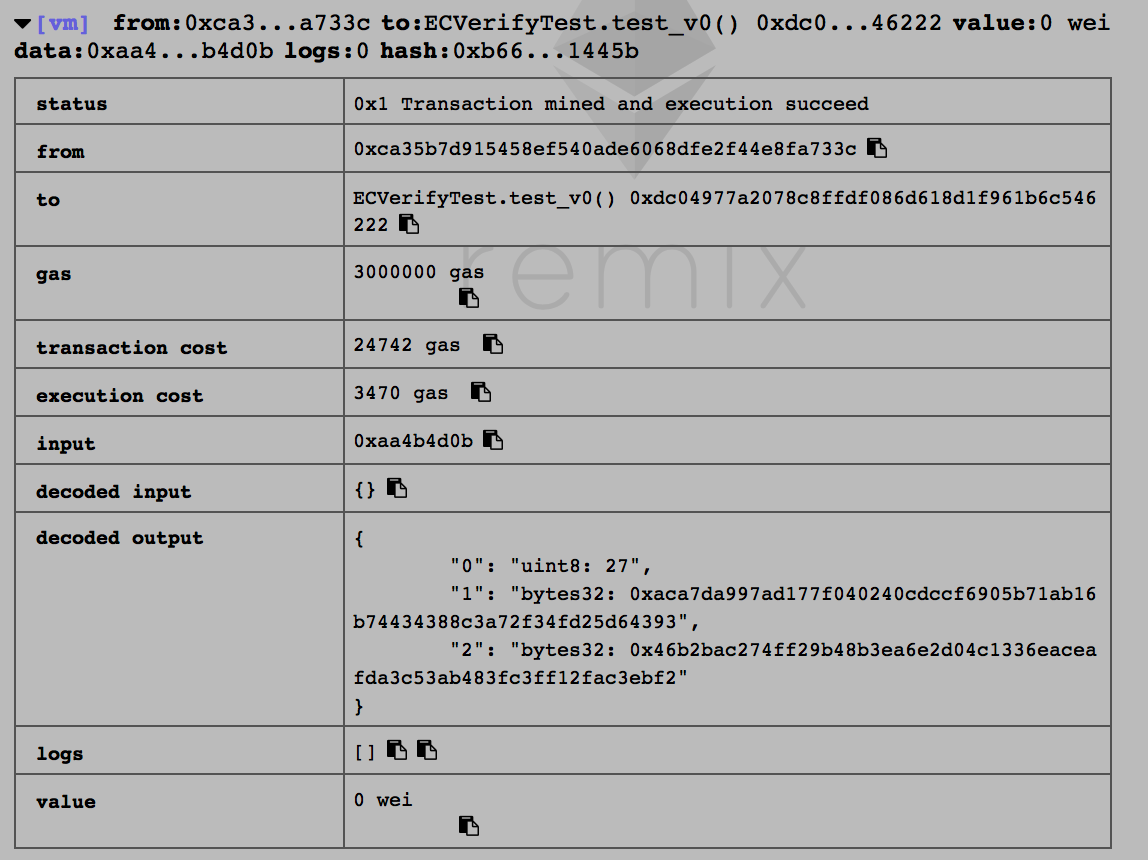
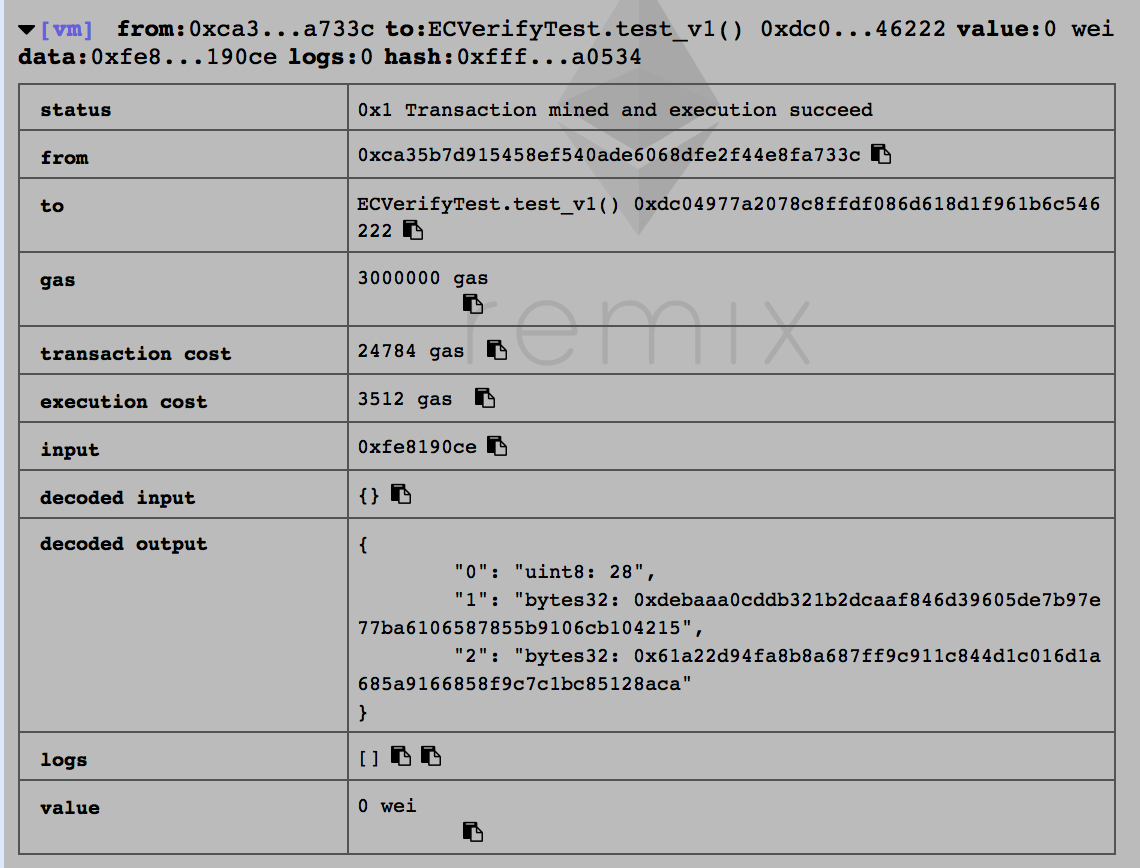
2)然后调用0位置的数据:
pragma solidity ^0.4.;

library ECVerify {

    function ecrecovery(bytes32 hash, bytes sig) public returns (uint8, bytes32, bytes32) {

        bytes32 r;

        bytes32 s;

        uint8 v;

        if (sig.length != )

          return (v, r, s);

        // The signature format is a compact form of:

        //   {bytes32 r}{bytes32 s}{uint8 v}

        // Compact means, uint8 is not padded to 32 bytes.

        assembly {

            r := mload(add(sig, ))

            s := mload(add(sig, ))

            // Here we are loading the last 32 bytes. We exploit the fact that

            // 'mload' will pad with zeroes if we overread.

            // There is no 'mload8' to do this, but that would be nicer.

            v := byte(, mload(add(sig, )))

            // Alternative solution:

            // 'byte' is not working due to the Solidity parser, so lets

            // use the second best option, 'and'

            // v := and(mload(add(sig, 65)), 255)

        }

        return (v, r, s);

    }

}

contract ECVerifyTest {

    function test_v0() public returns (uint8,bytes32, bytes32) {

        bytes32 hash = 0x47173285a8d7341e5e972fc677286384f802f8ef42a5ec5f03bbfa254cb01fad;

        bytes memory sig = "\xac\xa7\xda\x99\x7a\xd1\x77\xf0\x40\x24\x0c\xdc\xcf\x69\x05\xb7\x1a\xb1\x6b\x74\x43\x43\x88\xc3\xa7\x2f\x34\xfd\x25\xd6\x43\x93\x46\xb2\xba\xc2\x74\xff\x29\xb4\x8b\x3e\xa6\xe2\xd0\x4c\x13\x36\xea\xce\xaf\xda\x3c\x53\xab\x48\x3f\xc3\xff\x12\xfa\xc3\xeb\xf2\x00";

        return ECVerify.ecrecovery(hash, sig);

    }

    function test_v1() public returns(uint8,bytes32, bytes32) {

        bytes32 hash = 0x47173285a8d7341e5e972fc677286384f802f8ef42a5ec5f03bbfa254cb01fad;

        bytes memory sig = "\xde\xba\xaa\x0c\xdd\xb3\x21\xb2\xdc\xaa\xf8\x46\xd3\x96\x05\xde\x7b\x97\xe7\x7b\xa6\x10\x65\x87\x85\x5b\x91\x06\xcb\x10\x42\x15\x61\xa2\x2d\x94\xfa\x8b\x8a\x68\x7f\xf9\xc9\x11\xc8\x44\xd1\xc0\x16\xd1\xa6\x85\xa9\x16\x68\x58\xf9\xc7\xc1\xbc\x85\x12\x8a\xca\x01";

        return ECVerify.ecrecovery(hash, sig);

    }

}
返回结果:

0x41 = 65,所以能够得出结论,前32字节存储的是参数的长度
solidity 汇编语言问题——内存数据mload时为什么从第32位开始的更多相关文章
- [oracle] Oracle存储过程里操作BLOB的字节数据的办法,例如写入32位整数
作者: zyl910 一.缘由 BLOB是指二进制大对象,也就是英文Binary Large Object的缩写. 在很多时候,我们是通过其他编程语言(如Java)访问BLOB的字节数据,进行字节级的 ...
- 安装64位office时提示已安装32位的office
运行 regedit,进入到HKEY_CLASSES_ROOT\Installer\Products下,删除0000510开头的项,没有00005我把00002....的删了也可以
- 安装office2016 64位时提示64位与32位的office程序不兼容,在系统是64位的情况下,由于应用的需要,必须装64位的office,怎么办
解决办法如下: 如果是,那就看看32位的能不能安装了,要是能,就重新安装一次,把所有组件全部安装,然后,在进行卸载,一般可以卸载成功 如果卸载不成功,这个时候再使用微软的专用卸载工具,——要认清,一定 ...
- Linux就这个范儿 第15章 七种武器 linux 同步IO: sync、fsync与fdatasync Linux中的内存大页面huge page/large page David Cutler Linux读写内存数据的三种方式
Linux就这个范儿 第15章 七种武器 linux 同步IO: sync.fsync与fdatasync Linux中的内存大页面huge page/large page David Cut ...
- CCS内存数据转成图片
在嵌入式DSP图像处理开发过程中,经常需要将DSP内存中的图像数据保存下来,作为数据集.CCS5.4或者CCS3.3都只支持保存内存原始数据而不支持将内存数据直接存储为一张图片,为了能将CCS保存的. ...
- ASM:《X86汇编语言-从实模式到保护模式》第10章:32位x86处理器的编程架构
★PART1:32位的x86处理器执行方式和架构 1. 寄存器的拓展(IA-32) 从80386开始,处理器内的寄存器从16位拓展到32位,命名其实就是在前面加上e(Extend)就好了,8个通用寄存 ...
- 32位模式下C/C++程序可用最大内存
关于32位程序申请大内存问题(1.6G). 我在win7 64系统上面测试Visual studio 10 int* Test=new int[1024*1024*200]; int* Test2=n ...
- 32位x86处理器编程导入——《x86汇编语言:从实模式到保护模式》读书笔记08
在说正题之前,我们先看2个概念. 1.指令集架构(ISA) ISA 的全称是 instruction set architecture,中文就是指令集架构,是指对程序员实际"可见" ...
- 32位Windows7 利用多余的不能识别的电脑内存 RAMDISK5.5教程
32位Windows7 利用多余的不能识别的电脑内存 RAMDISK5.5教程 环境:Windows7 32位 Ultimate 内存8GB 只能识别2.95GB内存 ramdisk5.5只适用于Wi ...
随机推荐
- C#.net使用DotNetCharting控件生成报表统计图
在做项目时要对数据进行统计分析,所以必须生成一些报表统计图(如柱形图.饼图.曲线图等),网上强烈推荐了使用DotNetCharting控件来实现,于是自己对DotNetCharting控件进行了简单的 ...
- RBAC 权限设计(转载)
来源 :https://blog.csdn.net/rocher88/article/details/43190743 这是我在网上找的一些设计比较好的RBAC权限管理 不知道,像新浪.搜狐.网易.百 ...
- MathJax: 让前端支持数学公式
文章图片存储在GitHub,网速不佳的朋友,请看<MathJax:让前端支持数学公式> 或者 来我的技术小站 godbmw.com 1. 必须要说 1.1 开发背景 博主使用Vue开发的个 ...
- 前端学习 之 Bootstrap (一)
中文文档 一.前言 1.简介 Bootsrtap作为一个前端框架,开箱即用,封装了前段开发的大量底层细节,开放灵活,对响应式设计网页很好支持,组件丰富,社区活跃. 特点: 可重用性 一致性 灵活的栅栏 ...
- React中使用百度地图API
今天我们来搞一搞如何在React中使用百度地图API好吧,最近忙的头皮发麻,感觉身体被掏空,所以很久都没来写博客了,但今天我一定要来一篇好吧 话不多说,我们直接开始好吧 特别注意:该React项目是用 ...
- 【读书笔记】iOS-PhoneGap
以前,用PhoneGap平台创建的应用在提交到AppStore中的时候可能会遇到一些问题,不过PhoneGap 0.8.0版本已经很好地解决了这个问题,而且苹果公司也允许将通过PhoneGap构建的应 ...
- Ansible--常用模块使用
ansible命令解释 通过ansible命令执⾏的任务称为ad-hoc命令(任务),其实它是相对playbook⽽⾔的.通常,命令⾏⽤来实现ansible的批量管理功能,playbook⽤来实现批量 ...
- 生产者与消费者+Queue(线程安全)
from queue import Queue from lxml import etree import requests from urllib import request from threa ...
- iOS开发-本地存储(偏好设置,Plist,归档)
1. NSUserDefaults //TODO: 1.NSUserDefaults NSUserDefaults类除了可以存储数组.字典.NSdata外,还可以直接存储OC基本类型属性.但是不能 ...
- HttpClient与浏览器调用服务接口差异
我用httpclient访问接口,统计图有些不均匀,差距较大 ,有时只有几十毫秒,下图看到这种情况占多数,600-800毫秒之间的算是浏览器正常的产生调用接口的时间耗时 然后用jmeter跑时都是均值 ...