
Macro-Micro Adversarial Network for Human Parsing
Macro-Micro Adversarial Network for Human Parsing
ECCV-2018 2018-10-27 15:15:07
Paper: https://arxiv.org/pdf/1807.08260.pdf
Code: https://github.com/RoyalVane/MMAN
Motiviation-1: Why use the Adversarial Loss ?
Based on CNN architecture, the pixel-wise classification loss is usually used [19,34,10] which punishes the classification error for each pixel. Despite providing an effective baseline, the pixel-wise classification loss which is designed for per-pixel category prediction, has two drawbacks.
First, the pixel-wise classification loss may lead to local inconsistency, such as holes and blur. The reason is that it merely penalizes the false prediction on every pixel without explicitly considering the correlation among the adjacent pixels.
Second, pixel-wise classification loss may lead to semantic inconsistency in the overall segmentation map, such as unreasonable human poses and incorrect spatial relationship of body parts. Compared to the local inconsistency, the semantic inconsistency is generated from deeper layers. When only looking at a local region, the learned model does not have an overall sense of the topology of body parts.
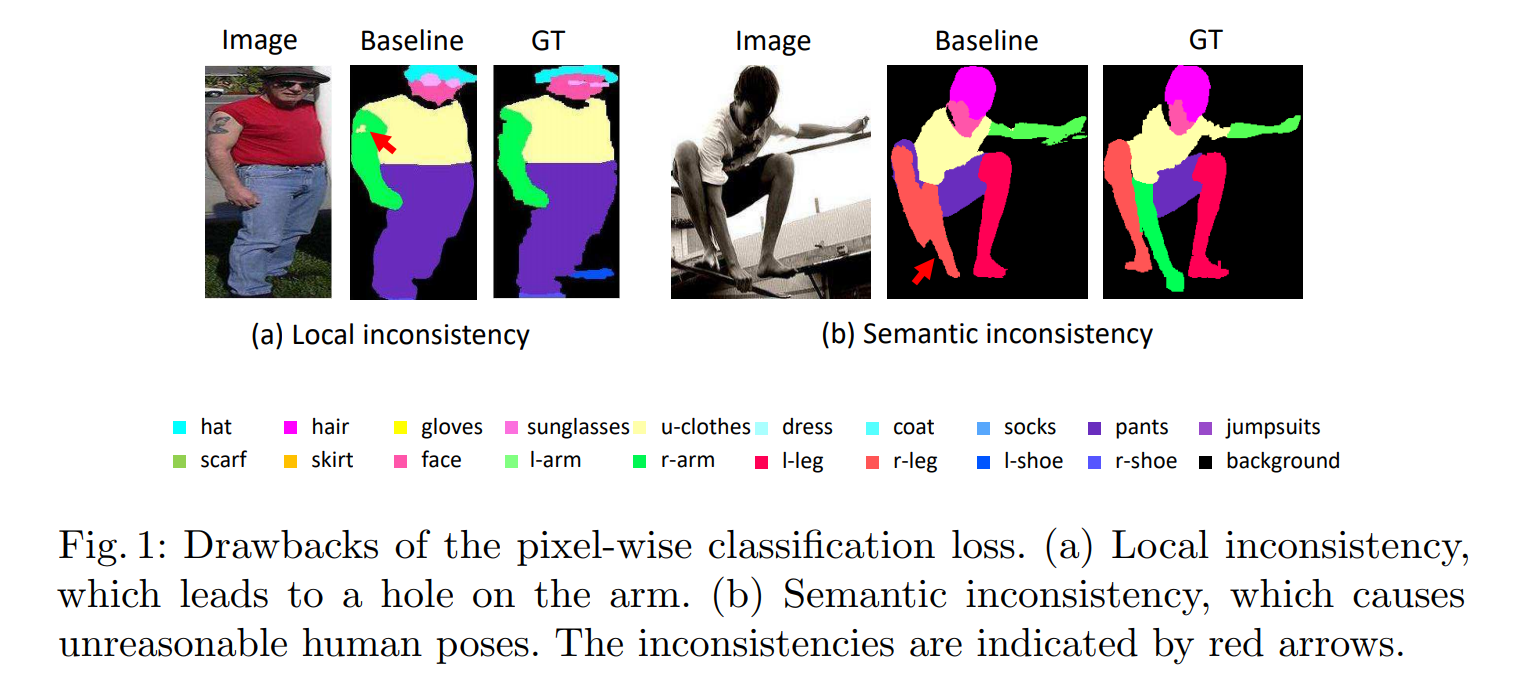
In the attempt to address the inconsistency problems, the conditional random fields (CRFs) [17] can be employed as a post processing method. However, CRFs usually handle inconsistency in very limited scope (locally) due to the pairwise potentials, and may even generate worse label maps given poor initial segmentation result. As an alternative to CRFs, a recent work proposes the use of adversarial network [24]. Since the adversarial loss assesses whether a label map is real or fake by joint configuration of many label variables, it can enforce higher-level consistency, which cannot be achieved with pairwise terms or the per-pixel classification loss. Now, an increasing number of works adopt the routine of combining the cross entropy loss with an adversarial loss to produce label maps closer to the ground truth [5,27,12].
Motiviation-2: Why use the Two Discriminator ?
Nevertheless, the previous adversarial network also has its limitations.
First, the single discriminator back propagates only one adversarial loss to the generator. However, the local inconsistency is generated from top layers and the semantic inconsistency is generated from deep layers. The two targeted layers can not be discretely trained with only one adversarial loss.
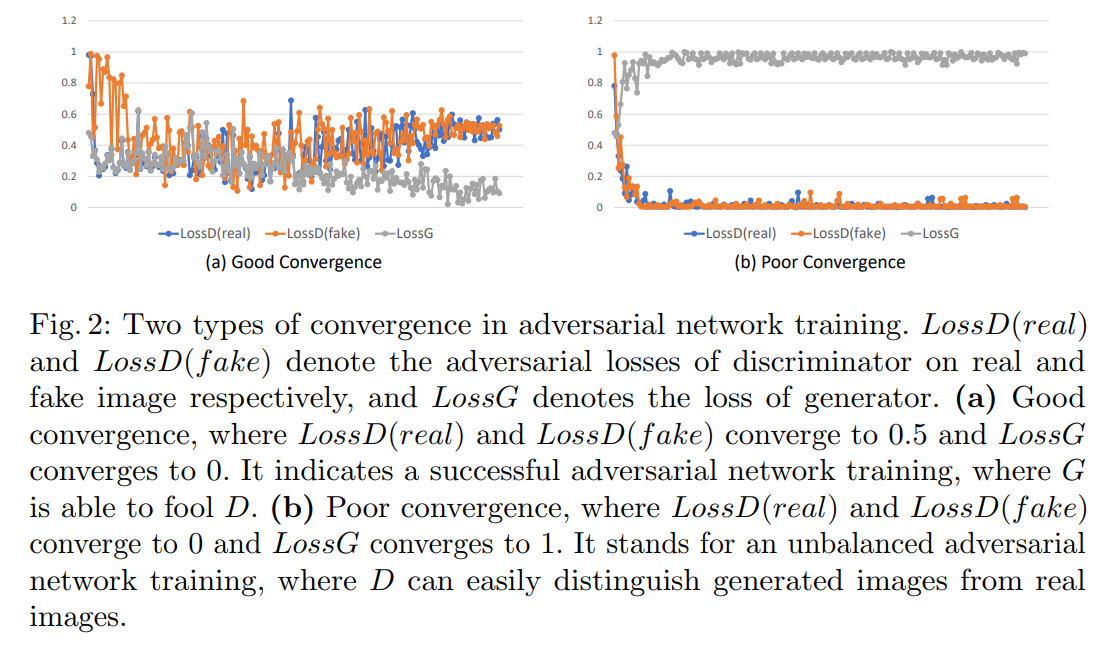
Second, a single discriminator has to look at overall high-resolution image (or a large part of it) in order to supervise the global consistency. As mentioned by numbers of literatures [7,14], it is very difficult for a generator to fool the discriminator on a high-resolution image. As a result, the single discriminator back propagates a maximum adversarial loss invariably, which makes the training unbalanced. We call it poor convergence problem, as shown in Fig. 2.
Our Proposed Approach:
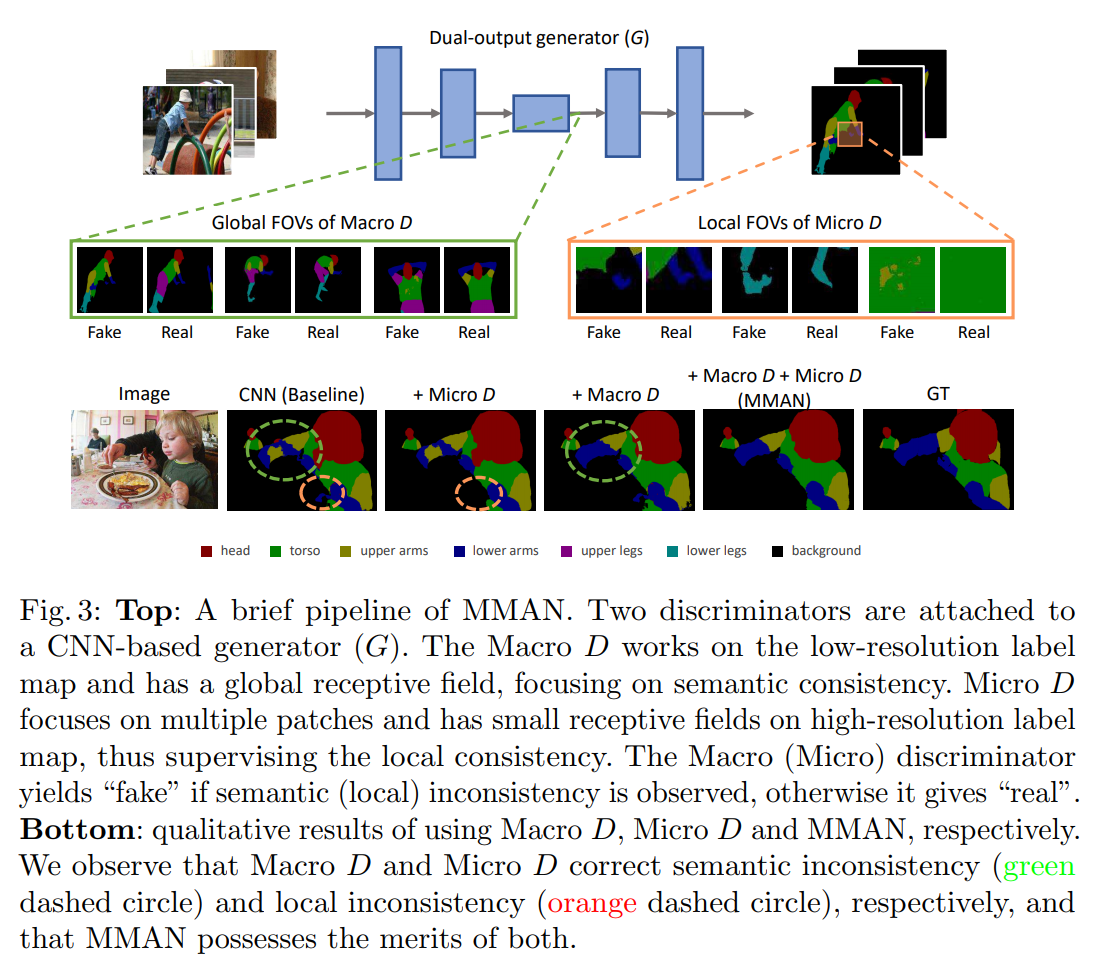
In this paper, the basic objective is to improve the local and semantic consistency of label maps in human parsing. We adopt the idea of adversarial training and at the same time aim to addresses its limitations, i.e., the inferior ability in improving parsing consistency with a single adversarial loss and the poor convergence problem. Specifically, we introduce the Macro-Micro Adversarial Nets (MMAN). MMAN consists of a dual-output generator (G) and two discriminators (D), named Macro D and Micro D. The three modules constitute two adversarial networks (Macro AN, Micro AN), addressing the semantic consistency and the local consistency, respectively.
Difference with Previous Works:
A brief pipeline of the proposed framework is shown in Fig. 3. It is in two critical aspects that MMAN departs from previous works.
First, our method explicitly copes with the local inconsistency and semantic inconsistency problem using two task-specific adversarial networks individually.
Second, our method does not use large-sized FOVs on high-resolution image, so we can avoid the poor convergence problem. More detailed description of the merits of the proposed network is provided in Section 3.5.
Our Contributions:
– We propose a new framework called Macro-Micro Adversarial Network (MMAN) for human parsing. The Macro AN and Micro AN focus on semantic and local inconsistency respectively, and work in complementary way to improve the parsing quality.
– The two discriminators in our framework achieve local and global supervision on the label maps with small field of views (FOVs), which avoids the poor convergence problem caused by high-resolution images.
– The proposed adversarial net achieves very competitive mIoU on the LIP and PASCAL-Person-Part datasets, and can be well generalized on a relatively small dataset PPSS.
==
Macro-Micro Adversarial Network for Human Parsing的更多相关文章
- 《Macro-Micro Adversarial Network for Human Parsing》论文阅读笔记
<Macro-Micro Adversarial Network for Human Parsing> 摘要:在人体语义分割中,像素级别的分类损失在其低级局部不一致性和高级语义不一致性方面 ...
- 论文阅读之:Photo-Realistic Single Image Super-Resolution Using a Generative Adversarial Network
Photo-Realistic Single Image Super-Resolution Using a Generative Adversarial Network 2016.10.23 摘要: ...
- 论文笔记: Mutual Learning to Adapt for Joint Human Parsing and Pose Estimation
Mutual Learning to Adapt for Joint Human Parsing and Pose Estimation 2018-11-03 09:58:58 Paper: http ...
- Face Aging with Conditional Generative Adversarial Network 论文笔记
Face Aging with Conditional Generative Adversarial Network 论文笔记 2017.02.28 Motivation: 本文是要根据最新的条件产 ...
- 生成对抗网络(Generative Adversarial Network)阅读笔记
笔记持续更新中,请大家耐心等待 首先需要大概了解什么是生成对抗网络,参考维基百科给出的定义(https://zh.wikipedia.org/wiki/生成对抗网络): 生成对抗网络(英语:Gener ...
- GAN Generative Adversarial Network 生成式对抗网络-相关内容
参考: https://baijiahao.baidu.com/s?id=1568663805038898&wfr=spider&for=pc Generative Adversari ...
- ASRWGAN: Wasserstein Generative Adversarial Network for Audio Super Resolution
ASEGAN:WGAN音频超分辨率 这篇文章并不具有权威性,因为没有发表,说不定是外国的某个大学的毕业设计,或者课程结束后的作业.或者实验报告. CS230: Deep Learning, Sprin ...
- 论文阅读:Single Image Dehazing via Conditional Generative Adversarial Network
Single Image Dehazing via Conditional Generative Adversarial Network Runde Li∗ Jinshan Pan∗ Zechao L ...
- Speech Super Resolution Generative Adversarial Network
博客作者:凌逆战 博客地址:https://www.cnblogs.com/LXP-Never/p/10874993.html 论文作者:Sefik Emre Eskimez , Kazuhito K ...
随机推荐
- Maven项目出现Perhaps you are running on a JRE rather than a JDK?
今天 换了一个IDE 然后 运行 maven的时候 报了一个 这个 错误 我记得以前 我遇到过 所以 把解决方法 记下来吧 原因 maven插件需要使用jdk 的 但是 eclipse默认 ...
- Win10上使用VS2015编译Caffe2
Caffe2的官网:https://caffe2.ai/ 1.下载.安装及相关准备 在Caffe2的官网点击"Get Started",即进入安装说明页面.官方还未提供编译好的bi ...
- 【C++/函数】实验2
1.实验内容 函数声明和函数定义: 形参和实参: 主调函数把实参的值传送给被调函数的形参从而实现主调函数向被调函数的数据传送. 形参:形式参数,表示主调函数与被调函数之间的联系.标识了在形参出现的位置 ...
- JavaScript 里,$ 代表什么?/JQuery是什么语言?/html中用link标签引入css时的中 rel="stylesheet"属性?/EL表达式是什么?
JavaScript 里,$ 代表什么? 比如说我写一个mouseover事件: $(document).ready(function(){ $("p").mouseover(fu ...
- jquery实现一个标签图标hover到上面的时候显示tooltip
设计图: 解决思路:1.在thumbnailbox.js这个插件中加入tags弹出框显示的内容,一开始让这些内容display:none; 然后再用css画出来一个三角形 实现方法: 知识点:Jque ...
- 基于UVM的verilog验证
Abstract 本文介绍UVM框架,并以crc7为例进行UVM的验证,最后指出常见的UVM验证开发有哪些坑,以及怎么避免. Introduction 本例使用环境:ModelSim 10.2c,UV ...
- Lint found fatal errors while assembling a release target
1.Android 打包错误信息 Generate signed Bundle or APK 打包时,报了一个错,错误信息如下: Error:Execution failed for task ´: ...
- Cartographer源码阅读(6):LocalTrajectoryBuilder和PoseExtrapolator
LocalTrajectoryBuilder意思是局部轨迹的构建,下面的类图中方法的参数没有画进去. 注意其中的三个类:PoseExtrapolator类,RealTimeCorrelativeSca ...
- iOS代理模式(delegate)的使用
前言: 代理模式是iOS中非常重要的一个模式,iOS SDK中的系统控件几乎都用到了代理模式.代理模式用来处理事件监听.参数传递功能. 协议创建(Protocol): 可手打如下代码,或者在代码块里面 ...
- 一、iOS开发环境搭建
前置条件 1. 必要:一台装有Mac OS X操作系统的电脑:经济允许的话可以买一部Mac book:否则的话,可以试试黑苹果或虚拟机. 2.必要:一个有可用的Apple ID:免费,在Apple的官 ...