
TCP粘包拆包基本解决方案
上个小节我们浅析了在Netty的使用的时候TCP的粘包和拆包的现象,Netty对此问题提供了相对比较丰富的解决方案
Netty提供了几个常用的解码器,帮助我们解决这些问题,其实上述的粘包和拆包的问题,归根结底的解决方案就是发送端给远程端一个标记,告诉远程端,每个信息的结束标志是什么,这样,远程端获取到数据后,根据跟发送端约束的标志,将接收的信息分切或者合并成我们需要的信息,这样我们就可以获取到正确的信息了
例如,我们刚才的例子中,我们可以在发送的信息中,加一个结束标志,例如两个远程端规定以行来切分数据,那么发送端,就需要在每个信息体的末尾加上行结束的标志,部分代码如下:
修改BaseClientHandler的req的构造:
- public BaseClientHandler() {
- // req = ("BazingaLyncc is learner").getBytes();
- req = ("In this chapter you general, we recommend Java Concurrency in Practice by Brian Goetz. His book w"
- + "ill give We’ve reached an exciting point—in the next chapter we’ll discuss bootstrapping, the process "
- + "of configuring and connecting all of Netty’s components to bring your learned about threading models in ge"
- + "neral and Netty’s threading model in particular, whose performance and consistency advantages we discuss"
- + "ed in detail In this chapter you general, we recommend Java Concurrency in Practice by Brian Goetz. Hi"
- + "s book will give We’ve reached an exciting point—in the next chapter we’ll discuss bootstrapping, the"
- + " process of configuring and connecting all of Netty’s components to bring your learned about threading "
- + "models in general and Netty’s threading model in particular, whose performance and consistency advantag"
- + "es we discussed in detailIn this chapter you general, we recommend Java Concurrency in Practice by Bri"
- + "an Goetz. His book will give We’ve reached an exciting point—in the next chapter;the counter is: 1 2222"
- + "sdsa ddasd asdsadas dsadasdas" + System.getProperty("line.separator")).getBytes();
- }
我们在我们巨长的req中末尾加了System.getProperty("line.separator"),这样相当于给req打了一个标记
打完标记,其实我们这个示例中的server中还不知道是以行为结尾的,所以我们需要修改server的handler链,在inbound链中加一个额外的处理链,判断一下,获取的信息按照行来切分,我们很庆幸,这样枯燥的代码Netty已经帮我们完美地完成了,Netty提供了一个LineBasedFrameDecoder这个类,顾名思义,这个类名字中有decoder,说明是一个解码器,我们再看看它的详细声明:
- /**
- * A decoder that splits the received {@link ByteBuf}s on line endings.
- * <p>
- * Both {@code "\n"} and {@code "\r\n"} are handled.
- * For a more general delimiter-based decoder, see {@link DelimiterBasedFrameDecoder}.
- */
- public class LineBasedFrameDecoder extends ByteToMessageDecoder {
- /** Maximum length of a frame we're willing to decode. */
- private final int maxLength;
- /** Whether or not to throw an exception as soon as we exceed maxLength. */
- private final boolean failFast;
- private final boolean stripDelimiter;
- /** True if we're discarding input because we're already over maxLength. */
- private boolean discarding;
- private int discardedBytes;
它是继承ByteToMessageDecoder的,是将byte类型转化成Message的,所以我们应该将这个解码器放在inbound处理器链的第一个,所以我们修改一下Server端的启动代码:
- package com.lyncc.netty.stickpackage.myself;
- import io.netty.bootstrap.ServerBootstrap;
- import io.netty.channel.ChannelFuture;
- import io.netty.channel.ChannelInitializer;
- import io.netty.channel.ChannelOption;
- import io.netty.channel.EventLoopGroup;
- import io.netty.channel.nio.NioEventLoopGroup;
- import io.netty.channel.socket.SocketChannel;
- import io.netty.channel.socket.nio.NioServerSocketChannel;
- import io.netty.handler.codec.LineBasedFrameDecoder;
- import io.netty.handler.codec.string.StringDecoder;
- import java.net.InetSocketAddress;
- public class BaseServer {
- private int port;
- public BaseServer(int port) {
- this.port = port;
- }
- public void start(){
- EventLoopGroup bossGroup = new NioEventLoopGroup(1);
- EventLoopGroup workerGroup = new NioEventLoopGroup();
- try {
- ServerBootstrap sbs = new ServerBootstrap().group(bossGroup,workerGroup).channel(NioServerSocketChannel.class).localAddress(new InetSocketAddress(port))
- .childHandler(new ChannelInitializer<SocketChannel>() {
- protected void initChannel(SocketChannel ch) throws Exception {
- ch.pipeline().addLast(new LineBasedFrameDecoder(2048));
- ch.pipeline().addLast(new StringDecoder());
- ch.pipeline().addLast(new BaseServerHandler());
- };
- }).option(ChannelOption.SO_BACKLOG, 128)
- .childOption(ChannelOption.SO_KEEPALIVE, true);
- // 绑定端口,开始接收进来的连接
- ChannelFuture future = sbs.bind(port).sync();
- System.out.println("Server start listen at " + port );
- future.channel().closeFuture().sync();
- } catch (Exception e) {
- bossGroup.shutdownGracefully();
- workerGroup.shutdownGracefully();
- }
- }
- public static void main(String[] args) throws Exception {
- int port;
- if (args.length > 0) {
- port = Integer.parseInt(args[0]);
- } else {
- port = 8080;
- }
- new BaseServer(port).start();
- }
- }
这样,我们只是在initChannel方法中增加了一个LineBasedFrameDecoder这个类,其中2048是规定一行数据最大的字节数
我们再次运行,我们再看看效果:

可以看到客户端发送的两次msg,被服务器端成功地两次接收了,我们要的效果达到了
我们将LineBasedFrameDecoder中的2048参数,缩小一半,变成1024,我们再看看效果:
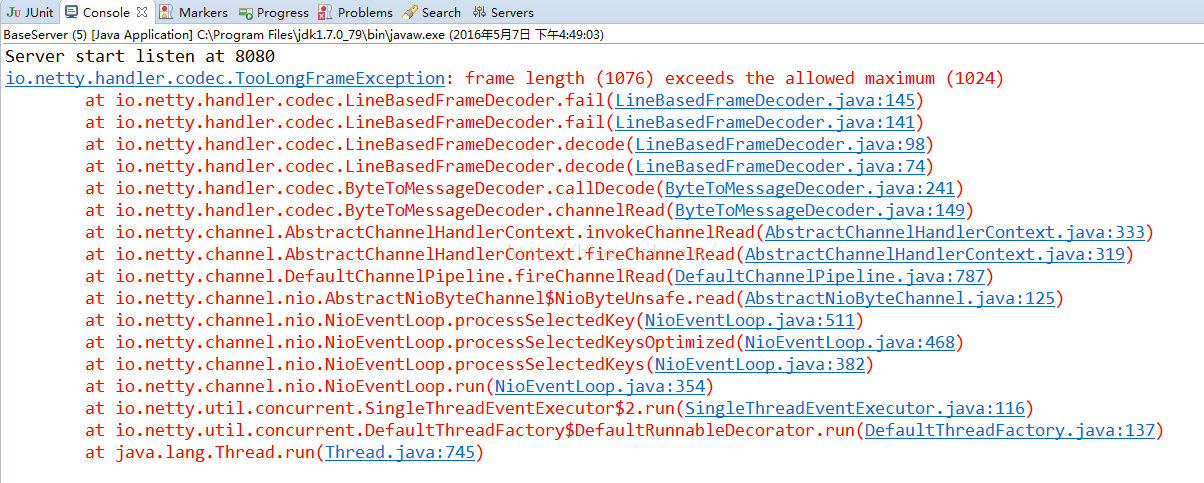
出现了异常,这个异常时TooLongFrameException,这个异常在Netty in Action中介绍过,帧的大小太大,在我们这个场景中,就是我们发送的一行信息大小是1076,大于了我们规定的1024所以报错了
我们再解决另一个粘包的问题,我们可以看到上节中介绍的那个粘包案例中,我们发送了100次的信息“BazingaLyncc is learner”,这个案例很特殊,这个信息是一个特长的数据,字节长度是23,所以我们可以使用Netty为我们提供的FixedLengthFrameDecoder这个解码器,看到这个名字就明白了大半,定长数据帧的解码器,所以我们修改一下代码:
BaseClientHandler:
- package com.lyncc.netty.stickpackage.myself;
- import io.netty.buffer.ByteBuf;
- import io.netty.buffer.Unpooled;
- import io.netty.channel.ChannelHandlerContext;
- import io.netty.channel.ChannelInboundHandlerAdapter;
- public class BaseClientHandler extends ChannelInboundHandlerAdapter{
- private byte[] req;
- public BaseClientHandler() {
- req = ("BazingaLyncc is learner").getBytes();
- // req = ("In this chapter you general, we recommend Java Concurrency in Practice by Brian Goetz. His book w"
- // + "ill give We’ve reached an exciting point—in the next chapter we’ll discuss bootstrapping, the process "
- // + "of configuring and connecting all of Netty’s components to bring your learned about threading models in ge"
- // + "neral and Netty’s threading model in particular, whose performance and consistency advantages we discuss"
- // + "ed in detail In this chapter you general, we recommend Java Concurrency in Practice by Brian Goetz. Hi"
- // + "s book will give We’ve reached an exciting point—in the next chapter we’ll discuss bootstrapping, the"
- // + " process of configuring and connecting all of Netty’s components to bring your learned about threading "
- // + "models in general and Netty’s threading model in particular, whose performance and consistency advantag"
- // + "es we discussed in detailIn this chapter you general, we recommend Java Concurrency in Practice by Bri"
- // + "an Goetz. His book will give We’ve reached an exciting point—in the next chapter;the counter is: 1 2222"
- // + "sdsa ddasd asdsadas dsadasdas" + System.getProperty("line.separator")).getBytes();
- }
- @Override
- public void channelActive(ChannelHandlerContext ctx) throws Exception {
- ByteBuf message = null;
- for (int i = 0; i < 100; i++) {
- message = Unpooled.buffer(req.length);
- message.writeBytes(req);
- ctx.writeAndFlush(message);
- }
- // message = Unpooled.buffer(req.length);
- // message.writeBytes(req);
- // ctx.writeAndFlush(message);
- // message = Unpooled.buffer(req.length);
- // message.writeBytes(req);
- // ctx.writeAndFlush(message);
- }
- @Override
- public void exceptionCaught(ChannelHandlerContext ctx, Throwable cause) {
- ctx.close();
- }
- }
BaseServer:
- package com.lyncc.netty.stickpackage.myself;
- import io.netty.bootstrap.ServerBootstrap;
- import io.netty.channel.ChannelFuture;
- import io.netty.channel.ChannelInitializer;
- import io.netty.channel.ChannelOption;
- import io.netty.channel.EventLoopGroup;
- import io.netty.channel.nio.NioEventLoopGroup;
- import io.netty.channel.socket.SocketChannel;
- import io.netty.channel.socket.nio.NioServerSocketChannel;
- import io.netty.handler.codec.FixedLengthFrameDecoder;
- import io.netty.handler.codec.string.StringDecoder;
- import java.net.InetSocketAddress;
- public class BaseServer {
- private int port;
- public BaseServer(int port) {
- this.port = port;
- }
- public void start(){
- EventLoopGroup bossGroup = new NioEventLoopGroup(1);
- EventLoopGroup workerGroup = new NioEventLoopGroup();
- try {
- ServerBootstrap sbs = new ServerBootstrap().group(bossGroup,workerGroup).channel(NioServerSocketChannel.class).localAddress(new InetSocketAddress(port))
- .childHandler(new ChannelInitializer<SocketChannel>() {
- protected void initChannel(SocketChannel ch) throws Exception {
- ch.pipeline().addLast(new FixedLengthFrameDecoder(23));
- ch.pipeline().addLast(new StringDecoder());
- ch.pipeline().addLast(new BaseServerHandler());
- };
- }).option(ChannelOption.SO_BACKLOG, 128)
- .childOption(ChannelOption.SO_KEEPALIVE, true);
- // 绑定端口,开始接收进来的连接
- ChannelFuture future = sbs.bind(port).sync();
- System.out.println("Server start listen at " + port );
- future.channel().closeFuture().sync();
- } catch (Exception e) {
- bossGroup.shutdownGracefully();
- workerGroup.shutdownGracefully();
- }
- }
- public static void main(String[] args) throws Exception {
- int port;
- if (args.length > 0) {
- port = Integer.parseInt(args[0]);
- } else {
- port = 8080;
- }
- new BaseServer(port).start();
- }
- }
我们就是在channelhandler链中,加入了FixedLengthFrameDecoder,且参数是23,告诉Netty,获取的帧数据有23个字节就切分一次
运行结果:
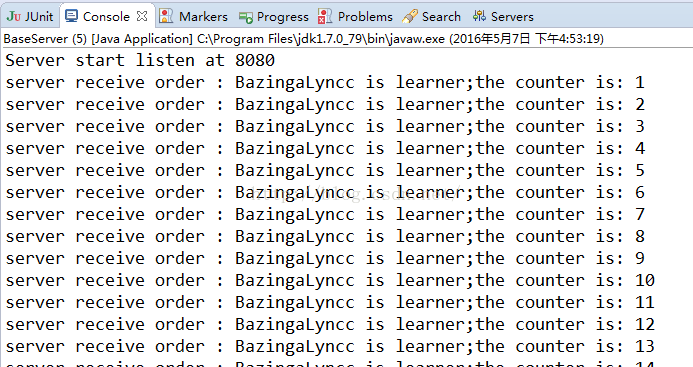
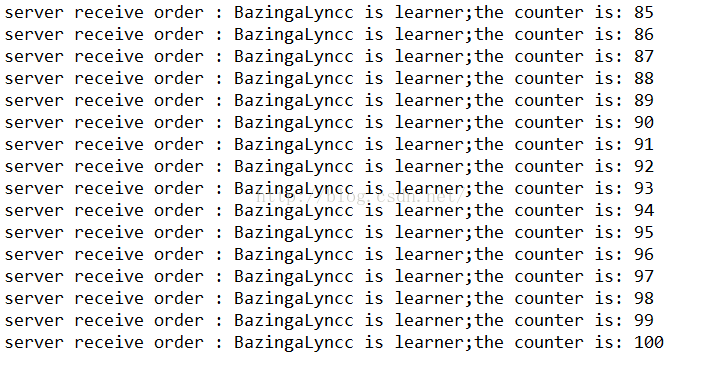
可以看见,我们获取到了我们想要的效果
当然Netty还提供了一些其他的解码器,有他们自己的使用场景,例如有按照某个固定字符切分的DelimiterBasedFrameDecoder的解码器
我们再次修改代码:
BaseClientHandler.java
- package com.lyncc.netty.stickpackage.myself;
- import io.netty.buffer.ByteBuf;
- import io.netty.buffer.Unpooled;
- import io.netty.channel.ChannelHandlerContext;
- import io.netty.channel.ChannelInboundHandlerAdapter;
- public class BaseClientHandler extends ChannelInboundHandlerAdapter{
- private byte[] req;
- public BaseClientHandler() {
- // req = ("BazingaLyncc is learner").getBytes();
- req = ("In this chapter you general, we recommend Java Concurrency in Practice by Brian Goetz. $$__ His book w"
- + "ill give We’ve reached an exciting point—in the next chapter we’ll $$__ discuss bootstrapping, the process "
- + "of configuring and connecting all of Netty’s components to bring $$__ your learned about threading models in ge"
- + "neral and Netty’s threading model in particular, whose performance $$__ and consistency advantages we discuss"
- + "ed in detail In this chapter you general, we recommend Java $$__Concurrency in Practice by Brian Goetz. Hi"
- + "s book will give We’ve reached an exciting point—in the next $$__ chapter we’ll discuss bootstrapping, the"
- + " process of configuring and connecting all of Netty’s components $$__ to bring your learned about threading "
- + "models in general and Netty’s threading model in particular, $$__ whose performance and consistency advantag"
- + "es we discussed in detailIn this chapter you general, $$__ we recommend Java Concurrency in Practice by Bri"
- + "an Goetz. His book will give We’ve reached an exciting $$__ point—in the next chapter;the counter is: 1 2222"
- + "sdsa ddasd asdsadas dsadasdas" + System.getProperty("line.separator")).getBytes();
- }
- @Override
- public void channelActive(ChannelHandlerContext ctx) throws Exception {
- ByteBuf message = null;
- // for (int i = 0; i < 100; i++) {
- // message = Unpooled.buffer(req.length);
- // message.writeBytes(req);
- // ctx.writeAndFlush(message);
- // }
- message = Unpooled.buffer(req.length);
- message.writeBytes(req);
- ctx.writeAndFlush(message);
- message = Unpooled.buffer(req.length);
- message.writeBytes(req);
- ctx.writeAndFlush(message);
- }
- @Override
- public void exceptionCaught(ChannelHandlerContext ctx, Throwable cause) {
- ctx.close();
- }
- }
我们在req的字符串中增加了“$$__”这样的切割符,然后再Server中照例增加一个DelimiterBasedFrameDecoder,来切割字符串:
- ServerBootstrap sbs = new ServerBootstrap().group(bossGroup,workerGroup).channel(NioServerSocketChannel.class).localAddress(new InetSocketAddress(port))
- .childHandler(new ChannelInitializer<SocketChannel>() {
- protected void initChannel(SocketChannel ch) throws Exception {
- ch.pipeline().addLast(new DelimiterBasedFrameDecoder(1024,Unpooled.copiedBuffer("$$__".getBytes())));
- ch.pipeline().addLast(new StringDecoder());
- ch.pipeline().addLast(new BaseServerHandler());
- };
- }).option(ChannelOption.SO_BACKLOG, 128)
- .childOption(ChannelOption.SO_KEEPALIVE, true);
我们在initChannel中第一个inbound中增加了DelimiterBasedFrameDecoder,且规定切割符就是“$$__”,这样就能正常切割了,我们看看运行效果:
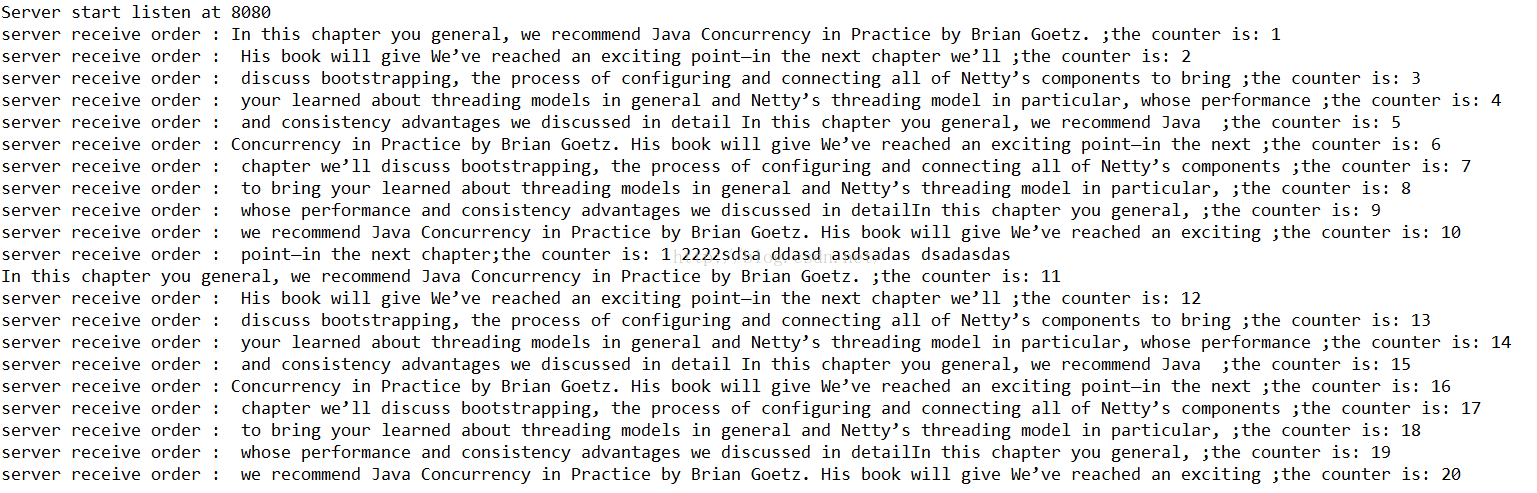
可以看到被分了20次读取,我们可以这样理解,客户端发送了2次req字节,每个req中有10个“$$__”,这样就是第11次切割的时候其实发送了粘包,第一个req中末尾部分和第二次的头部粘在了一起,作为第11部分的内容
而最后一部分的内容因为没有"$$__"切割,所以没有打印在控制台上~
其实这类的Handler还是相对比较简单的,真实的生产环境这些decoder只是作为比较基本的切分类,但是这些decoder还是很好用的~
希望讲的对您有所帮助~END~
TCP粘包拆包基本解决方案的更多相关文章
- TCP 粘包 - 拆包问题及解决方案
目录 TCP粘包拆包问题 什么是粘包 - 拆包问题 为什么存在粘包 - 拆包问题 粘包 - 拆包 演示 粘包 - 拆包 解决方案 方式一: 固定缓冲区大小 方式二: 封装请求协议 方式三: 特殊字符结 ...
- Netty(三)TCP粘包拆包处理
tcp是一个“流”的协议,一个完整的包可能会被TCP拆分成多个包进行发送,也可能把小的封装成一个大的数据包发送,这就是所谓的TCP粘包和拆包问题. 粘包.拆包问题说明 假设客户端分别发送数据包D1和D ...
- TCP粘包/拆包问题
无论是服务端还是客户端,当我们读取或者发送消息的时候,都需要考虑TCP底层的粘包/拆包机制. TCP粘包/拆包 TCP是个"流"协议,所谓流,就是没有界限的一串数据.大家可以想想河 ...
- TCP 粘包/拆包问题
简介 TCP 是一个’流’协议,所谓流,就是没有界限的一串数据. 大家可以想想河里的流水,是连成一片的.期间并没有分界线, TCP 底层并不了解上层业务数据的具体含义 ,它会根据 TCP 缓冲区 ...
- Netty(二)——TCP粘包/拆包
转载请注明出处:http://www.cnblogs.com/Joanna-Yan/p/7814644.html 前面讲到:Netty(一)--Netty入门程序 主要内容: TCP粘包/拆包的基础知 ...
- Java网络编程基础之TCP粘包拆包
TCP是个"流"协议,所谓流,就是没有界限的一串数据.大家可以想象河里的流水,他们是连成一片的,其间并没有分界线.TCP底层并不了解上层业务数据的具体含义,他会根据TCP缓冲区的实 ...
- Netty使用LineBasedFrameDecoder解决TCP粘包/拆包
TCP粘包/拆包 TCP是个”流”协议,所谓流,就是没有界限的一串数据.TCP底层并不了解上层业务数据的具体含义,它会根据TCP缓冲区的实际情况进行包的划分,所以在业务上认为,一个完整的包可能会被TC ...
- TCP粘包/拆包(Netty权威指南)
无论是服务端还是客户端,当我们读取或者发送消息的时候,都需要考虑TCP底层的粘包/拆包机制. TCP粘包/拆包 TCP是个“流”协议,所谓流,就是没有界限的一串数据.大家可以想想河里的流水,是连成一片 ...
- 《精通并发与Netty》学习笔记(13 - 解决TCP粘包拆包(一)概念及实例演示)
一.粘包/拆包概念 TCP是一个“流”协议,所谓流,就是没有界限的一长串二进制数据.TCP作为传输层协议并不不了解上层业务数据的具体含义,它会根据TCP缓冲区的实际情况进行数据包的划分,所以在业务上认 ...
随机推荐
- Python3 移动文件——合集
文件/文件夹操作头文件 import os import shutil 参考 Python3批量移动指定文件到指定文件夹
- js之隔行换色
HTML <!DOCTYPE html> <html> <head> <meta charset="utf-8" /> <ti ...
- 安装伪分布式hbase 0.99.0
查看是否启动成功,输入jps,看到有HMaster和HQuorumPeer,浏览器输入http://localhost:16030/master-status,能打开说明成功 hbase(main): ...
- mysql安装优化
安装centos7 安装mysql解决方案1 安装mariadb解决方案2 官网下载安装mysql-server时区批量配置编码远程连接my.cnf简版的参数说明核心配置参数升级版mysql存储引擎M ...
- Codeforces Round #371 & HihoCoder1529【玄学】
时间限制:40000ms 单点时限:2000ms 内存限制:256MB 描述 给定一个长度为 n 的非负整数序列 a[1..n]. 你每次可以花费 1 的代价给某个 a[i] 加1或者减1. 求最少需 ...
- vector 介绍
介绍 这篇文章的目的是为了介绍std::vector,如何恰当地使用它们的成员函数等操作.本文中还讨论了条件函数和函数指针在迭代算法中使用,如在remove_if()和for_each()中的使用.通 ...
- css设置图片水平及垂直居中
.box { /*非IE的主流浏览器识别的垂直居中的方法*/ display: table-cell; vertical-align:middle; /*设置水平居中*/ text-align:cen ...
- autoconf 添加三方库(libcurl)简单试用
1. 参考项目 https://github.com/rongfengliang/autoconf-project 2. 项目说明 a. 项目结构 ├── Jenkinsfile # jenkins ...
- 去掉UIWebView上下滚动出边界时的黑色阴影
for (UIView *viewin [_webViewsubviews]){ if ([viewisKindOfClass:[UIScrollView class]]){ for (UIView ...
- Centos6.5 恢复误删的系统面板
在CentOS6.5下往面板上拖应用程序时,手贱了,点了"Delete This Panel".结果就悲剧了~面板不见了! 从网上搜了一下解决方法,列举一下. 1.新建面板 如果下 ...