
UVa 122 Trees on the level(二叉树层序遍历)
Trees are fundamental in many branches of computer science. Current state-of-the art parallel computers such as Thinking Machines’ CM-5 are based on fat trees. Quad- and octal-trees are fundamental to many algorithms in computer graphics.
This problem involves building and traversing binary trees.
Given a sequence of binary trees, you are to write a program that prints a level-order traversal of each tree. In this problem each node of a binary tree contains a positive integer and all binary trees have have fewer than 256 nodes.
In a level-order traversal of a tree, the data in all nodes at a given level are printed in left-to-right order and all nodes at level k are printed before all nodes at level k+1.
For example, a level order traversal of the tree
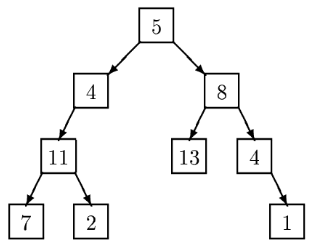
is: 5, 4, 8, 11, 13, 4, 7, 2, 1.
In this problem a binary tree is specified by a sequence of pairs (n,s) where n is the value at the node whose path from the root is given by the string s. A path is given be a sequence of L’s and R’s where L indicates a left branch and R indicates a right branch. In the tree diagrammed above, the node containing 13 is specified by (13,RL), and the node containing 2 is specified by (2,LLR). The root node is specified by (5,) where the empty string indicates the path from the root to itself. A binary tree is considered to be completely specified if every node on all root-to-node paths in the tree is given a value exactly once.
Input
The input is a sequence of binary trees specified as described above. Each tree in a sequence consists of several pairs (n,s) as described above separated by whitespace. The last entry in each tree is (). No whitespace appears between left and right parentheses.
All nodes contain a positive integer. Every tree in the input will consist of at least one node and no more than 256 nodes. Input is terminated by end-of-file.
Output
For each completely specified binary tree in the input file, the level order traversal of that tree should be printed. If a tree is not completely specified, i.e., some node in the tree is NOT given a value or a node is given a value more than once, then the string “not complete” should be printed.
Sample Input
(11,LL) (7,LLL) (8,R)
(5,) (4,L) (13,RL) (2,LLR) (1,RRR) (4,RR) ()
(3,L) (4,R) ()
Sample Output
5 4 8 11 13 4 7 2 1
not complete
题意
把给你的所有结点转成一棵树,并按层次遍历输出
题解
用链表的就不多说了,贴个数组的
代码
 #include<bits/stdc++.h>

 using namespace std;

 int Left[],Right[],V[],failed,cnt;

 vector<int> vec;

 void addnode(int v,char *s)

 {

     int n=strlen(s);//s[0]=','后的一个字符

     int u=;

     for(int i=;i<n;i++)

     {

         if(s[i]=='L')

         {

             if(Left[u]==-)

             {

                 ++cnt;

                 Left[cnt]=Right[cnt]=V[cnt]=-;

                 Left[u]=cnt;

             }

             u=Left[u];

         }

         else if(s[i]=='R')

         {

             if(Right[u]==-)

             {

                 ++cnt;

                 Left[cnt]=Right[cnt]=V[cnt]=-;

                 Right[u]=cnt;

             }

             u=Right[u];

         }

         else break;

     }

     if(V[u]!=-)failed=;//节点值已经存在

     V[u]=v;

 }

 int bfs()

 {

     vec.clear();

     queue<int> qu;

     qu.push();

     while(!qu.empty())

     {

         int top=qu.front();qu.pop();

         if(V[top]==-)return ;//节点没有赋值

         vec.push_back(V[top]);

         if(Left[top]!=-)qu.push(Left[top]);

         if(Right[top]!=-)qu.push(Right[top]);

     }

     return ;

 }

 int read()

 {

     int v;

     char s[];

     Left[]=Right[]=V[]=-;//0为根节点

     failed=;

     cnt=;

     for(;;)

     {

         if(scanf("%s",s)!=)return ;

         if(!strcmp(s,"()"))break;

         sscanf(&s[],"%d",&v);//从s[1]开始读一个数字

         addnode(v,strchr(s,',')+);

     }

     return ;

 }

 int main()

 {

     while(read())

     {

         if(failed==||bfs()==)

             printf("not complete\n");

         else

             for(int i=;i<vec.size();i++)

                 printf("%d%c",vec[i],i==vec.size()-?'\n':' ');

     }

     return ;

 }
UVa 122 Trees on the level(二叉树层序遍历)的更多相关文章
- UVA.122 Trees on the level(二叉树 BFS)
UVA.122 Trees on the level(二叉树 BFS) 题意分析 给出节点的关系,按照层序遍历一次输出节点的值,若树不完整,则输出not complete 代码总览 #include ...
- UVa 122 Trees on the level (动态建树 && 层序遍历二叉树)
题意 :输入一棵二叉树,你的任务是按从上到下.从左到右的顺序输出各个结点的值.每个结 点都按照从根结点到它的移动序列给出(L表示左,R表示右).在输入中,每个结点的左 括号和右括号之间没有空格,相邻 ...
- UVA 122 -- Trees on the level (二叉树 BFS)
Trees on the level UVA - 122 解题思路: 首先要解决读数据问题,根据题意,当输入为“()”时,结束该组数据读入,当没有字符串时,整个输入结束.因此可以专门编写一个rea ...
- UVa 122 Trees on the level(链式二叉树的建立和层次遍历)
题目链接: https://cn.vjudge.net/problem/UVA-122 /* 问题 给出每个节点的权值和路线,输出该二叉树的层次遍历序列. 解题思路 根据输入构建链式二叉树,再用广度优 ...
- UVA - 122 Trees on the level (二叉树的层次遍历)
题意:给定结点值和从根结点到该结点的路径,若根到某个叶结点路径上有的结点输入中未给出或给出超过一次,则not complete,否则层次遍历输出所有结点. 分析:先建树,建树的过程中,沿途结点都申请了 ...
- uva 122 trees on the level——yhx
题目如下:Given a sequence of binary trees, you are to write a program that prints a level-order traversa ...
- UVa 122 Trees on the level
题目的意思: 输入很多个节点,包括路径和数值,但是不一定这些全部可以构成一棵树,问题就是判断所给的能否构成一棵树,且没有多余. 网上其他大神已经给出了题目意思:比如我一直很喜欢的小白菜又菜的博客 说一 ...
- 【LeetCode-面试算法经典-Java实现】【107-Binary Tree Level Order Traversal II(二叉树层序遍历II)】
[107-Binary Tree Level Order Traversal II(二叉树层序遍历II)] [LeetCode-面试算法经典-Java实现][全部题目文件夹索引] 原题 Given a ...
- [LeetCode] 107. Binary Tree Level Order Traversal II 二叉树层序遍历 II
Given a binary tree, return the bottom-up level order traversal of its nodes' values. (ie, from left ...
随机推荐
- UI5-Fiori初学者导航
正文 你是UI5和Fiori的新手?来对地方了. 对我来说,今年是不得不“跟上时代”去提升自己ABAP世界以外的技术技能的困难的一年.幸运的是,有很多可免费获得的信息和课程可以帮你实现这个跳跃.不要等 ...
- jinjia
https://www.cnblogs.com/dachenzi/p/8242713.html
- eclipse中导入java类失败的问题
在 Eclips 开发时,新建了一个 Dynamic Web Project,在运行jsp文件时tomcat报错: org.apache.jasper.JasperException: Unable ...
- 尚硅谷springboot学习16-slf4j的使用
如何在系统中使用SLF4j 以后开发的时候,日志记录方法的调用,不应该来直接调用日志的实现类,而是调用日志抽象层里面的方法: 给系统里面导入slf4j的jar和 logback的实现jar impor ...
- 【转】解决Eclipse中SVN版本信息不显示的问题
eclipse 中使用 svn 插件,原本正常,未作任何更改,最近几天突然eclipse 中查看文件时,文件后面的 版本号 . 文件的状态图标 等等都不见了.以为有插件冲突,卸载了好多其他的相关的插件 ...
- C++ : 窗口变化相关消息 OnSize、OnSizing和OnGetMinMaxInfo,onsizeonsizing
个消息分别是:WM_SIZE.WM_SIZING.WM_GETMINMAXINFO:分别对应相应的处理函数:OnSize.OnSizing.OnGetMinMaxInfo. 当窗口大小发生变化时,响应 ...
- Java8 Optional的简单操作
我们经常会遇到这种情况:首先判断一个对象是否为null,如果不为null,获取一个对象中的一个属性,如果该属性不为null,又获取该属性的属性,如果该属性的属性不为null,又获取属性的属性的属性: ...
- JAVA语言 第七周
啊因为来学校了,没有网,昨天的总结今天来写吧. num1=In.next(); student1[number].stuNum=num1; 这个添加的代码,显示添加成功了,但是根本查询不出来,烦 ...
- vue 学习笔记1
1.子组件在父组件的原生的事件例如一个child子组件的点击事件<child @click="handleClick">点击</child>这种情况在父组件 ...
- Gradle安装和在IDEA使用 基本操作
阅读目录 简单介绍 安装 使用idea创建一个web的Gradle项目 如何进行打包 解释build.gradle和settings.gradle 有关gradle的jar冲突 本地jar包位置和修改 ...