
Mybatis Generator通用Join的实现
通常,我们使用Mybatis实现join表关联的时候,一般都是通过在xml或注解里写自定义sql实现。
本文通过Mybatis Generator的插件功能新增一个JoinPlugin插件,只要在配置文件里加上该插件就可以使用。无其他第三方依赖。如下图:
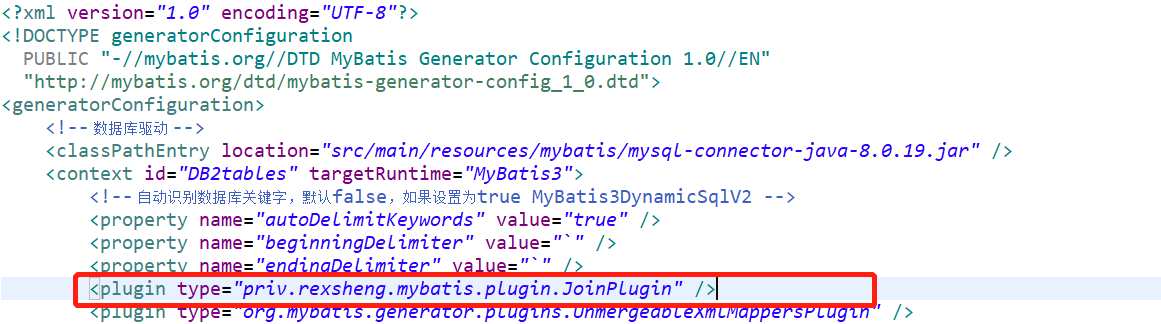
该插件符合mbg plugin即插即用的特点,不影响生成的实体类,只对生成的Example文件做少量变动(新增一个内部类)。
首选我们看一下使用效果,如果符合你的要求,请关注支持。
/**

     * 简单join查询示例

     * select t0.user_id as t0_user_id,t0.user_name as t0_user_name,t0.login_account as t0_login_account,t0.login_password as t0_login_password,

     *  t0.user_sex as t0_user_sex,t0.user_email as t0_user_email,t0.user_mobile as t0_user_mobile,t0.user_avatar as t0_user_avatar,

     *  t0.user_company as t0_user_company,t0.user_dept as t0_user_dept,t0.is_del as t0_is_del,t0.is_admin as t0_is_admin,

     *  t0.system_type as t0_system_type,t0.last_login_time as t0_last_login_time,t0.create_time as t0_create_time,t0.create_user as t0_create_user,

     *  t0.update_time as t0_update_time,t0.update_user as t0_update_user,

     *  t2.role_id as t2_role_id,t2.role_name as t2_role_name

     * from auth_user as t0

     * inner join auth_user_role as t1 on t0.user_id = t1.user_id

     * left join auth_role as t2 on t2.role_id = t1.role_id

     * where ( ( t0.user_id is not null and ( t0.create_time is not null or t0.create_user is not null ) ) ) and ( t1.user_id <>999999 and t1.role_id >=1 )

     * order by t2.role_id desc,t0.create_time

     * limit  10,100

     */

    public void joinTable() {

        AuthUserExample authUserExample=new AuthUserExample();

        AuthUserExample.Criteria criteria=authUserExample.createCriteria();

        //where条件

        criteria.andUserIdIsNotNull();

        criteria.createOrCriteria().andCreateTimeIsNotNull().andCreateUserIsNotNull();

        //关联user_role

        AuthUserRoleExample urExample=new AuthUserRoleExample();

        //where中user_role表的条件

        urExample.createCriteria().andUserIdNotEqualTo(999999).andRoleIdGreaterThanOrEqualTo(1);

        criteria.createJoinCriteria()

        .innerJoinTable(urExample)

        //使用User表的user_id关联user_role表的user_id

        .on(a->a.getUserId(), a->a.equalTo(b->b.tableInfo.getUserId()));

        //关联role

        AuthRoleExample roleExample=new AuthRoleExample();

        criteria.createJoinCriteria()

        .leftJoinTable(roleExample)

        //使用role表的role_id关联user_role表的role_id

        .on(a->a.tableInfo.getRoleId(), a->a.equalTo(b->b.tableInfo.getRoleId()), urExample)

        //先按照role表的role_id降序

        .orderByDesc(a->a.tableInfo.getRoleId())

        //再按照user表的create_time升序

        .orderByFirstTable(a->a.getCreateTime())

        //跳过前10条

        .skip(10)

        //取100条记录

        .take(100)

        //只查询role表的role_id和role_name两个字段

        .select(a->new String[] {a.tableInfo.getRoleId(),a.tableInfo.getRoleName()});

        //执行查询

        List<Tuple> userList=userDao.selectJoinByExample(authUserExample);

        int totalItemCount=(int) userDao.countJoinByExample(authUserExample);

        System.out.println(userList.size()+",total:"+totalItemCount);

        for(Tuple tuple:userList) {

            AuthUser authUser=tuple.getObject(AuthUser.class);

            AuthUserRole authUserRole=tuple.getObject(AuthUserRole.class);

            AuthRole authRole=tuple.getObject(AuthRole.class);

            totalItemCount++;

        }

    }
控制台打印内容如下:
2020-04-23 23:09:16.326  INFO 10308 --- [nio-9000-exec-4] p.r.m.i.SqlStatementInterceptor          : ===>sql:select t0.user_id as t0_user_id,t0.user_name as t0_user_name,t0.login_account as t0_login_account,t0.login_password as t0_login_password,t0.user_sex as t0_user_sex,t0.user_email as t0_user_email,t0.user_mobile as t0_user_mobile,t0.user_avatar as t0_user_avatar,t0.user_company as t0_user_company,t0.user_dept as t0_user_dept,t0.is_del as t0_is_del,t0.is_admin as t0_is_admin,t0.system_type as t0_system_type,t0.last_login_time as t0_last_login_time,t0.create_time as t0_create_time,t0.create_user as t0_create_user,t0.update_time as t0_update_time,t0.update_user as t0_update_user,t0.`type` as t0_type,t0.title as t0_title,t0.bz as t0_bz,t2.role_id as t2_role_id,t2.role_name as t2_role_name

from auth_user as t0

inner join auth_user_role as t1 on t0.user_id = t1.user_id

left join auth_role as t2 on t2.role_id = t1.role_id

where ( ( t0.user_id is not null and ( t0.create_time is not null or t0.create_user is not null ) ) ) and ( t1.user_id <>999999 and t1.role_id >=1 )

order by t2.role_id desc,t0.create_time

limit  10,100

2020-04-23 23:09:16.329 DEBUG 10308 --- [nio-9000-exec-4] c.r.m.d.A.selectJoinByExample            : ==>  Preparing: select t0.user_id as t0_user_id,t0.user_name as t0_user_name,t0.login_account as t0_login_account,t0.login_password as t0_login_password,t0.user_sex as t0_user_sex,t0.user_email as t0_user_email,t0.user_mobile as t0_user_mobile,t0.user_avatar as t0_user_avatar,t0.user_company as t0_user_company,t0.user_dept as t0_user_dept,t0.is_del as t0_is_del,t0.is_admin as t0_is_admin,t0.system_type as t0_system_type,t0.last_login_time as t0_last_login_time,t0.create_time as t0_create_time,t0.create_user as t0_create_user,t0.update_time as t0_update_time,t0.update_user as t0_update_user,t0.`type` as t0_type,t0.title as t0_title,t0.bz as t0_bz,t2.role_id as t2_role_id,t2.role_name as t2_role_name from auth_user as t0 inner join auth_user_role as t1 on t0.user_id = t1.user_id left join auth_role as t2 on t2.role_id = t1.role_id WHERE ( ( t0.user_id is not null and ( t0.create_time is not null or t0.create_user is not null ) ) ) and ( t1.user_id <>? and t1.role_id >=? ) order by t2.role_id desc,t0.create_time limit 10,100

2020-04-23 23:09:16.330 DEBUG 10308 --- [nio-9000-exec-4] c.r.m.d.A.selectJoinByExample            : ==> Parameters: 999999(Integer), 1(Integer)

2020-04-23 23:09:16.361 DEBUG 10308 --- [nio-9000-exec-4] c.r.m.d.A.selectJoinByExample            : <==      Total: 100

2020-04-23 23:09:16.367  INFO 10308 --- [nio-9000-exec-4] p.r.m.i.SqlStatementInterceptor          : c.r.m.d.AuthUserMapper.selectJoinByExample:41ms

2020-04-23 23:09:16.371  INFO 10308 --- [nio-9000-exec-4] p.r.m.i.SqlStatementInterceptor          : ===>sql:select count(*)

from auth_user as t0

inner join auth_user_role as t1 on t0.user_id = t1.user_id

left join auth_role as t2 on t2.role_id = t1.role_id

where ( ( t0.user_id is not null and ( t0.create_time is not null or t0.create_user is not null ) ) ) and ( t1.user_id <>999999 and t1.role_id >=1 )

2020-04-23 23:09:16.375 DEBUG 10308 --- [nio-9000-exec-4] c.r.m.d.A.countJoinByExample             : ==>  Preparing: select count(*) from auth_user as t0 inner join auth_user_role as t1 on t0.user_id = t1.user_id left join auth_role as t2 on t2.role_id = t1.role_id WHERE ( ( t0.user_id is not null and ( t0.create_time is not null or t0.create_user is not null ) ) ) and ( t1.user_id <>? and t1.role_id >=? )

2020-04-23 23:09:16.376 DEBUG 10308 --- [nio-9000-exec-4] c.r.m.d.A.countJoinByExample             : ==> Parameters: 999999(Integer), 1(Integer)

2020-04-23 23:09:16.385 DEBUG 10308 --- [nio-9000-exec-4] c.r.m.d.A.countJoinByExample             : <==      Total: 1

2020-04-23 23:09:16.385  INFO 10308 --- [nio-9000-exec-4] p.r.m.i.SqlStatementInterceptor          : c.r.m.d.AuthUserMapper.countJoinByExample:14ms

100,total:5190
通过上面简单例子我们可以看到,生成的sql是完全符合预期的,并且不需要我们额外的手写sql了。
该插件特点:
1.可关联多表,on多个字段关联,on多种条件查询,例如:left join t_role as t1 on t0.role_id=t1.role_id and t0.sys_type=t1.role_type and t1.is_del=0 and t1.role_type='T'
2.可自定义表别名
3.sql中的所有表都可自定义要查询的字段,表字段多时,指定字段查询明显提高效率
4.分页、多表排序支持,函数式编程写法
5.支持in,exists等子查询
6.mybatis原生特性,无其他依赖
该插件原理:
由于mbg每个表都生成一个xml,在xml里自动组装生成的sql,并返回map对象。通过mybatis的拦截器拦截返回结果,将map转换成不同表的实体对象然后组装返回到一个类Tuple中。
本插件初衷:为了简化开发人员的数据库sql繁琐查询工作及改善mybatis写join关联时只能自定义的状况。开发过程中当表结构改变时,所有手写自定义的sql里的字段都要改一遍。
另外,mbg1.4.0的dynamic-sql不怎么好用,这么久了更新这样一个新版本很失望。
Mybatis Generator通用Join的实现的更多相关文章
- springboot中通用mapper结合mybatis generator的使用
通用mapper就是指的是 tk.mybatis 包下的.这个是通用mapper就是说自动生成的dao层需要继承这个框架提供的mapper类.而我们之前用的org.mybatis这个最开始是普通的 ...
- Mybatis通用Join的实现(最终版)
你是否还在为mybatis的多表关联查询而写xml烦恼,是否还在为动态组装查询条件烦恼,是否还在为此没有合适的解决方案烦恼? mybatis-extension插件,解决开发过程中需要多表关联时需手写 ...
- MyBatis Generator 自动生成的POJO对象的使用(一)
MyBatis Generator 会自动生成以下几种类型的对象(除非你使用MyBatis3DynamicSql 的运行环境): Java Model Objects(总是生成) SQL Map Fi ...
- mybatis Generator生成代码及使用方式
本文原创,转载请注明:http://www.cnblogs.com/fengzheng/p/5889312.html 为什么要有mybatis mybatis 是一个 Java 的 ORM 框架,OR ...
- MyBatis Generator 详解
MyBatis Generator中文文档 MyBatis Generator中文文档地址:http://mbg.cndocs.tk/ 该中文文档由于尽可能和原文内容一致,所以有些地方如果不熟悉,看中 ...
- MyBatis Generator 详解 【转来纯为备忘】
版权声明:版权归博主所有,转载请带上本文链接!联系方式:abel533@gmail.com 目录(?)[+] MyBatis Generator中文文档 运行MyBatis Generator X ...
- mybatis Generator配置文件详解
这里按照配置的顺序对配置逐个讲解,更细的内容可以配合中文文档参照. 1. 配置文件头 <?xml version="1.0" encoding="UTF-8&quo ...
- Mybatis Generator(定制化)代码生成器
1.使用Mapper专用的MyBatis Generator插件 通用Mapper在1.0.0版本的时候增加了MyBatis Generator(以下简称MBG)插件,使用该插件可以很方便的生成实体类 ...
- mybatis.generator.configurationFile
mybatis.generator.configurationFile 有一个更好的配置方法,可以不用在generateConfig.xml里面写死驱动的地址:如果你的mybatis连接也是在pom. ...
随机推荐
- 本地不安装Oracle时,PLSQL的配置
这篇我在csdn上写过的,文章地址:https://blog.csdn.net/weixin_40404606/article/details/101940542
- [noip模拟]水灾<BFS>
水灾(sliker.cpp/c/pas) 1000MS 64MB 大雨应经下了几天雨,却还是没有停的样子.土豪CCY刚从外地赚完1e元回来,知道不久除了自己别墅,其他的地方都将会被洪水淹没. CCY ...
- [bzoj1800]fly 飞行棋<暴力>
题目链接:http://www.lydsy.com/JudgeOnline/problem.php?id=1800 说实话我这几天运气不错,随便在bzoj上找题都可以找到水题,这题在代码上没有丝毫难度 ...
- JQuery主要内容
一.什么是JQuery jquery全称javaScript Query,是js的一个框架,本质上仍然是js 二.jQuery的特点 支持各种主流浏览器 使用特别简单 拥有丰富的插件和边界的插件扩展机 ...
- springboot项目启动-自动创建数据表
很多时候,我们部署一个项目的时候,需要创建大量的数据表.例如mysql,一般的方法就是通过source命令完成数据表的移植,如:source /root/test.sql.如果我们需要一个项目启动后, ...
- el-table分页展示数据
<el-table :data="tableData.slice((currentPage-1)*pageSize,currentPage*pageSize)" :show- ...
- 1272: 【基础】求P进制数的最大公因子与最小公倍数
1272: [基础]求P进制数的最大公因子与最小公倍数 时间限制: 1 Sec 内存限制: 16 MB 提交: 684 解决: 415 [提交] [状态] [讨论版] [命题人:外部导入] 题目描述 ...
- WEB缓存系统之varnish缓存项修剪
前文我们聊了下varnish的状态引擎和不同类型的变量对应该使用在那个状态引擎中,以及每个状态引擎的对应处理事务:回顾请参考https://www.cnblogs.com/qiuhom-1874/p/ ...
- Unity 游戏框架搭建 2019 (二十五) 类的第一个作用 与 Obselete 属性
在上一篇我们整理到了第七个示例,我们今天再接着往下整理.我们来看第八个示例: #if UNITY_EDITOR using UnityEditor; #endif using UnityEngine; ...
- Java基础部分脑图
这两天事情多,Java摸鱼了,就抽空写了一个脑图聊以自慰,表示自己还是学了的 下面这些全会了,恭喜你,Java的基础你可以毕业了