
《C-RNN-GAN: Continuous recurrent neural networks with adversarial training》论文笔记
出处:arXiv: Artificial Intelligence, 2016(一年了还没中吗?)
Motivation
使用GAN+RNN来处理continuous sequential data,并训练生成古典音乐
Introduction
In this work, we investigate the feasibility of using adversarial training for a sequential model with continuous data, and evaluate it using classical music in freely available midi files.也就是利用GAN+RNN来处理midi file中的连续数据。RNN主要工作用于处理时序相关的自然语言,同时也被引入到了音乐生成的领域[1,2,3],but to our knowledge they always use a symbolic representation. In contrast,our work demonstrates how one can train a highly flexible and expressive model with fully continuous sequence data for tone lengths, frequencies, intensities, and timing.作者还刻意提到了LapGAN实现coarse-to-fine的图片生成过程(个人思考:对音乐生成很有启发,包括利用双层GAN来从caption生成image,一层用于生成低分辨率的粗线条色彩图片,一层用于生成细节,这些思路应该可以结合到音乐生成中去)。
Model

对抗网络中的G和D都是RNN模型,损失函数定义为
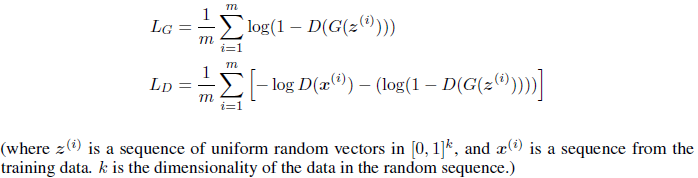
The input to each cell in G is a random vector, concatenated with the output of previous cell.D采用的是双向循环RNN(LSTM)。数据方面构建了一个tone length, frequency, intensity, and time的四元数组,数据可以表示出复调和弦polyphonous chords。
G和D的LSTM层数皆设置为2,BaseLine为去掉对抗性的单一的RNN生成网络。训练集Dataset是从网上down下来的标准midi格式的古典音乐文件,对所有的”note on“事件进行了记录的读取(包括该note的其他属性,时延,tone,强度等等),代码地址:https://github.com/olofmogren/c-rnn-gan
Training过程中使用了很多小技巧:
- 使用L2 regularization对G和D的权重做正则化约束
- The model was pretrained for 6 epochs with a squared error loss for predicting the next event in the
training sequence - the input to each LSTM cell is a random vector v, concatenated with the output at previous time step. v is uniformly distributed in [0; 1]k, and k
was chosen to be the number of features in each tone, 4. - 在预训练时,对采样的序列长度做了管理,从小序列开始逐渐加大,最后变成长序列
- 采用了[4]中的freezen的trick,当D或G被训练得异常强大以至于对方梯度消失,无法正常进行训练时,对过于强大的一方实施冻结。这里采用的是A‘s training loss is less than 70% of the training loss of B时,冻结A
- 采用了[4]中的feature matching的trick,将G的目标函数替换为使真假样本的feature差值最小化:
 其中,R是D的最后一层(激活函数logistic之前)输出。
评估标准
Polyphony 复音是否在同一时间点开始
Scale consistency were computed by counting the fraction of tones that were part of a standard scale, and reporting the number for the best matching such scale.(标准音程是什么鬼?)
Repetitions 小节重复数量
Tone span 最高音和最低音的音程统计
评估工具代码也放在github上面了
结论
第一例通过GAN对抗训练来生成音乐的paper。从人耳听觉的感受上来说,c-RNN-GAN生成的音乐完全不能和真实样本相提并论,应该是单纯地进行对抗训练,单轨音调,缺乏先验乐理知识的融入的缘故导致。
sample 试听:http://mogren.one/publications/2016/c-rnn-gan/
[1]Douglas Eck and Juergen Schmidhuber. Finding temporal structure in music: Blues improvisation
with lstm recurrent networks. In Neural Networks for Signal Processing, 2002. Proceedings of the
2002 12th IEEE Workshop on, pages 747–756. IEEE, 2002.
[2]Pascal Vincent Nicolas Boulanger-Lewandowski, Yoshua Bengio. Modeling temporal dependencies
in high-dimensional sequences: Application to polyphonic music generation and transcription. In
Proceedings of the 29th International Conference on Machine Learning (ICML), page 1159–1166,
2012.
[3]Lantao Yu, Weinan Zhang, Jun Wang, and Yong Yu. Seqgan: Sequence generative adversarial nets
with policy gradient. arXiv preprint arXiv:1609.05473, 2016.
[4]Tim Salimans, Ian Goodfellow, Wojciech Zaremba, Vicki Cheung, Alec Radford, and Xi Chen.
Improved techniques for training gans. In Advances in Neural Information Processing Systems,
pages 2226–2234, 2016.
代码分析
Restore保存的参数:
'num_layers_g' : RNN cell g的层数
'num_layers_d' :RNN Cell D的层数
'meta_layer_size':
'hidden_size_g':
'hidden_size_d':
'biscale_slow_layer_ticks':
'multiscale':
'disable_feed_previous':
'pace_events':
'minibatch_d':
'unidirectional_d':
'feature_matching':
'composer':选取训练集中哪个作曲家的风格来进行训练,如巴赫 贝多芬......
do-not-redownload.txt存在,则不再下载新的midi文件
read_data函数读出的格式为[genre, composer, song_data]
这里组织了一个sources列表,键值为风格,艺术家

用python-midi读出midi_pattern后,遍历每一个track的每一个event,通过NoteOnEvent和NoteOffEvent记录每一个note的四个维度数值:
最后,一首歌的所有的note被汇总到一个song_data的list中去了。每一个[genre, composer, song_data]代表一首歌的特征数据,这些数据被append到 loader.songs['validation'], loader.songs['test'] ,loader.songs['train']中去了。
创建模型训练时使用了l2正则项来避免过拟合:scope.set_regularizer(tf.contrib.layers.l2_regularizer(scale=FLAGS.reg_scale))
创建G,一个多层的LSTM:

输入噪声random_rnninputs的shape为[batch_size, songlength, int(FLAGS.random_input_scale*num_song_features)],然后转换为list

---恢复内容结束---
出处:arXiv: Artificial Intelligence, 2016(一年了还没中吗?)
Motivation
使用GAN+RNN来处理continuous sequential data,并训练生成古典音乐
Introduction
In this work, we investigate the feasibility of using adversarial training for a sequential model with continuous data, and evaluate it using classical music in freely available midi files.也就是利用GAN+RNN来处理midi file中的连续数据。RNN主要工作用于处理时序相关的自然语言,同时也被引入到了音乐生成的领域[1,2,3],but to our knowledge they always use a symbolic representation. In contrast,our work demonstrates how one can train a highly flexible and expressive model with fully continuous sequence data for tone lengths, frequencies, intensities, and timing.作者还刻意提到了LapGAN实现coarse-to-fine的图片生成过程(个人思考:对音乐生成很有启发,包括利用双层GAN来从caption生成image,一层用于生成低分辨率的粗线条色彩图片,一层用于生成细节,这些思路应该可以结合到音乐生成中去)。
Model
对抗网络中的G和D都是RNN模型,损失函数定义为
The input to each cell in G is a random vector, concatenated with the output of previous cell.D采用的是双向循环RNN(LSTM)。数据方面构建了一个tone length, frequency, intensity, and time的四元数组,数据可以表示出复调和弦polyphonous chords。
G和D的LSTM层数皆设置为2,BaseLine为去掉对抗性的单一的RNN生成网络。训练集Dataset是从网上down下来的标准midi格式的古典音乐文件,对所有的”note on“事件进行了记录的读取(包括该note的其他属性,时延,tone,强度等等),代码地址:https://github.com/olofmogren/c-rnn-gan
Training过程中使用了很多小技巧:
- 使用L2 regularization对G和D的权重做正则化约束
- The model was pretrained for 6 epochs with a squared error loss for predicting the next event in the
training sequence - the input to each LSTM cell is a random vector v, concatenated with the output at previous time step. v is uniformly distributed in [0; 1]k, and k
was chosen to be the number of features in each tone, 4. - 在预训练时,对采样的序列长度做了管理,从小序列开始逐渐加大,最后变成长序列
- 采用了[4]中的freezen的trick,当D或G被训练得异常强大以至于对方梯度消失,无法正常进行训练时,对过于强大的一方实施冻结。这里采用的是A‘s training loss is less than 70% of the training loss of B时,冻结A
- 采用了[4]中的feature matching的trick,将G的目标函数替换为使真假样本的feature差值最小化:
其中,R是D的最后一层(激活函数logistic之前)输出。
评估标准
Polyphony 复音是否在同一时间点开始
Scale consistency were computed by counting the fraction of tones that were part of a standard scale, and reporting the number for the best matching such scale.(标准音程是什么鬼?)
Repetitions 小节重复数量
Tone span 最高音和最低音的音程统计
评估工具代码也放在github上面了
结论
第一例通过GAN对抗训练来生成音乐的paper。从人耳听觉的感受上来说,c-RNN-GAN生成的音乐完全不能和真实样本相提并论,应该是单纯地进行对抗训练,单轨音调,缺乏先验乐理知识的融入的缘故导致。
sample 试听:http://mogren.one/publications/2016/c-rnn-gan/
[1]Douglas Eck and Juergen Schmidhuber. Finding temporal structure in music: Blues improvisation
with lstm recurrent networks. In Neural Networks for Signal Processing, 2002. Proceedings of the
2002 12th IEEE Workshop on, pages 747–756. IEEE, 2002.
[2]Pascal Vincent Nicolas Boulanger-Lewandowski, Yoshua Bengio. Modeling temporal dependencies
in high-dimensional sequences: Application to polyphonic music generation and transcription. In
Proceedings of the 29th International Conference on Machine Learning (ICML), page 1159–1166,
2012.
[3]Lantao Yu, Weinan Zhang, Jun Wang, and Yong Yu. Seqgan: Sequence generative adversarial nets
with policy gradient. arXiv preprint arXiv:1609.05473, 2016.
[4]Tim Salimans, Ian Goodfellow, Wojciech Zaremba, Vicki Cheung, Alec Radford, and Xi Chen.
Improved techniques for training gans. In Advances in Neural Information Processing Systems,
pages 2226–2234, 2016.
代码分析
Restore保存的参数:
'num_layers_g' : RNN cell g的层数
'num_layers_d' :RNN Cell D的层数
'meta_layer_size':
'hidden_size_g':
'hidden_size_d':
'biscale_slow_layer_ticks':
'multiscale':
'disable_feed_previous':
'pace_events':
'minibatch_d':
'unidirectional_d':
'feature_matching':
'composer':选取训练集中哪个作曲家的风格来进行训练,如巴赫 贝多芬......
do-not-redownload.txt存在,则不再下载新的midi文件
read_data函数读出的格式为[genre, composer, song_data]
这里组织了一个sources列表,键值为风格,艺术家
用python-midi读出midi_pattern后,遍历每一个track的每一个event,通过NoteOnEvent和NoteOffEvent记录每一个note的四个维度数值:
最后,一首歌的所有的note被汇总到一个song_data的list中去了。每一个[genre, composer, song_data]代表一首歌的特征数据,这些数据被append到 loader.songs['validation'] loader.songs['test'] loader.songs['train']中去了。
对于待训练的placeholder数据有:
创建模型训练时使用了l2正则项来避免过拟合:scope.set_regularizer(tf.contrib.layers.l2_regularizer(scale=FLAGS.reg_scale))
创建G的LSTM网络:
输入噪声random_rnninputs的shape为[batch_size, songlength, int(FLAGS.random_input_scale*num_song_features)],然后转换为list(unstack?)
对G进行RNN的分步训练过程,每个循环是一步,输入为噪音random_rnninput和上一步的输出generated_point(两者concat为一个[batch_size,2*num_song_features]的tensor,第一步输出的初始化从均匀分布中采样)

对G还有个pretraining的过程,输入为噪音random_rnninputs和真实的sample songdata_input[i]

针对G的pretraining的loss是L2距离,注意这里的链表stack和[1,0,2]转置:

要注意的是(1)由于bidirectional_dynamic_rnn每构建一次就会自动在名字空间中序号+1,所以用层数名来限定了scope(折腾了一天,是我菜还是tf太坑?)
(2)每次的输入_inputs需要把output中包含了bw和fw的tuple元组concat起来,每个tensor的shape为[batch_size,song_length,ouput_dim],其中output_dim和lstm隐层单元数量(状态数量)
一致,合并后shape为[batch_size,song_length,2×ouput_dim]
随后D将双向LSTM的输出全连接(output num = 1)并sigmoid映射为真假概率,同时输出output作为features,参与到feature loss的计算中去。
loss计算:

《C-RNN-GAN: Continuous recurrent neural networks with adversarial training》论文笔记的更多相关文章
- 《Vision Permutator: A Permutable MLP-Like ArchItecture For Visual Recognition》论文笔记
论文题目:<Vision Permutator: A Permutable MLP-Like ArchItecture For Visual Recognition> 论文作者:Qibin ...
- [place recognition]NetVLAD: CNN architecture for weakly supervised place recognition 论文翻译及解析(转)
https://blog.csdn.net/qq_32417287/article/details/80102466 abstract introduction method overview Dee ...
- 论文笔记系列-Auto-DeepLab:Hierarchical Neural Architecture Search for Semantic Image Segmentation
Pytorch实现代码:https://github.com/MenghaoGuo/AutoDeeplab 创新点 cell-level and network-level search 以往的NAS ...
- 论文笔记——Rethinking the Inception Architecture for Computer Vision
1. 论文思想 factorized convolutions and aggressive regularization. 本文给出了一些网络设计的技巧. 2. 结果 用5G的计算量和25M的参数. ...
- 论文笔记:Fast Neural Architecture Search of Compact Semantic Segmentation Models via Auxiliary Cells
Fast Neural Architecture Search of Compact Semantic Segmentation Models via Auxiliary Cells 2019-04- ...
- 论文笔记:ProxylessNAS: Direct Neural Architecture Search on Target Task and Hardware
ProxylessNAS: Direct Neural Architecture Search on Target Task and Hardware 2019-03-19 16:13:18 Pape ...
- 论文笔记:DARTS: Differentiable Architecture Search
DARTS: Differentiable Architecture Search 2019-03-19 10:04:26accepted by ICLR 2019 Paper:https://arx ...
- 论文笔记:Progressive Neural Architecture Search
Progressive Neural Architecture Search 2019-03-18 20:28:13 Paper:http://openaccess.thecvf.com/conten ...
- 论文笔记:Auto-DeepLab: Hierarchical Neural Architecture Search for Semantic Image Segmentation
Auto-DeepLab: Hierarchical Neural Architecture Search for Semantic Image Segmentation2019-03-18 14:4 ...
- 论文笔记系列-DARTS: Differentiable Architecture Search
Summary 我的理解就是原本节点和节点之间操作是离散的,因为就是从若干个操作中选择某一个,而作者试图使用softmax和relaxation(松弛化)将操作连续化,所以模型结构搜索的任务就转变成了 ...
随机推荐
- [luoguP1273] 有线电视网(DP)
传送门 f[i][j]表示节点i选j个用户的最大收益 #include <cstdio> #include <cstring> #include <iostream> ...
- [luoguP1773] 符文之语_NOI导刊2010提高(02)(DP)
传送门 f[i][j]表示前i个数余数为j的最优解 sum[i][j]表示字符串i~j所构成的数 #include <cstdio> #include <cstring> #d ...
- POJ3321Apple Tree【dfs 树状数组】
题目大意:一棵树(不一定是二叉树!!),树的节点上本来都有一个苹果,要求完成以下操作: 1.指定某个节点,如果这个节点原本有苹果则拿去,如果没有苹果则填上一个苹果 2.询问某个节点以及其子树一共有多少 ...
- CF613A:Peter and Snow Blower
用一个圆心在(x,y)的圆环覆盖一个n边形,顺或逆时针给出n边形所有顶点,求圆环最小面积. 卡了好久,各种傻逼错误.. 题目就是让我们固定一大一小两个边界圆,我们来看看这两个圆满足什么条件. 首先外面 ...
- POJ 1753 Flip Game【枚举】
题目链接: http://poj.org/problem?id=1753 题意: 由白块黑块组成的4*4方格,每次换一个块的颜色,其上下左右的块也会被换成相反的颜色.问最少换多少块,使得最终方格变为全 ...
- 转 gSOAP中使用TCP协议传输数据
一 模型 TCP/IP是一个协议族(Internet protocol suite),包含众多的协议,传输控制协议(TCP)和网际协议(IP)分属不同的层次,是保证数据完整传输的两个基本的重要协议. ...
- Java数组操作方法收集(快速判断某个值在这个数组中)
Java数组操作最高效的方式是循环取值,如果转换成集合那么就会分配内存,效率不如前者,但是方法多,需要在性能调优上去权衡.切记:数组是数组,集合是集合. 下面是收集最常用的数组转成集合的操作方法: i ...
- Java中的字符
以下内容引用自http://wiki.jikexueyuan.com/project/java/characters.html: 一般情况下,当处理字符时,使用的是原始数据类型char. 示例: ch ...
- S5700&S5710 产品文档 : 配置
http://support.huawei.com/hdx/hdx.do?docid=SC0000699332&lang=zh&path=PBI1-C103367%2FPBI1-C10 ...
- 删除,“windows setup 启用EMS”
方案1[笔者推荐]:进入Windows后按Windows+R输入msconfig回车进入系统配置,切换到引导,点击你要删除的选项然后点击删除就行[1].