
Python数据结构应用1——Stack
自学一下数据结构,学完之后刷leetcode,使用python,从stack开始
Stack建立
class Stack:

    def __init__(self):

        self.items = []

    def is_empty(self):

        return self.items == []

    def push(self,item):

        self.items.append(item)

    def pop(self):

        return self.items.pop()

    def peek(self):

        return self.items[-1]

    def size(self):

        return len(self.items)
以上stack的top位置位于list的ending位置,如果要设置stack的top位置为list的beginning位置,只需要做如下改动
class Stack:

    def __init__(self):

        self.items = []

    def is_empty(self):

        return self.items == []

    def push(self,item):

        self.items.insert(0,item)

    def pop(self):

        return self.items.pop(0)

    def peek(self):

        return self.items[0]

    def size(self):

        return len(self.items)
这两种方式的时间复杂度明显不同,具体可以参见下表中的list处理的时间复杂度 
pop(i)和insert(i,item)的时间复杂度为O(n),而pop()和append()的时间复杂度为O(1)
用stack在python中解决实际问题
括号对称问题
这个问题貌似是个很经典的stack问题了,判断string中的括号是否对称:
如:
()(()((()))) 为对称
(()()(()(()))) 为不对称
基本思路:
遍历string中的每个字符
- 当遇到左括号
(时,push到stack里 - 当遇到右括号
)时,pop对应的左括号( - 如果在遇到右括号
)时,此时stack为空,则该右括号)没有对应的左括号,返回False - 如果遍历完所有字符后,stack不为空,则stack里全为左括号
(,返回False
def par_checker(symbol_string):

    s = Stack()

    balanced = True

    index =0

    while index<len(symbol_string) and balanced:

        symbol = symbol_string[index]

        if symbol == '(':

            s.push(symbol)

        else:

            if s.is_empty():

                balanced = False

            else:

                s.pop()

        index = index+1

    if balanced and s.is_empty():

        return True

    else:

        return False
print(par_checker('()((()))'))
print(par_checker('()(()'))True
False
运用以上方法,可以解决类似问题,如括号为({[的问题
将十进制数转换为二进制数
很简单,这里用的是高中的方法,除2取余,除2取余……
def divide_by_2(dec_number):

    rem_stack = Stack()

    while dec_number > 0:

        rem = dec_number%2

        rem_stack.push(rem)

        dec_number = dec_number//2

        # '//' 取整除,返回商整数部分

    bin_string = ''

    while not rem_stack.is_empty():

        bin_string = bin_string + str(rem_stack.pop())

    return bin_string

print(divide_by_2(42))
101010
这个方法可以自然的扩展到转换为8进制(octal),16进制(hex),运用的也是同样的方法,只是在代码的开始建立一个’符号字典’。
def base_converter(dec_number, base):

    digits = '0123456789ABCDEF'

    rem_stack = Stack()

    while dec_number>0:

        rem = dec_number%base

        rem_stack.push(rem)

        dec_number = dec_number//base

    new_string = ''

    while not rem_stack.is_empty():

        new_string = new_string + digits[rem_stack.pop()]

    return new_string

print(base_converter(25, 8))

print(base_converter(30, 16))
31
1E
Infix, Prefix, Postfix相互转换
1、转换的作用:
Something very important has hap- pened. Where did the parentheses go? Why don’t we need them in prefix and postfix? The answer is that the operators are no longer ambiguous with respect to the operands that they work on. Only infix notation requires the additional symbols. The order of operations within prefix and postfix expressions is completely determined by the position of the operator and nothing else. In many ways, this makes infix the least desirable notation to use.
2、转换结果:
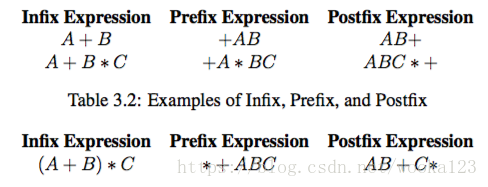
简单来说,这一切都跟运算符的先后顺序有关。乘除法的优先率要高于加减法,如果要改变这种定律,只能加括号。而perfix和postfix的表示方法给了一种用加括号的方式来改变这种运算顺序。
Prefix:将运算符置于运算数之前,如
+AB表示A+B;
+A*BC表示A+B*C;
若要表示(?+?)*?,只需写*+ABC(先执行+AB,后执行*(+AB)C)
3、转换方法(postfix):
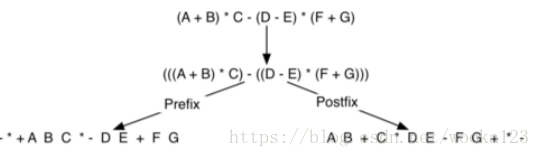
- 创建一个stack来储存运算符,创建一个list来做输出
- 将infix表达式转换为list from string
- 从左往右遍历2中的list,假设每一遍历的元素为token:
- 如果token是运算数,直接输出
- 如果token是左括号
(,push到stack里 - 如果token是右括号
),将stack里的元素逐个pop出来并输出直到遇到对应的左括号( - 如果token是运算符,push到stack里。然而,在push之前,首先按顺序pop出stack里比该运算符优先级相同或者更高的运算符,并输出。
def infix_to_postfix(infix_expr):

    # 建立一个字典用来表示运算符的优先级:其中左括号的优先级最低

    prec = {}

    prec["*"] =3

    prec["/"] =3

    prec["+"] =2

    prec["-"] =2

    prec["("] =1

    op_stack = Stack()

    postfix_list=[] # output

    token_list = infix_expr.split()

    for token in token_list:

        # 如果token是运算数,直接输出

        if token in "ABCDEFGHIJKLMNOPQRSTUVWXYZ" or token in "0123456789":

            postfix_list.append(token)

        # 如果token是左括号(,push到stack里

        elif token == '(':

            op_stack.push(token)

        # 如果token是右括号),将stack里的元素逐个pop出来并输出直到遇到对应的左括号(

        elif token == ')':

            top_token = op_stack.pop()

            while top_token != '(':

                postfix_list.append(top_token)

                top_token = op_stack.pop()

        else:

            # 如果token是运算符,push到stack里。然而,在push之前,首先按顺序pop出stack里比该运算符优先级相同或者更高的运算符,并输出。

            while (not op_stack.is_empty()) and (prec[op_stack.peek()]>=prec[token]):

                postfix_list.append(op_stack.pop())

            op_stack.push(token)

    while not op_stack.is_empty():

        postfix_list.append(op_stack.pop())

    # str.join() 方法用于将序列中的元素以指定的字符连接生成一个新的字符串

    return ' '.join(postfix_list)

print(infix_to_postfix("A * B + C * D"))

print(infix_to_postfix("( A + B ) * C - ( D - E ) * ( F + G )"))
A B * C D * +
A B + C * D E - F G + * -
Postfix使用
当转换成postfix格式后,使用确实是一个问题,但下图已经很好的诠释了这一过程。 
- 创建一个stack用来储存运算数
- 将string转换成list
- 从左往右遍历上述list,for evevy token in list:
- 如果token是一个运算数,将其转换为interger并push到stack中
- 如果token是一个运算符,它需要两个运算数来进行计算。pop两次,第一次pop的数在左,第二次pop的数在右,并用该运算符进行计算,将计算后的值push到stack里
- 当list中的值处理完毕,最后的结果在stack中
def postfix_eval(postfix_expr):

    operand_stack = Stack()

    token_list = postfix_expr.split()

    for token in token_list:

        if token in "0123456789":

            operand_stack.push(int(token))

        else:

            operand2 = operand_stack.pop()

            operand1 = operand_stack.pop()

            result = do_math(token, operand1, operand2)

            operand_stack.push(result)

    return operand_stack.pop()

def do_math(op, op1, op2):

    if op == "*":

        return op1 * op2

    elif op == "/":

        return op1 / op2

    elif op == "+":

        return op1 + op2

    else:

        return op1 - op2

print(postfix_eval('7 8 + 3 2 + /'))
Python数据结构应用1——Stack的更多相关文章
- [Python数据结构] 使用List实现Stack
[Python数据结构] 使用List实现Stack 1. Stack 堆栈(Stack)又称为栈或堆叠,是计算机科学中一种特殊的串列形式的抽象数据类型(ADT),其特殊之处在于只能允许在阵列的一端进 ...
- python数据结构之栈与队列
python数据结构之栈与队列 用list实现堆栈stack 堆栈:后进先出 如何进?用append 如何出?用pop() >>> >>> stack = [3, ...
- Python - 数据结构 - 第十五天
Python 数据结构 本章节我们主要结合前面所学的知识点来介绍Python数据结构. 列表 Python中列表是可变的,这是它区别于字符串和元组的最重要的特点,一句话概括即:列表可以修改,而字符串和 ...
- Python数据结构汇总
Python数据结构汇总 作者:尹正杰 版权声明:原创作品,谢绝转载!否则将追究法律责任. 一.线性数据结构 1>.列表(List) 在内存空间中是连续地址,查询速度快,修改也快,但不利于频繁新 ...
- python数据结构之二叉树的统计与转换实例
python数据结构之二叉树的统计与转换实例 这篇文章主要介绍了python数据结构之二叉树的统计与转换实例,例如统计二叉树的叶子.分支节点,以及二叉树的左右两树互换等,需要的朋友可以参考下 一.获取 ...
- Python数据结构与算法之图的广度优先与深度优先搜索算法示例
本文实例讲述了Python数据结构与算法之图的广度优先与深度优先搜索算法.分享给大家供大家参考,具体如下: 根据维基百科的伪代码实现: 广度优先BFS: 使用队列,集合 标记初始结点已被发现,放入队列 ...
- python数据结构与算法
最近忙着准备各种笔试的东西,主要看什么数据结构啊,算法啦,balahbalah啊,以前一直就没看过这些,就挑了本简单的<啊哈算法>入门,不过里面的数据结构和算法都是用C语言写的,而自己对p ...
- python数据结构与算法——链表
具体的数据结构可以参考下面的这两篇博客: python 数据结构之单链表的实现: http://www.cnblogs.com/yupeng/p/3413763.html python 数据结构之双向 ...
- python数据结构之图的实现
python数据结构之图的实现,官方有一篇文章介绍,http://www.python.org/doc/essays/graphs.html 下面简要的介绍下: 比如有这么一张图: A -> B ...
随机推荐
- 数据库面试题目- ORACLE
Posted on 2009-06-08 17:38 漠北的天空 阅读(110) 评论(0) 编辑 收藏 1. 列举几种表连接方式 Answer:等连接(内连接).非等连接.自连接.外连 ...
- pyspider的一个诡异问题
其Start_url两次抓取处理失败以后,其之后的所有抓取行为就不正常,似乎根本没有HTTP访问,我把该爬虫的taskdb清空,该爬虫爬取行为恢复正常.这个问题已提交pyspider官方,静待回答.
- 与班尼特·胡迪一起攻破浮空城 (HZNU-2264)
与班尼特·胡迪一起攻破浮空城 AC Time Limit: 1 s Memory Limit: 256 MB Description 桐人为了拯救被困在浮空城堡最顶层的亚丝娜,决定从第 ...
- AQS分析(AbstractQueuedSynchronizer)(三)
1.AQS是什么 AQS同步器是Java并发编程的基础,从资源共享的角度分成独占和共享两种模式,像ReentrantLock.ThreadPoolExecutor.CountDownLatch等都是基 ...
- C#WebService 出现No 'Access-Control-Allow-Origin' header is present on the requested resource
C#WebService 出现No 'Access-Control-Allow-Origin' header is present on the requested resource 解决办法: 在c ...
- SQL基本语句的优化10个原则
原则一:尽量避免在列上进行运算,这样会导致索引失效. 例如: ; 优化: SELECT * FROM table WHERE d >= '2011-01-01'; 原则二:使用JOIN时,应该用 ...
- Linux 系统化学习系列文章总目录(持续更新中)
本页内容都是本人系统化学习Linux 时整理出来的.这些文章中,绝大多数命令类内容都是翻译.整理man或info文档总结出来的,所以相对都比较完整. 本人的写作方式.风格也可能会让朋友一看就恶心到直接 ...
- php判断图片是否存在的几种方法
在我们日常的开发中,经常需要用到判断图片是否存在,存在则显示,不存在则显示默认图片,那么我们用到的判断有哪些呢?今天我们就来看下几个常用的方法: 1.getimagesize()函数 getimage ...
- javascript 易漏点
javascript 是一种解释型语言,不是java或c++那样的编译语言.javascript指令以普通文本形式传递给浏览器,然后依次解释执行.它们不必首先“编译”成只有计算机处理器能理解的机器码. ...
- 深入理解SpringBoot之自动装配
SpringBoot的自动装配是拆箱即用的基础,也是微服务化的前提.其实它并不那么神秘,我在这之前已经写过最基本的实现了,大家可以参考这篇文章.这次主要的议题是,来看看它是怎么样实现的,我们透过源代码 ...