
Analysis of Variance ANOVA versus T test 方差分析和T检验
Levels are different groupings within the same independent variable(factor).
Eg. if the independent variable is “eggs” the levels might be Non-Organic, Organic, and Free Range Organic.
Analysis of Variance ANOVA 方差分析
Goal
whether there is a significant difference between/among the levels of the independent variables.
Assumptions
- Independence of observations
- Normality the distributions of the residuals are normal
- Equality (or "homogeneity") of variances —the variance of data in groups should be the same.
Levels are different groupings within the same independent variable(factor).
Eg. if the independent variable is “eggs” the levels might be Non-Organic, Organic, and Free Range Organic.
Eg.
You recruit 9 anxious individuals and randomly assign them to receive CBT, EMDR, M, 3 kinds of treatment for 5 weeks
Treatment is a between-groups factor with 3 levels. It’s called a between-groups factor because patients are assigned to one and only one group.
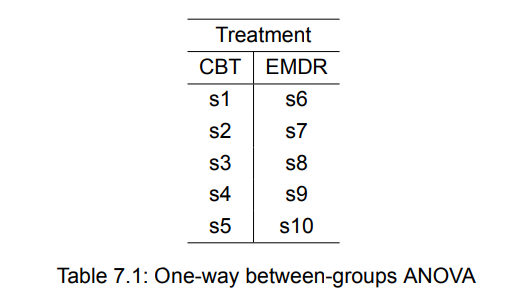
Because there are an equal number of observations in each treatment condition, you have a balanced design. When the sample sizes are unequal across the cells of a design, you have an unbalanced design.
If you are interested in the effect of CBT on anxiety over time, you could place 9 patients in the CBT group and assess them at the end of therapy and again 6 months later.
Time is a within-groups factor with two levels. It’s called a within-groups factor because each patient is measured under both levels.
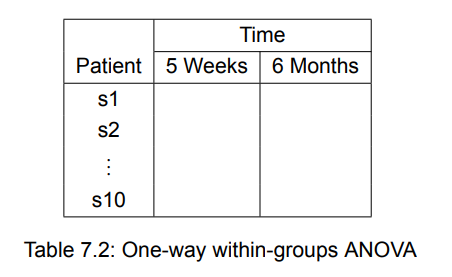
within-groups ANOVA is also called repeated measures ANOVA.
Hypothesis
\(H_0\) : \(\mu_1 = \mu_2\)
One-way ANOVA
\]
\(Y_{ij}\) is the -th observation in the -th out of \(\) groups and \(\) is the overall sample size, \(n_i\) is the sample size of each group
d.f.1= K - 1
d.f.2 = N - K
The F statistic will be large if the between-group variability is large relative to the within-group variability, which means the mean value of each group is not the same.
F large, reject \(H_0\)
Two-way ANOVA
![[Pasted image 20221128143527.png]]
Therapy (averaged across time), Time (averaged across therapy type) are called the main effects, and the interaction of Therapy and Time called interaction effect.
When you cross two or more factors, as you’ve done here, you have a factorial ANOVA design. Crossing two factors produces a two-way ANOVA, crossing three factors produces a three-way ANOVA, and so forth. When a factorial design includes both between-groups and within-groups factors, it’s also called a mixed-model ANOVA. The current design is a two-way mixed-model factorial ANOVA.
In this case you’ll have three F tests: one for Therapy, one for Time, and one for the Therapy_Time interaction.
The above focus on axiety, however, depression and anxiety often co-occur. Because depression could also explain the group differences on the dependent variable, it’s a confounding factor and its value is a covariate. And if you’re not interested in depression, it’s called a nuisance variable. If you are, then the design would be called an analysis of covariance (ANCOVA)
Finally, you’ve recorded a single dependent variable in this study (the STAI ). You could increase the validity of this study by including additional measures of anxiety (such as family ratings, therapist ratings, and a measure assessing the impact of anxiety on their daily functioning). When there’s more than one dependent variable, the design is called a multivariate analysis of variance (MANOVA). If there are covariates present, it’s called a multivariate analysis of covariance (MANCOVA).
Implementation with R
aov()
- usage:
aov(formula, data = dataframe) - symbols-used-for-ANOVA-in-R-formulas
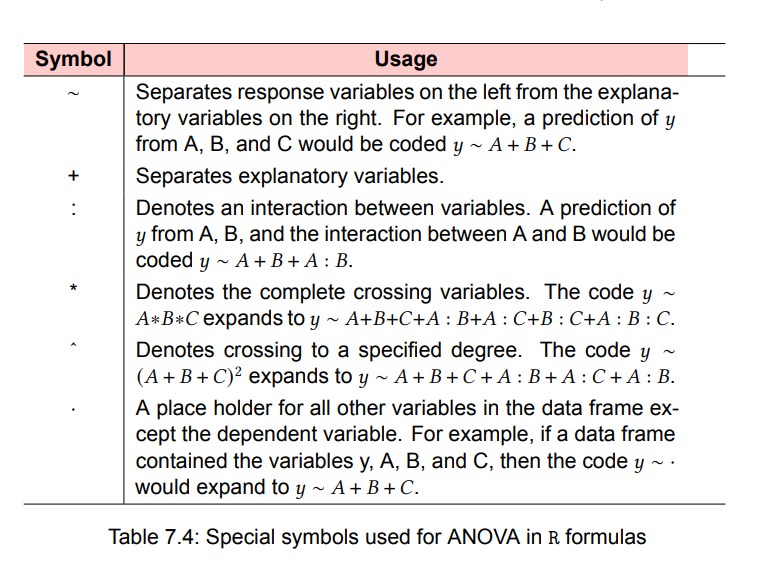
Below are formulas for several common research designs. In this table, lowercase letters are quantitative variables, uppercase letters are grouping factors, and Subject is a unique identifier variable for subjects.

Type I (sequential) Effects are adjusted for those that appear earlier in the formula. is unadjusted. B is adjusted for the . The : interaction is adjusted for and .
Type II (hierarchical) Effects are adjusted for other effects at the same or lower level. is adjusted for . is adjusted for . The : interaction is adjusted for both and .
Type III (marginal) Each effect is adjusted for every other effect in the model. is adjusted for and : . is adjusted for and : . The : interaction is adjusted for and .
R employs the Type I approach by default. Other programs such as SAS and SPSS employ the Type III approach by default.The first model can be written out as ∼ + + : . The resulting R ANOVA table will assess
• The impact of on
• The impact of on , controlling for
• The interaction of and , controlling for the and main effects.
The greater the imbalance in sample sizes, the greater the impact that the order of the terms will have on the results. In general, more fundamental effects should be listed earlier in the formula. In particular, covariates should be listed first, followed by main effects, followed by two-way interactions, followed by three-way interactions, and so on.
Note that the Anova() function in the car package provides the option of using the Type II or Type III approach, rather than the Type I approach used by the aov() function. You may want to use the Anova() function if you’re concerned about matching your results to those provided by other packages such as SAS and SPSS .
T test
Assumptions
- Independence of observations
- Normality:the distributions of the residuals are normal
- Equality (or "homogeneity") of variances —the variance of data in groups should be the same.
Analysis of Variance ANOVA 方差分析 vs T test
formulas
ANOVA: $$F = \frac{MST}{MSE} = \frac{\text{Mean sum of squares due to treatment}}{\text{Mean sum of squares due to error}}$$
t-test: 2groups (通常是两种疗法把样本分成两类)
ANOVA: 2 or more groups (one factor 2/3/4...levels (groups) / many factors)
when 2 group, n < 50 t-test; otherwise ANOVA
Analysis of Variance ANOVA versus T test 方差分析和T检验的更多相关文章
- 方差分析、T检验、卡方分析如何区分?
差异研究的目的在于比较两组数据或多组数据之间的差异,通常包括以下几类分析方法,分别是方差分析.T检验和卡方检验. 三个方法的区别 其实核心的区别在于:数据类型不一样.如果是定类和定类,此时应该使用卡方 ...
- Analysis of variance(ANOVA)
方差分析,也称为"变异数分析",用于两个及两个以上样本均值(group means)差别的显著性检验.在 ANOVA 的环境下,一个观测得到的方差视为是由不同方差的源组合而成.
- Hotelling T2检验和多元方差分析
1.1 Hotelling T2检验 Hotelling T2检验是一种常用多变量检验方法,是单变量检验的自然推广,常用于两组均向量的比较. 设两个含量分析为n,m的样本来自具有公共协方差阵的q维正态 ...
- 使用spss做方差分析
还记得上学那会老师专门敲了黑板,强调方差分析很重要..单因素方差分析(Analysis of Variance, ANOVA),如果变量多,就是多因素方差分析,还需要考虑到多重共线性, 也就是线性代数 ...
- 单因素方差分析(One Way ANOVA)
Analysis of variance (ANOVA) is a collection of statistical models and their associated estimation p ...
- SAS学习笔记26 方差分析
对于多于两组(k>2)样本均数的比较,t检验不再适用,方差分析(analysis of variance, ANOVA)则是解决上述问题的重要分析方法.方差分析由R.A.Fisher(1923) ...
- 方差分析(python代码实现)
python机器学习-乳腺癌细胞挖掘(欢迎关注博主主页,学习python视频资源,还有大量免费python经典文章) https://study.163.com/course/introduction ...
- ANOVA (paper from the onlinestat)
Introduction Author(s) David M. Lane Prerequisites Variance, Significance Testing,All Pairwise Compa ...
- [Reship]如何回复审稿人意见
================================= This article came from here:http://blog.renren.com/GetEntry.do?id= ...
- Multiple Regression
Multiple Regression What is multiple regression? Multiple regression is regression analysis with mor ...
随机推荐
- new一个实例的原理及过程
前提,要明白new出来的实例是什么,包含了哪些内容? 请看一下举例代码↓↓↓↓ function Person(name,age){ this.name = name; this.age = age; ...
- 利用shell脚本提高访问GitHub速度
Github由于做了域名限制,所以访问比较慢,编写了个脚本达到做本地域名解析提高GitHub的访问速度 #!/usr/bin/env bash # 该脚本用来提升github的访问速度 ROOT_UI ...
- 掷骰子【普通线性DP】【转移方程可以优化为矩阵快速幂】
掷骰子 思路 可以先定义一个状态f[i] [j]: 前i个骰子,最后一个面是j的方法数, 肯定超时,然鹅可以混一些分,代码如下 for(int i=1;i<=6;i++) f[0][i]=1; ...
- Cross Site Scripting DOM (XSS) 攻击jQuery append() 的处理方法
做安全红线使用Fortify工具进行扫描时,jquery append会报Cross Site Scripting DOM风险.解决该问题有两种办法. 一.原生dom方式 使用JavaScript原生 ...
- Oracle-安装问题:Win10系统离线安装framework3.5报0x8024402c的问题
Oracle-安装问题:Win10系统离线安装framework3.5报0x8024402c的问题 像神州信用政府版本相关的系统都不允许联网,也就需要离线安装下,Net3.5之类的文件 具体步骤可以参 ...
- mybaits-plus 部分注解说明
参考: https://blog.csdn.net/qq_45684867/article/details/123951309
- 《MySQL是怎样运行的》第七章小结
- webgl 系列 —— 变换矩阵和动画
其他章节请看: webgl 系列 变换矩阵和动画 动画就是不停地将某个东西变换(transform).例如将三角形不停地旋转就是一个动画 和 CSS transform 类似,变换有三种形式:平移.缩 ...
- 打开CMD方式
打开CMD的方式 win+r 输入cmd 常用的Dos命令 1.#盘符切换2.#查看当前文件目录下的所有文件 dir3.#切换目录 cd change directory4.#cd .. 返回上级5. ...
- 大数据面试——Flink
一.公司怎么提交的实时任务,有多少 Job Manager.TaskManager 是多少 我们使用 yarn session 模式提交任务:另一种方式是每次提交都会创建一个新的 Flink集群,为每 ...