
Sudoku POJ - 3076
| Time Limit: 10000MS | Memory Limit: 65536K | |
| Total Submissions: 5769 | Accepted: 2684 |
Description
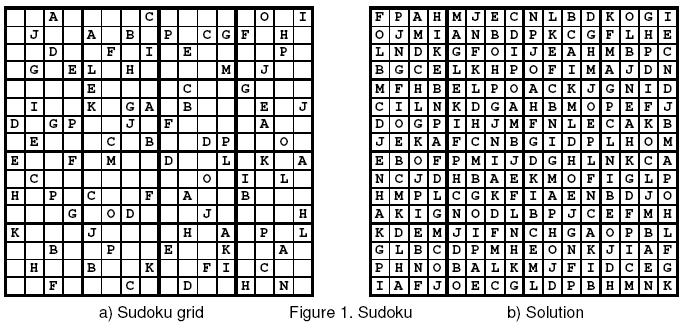
Write a Sudoku playing program that reads data sets from a text file.
Input
Output
Sample Input
--A----C-----O-I

-J--A-B-P-CGF-H-

--D--F-I-E----P-

-G-EL-H----M-J--

----E----C--G---

-I--K-GA-B---E-J

D-GP--J-F----A--

-E---C-B--DP--O-

E--F-M--D--L-K-A

-C--------O-I-L-

H-P-C--F-A--B---

---G-OD---J----H

K---J----H-A-P-L

--B--P--E--K--A-

-H--B--K--FI-C--

--F---C--D--H-N-
Sample Output
FPAHMJECNLBDKOGI

OJMIANBDPKCGFLHE

LNDKGFOIJEAHMBPC

BGCELKHPOFIMAJDN

MFHBELPOACKJGNID

CILNKDGAHBMOPEFJ

DOGPIHJMFNLECAKB

JEKAFCNBGIDPLHOM

EBOFPMIJDGHLNKCA

NCJDHBAEKMOFIGLP

HMPLCGKFIAENBDJO

AKIGNODLBPJCEFMH

KDEMJIFNCHGAOPBL

GLBCDPMHEONKJIAF

PHNOBALKMJFIDCEG

IAFJOECGLDPBHMNK
Source
这个就是2676变了一下形
直接上代码了
#include <iostream>

#include <cstdio>

#include <sstream>

#include <cstring>

#include <map>

#include <cctype>

#include <set>

#include <vector>

#include <stack>

#include <queue>

#include <algorithm>

#include <cmath>

#include <bitset>

#define rap(i, a, n) for(int i=a; i<=n; i++)

#define rep(i, a, n) for(int i=a; i<n; i++)

#define lap(i, a, n) for(int i=n; i>=a; i--)

#define lep(i, a, n) for(int i=n; i>a; i--)

#define rd(a) scanf("%d", &a)

#define rlld(a) scanf("%lld", &a)

#define rc(a) scanf("%c", &a)

#define rs(a) scanf("%s", a)

#define rb(a) scanf("%lf", &a)

#define rf(a) scanf("%f", &a)

#define pd(a) printf("%d\n", a)

#define plld(a) printf("%lld\n", a)

#define pc(a) printf("%c\n", a)

#define ps(a) printf("%s\n", a)

#define MOD 2018

#define LL long long

#define ULL unsigned long long

#define Pair pair<int, int>

#define mem(a, b) memset(a, b, sizeof(a))

#define _  ios_base::sync_with_stdio(0),cin.tie(0)

//freopen("1.txt", "r", stdin);

using namespace std;

const int maxn = , INF = 0x7fffffff;

int S[maxn], head[maxn], vis[maxn];

int U[maxn], D[maxn], L[maxn], R[maxn];

int C[maxn], X[maxn];

int n, m, ans, ret, ans1;

void init()

{

    for(int i = ; i <= m; i++)

        D[i] = i, U[i] = i, R[i] = i + , L[i] = i - ;

    L[] = m, R[m] = ;

    mem(S, ), mem(head, -);

    ans = m + ;

}

void delc(int c)

{

    L[R[c]] = L[c], R[L[c]] = R[c];

    for(int i = D[c]; i != c; i = D[i])

        for(int j = R[i]; j != i; j = R[j])

            U[D[j]] = U[j], D[U[j]] = D[j], S[C[j]]--;

}

void resc(int c)

{

    for(int i = U[c]; i != c; i = U[i])

        for(int j = L[i]; j != i; j = L[j])

            U[D[j]] = j, D[U[j]] = j, S[C[j]]++;

    L[R[c]] = c, R[L[c]] = c;

}

void add(int r, int c)

{

    ans++, S[c]++, C[ans] = c, X[ans] = r;

    D[ans] = D[c];

    U[ans] = c;

    U[D[c]] = ans;

    D[c] = ans;

    if(head[r] < ) head[r] = L[ans] = R[ans] = ans;

    else L[ans] = head[r], R[ans] = R[head[r]],L[R[head[r]]] = ans, R[head[r]] = ans;

}

bool dfs(int sh)

{

    if(!R[])

    {

        sort(vis, vis +  * );

        int cnt = ;

        for(int i = ; i < ; i++)

        {

            for(int j = ; j < ; j++)

            {

                int num = vis[cnt++];

                num=num - (i *  + j) * ;

                printf("%c", 'A' + num - );

               // cout << 111 << endl;

            }

            printf("\n");

        }

        printf("\n");

        return true;

    }

    int c = R[];

    for(int i = R[]; i; i = R[i]) if(S[c] > S[i]) c = i;

    delc(c);

    for(int i = D[c]; i != c; i = D[i])

    {

        vis[sh] = X[i];

        for(int j = R[i]; j != i; j = R[j])

            delc(C[j]);

        if(dfs(sh + )) return true;

        for(int j = L[i]; j != i; j = L[j])

            resc(C[j]);

    }

    resc(c);

    return false;

}

char str[][];

void build(int x, int y, int k)

{

    ans1 = (x *  + y - ) *  + k;

    add(ans1, x *  + k);

    add(ans1,  *  + (y - ) *  + k);

    add(ans1,  *  *  + x *  + y);

    int block = (y - ) /  *  + x / ;

    add(ans1,  *  *  + block *  + k);

}

int main()

{

    while(~scanf("%s", str[]))

    {

        m =  *  * ;

        init();

        for(int i = ; i < ; i++)

        {

            rs(str[i]);

        }

        for(int i = ; i < ; i++)

            for(int j = ; j <= ; j++)

            {

                if(str[i][j - ] == '-')

                    for(int k = ; k <= ; k++) build(i, j, k);

                else

                    build(i, j, str[i][j - ] - ('A' - ));

            }

        dfs();

    }

    return ;

}
Sudoku POJ - 3076的更多相关文章
- Sudoku POJ - 3076 (dfs+剪枝)
Description A Sudoku grid is a 16x16 grid of cells grouped in sixteen 4x4 squares, where some cells ...
- (简单) POJ 3076 Sudoku , DLX+精确覆盖。
Description A Sudoku grid is a 16x16 grid of cells grouped in sixteen 4x4 squares, where some cells ...
- POJ 3076 Sudoku DLX精确覆盖
DLX精确覆盖模具称号..... Sudoku Time Limit: 10000MS Memory Limit: 65536K Total Submissions: 4416 Accepte ...
- POJ 3076 / ZOJ 3122 Sudoku(DLX)
Description A Sudoku grid is a 16x16 grid of cells grouped in sixteen 4x4 squares, where some cells ...
- 【POJ 3076】 Sudoku
[题目链接] http://poj.org/problem?id=3076 [算法] 将数独问题转化为精确覆盖问题,用Dancing Links求解 [代码] #include <algorit ...
- POJ 3076 Sudoku
3076 思路: dfs + 剪枝 首先,如果这个位置只能填一种字母,那就直接填 其次,如果对于每一种字母,如果某一列或者某一行或者某一块只能填它,那就填它 然后,对于某个位置如果不能填字母了,或者某 ...
- POJ 3076 Sudoku (dancing links)
题目大意: 16*16的数独. 思路分析: 多说无益. 想说的就是dancing links 的行是依照 第一行第一列填 1 第一行第二列填 2 -- 第一行第十五列填15 第一行第二列填 1 -- ...
- Sudoku POJ - 2676(DLX)
Sudoku Time Limit: 2000MS Memory Limit: 65536K Total Submissions: 25356 Accepted: 11849 Specia ...
- POJ 3076 SUKODU [Dangcing Links DLX精准覆盖]
和3074仅仅有数目的不同,3074是9×9.本来想直接用3074的.然后MLE,,,就差那么20M的空间,,. 从这里学习到了解法: http://www.cnblogs.com/ylfdrib/a ...
随机推荐
- c++_work
while((ch=getopt(argc, argv, "X:Y:C:")) != EOF) { switch((char)ch) { case 'X': strcpy(strS ...
- RuntimeError: Model class apps.users.models.User doesn't declare an explicit app_label and isn't in an application in INSTALLED_APPS.
报错代码: File "/home/bsodgm/Desktop/Django_projection/mall/apps/users/views.py", line 9, in & ...
- Jenkins-job之间依赖关系配置
使用场景: 想要在某APP打新包之后,立即执行自动化测试的job来验证该新包. 比如Job A 执行完执行Job B ,如下图所示,如何建立依赖呢? 1.配置上游依赖 构建触发器-配置如下信息: 选择 ...
- 牛客---java练习
一. 1. abstract可以修饰方法和类,不能修饰属性.抽象方法没有方法体,即没有大括号{}.抽象类中的成员属性都是public static final类型的:成员方法都是public abst ...
- 【问题解决方案】之 hadoop 用jps命令后缺少namenode的问题
用Xshell连接腾讯cloud里的虚拟机后,jps命令查无namenode导致过滤排序程序跑不起来,如图: 解决方案: Google之,说需要重启,格式化后再启动Hadoop.但鉴于本人不知道实现的 ...
- Linux 典型应用之远程连接SSH
查看版本 cat /etc/redhat-release 如果ifconfig不能使用 yum install net-tools 修改配置 vim /etc/sysconfig/network-sc ...
- storm问题汇总
1.删除了本地topology导致无法启动nimbus 删除storm的自定义的库中的数据 删除zookeeper中配置的dataDir中的数据 重启服务即可
- 渗透测试平台bwapp简单介绍及安装
先来介绍一下bwapp bwapp是一款非常好用的漏洞演示平台,包含有100多个漏洞 SQL, HTML, iFrame, SSI, OS Command, XML, XPath, LDAP, PHP ...
- syncthing 多主机同步文件工具
周五看了下阮一峰的blog 看到有一个 syncthing的小工具挺好用的 进行了简单的尝试: 1. 下载文件位置: https://syncthing.net 2. 下载文件后的简单安装 绿色版直接 ...
- 剑指offer(4)
题目: 输入某二叉树的前序遍历和中序遍历的结果,请重建出该二叉树.假设输入的前序遍历和中序遍历的结果中都不含重复的数字.例如输入前序遍历序列{1,2,4,7,3,5,6,8}和中序遍历序列{4,7,2 ...