
select、poll、epoll
1.概念
select、poll、epoll都是事件触发机制,当等待的事件发生就触发进行处理,用于I/O复用
2.简单例子理解

3.select函数
3.1函数详解
int select(int maxfdp1,fd_set *readset,fd_set *writeset,fd_set *exceptset,const struct timeval *timeout)

//返回值:就绪描述符的数目,超时返回0,出错返回-1
1)第一个参数maxfdp1指定待测试的描述符个数,它的值是待测试的最大描述符加1(因此把该参数命名为maxfdp1),描述字0、1、2...maxfdp1-1均将被测试(即使你中间有不想测的)
2)中间的三个参数readset、writeset和exceptset指定我们要让内核测试读、写和异常条件的描述符。如果对某一个的条件不感兴趣,就可以把它设为空指针。fd_set存放着描述符,它是一个long类型的数组,是一个bitmap,可通过以下四个宏进行设置:
void FD_ZERO(fd_set *fdset);           //清空集合

void FD_SET(int fd, fd_set *fdset);   //将一个给定的文件描述符加入集合之中

void FD_CLR(int fd, fd_set *fdset);   //将一个给定的文件描述符从集合中删除

int FD_ISSET(int fd, fd_set *fdset);   // 检查集合中指定的文件描述符是否可以读写
3)timeout告知内核等待所指定描述符中的任何一个就绪可花多少时间。其timeval结构用于指定这段时间的秒数和微秒数
struct timeval {

    long tv_sec;   //seconds

    long tv_usec;  //microseconds

};
这个参数有三种可能:
①永远等待下去:仅在有一个描述符准备好I/O时才返回;为此,把该参数设置为空指针NULL(等到你好了我才返回)
②等待一段固定时间:在有一个描述符准备好I/O时返回,但是不超过由该参数所指向的timeval结构中指定的秒数和微秒数(我到了固定时间就返回)
③根本不等待:检查描述符后立即返回,这称为轮询。为此,该参数必须指向一个timeval结构,而且其中的定时器值必须为0(我不断地检查你好没好,不管你好没好我都返回)
3.2实现过程
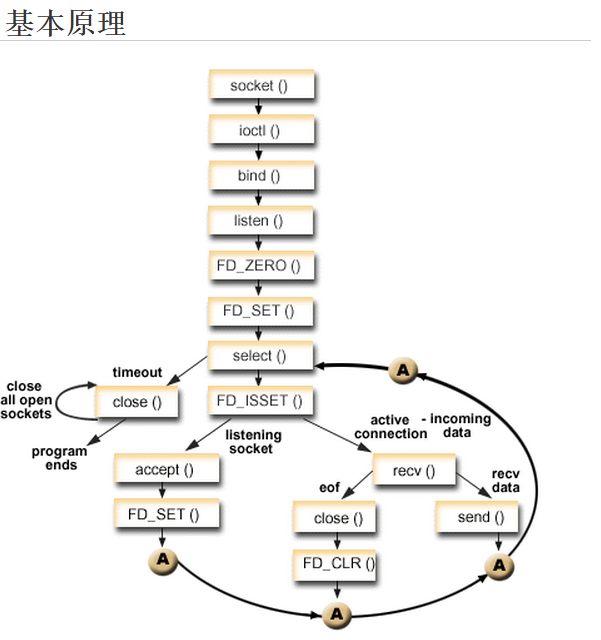

如图,select会在1~7之间不断循环
1)使用copy_from_user将fd_set(描述符集合)拷贝到内核
2)注册一个函数__pollwait,也是就所谓的poll方法
3)遍历所有描述符fd,调用其对应的poll方法(对于socket,这个poll方法是sock_poll,sock_poll根据情况会调用到tcp_poll,udp_poll或者datagram_poll),poll方法的主要工作就是把current进程挂到fd对应的设备等待队列中,当fd可读写时,会唤醒等待队列上睡眠的进程;poll方法返回的是一个描述读写是否就绪的mask掩码,用这个mask掩码给fd_set赋值
4)遍历完以后,如果发现有可读写的mask掩码,则跳到7
5)如果没有,则调用schedule_timeout使current进程进入睡眠
6)睡眠期间如果有fd可读写时,或者超过了睡眠时间,current进程会被唤醒获得CPU进行工作,跳到3
7)使用copy_to_user把fd_set从内核拷贝到用户空间
最后,进程在用户空间检查fd_set,找到可读写的fd,对其进行I/O操作
3.3缺点
1)select可监听的文件描述符数量较小,linux上默认为1024,由宏定义FD_SETSIZE确定
2)每次调用select,都需要把整个fd集合从用户态拷贝到内核态,返回时再从内核态拷贝到用户态,存在开销
3)current进程每次被唤醒时都要遍历所有的fd(即轮询),这样做效率很低
3.4实例
#include <stdio.h>

#include <sys/select.h>

#include <sys/time.h>

#include <errno.h>

#include <stdlib.h>

#include <string.h>

int max(int a, int b)

{

    return(a >= b ? a : b);

}

void str_cli(FILE *fp, int sockfd)

{

    int       maxfdpl;

    fd_set    rset;

    char      sendline[], recvline[];

    FD_ZERO(&rset);

    for (;;)

    {

        FD_SET(fileno(fp), &rset);

        FD_SET(sockfd, &rset);

        maxfdpl = max(fileno(fp), sockfd) + ;

        if (select(maxfdpl, &rset, NULL, NULL, NULL) < )

        {

            perror("select");

            exit();

        }

        if (FD_ISSET(sockfd, &rset))    /* socket is readable */

        {

            if (readline(sockfd, recvline, ) == )

            {

                printf("str_cli: server terminated prematurely\n");

                exit();

            }

            fputs(recvline, stdout);

        }

        if (FD_ISSET(fileno(fp), &rset)) /* input is readable */

        {

            if (fgets(sendline, , fp) == NULL)

                return;

            writen(sockfd, sendline, strlen(sendline));

        }

    }

}
4.poll函数
4.1函数详解
#include <poll.h>

int poll(struct pollfd fds[], nfds_t nfds, int timeout);
1)poll使用一个结构数组fds来存放套接字描述符,其中每一个元素为pollfd结构
struct pollfd {

    int fd;//表示文件描述符

    short events;//表示请求检测的事件

    short revents; //表示检测之后返回的事件,如果当某个fd有状态变化时,revents的值就不为空

};
为了加快处理速度和提高系统性能,poll将会把fds中所有struct pollfd表示为内核的struct poll_list链表,即内核层是用链表来保存描述符
struct poll_list {

    struct poll_list *next;

    int len;

    struct pollfd entries[];

};
2)参数说明
fds:存放需要被检测状态的Socket描述符;与select不同(select函数在调用之后,会清空检测socket描述符的数组),每当调用poll之后,不会清空这个数组,而是将有状态变化的描述符结构的revents变量状态变化,操作起来比较方便;
nfds:用于标记数组fds中的struct pollfd结构元素的总数量;
timeout:poll函数调用阻塞的时间,单位是MS(毫秒)
3)返回值
- 大于0:表示数组fds中有socket描述符的状态发生变化,或可以读取、或可以写入、或出错。并且返回的值表示这些状态有变化的socket描述符的总数量;此时可以对fds数组进行遍历,以寻找那些revents不空的socket描述符,然后判断这个里面有哪些事件以读取数据
- 等于0:表示没有socket描述符有状态变化,并且调用超时
- 小于0:此时表示有错误发生,此时全局变量errno保存错误码
4.2实现过程
poll的实现过程与select差不多
4.2优点
1)poll没有最大数量的限制,struct pollfd数组fds大小的可以根据我们自己的需要来定义(但是数量过大后性能也是会下降)
4.3缺点
和select的两个缺点一样
5.epoll函数
epoll是linux下select/poll的改进
5.1函数详解
epoll会调用三个函数,分别如下:
- epoll_create:创建一个epoll的句柄
int epoll_create(int size);

//  size:用来告诉内核这个监听的描述符数量,必须大于0,否则会返回错误EINVAL,这只是对内核初始分配内部数据结构的一个建议,从源码上看,这个size其实没有啥用!!!
1)在内核里,一切皆文件,epoll会在内核初始化时(系统启动时),注册一个文件系统,即开辟出自己的内核cache(高速缓存区),用于存储需要被监控的socket,这些socket会以红黑树的形式保存在内核cache里,以支持快速的查找、插入、删除
2)当调用epoll_create时,会在epoll文件系统里创建一棵红黑树(用来存储之后epoll_ctl传来的描述符),还有一个就绪链表(用于存储准备就绪的描述符)
3)注意:epoll句柄本身会占用一个fd值(linux下可以通过/proc/进程id/fd/查看),所以在使用完epoll后,必须调用close()关闭,否则可能导致fd被耗尽
- epoll_ctl:向epoll_create产生的epoll句柄中添加或删除需要监听的描述符fd,并注册要监听的事件类型,每一个描述符和事件类型都写在一个epoll_event结构中
int epoll_ctl(int epfd, int op, int fd, struct epoll_event *event);

/*

epfd:是epoll_create()的返回值。

op:表示op操作,用三个宏来表示:添加EPOLL_CTL_ADD,删除EPOLL_CTL_DEL,修改EPOLL_CTL_MOD,分别添加、删除和修改对fd的监听事件

fd:是需要监听的fd(文件描述符)

epoll_event:是告诉内核需要监听什么事,ET模式也是在这个结构里设置

*/
1)调用copy_from_user把epoll_event结构拷贝到内核空间(网上很多博客说epoll使用了共享内存,这个是完全错误的 ,可以阅读源码,会发现完全没有使用共享内存的任何api)
2)将需要监听的socket fd加入到红黑树中(也可删除和修改,若存在则立即返回,不存在则添加到树上),在插入的过程中还会为这个socket注册一个回调函数ep_poll_callback,当它就绪时时,就会立刻执行这个回调函数(而不是像select/poll中执行唤醒操作default_wake_function)
3)回调函数ep_poll_callback的作用:会把就绪的fd放入就绪链表,再唤醒current进程
- epoll_wait:循环地判断就绪链表是否为空
int epoll_wait(int epfd, struct epoll_event * events, int maxevents, int timeout);
epoll_wait会在1~6之间不断循环
1)epoll_wait判断就绪链表是否为空
2)如果不空,则跳到6
3)如果为空,则调用schedule_timeout使current进程进入睡眠
4)睡眠期间如果有fd就绪了,就绪fd会调用回调函数ep_poll_callback,回调函数会把就绪的fd放入就绪链表,并唤醒current进程,然后跳到1
5)或者超过了睡眠时间,也跳到1
6)使用__put_user把就绪的fd拷贝到用户空间
5.2epoll优点
1)epoll可监听的描述符数量很大,上限为系统所有进程最大可打开文件的数目,具体数目可以cat /proc/sys/fs/file-max查看(ubuntu14.04上为98875)
2)select/poll每次调用都要进行整个fd集合在用户态和内核态之间的拷贝,而epoll返回时只需拷贝就绪fd,减少了拷贝的开销
3)select/poll、epoll都是睡眠和唤醒多次交替,但是select/poll在“醒着”的时候要遍历整个fd集合,而epoll在“醒着”的时候只要判断就绪链表是否为空就行了,大大提升了效率
5.3epoll的两种模式
5.3.1水平触发模式(LT:level-triggered)
1)LT模式是epoll默认的工作模式,可支持阻塞和非阻塞套接字
2)传统的select/poll都是这种模式
3)LT模式的源码实现:当一个fd就绪时,回调函数会把该fd放入就绪链表中,这时调用epoll_wait,就会把这个就绪fd拷贝到用户态,然后清空就绪链表,最后epoll_wait干了件事,就是检查这个fd,如果这个fd确实未被处理,又把该fd放回到刚刚清空的就绪链表,于是这个fd又会被下次的epoll_wait返回;而ET模式没有这个检查
5.3.2边缘触发模式(ET:edge-triggered)
1)二者的差异在于LT模式下只要某个socket处于readable/writable状态,无论什么时候进行epoll_wait都会返回该socket;而ET模式下只有某个fd从unreadable变为readable或从unwritable变为writable时(相当于高低电平触发),epoll_wait才会返回该socket
2)这种差异导致ET模式下,正确的读写方式必须为:
读:只要可读,就一直读,直到读完套接字的接收缓冲区
写:只要可写,就一直写,直到写满接收缓冲区
为什么?
- 当epoll工作在ET模式下时,对于读操作,如果read一次没有读尽套接字接收缓冲区中的数据,这个socket fd仍然处于readable的状态,那么下次epoll_wait是得不到socket fd读就绪的通知的,这时候除非对端发送了新的数据过来,但是对端发新数据的前提是要收到确认,你现在连缓冲区中的数据都没有读完,你怎么发确认给对端?这样就造成了缓冲区中的残留数据永远将没有机会被读出的死局
- 对于写,也是一样的道理
3)阻塞套接字
- 当你去读一个阻塞的文件描述符时,如果在该文件描述符上没有数据可读,那么它会一直阻塞(通俗一点就是一直卡在调用函数那里),直到有数据可读
- 当你去写一个阻塞的文件描述符时如果在该文件描述符上没有空间(通常是缓冲区)可写,那么它会一直阻塞 ,直到有空间可写
- 以上的读和写我们统一指在某个文件描述符进行的操作,不单单指真正的读数据,写数据, 还包括接收连接accept(),发起连接connect()等操作...
4)非阻塞套接字
- 当你去读写一个非阻塞的文件描述符时,不管可不可以读写,它都会立即返回, 返回成功说明读写操作完成了,返回失败会设置相应errno状态码(EAGAIN),根据这个errno可以进一步执行其他处理,它不会像阻塞套接字那样,卡在那里不动
5)因为ET模式只能采用上面 第2)点 中的读写方式,所以ET模式只支持非阻塞套接字,试想,如果你使用阻塞套接字:因为ET模式要一直读直到把数据读完,所以一般在编写epoll边缘触发模式的程序时,会用一个while循环一直读取socket,读到没有数据可读了的时候,阻塞式套接字会一直阻塞下去,永远卡在while里面的read上,就不是阻塞在epoll_wait上了,造成其他套接字饿死;只有非阻塞套接字,读到没有数据可读了的时候,read返回0,于是退出while循环,程序继续执行下去,其他套接字得到处理
//读

if (events[i].events & EPOLLIN)

{

    n = ;

    while ((nread = read(fd, buf + n, BUFSIZ - )) > )//直到读完,读完时read返回0

    {

        n += nread;

        if (nread == - && errno != EAGAIN)

        {

            perror("read error");

        }

    }

    ev.data.fd = fd;

    ev.events = events[i].events | EPOLLOUT;

    epoll_ctl(epfd, EPOLL_CTL_MOD, fd, &ev);

}

//写

if (events[i].events & EPOLLOUT)

{

    int nwrite, data_size = strlen(buf);

    n = data_size;

    while (n > )//直到写满,写满时n减少到0

    {

        nwrite = write(fd, buf + data_size - n, n);

        if (nwrite < n)

        {

            if (nwrite == - && errno != EAGAIN)

            {

                perror("write error");

            }

            break;

        }

        n -= nwrite;

    }

    ev.data.fd = fd;

    ev.events = EPOLLIN | EPOLLET;

    epoll_ctl(epfd, EPOLL_CTL_MOD, fd, &ev);  //修改sockfd上要处理的事件为EPOLIN

}
5.3.4使用LT模式,当socket可写时,会不停的触发socket可写的事件,如何处理?
1)开始不把socket加入epoll,需要向socket写数据的时候,直接调用write,此时返回EAGAIN,这时候再把socket加入epoll,在epoll的驱动下写数据,全部数据发送完毕后,再移出epoll
2)这种方式的优点是:数据不多的时候可以避免epoll的触法,提高效率
5.3.3LT模式和ET模式的选择
1)LT模式每次都会返回可读的套接口,ET模式满足边缘条件时才返回可读的套接口,减少了重复的epoll系统调用,因此效率高
2)LT模式对代码编写要求比较低,不容易出现问题;ET模式对编程要求高,每次要彻底处理完每个事件,不彻底处理完的话就没有下一次机会再处理了,所以容易发生丢失事件的情况
5.4epoll源码
/*

* 在深入了解epoll的实现之前, 先来了解内核的3个方面.

* 1. 等待队列 waitqueue

* 我们简单解释一下等待队列:

* 队列头(wait_queue_head_t)往往是资源生产者,

* 队列成员(wait_queue_t)往往是资源消费者,

* 当头的资源ready后, 会逐个执行每个成员指定的回调函数,

* 来通知它们资源已经ready了, 等待队列大致就这个意思.

* 2. 内核的poll机制

* 被Poll的fd, 必须在实现上支持内核的Poll技术,

* 比如fd是某个字符设备,或者是个socket, 它必须实现

* file_operations中的poll操作, 给自己分配有一个等待队列头.

* 主动poll fd的某个进程必须分配一个等待队列成员, 添加到

* fd的对待队列里面去, 并指定资源ready时的回调函数.

* 用socket做例子, 它必须有实现一个poll操作, 这个Poll是

* 发起轮询的代码必须主动调用的, 该函数中必须调用poll_wait(),

* poll_wait会将发起者作为等待队列成员加入到socket的等待队列中去.

* 这样socket发生状态变化时可以通过队列头逐个通知所有关心它的进程.

* 这一点必须很清楚的理解, 否则会想不明白epoll是如何

* 得知fd的状态发生变化的.

* 3. epollfd本身也是个fd, 所以它本身也可以被epoll,

* 可以猜测一下它是不是可以无限嵌套epoll下去...

*

* epoll基本上就是使用了上面的1,2点来完成.

* 可见epoll本身并没有给内核引入什么特别复杂或者高深的技术,

* 只不过是已有功能的重新组合, 达到了超过select的效果.

*/

/*

* 相关的其它内核知识:

* 1. fd我们知道是文件描述符, 在内核态, 与之对应的是struct file结构,

* 可以看作是内核态的文件描述符.

* 2. spinlock, 自旋锁, 必须要非常小心使用的锁,

* 尤其是调用spin_lock_irqsave()的时候, 中断关闭, 不会发生进程调度,

* 被保护的资源其它CPU也无法访问. 这个锁是很强力的, 所以只能锁一些

* 非常轻量级的操作.

* 3. 引用计数在内核中是非常重要的概念,

* 内核代码里面经常有些release, free释放资源的函数几乎不加任何锁,

* 这是因为这些函数往往是在对象的引用计数变成0时被调用,

* 既然没有进程在使用在这些对象, 自然也不需要加锁.

* struct file 是持有引用计数的.

*/

/* --- epoll相关的数据结构 --- */

/*

* This structure is stored inside the "private_data" member of the file

* structure and rapresent the main data sructure for the eventpoll

* interface.

*/

/* 每创建一个epoll句柄, 内核就会分配一个eventpoll与之对应*/

struct eventpoll

{

    /* Protect the this structure access */

    spinlock_t lock;

    /*

    * This mutex is used to ensure that files are not removed

    * while epoll is using them. This is held during the event

    * collection loop, the file cleanup path, the epoll file exit

    * code and the ctl operations.

    */

    /* 添加, 修改或者删除监听fd的时候, 以及epoll_wait返回, 向用户空间

    * 传递数据时都会持有这个互斥锁, 所以在用户空间可以放心的在多个线程

    * 中同时执行epoll相关的操作, 内核级已经做了保护. */

    struct mutex mtx;

    /* Wait queue used by sys_epoll_wait() */

    /* 调用epoll_wait()时, 我们就是"睡"在了这个等待队列上... */

    wait_queue_head_t wq;

    /* Wait queue used by file->poll() */

    /* 这个用于epollfd本事被poll的时候... */

    wait_queue_head_t poll_wait;

    /* List of ready file descriptors */

    /* 所有已经ready的epitem都在这个链表里面 */

    struct list_head rdllist;

    /* RB tree root used to store monitored fd structs */

    /* 所有要监听的epitem都在这里 */

    struct rb_root rbr;

    /*

    这是一个单链表链接着所有的struct epitem当event转移到用户空间时

    */

    * This is a single linked list that chains all the "struct epitem" that

        * happened while transfering ready events to userspace w / out

        * holding->lock.

        * /

        struct epitem *ovflist;

    /* The user that created the eventpoll descriptor */

    /* 这里保存了一些用户变量, 比如fd监听数量的最大值等等 */

    struct user_struct *user;

};

/*

* Each file descriptor added to the eventpoll interface will

* have an entry of this type linked to the "rbr" RB tree.

*/

/* epitem 表示一个被监听的fd */

struct epitem

{

    /* RB tree node used to link this structure to the eventpoll RB tree */

    /* rb_node, 当使用epoll_ctl()将一批fds加入到某个epollfd时, 内核会分配

    * 一批的epitem与fds们对应, 而且它们以rb_tree的形式组织起来, tree的root

    * 保存在epollfd, 也就是struct eventpoll中.

    * 在这里使用rb_tree的原因我认为是提高查找,插入以及删除的速度.

    * rb_tree对以上3个操作都具有O(lgN)的时间复杂度 */

    struct rb_node rbn;

    /* List header used to link this structure to the eventpoll ready list */

    /* 链表节点, 所有已经ready的epitem都会被链到eventpoll的rdllist中 */

    struct list_head rdllink;

    /*

    * Works together "struct eventpoll"->ovflist in keeping the

    * single linked chain of items.

    */

    /* 这个在代码中再解释... */

    struct epitem *next;

    /* The file descriptor information this item refers to */

    /* epitem对应的fd和struct file */

    struct epoll_filefd ffd;

    /* Number of active wait queue attached to poll operations */

    int nwait;

    /* List containing poll wait queues */

    struct list_head pwqlist;

    /* The "container" of this item */

    /* 当前epitem属于哪个eventpoll */

    struct eventpoll *ep;

    /* List header used to link this item to the "struct file" items list */

    struct list_head fllink;

    /* The structure that describe the interested events and the source fd */

    /* 当前的epitem关系哪些events, 这个数据是调用epoll_ctl时从用户态传递过来 */

    struct epoll_event event;

};

struct epoll_filefd

{

    struct file *file;

    int fd;

};

/* poll所用到的钩子Wait structure used by the poll hooks */

struct eppoll_entry

{

    /* List header used to link this structure to the "struct epitem" */

    struct list_head llink;

    /* The "base" pointer is set to the container "struct epitem" */

    struct epitem *base;

    /*

    * Wait queue item that will be linked to the target file wait

    * queue head.

    */

    wait_queue_t wait;

    /* The wait queue head that linked the "wait" wait queue item */

    wait_queue_head_t *whead;

};

/* Wrapper struct used by poll queueing */

struct ep_pqueue

{

    poll_table pt;

    struct epitem *epi;

};

/* Used by the ep_send_events() function as callback private data */

struct ep_send_events_data

{

    int maxevents;

    struct epoll_event __user *events;

};

//SYSCALL_DEFINE1是一个宏,用于定义有一个参数的系统调用函数;

//这就是epoll_create真身,先进行判断size是否>0,若是则直接调用epoll_create1

//所以其实int epoll_create(int size);中的size真的没啥用!!!

SYSCALL_DEFINE1(epoll_create, int size)

{

    if (size <= )

        return -EINVAL;//无效的参数,#define EINVAL 22 /* Invalid argument */

    return sys_epoll_create1();

}

/* epoll_create1 */

SYSCALL_DEFINE1(epoll_create1, int, flags)

{

    int error;

    struct eventpoll *ep = NULL;//主描述符

                                /* Check the EPOLL_* constant for consistency.  */

                                /* 这句没啥用处... */

    BUILD_BUG_ON(EPOLL_CLOEXEC != O_CLOEXEC);

    /* 对于epoll来讲, 目前唯一有效的FLAG就是CLOEXEC */

    if (flags & ~EPOLL_CLOEXEC)

        return -EINVAL;

    /*

    * Create the internal data structure ("struct eventpoll").

    */

    /* 分配一个struct eventpoll, 分配和初始化细节我们随后深聊~ */

    error = ep_alloc(&ep);

    if (error < )

        return error;

    /*

    * Creates all the items needed to setup an eventpoll file. That is,

    * a file structure and a free file descriptor.

    */

    /* 这里是创建一个匿名fd, 说起来就话长了...长话短说:

    * epollfd本身并不存在一个真正的文件与之对应, 所以内核需要创建一个

    * "虚拟"的文件, 并为之分配真正的struct file结构, 而且有真正的fd.

    * 这里2个参数比较关键:

    * eventpoll_fops, fops就是file operations, 就是当你对这个文件(这里是虚拟的)进行操作(比如读)时,

    * fops里面的函数指针指向真正的操作实现, 类似C++里面虚函数和子类的概念.

    * epoll只实现了poll和release(就是close)操作, 其它文件系统操作都有VFS全权处理了.

    * ep, ep就是struct epollevent, 它会作为一个私有数据保存在struct file的private指针里面.

    * 其实说白了, 就是为了能通过fd找到struct file, 通过struct file能找到eventpoll结构.

    * 如果懂一点Linux下字符设备驱动开发, 这里应该是很好理解的,

    * 推荐阅读 <Linux device driver 3rd>

    */

    error = anon_inode_getfd("[eventpoll]", &eventpoll_fops, ep,

        O_RDWR | (flags & O_CLOEXEC));

    if (error < )

        ep_free(ep);

    return error;

}

/*

* 创建好epollfd后, 接下来我们要往里面添加fd咯

* 来看epoll_ctl

* epfd 就是epollfd

* op ADD,MOD,DEL

* fd 需要监听的描述符

* event 我们关心的events

*/

SYSCALL_DEFINE4(epoll_ctl, int epfd, int op, int fd, struct epoll_event __user* event)

{

    int error;

    struct file *file, *tfile;

    struct eventpoll *ep;

    struct epitem *epi;

    struct epoll_event epds;

    error = -EFAULT;

    /*

    * 错误处理以及从用户空间将epoll_event结构copy到内核空间.

    */

    if (ep_op_has_event(op) &&

        copy_from_user(&epds, event, sizeof(struct epoll_event)))

        goto error_return;

    /* Get the "struct file *" for the eventpoll file */

    /* 取得struct file结构, epfd既然是真正的fd, 那么内核空间

    * 就会有与之对于的一个struct file结构

    * 这个结构在epoll_create1()中, 由函数anon_inode_getfd()分配 */

    error = -EBADF;

    file = fget(epfd);

    if (!file)

        goto error_return;

    /* Get the "struct file *" for the target file */

    /* 我们需要监听的fd, 它当然也有个struct file结构, 上下2个不要搞混了哦 */

    tfile = fget(fd);

    if (!tfile)

        goto error_fput;

    /* The target file descriptor must support poll */

    error = -EPERM;

    /* 如果监听的文件不支持poll, 那就没辙了.

    * 你知道什么情况下, 文件会不支持poll吗?

    */

    if (!tfile->f_op || !tfile->f_op->poll)

        goto error_tgt_fput;

    /*

    * We have to check that the file structure underneath the file descriptor

    * the user passed to us _is_ an eventpoll file. And also we do not permit

    * adding an epoll file descriptor inside itself.

    */

    error = -EINVAL;

    /* epoll不能自己监听自己... */

    if (file == tfile || !is_file_epoll(file))

        goto error_tgt_fput;

    /*

    * At this point it is safe to assume that the "private_data" contains

    * our own data structure.

    */

    /* 取到我们的eventpoll结构, 来自与epoll_create1()中的分配 */

    ep = file->private_data;

    /* 接下来的操作有可能修改数据结构内容, 锁之~ */

    mutex_lock(&ep->mtx);

    /*

    * Try to lookup the file inside our RB tree, Since we grabbed "mtx"

    * above, we can be sure to be able to use the item looked up by

    * ep_find() till we release the mutex.

    */

    /* 对于每一个监听的fd, 内核都有分配一个epitem结构,

    * 而且我们也知道, epoll是不允许重复添加fd的,

    * 所以我们首先查找该fd是不是已经存在了.

    * ep_find()其实就是RBTREE查找, 跟C++STL的map差不多一回事, O(lgn)的时间复杂度.

    */

    epi = ep_find(ep, tfile, fd);

    error = -EINVAL;

    switch (op) {

        /* 首先我们关心添加 */

    case EPOLL_CTL_ADD:

        if (!epi) {

            /* 之前的find没有找到有效的epitem, 证明是第一次插入, 接受!

            * 这里我们可以知道, POLLERR和POLLHUP事件内核总是会关心的

            * */

            epds.events |= POLLERR | POLLHUP;

            /* rbtree插入, 详情见ep_insert()的分析

            * 其实我觉得这里有insert的话, 之前的find应该

            * 是可以省掉的... */

            error = ep_insert(ep, &epds, tfile, fd);

        }

        else

            /* 找到了!? 重复添加! */

            error = -EEXIST;

        break;

        /* 删除和修改操作都比较简单 */

    case EPOLL_CTL_DEL:

        if (epi)

            error = ep_remove(ep, epi);

        else

            error = -ENOENT;

        break;

    case EPOLL_CTL_MOD:

        if (epi) {

            epds.events |= POLLERR | POLLHUP;

            error = ep_modify(ep, epi, &epds);

        }

        else

            error = -ENOENT;

        break;

    }

    mutex_unlock(&ep->mtx);

error_tgt_fput:

    fput(tfile);

error_fput:

    fput(file);

error_return:

    return error;

}

/*

* ep_insert()在epoll_ctl()中被调用, 完成往epollfd里面添加一个监听fd的工作

* tfile是fd在内核态的struct file结构

*/

static int ep_insert(struct eventpoll *ep, struct epoll_event *event,struct file *tfile, int fd)

{

    int error, revents, pwake = ;

    unsigned long flags;

    struct epitem *epi;

    struct ep_pqueue epq;

    /* 查看是否达到当前用户的最大监听数 */

    if (unlikely(atomic_read(&ep->user->epoll_watches) >=

        max_user_watches))

        return -ENOSPC;

    /* 从著名的slab中分配一个epitem */

    if (!(epi = kmem_cache_alloc(epi_cache, GFP_KERNEL)))

        return -ENOMEM;

    /* Item initialization follow here ... */

    /* 这些都是相关成员的初始化... */

    INIT_LIST_HEAD(&epi->rdllink);

    INIT_LIST_HEAD(&epi->fllink);

    INIT_LIST_HEAD(&epi->pwqlist);

    epi->ep = ep;

    /* 这里保存了我们需要监听的文件fd和它的file结构 */

    ep_set_ffd(&epi->ffd, tfile, fd);

    epi->event = *event;

    epi->nwait = ;

    /* 这个指针的初值不是NULL哦... */

    epi->next = EP_UNACTIVE_PTR;

    /* Initialize the poll table using the queue callback */

    /* 好, 我们终于要进入到poll的正题了 */

    epq.epi = epi;

    /* 初始化一个poll_table

    * 其实就是指定调用poll_wait(注意不是epoll_wait!!!)时的回调函数,和我们关心哪些events,

    * ep_ptable_queue_proc()就是我们的回调啦, 初值是所有event都关心 */

    init_poll_funcptr(&epq.pt, ep_ptable_queue_proc);

    /*

    * Attach the item to the poll hooks and get current event bits.

    * We can safely use the file* here because its usage count has

    * been increased by the caller of this function. Note that after

    * this operation completes, the poll callback can start hitting

    * the new item.

    */

    /* 这一部很关键, 也比较难懂, 完全是内核的poll机制导致的...

    * 首先, f_op->poll()一般来说只是个wrapper, 它会调用真正的poll实现,

    * 拿UDP的socket来举例, 这里就是这样的调用流程: f_op->poll(), sock_poll(),

    * udp_poll(), datagram_poll(), sock_poll_wait(), 最后调用到我们上面指定的

    * ep_ptable_queue_proc()这个回调函数...(好深的调用路径...).

    * 完成这一步, 我们的epitem就跟这个socket关联起来了, 当它有状态变化时,

    * 会通过ep_poll_callback()来通知.

    * 最后, 这个函数还会查询当前的fd是不是已经有啥event已经ready了, 有的话

    * 会将event返回. */

    revents = tfile->f_op->poll(tfile, &epq.pt);

    /*

    * We have to check if something went wrong during the poll wait queue

    * install process. Namely an allocation for a wait queue failed due

    * high memory pressure.

    */

    error = -ENOMEM;

    if (epi->nwait < )

        goto error_unregister;

    /* Add the current item to the list of active epoll hook for this file */

    /* 这个就是每个文件会将所有监听自己的epitem链起来 */

    spin_lock(&tfile->f_lock);

    list_add_tail(&epi->fllink, &tfile->f_ep_links);

    spin_unlock(&tfile->f_lock);

    /*

    * Add the current item to the RB tree. All RB tree operations are

    * protected by "mtx", and ep_insert() is called with "mtx" held.

    */

    /* 都搞定后, 将epitem插入到对应的eventpoll中去 */

    ep_rbtree_insert(ep, epi);

    /* We have to drop the new item inside our item list to keep track of it */

    spin_lock_irqsave(&ep->lock, flags);

    /* If the file is already "ready" we drop it inside the ready list */

    /* 到达这里后, 如果我们监听的fd已经有事件发生, 那就要处理一下 */

    if ((revents & event->events) && !ep_is_linked(&epi->rdllink)) {

        /* 将当前的epitem加入到ready list中去 */

        list_add_tail(&epi->rdllink, &ep->rdllist);

        /* Notify waiting tasks that events are available */

        /* 谁在epoll_wait, 就唤醒它... */

        if (waitqueue_active(&ep->wq))

            wake_up_locked(&ep->wq);

        /* 谁在epoll当前的epollfd, 也唤醒它... */

        if (waitqueue_active(&ep->poll_wait))

            pwake++;

    }

    spin_unlock_irqrestore(&ep->lock, flags);

    atomic_inc(&ep->user->epoll_watches);

    /* We have to call this outside the lock */

    if (pwake)

        ep_poll_safewake(&ep->poll_wait);

    return ;

error_unregister:

    ep_unregister_pollwait(ep, epi);

    /*

    * We need to do this because an event could have been arrived on some

    * allocated wait queue. Note that we don't care about the ep->ovflist

    * list, since that is used/cleaned only inside a section bound by "mtx".

    * And ep_insert() is called with "mtx" held.

    */

    spin_lock_irqsave(&ep->lock, flags);

    if (ep_is_linked(&epi->rdllink))

        list_del_init(&epi->rdllink);

    spin_unlock_irqrestore(&ep->lock, flags);

    kmem_cache_free(epi_cache, epi);

    return error;

}

/*

* 这个是关键性的回调函数, 当我们监听的fd发生状态改变时, 它会被调用.

* 参数key被当作一个unsigned long整数使用, 携带的是events.

*/

static int ep_poll_callback(wait_queue_t *wait, unsigned mode, int sync, void *key)

{

    int pwake = ;

    unsigned long flags;

    struct epitem *epi = ep_item_from_wait(wait);//从等待队列获取epitem.需要知道哪个进程挂载到这个设备

    struct eventpoll *ep = epi->ep;//获取

    spin_lock_irqsave(&ep->lock, flags);

    /*

    * If the event mask does not contain any poll(2) event, we consider the

    * descriptor to be disabled. This condition is likely the effect of the

    * EPOLLONESHOT bit that disables the descriptor when an event is received,

    * until the next EPOLL_CTL_MOD will be issued.

    */

    if (!(epi->event.events & ~EP_PRIVATE_BITS))

        goto out_unlock;

    /*

    * Check the events coming with the callback. At this stage, not

    * every device reports the events in the "key" parameter of the

    * callback. We need to be able to handle both cases here, hence the

    * test for "key" != NULL before the event match test.

    */

    /* 没有我们关心的event... */

    if (key && !((unsigned long)key & epi->event.events))

        goto out_unlock;

    /*

    * If we are trasfering events to userspace, we can hold no locks

    * (because we're accessing user memory, and because of linux f_op->poll()

    * semantics). All the events that happens during that period of time are

    * chained in ep->ovflist and requeued later on.

    */

    /*

    * 这里看起来可能有点费解, 其实干的事情比较简单:

    * 如果该callback被调用的同时, epoll_wait()已经返回了,

    * 也就是说, 此刻应用程序有可能已经在循环获取events,

    * 这种情况下, 内核将此刻发生event的epitem用一个单独的链表

    * 链起来, 不发给应用程序, 也不丢弃, 而是在下一次epoll_wait

    * 时返回给用户.

    */

    if (unlikely(ep->ovflist != EP_UNACTIVE_PTR)) {

        if (epi->next == EP_UNACTIVE_PTR) {

            epi->next = ep->ovflist;

            ep->ovflist = epi;

        }

        goto out_unlock;

    }

    /* If this file is already in the ready list we exit soon */

    /* 将当前的epitem放入ready list */

    if (!ep_is_linked(&epi->rdllink))

        list_add_tail(&epi->rdllink, &ep->rdllist);

    /*

    * Wake up ( if active ) both the eventpoll wait list and the ->poll()

    * wait list.

    */

    /* 唤醒epoll_wait... */

    if (waitqueue_active(&ep->wq))

        wake_up_locked(&ep->wq);

    /* 如果epollfd也在被poll, 那就唤醒队列里面的所有成员. */

    if (waitqueue_active(&ep->poll_wait))

        pwake++;

out_unlock:

    spin_unlock_irqrestore(&ep->lock, flags);

    /* We have to call this outside the lock */

    if (pwake)

        ep_poll_safewake(&ep->poll_wait);

    return ;

}

/*

* Implement the event wait interface for the eventpoll file. It is the kernel

* part of the user space epoll_wait(2).

*/

SYSCALL_DEFINE4(epoll_wait, int, epfd, struct epoll_event __user *, events,

    int, maxevents, int, timeout)

{

    int error;

    struct file *file;

    struct eventpoll *ep;

    /* The maximum number of event must be greater than zero */

    if (maxevents <=  || maxevents > EP_MAX_EVENTS)

        return -EINVAL;

    /* Verify that the area passed by the user is writeable */

    /* 这个地方有必要说明一下:

    * 内核对应用程序采取的策略是"绝对不信任",

    * 所以内核跟应用程序之间的数据交互大都是copy, 不允许(也时候也是不能...)指针引用.

    * epoll_wait()需要内核返回数据给用户空间, 内存由用户程序提供,

    * 所以内核会用一些手段来验证这一段内存空间是不是有效的.

    */

    if (!access_ok(VERIFY_WRITE, events, maxevents * sizeof(struct epoll_event))) {

        error = -EFAULT;

        goto error_return;

    }

    /* Get the "struct file *" for the eventpoll file */

    error = -EBADF;

    /* 获取epollfd的struct file, epollfd也是文件嘛 */

    file = fget(epfd);

    if (!file)

        goto error_return;

    /*

    * We have to check that the file structure underneath the fd

    * the user passed to us _is_ an eventpoll file.

    */

    error = -EINVAL;

    /* 检查一下它是不是一个真正的epollfd... */

    if (!is_file_epoll(file))

        goto error_fput;

    /*

    * At this point it is safe to assume that the "private_data" contains

    * our own data structure.

    */

    /* 获取eventpoll结构 */

    ep = file->private_data;

    /* Time to fish for events ... */

    /* OK, 睡觉, 等待事件到来~~ */

    error = ep_poll(ep, events, maxevents, timeout);

error_fput:

    fput(file);

error_return:

    return error;

}

/* 这个函数真正将执行epoll_wait的进程带入睡眠状态... */

static int ep_poll(struct eventpoll *ep, struct epoll_event __user *events, int maxevents, long timeout)

{

    int res, eavail;

    unsigned long flags;

    long jtimeout;

    wait_queue_t wait;//等待队列

                      /*

                      * Calculate the timeout by checking for the "infinite" value (-1)

                      * and the overflow condition. The passed timeout is in milliseconds,

                      * that why (t * HZ) / 1000.

                      */

                      /* 计算睡觉时间, 毫秒要转换为HZ */

    jtimeout = (timeout <  || timeout >= EP_MAX_MSTIMEO) ?

        MAX_SCHEDULE_TIMEOUT : (timeout * HZ + ) / ;

retry:

    spin_lock_irqsave(&ep->lock, flags);

    res = ;

    /* 如果ready list不为空, 就不睡了, 直接干活... */

    if (list_empty(&ep->rdllist))

    {

        /*

        * We don't have any available event to return to the caller.

        * We need to sleep here, and we will be wake up by

        * ep_poll_callback() when events will become available.

        */

        /* OK, 初始化一个等待队列, 准备直接把自己挂起,

        * 注意current是一个宏, 代表当前进程 */

        init_waitqueue_entry(&wait, current);//初始化等待队列,wait表示当前进程

        __add_wait_queue_exclusive(&ep->wq, &wait);//挂载到ep结构的等待队列

        for (;;)

        {

            /*

            * We don't want to sleep if the ep_poll_callback() sends us

            * a wakeup in between. That's why we set the task state

            * to TASK_INTERRUPTIBLE before doing the checks.

            */

            /* 将当前进程设置位睡眠, 但是可以被信号唤醒的状态,

            * 注意这个设置是"将来时", 我们此刻还没睡! */

            set_current_state(TASK_INTERRUPTIBLE);

            /* 如果这个时候, ready list里面有成员了,

            * 或者睡眠时间已经过了, 就直接不睡了... */

            if (!list_empty(&ep->rdllist) || !jtimeout)

                break;

            /* 如果有信号产生, 也起床... */

            if (signal_pending(current))

            {

                res = -EINTR;

                break;

            }

            /* 啥事都没有,解锁, 睡觉... */

            spin_unlock_irqrestore(&ep->lock, flags);

            /* jtimeout这个时间后, 会被唤醒,

            * ep_poll_callback()如果此时被调用,

            * 那么我们就会直接被唤醒, 不用等时间了...

            * 再次强调一下ep_poll_callback()的调用时机是由被监听的fd

            * 的具体实现, 比如socket或者某个设备驱动来决定的,

            * 因为等待队列头是他们持有的, epoll和当前进程

            * 只是单纯的等待...

            **/

            jtimeout = schedule_timeout(jtimeout);//睡觉

            spin_lock_irqsave(&ep->lock, flags);

        }

        __remove_wait_queue(&ep->wq, &wait);

        /* OK 我们醒来了... */

        set_current_state(TASK_RUNNING);

    }

    /* Is it worth to try to dig for events ? */

    eavail = !list_empty(&ep->rdllist) || ep->ovflist != EP_UNACTIVE_PTR;

    spin_unlock_irqrestore(&ep->lock, flags);

    /*

    * Try to transfer events to user space. In case we get 0 events and

    * there's still timeout left over, we go trying again in search of

    * more luck.

    */

    /* 如果一切正常, 有event发生, 就开始准备数据copy给用户空间了... */

    if (!res && eavail &&

        !(res = ep_send_events(ep, events, maxevents)) && jtimeout)

        goto retry;

    return res;

}
参考资料:
https://www.linuxidc.com/Linux/2012-05/59873.htm
https://www.nowcoder.com/discuss/26226
https://blog.csdn.net/zmxiangde_88/article/details/8099049
https://blog.csdn.net/baiye_xing/article/details/76352935
https://blog.csdn.net/hdutigerkin/article/details/7517390
https://blog.csdn.net/weiyuefei/article/details/52242880
https://blog.csdn.net/al_xin/article/details/39047047
https://blog.csdn.net/weiyuefei/article/details/52242890
select、poll、epoll的更多相关文章
- select、poll、epoll之间的区别总结
select.poll.epoll之间的区别总结 05/05. 2014 select,poll,epoll都是IO多路复用的机制.I/O多路复用就通过一种机制,可以监视多个描述符,一旦某个描述符就绪 ...
- (转载) Linux IO模式及 select、poll、epoll详解
注:本文是对众多博客的学习和总结,可能存在理解错误.请带着怀疑的眼光,同时如果有错误希望能指出. 同步IO和异步IO,阻塞IO和非阻塞IO分别是什么,到底有什么区别?不同的人在不同的上下文下给出的答案 ...
- select、poll、epoll之间的区别总结[整理]
select,poll,epoll都是IO多路复用的机制.I/O多路复用就通过一种机制,可以监视多个描述符,一旦某个描述符就绪(一般是读就绪或者写就绪),能够通知程序进行相应的读写操作.但select ...
- select、poll、epoll区别总结
1 本质上都是同步I/O 三者都是I/O复用,本质上都属于同步I/O.因为三者只是负责通知应用程序什么时候数据准备好了,实际的I/O操作还是在由应用程序处理:如果是异步I/O的话,实际I/O由内核处理 ...
- socket阻塞与非阻塞,同步与异步、I/O模型,select与poll、epoll比较
1. 概念理解 在进行网络编程时,我们常常见到同步(Sync)/异步(Async),阻塞(Block)/非阻塞(Unblock)四种调用方式: 同步/异步主要针对C端: 同步: 所谓同步,就 ...
- 聊聊IO多路复用之select、poll、epoll详解
本文转载自: http://mp.weixin.qq.com/s?__biz=MzAxODI5ODMwOA==&mid=2666538922&idx=1&sn=e6b436ef ...
- select、poll、epoll之间的区别
select.poll.epoll之间的区别总结[整理] select,poll,epoll都是IO多路复用的机制.I/O多路复用就通过一种机制,可以监视多个描述符,一旦某个描述符就绪(一般是读就 ...
- (转)Linux IO模式及 select、poll、epoll详解
本文为转载,并作了部门调整.修改. [原文出处:https://segmentfault.com/a/1190000003063859] 同步IO和异步IO,阻塞IO和非阻塞IO分别是什么,到底有什么 ...
- 【UNIX】select、poll、epoll学习
三者都是UNIX下多路复用的内核接口,select是跨平台的接口,poll是systemV标准,epoll是linux专有的接口,基于poll改造而成. select 函数原型: int select ...
- select、poll、epoll用法
我们先从著名的C10K问题开始探讨,由于早期在网络还不普及的时候,互联网的用户并不是很多,一台服务器同时在线100个用户估计在当时已经算是大型应用了.但是随着互联网的发展,用户群体迅速的扩大,每一个用 ...
随机推荐
- [Kafka] |FAIL|rdkafka#producer-1 : Receive failed: Disconnected
Why am I seeing Receive failed: Disconnected? 1. broker 的空闲连接回收器关闭不活跃连接. 由 broker 的配置属性 connections. ...
- C# 打印 长字符串自动换行
主要代码如下: StringFormat fmt = new StringFormat(); fmt.LineAlignment = StringAlignment.Near;//左对齐 fmt.Fo ...
- CPU二则
CPU二则 CPU二则 aligned load & unaligned load non-temporal store(streaming store) 参考文献 aligned load ...
- SSM商城项目(十二)
1. 学习计划 1.购物车实现 2.未登录状态下使用购物车 3.登录状态下使用购物车 2. 购物车的实现 2.1. 功能分析 1.购物车是一个独立的表现层工程. 2.添加购物车不要求登录.可以 ...
- Object备忘录
1.Object.assign(target,...source) 方法用于将所有可枚举属性的值从一个或多个源对象复制到目标对象.它将返回目标对象. 2.Object.create()方法创建一个新对 ...
- 【CPU微架构设计】利用Verilog设计基于饱和计数器和BTB的分支预测器
在基于流水线(pipeline)的微处理器中,分支预测单元(Branch Predictor Unit)是一个重要的功能部件,它负责收集和分析分支/跳转指令的执行结果,当处理后续分支/跳转指令时,BP ...
- SourInsight4 配置视野内引用高亮
- mysql出现“Incorrect key file for table”解决办法
本文来自: https://www.cnblogs.com/zjoch/archive/2013/08/19/3267131.html 今天mysql突然出现以下错误: mysql> selec ...
- mysql学习笔记--遇到的坑
一.navcat 连接不支持密码输入 1. 先通过命令行进去mysql的root账户 mysql -uroot -p'password' 2. 更改加密方式 alter user 'root'@'lo ...
- jsp4
SESSION ID=B564A2D318ECDF70EB94C6DE2080E951 SESSION ID=B564A2D318ECDF70EB94C6DE2080E951 SESSION ID=B ...