
poj 3608 凸包间的最小距离
| Time Limit: 1000MS | Memory Limit: 65536K | |||
| Total Submissions: 7632 | Accepted: 2263 | Special Judge | ||
Description
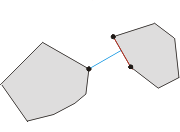
Thousands of thousands years ago there was a small kingdom located in the middle of the Pacific Ocean. The territory of the kingdom consists two separated islands. Due to the impact of the ocean current, the shapes of both the islands became convex polygons. The king of the kingdom wanted to establish a bridge to connect the two islands. To minimize the cost, the king asked you, the bishop, to find the minimal distance between the boundaries of the two islands.
Input
The input consists of several test cases. Each test case begins with two integers N, M. (3 ≤ N, M ≤ 10000) Each of the next N lines contains a pair of coordinates, which describes the position of a vertex in one convex polygon. Each of the next M lines contains a pair of coordinates, which describes the position of a vertex in the other convex polygon. A line with N = M = 0 indicates the end of input. The coordinates are within the range [-10000, 10000].
Output
For each test case output the minimal distance. An error within 0.001 is acceptable.
Sample Input
4 4

0.00000 0.00000

0.00000 1.00000

1.00000 1.00000

1.00000 0.00000

2.00000 0.00000

2.00000 1.00000

3.00000 1.00000

3.00000 0.00000

0 0
Sample Output
1.00000
分析:
凸多边形间最小距离
给定两个非连接(比如不相交)的凸多边形 P 和 Q, 目标是找到拥有最小距离的点对 (p,
q) (p 属于 P 且 q 属于 Q)。

事实上, 多边形非连接十分重要, 因为我们所说的多边形包含其内部。 如果多边形相交,
 那么最小距离就变得没有意义了。 然而, 这个问题的另一个版本, 凸多边形顶点对间最
小距离对于相交和非相交的情况都有解存在。

回到我们的主问题: 直观的, 确定最小距离的点不可能包含在多边形的内部。 与最大距
离问题相似, 我们有如下结论:

两个凸多边形 P 和 Q 之间的最小距离由多边形间的对踵点对确立。 存在凸多边形间的三
种多边形间的对踵点对, 因此就有三种可能存在的最小距离模式:
1. “顶点-顶点”的情况
2. “顶点-边”的情况
3. “边-边”的情况

换句话说, 确定最小距离的点对不一定必须是顶点。
考虑如下的算法, 算法的输入是两个分别有 m 和 n 个顺时针给定顶点的凸多边形 P 和
 Q。
1. 计算 P 上 y 坐标值最小的顶点(称为 yminP ) 和 Q 上 y 坐标值最大的顶点(称
为 ymaxQ)。
2. 为多边形在 yminP 和 ymaxQ 处构造两条切线 LP 和 LQ 使得他们对应的多边
形位于他们的右侧。 此时 LP 和 LQ 拥有不同的方向, 并且 yminP 和 ymaxQ
成为了多边形间的一个对踵点对。
3. 计算距离(yminP,ymaxQ) 并且将其维护为当前最小值。
4. 顺时针同时旋转平行线直到其中一个与其所在的多边形的边重合。
5. 如果只有一条线与边重合, 那么只需要计算“顶点-边”对踵点对和“顶点-顶点”对踵点
对距离。 都将他们与当前最小值比较, 如果小于当前最小值则进行替换更新。 如果
两条切线都与边重合, 那么情况就更加复杂了。 如果边“交叠,”  也就是可以构造一
条与两条边都相交的公垂线(但不是在顶点处相交), 那么就计算“边-边”距离。 否
则计算三个新的“顶点-顶点”对踵点对距离。 所有的这些距离都与当前最小值进行比
较, 若小于当前最小值则更新替换。
6. 重复执行步骤4和步骤5, 直到新的点对为(yminP,ymaxQ)。
7. 输出最大距离。
旋转卡壳模式保证了所有的对踵点对(和所有可能的子情况)都被考虑到。 此外, 整个算
法拥有现行的时间复杂度, 因为(除了初始化), 只有与顶点数同数量级的操作步数需要
执行。
#include <iostream>

#include <cmath>

#include <cstdio>

#include <vector>

#include <algorithm>

using namespace std;

struct Point

{

	double x,y;

	Point() {}

	Point(double x,double y):x(x),y(y) {}

};

typedef Point Vector;

Vector operator +(Vector A,Vector B){return Vector(A.x+B.x,A.y+B.y);}

Vector operator -(Vector A,Vector B){return Vector(A.x-B.x,A.y-B.y);}

Vector operator *(Vector A,double p){return Vector(A.x*p,A.y*p);}

Vector operator /(Vector A,double p){return Vector(A.x/p,A.y/p);}

bool operator < (const Point &a,const Point &b)

{

    return a.x<b.x||(a.x==b.x&&a.y<b.y);

}

const double eps=1e-10;

int dcmp(double x)

{

    if(fabs(x)<eps) return 0;

    else return x<0?-1:1;

}

bool operator == (const Point &a,const Point &b){

    return (dcmp(a.x-b.x)==0 && dcmp(a.y-b.y)==0);

}

double Dot(Vector A,Vector B){return A.x*B.x+A.y*B.y;}

double Length(Vector A){return sqrt(Dot(A,A));}

double Angle(Vector A,Vector B){return acos(Dot(A,B)/Length(A)/Length(B));}

double Cross(Vector A,Vector B){ return A.x*B.y-A.y*B.x;}

double min(double a,double b){ return a<b?a:b;}

double max(double a,double b){ return a>b?a:b;}

double Dist(Point a,Point b){ return Length(a-b);}

Point read_point()

{

	Point p;

	scanf("%lf %lf",&p.x,&p.y);

	return p;

}

double DistanceToSegment(Point p,Point a,Point b)//点到线段的距离

{

	if(a == b) return Length(p-a);

	Vector v1=b-a,v2=p-a,v3=p-b;

	if(dcmp(Dot(v1,v2)) < 0) return Length(v2);

	else if(dcmp(Dot(v1,v3)) > 0) return Length(v3);

	else return fabs(Cross(v1,v2))/Length(v1);

}

vector<Point> ConvexHull(vector<Point>& p) //求凸包

{

    sort(p.begin(), p.end());

    p.erase(unique(p.begin(), p.end()), p.end());

    int i,n = p.size();

    int m = 0;

    vector<Point> ch(n+1);

    for(i = 0; i < n; i++) {

        while(m > 1 && Cross(ch[m-1]-ch[m-2], p[i]-ch[m-2]) <= 0) m--;

        ch[m++] = p[i];

    }

    int k = m;

    for(i = n-2; i >= 0; i--) {

        while(m > k && Cross(ch[m-1]-ch[m-2], p[i]-ch[m-2]) <= 0) m--;

        ch[m++] = p[i];

    }

    if(n > 1) m--;

    ch.resize(m);

    return ch;

}

double DistSegToSeg(Point p0,Point p1,Point p2,Point p3)//两线段间的最小距离

{

    double ans1 = min(DistanceToSegment(p0,p2,p3),DistanceToSegment(p1,p2,p3));

    double ans2 = min(DistanceToSegment(p2,p0,p1),DistanceToSegment(p3,p0,p1));

    return min(ans1,ans2);

}

double Rotating_Calipers(vector<Point> p1,vector<Point> p2)//旋转卡壳算法凸包间的最小距离
{

	int s1=0,s2=0,n=p1.size(),m=p2.size(),i;

	p1.push_back(p1[0]);

	p2.push_back(p2[0]);

	double ans=1e10;

        int temp;

	for(i=0;i<n;i++)//找出p1凸包上y值最小的点

		if(dcmp(p1[i].y-p1[s1].y) < 0) s1=i;

        for(i=0;i<m;i++)//找出p2凸包上y值最大的点

			if(dcmp(p2[i].y-p2[s2].y) > 0) s2=i;

			for(i=0;i<n;i++)

			{

				while(temp=dcmp(Cross(p2[(s2+1)%m]-p2[s2],p2[s2]+p1[(s1+1)%n]-p1[s1]-p2[s2])) < 0)

					s2=(s2+1)%m;

                if(temp == 0)

					ans = min(ans,DistSegToSeg(p1[s1],p1[(s1+1)%n],p2[s2],p2[(s2+1)%m]));

                else ans = min(ans,DistanceToSegment(p2[s2],p1[s1],p1[(s1+1)%n]));

				s1 = (s1+1)%n;

			}

			return ans;

}

double solve(vector<Point> p1,vector<Point> p2)

{

	return min(Rotating_Calipers(p1,p2),Rotating_Calipers(p2,p1));

}

int main()

{

	int n,m,i;

	vector<Point> p1,p2;

	while(scanf("%d %d",&n,&m),n+m)

	{

		p1.clear();p2.clear();

		for(i=0;i<n;i++) p1.push_back(read_point());

		for(i=0;i<m;i++) p2.push_back(read_point());

		printf("%.5lf\n",solve(ConvexHull(p1),ConvexHull(p2)));

	}

	return 0;

}
poj 3608 凸包间的最小距离的更多相关文章
- POJ 3608 凸包间最短距离(旋转卡壳)
Bridge Across Islands Time Limit: 1000MS Memory Limit: 65536K Total Submissions: 11539 Accepted: ...
- ●POJ 3608 Bridge Across Islands
题链: http://poj.org/problem?id=3608 题解: 计算几何,求两个凸包间的最小距离,旋转卡壳 两个凸包间的距离,无非下面三种情况: 所以可以基于旋转卡壳的思想,去求最小距离 ...
- poj 2187 凸包加旋转卡壳算法
题目链接:http://poj.org/problem?id=2187 旋转卡壳算法:http://www.cppblog.com/staryjy/archive/2009/11/19/101412. ...
- poj 3608 Bridge Across Islands
题目:计算两个不相交凸多边形间的最小距离. 分析:计算几何.凸包.旋转卡壳.分别求出凸包,利用旋转卡壳求出对踵点对,枚举距离即可. 注意:1.利用向量法判断旋转,而不是计算角度:避免精度问题和TLE. ...
- POJ - 3608 Bridge Across Islands【旋转卡壳】及一些有趣现象
给两个凸包,求这两个凸包间最短距离 旋转卡壳的基础题 因为是初学旋转卡壳,所以找了别人的代码进行观摩..然而发现很有意思的现象 比如说这个代码(只截取了关键部分) double solve(Point ...
- poj 1873 凸包+枚举
The Fortified Forest Time Limit: 1000MS Memory Limit: 30000K Total Submissions: 6198 Accepted: 1 ...
- poj 1113 凸包周长
Wall Time Limit: 1000MS Memory Limit: 10000K Total Submissions: 33888 Accepted: 11544 Descriptio ...
- Poj 2187 凸包模板求解
Poj 2187 凸包模板求解 传送门 由于整个点数是50000,而求凸包后的点也不会很多,因此直接套凸包之后两重循环即可求解 #include <queue> #include < ...
- POJ 3608 Bridge Across Islands --凸包间距离,旋转卡壳
题意: 给你两个凸包,求其最短距离. 解法: POJ 我真的是弄不懂了,也不说一声点就是按顺时针给出的,不用调整点顺序. 还是说数据水了,没出乱给点或给逆时针点的数据呢..我直接默认顺时针给的点居然A ...
随机推荐
- (九)mybatis之生命周期
生命周期 SqlSessionFactoryBuilder SqlSessionFactoryBuilder的作用就是生成SqlSessionFactory对象,是一个构建器.所以我们一旦构建 ...
- UVA 10817 - Headmaster's Headache(三进制状压dp)
题目:https://uva.onlinejudge.org/index.php?option=com_onlinejudge&Itemid=8&category=20&pag ...
- 2.add two number
在初始化的时候:ListNode* result;这样就会报runtime error
- 二分查找算法java
二分查找又称折半查找,它是一种效率较高的查找方法. 折半查找的算法思想是将数列按有序化(递增或递减)排列,查找过程中采用跳跃式方式查找,即先以有序数列的中点位置为比较对象,如果要找的元素值小于该中点元 ...
- 不安装oracle客户端用sqlplus连接数据库
在不安装oracle客户端情况下用sqlplus连接数据库: 1.去官网下载 http://www.oracle.com/technetwork/topics/winx64soft-089540.ht ...
- ios多线程原理及runloop介绍
一.线程概述 有些程序是一条直线,起点到终点:有些程序是一个圆,不断循环,直到将它切断.直线的如简单的Hello World,运行打印完,它的生命周期便结束了,像昙花一现那样:圆如操作系统,一直运行直 ...
- 【OS_Linux】清空终端屏幕的方法
使用clear命令或Ctrl+L组合键来清空终端屏幕,它不是真正的清空了,而是给人以错觉,当向上滚动鼠标后发现屏幕的内容依然在. 使用printf '\033c'才真正意义上清空了屏幕,它同DOS下的 ...
- (42)zabbix使用IT services 了解服务器SLA整体情况
什么是IT Services 服务器或者某项服务.业务的可用率,不懂技术的上级领导会过问最近服务器可用率如何.所有api的状况怎么样? 通常一些技术人员会说负载怎么样,哪些cpu使用率怎么样,硬盘使用 ...
- linux下如何编译运行c程序
GCC是Linux操作系统下一个非常重要的源代码编译工具,有着许多重要的选项,支持许多不同语言的编译,如C.C++.Ada.Fortran.Objective.Perl.Python.Ruby以及Ja ...
- LeetCode答案(python)
1. 两数之和 给定一个整数数组 nums 和一个目标值 target,请你在该数组中找出和为目标值的那 两个 整数,并返回他们的数组下标. 你可以假设每种输入只会对应一个答案.但是,你不能重复利用这 ...