
lower_bound && upper_bound
用lower_bound进行二分查找
●在从小到大排好序的基本类型数组上进行二分查找。
这是二分查找的一种版本,试图在已排序的[first,last)中寻找元素value。如果[first,last)具有与value相等的元素(s),便返回一个迭代器,指向其中第一个元素。如果没有这样的元素存在,便返回“假设这样的元素存在是应该出现的位置”。也就是说,它会返回一个迭代器,指向第一个“不小于value的元素”。如果value大于[first,last)内的任何一个元素,则返回last。以稍许不同的观点来看lower_bound,其返回值是“在不破坏顺序状态的原则下,可插入value的第一个位置”。如下图
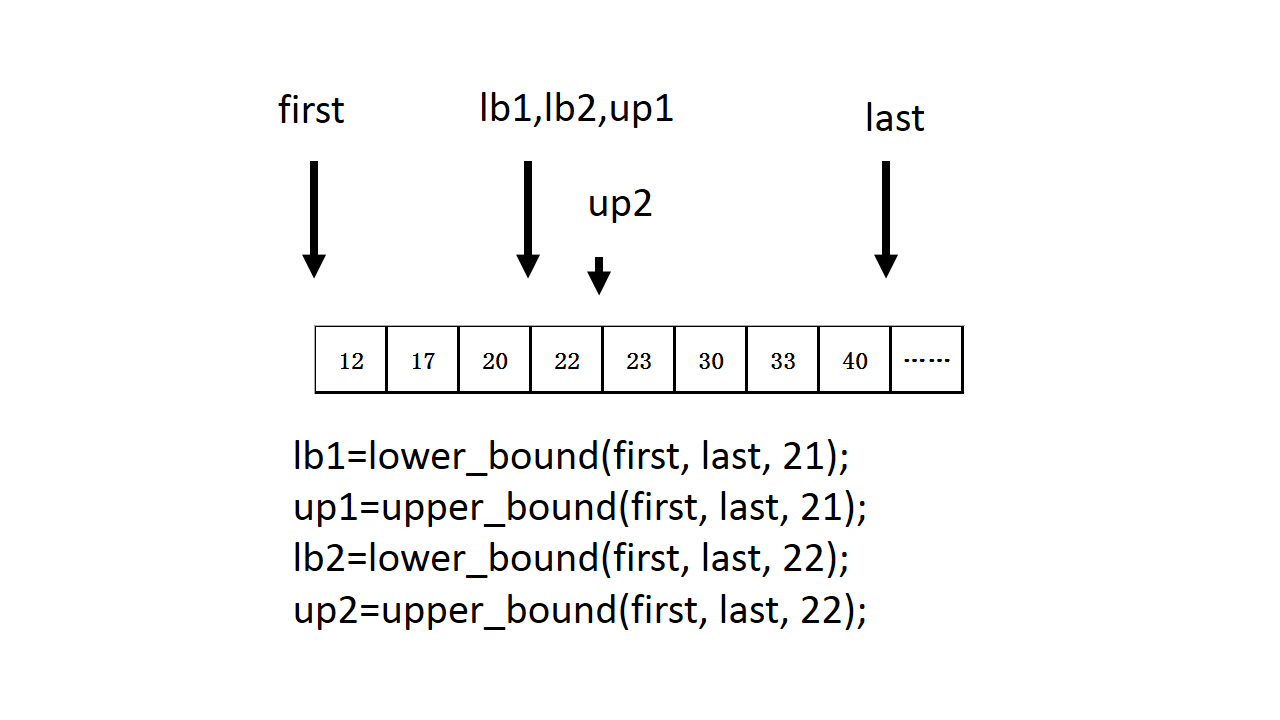
具体的用法是:
I
在对元素类型为T的从小到大排好序的基本类型的数组中进行查找。
T * lower_bound ( 数组名 + n1, 数组名 + n2 , 值 );
* p 是查找区间里下标最小的,大于等于“值”的元素。如果找不到,p指向下标为n2的元素。
II
在元素为任意的T类型、按照自定义排序规则排好序的数组中进行查找。
T * lower_bound ( 数组名 + n1, 数组名 + n2, 值 , 排序规则结构名());
返回一个指针 T * P;
* P是查找区间里下标最小的,按自定义排序规则,可以排在“值”后面的元素。如果找不到,p指向下标为n2的元素。
这个算法有两个版本,版本1采用operator<进行比较,版本2采用仿函数comp。更正式地说,版本1返回[first,last)中最远的迭代器i,使得[first,i)中的每个迭代器j都满足 *j < value。版本2返回[first,last)中最远的迭代器i,使[first,i)中的每个迭代器j都满足“comp(j *, value)为真”。
函数原型就不给了,讲一讲用法就行了。
用upper_bound进行二分查找
算法upper_bound是二分查找(binary_search)的另一个版本。它试图在已排序的[first,last)中寻找value。更明确地说,它会返回 “在不破坏顺序的情况下,可插入 value的最后一个合适的位置”。
由于STL规范“区间圈定”时的起头和结尾并不对称(是的,[first,last)包含first但不包含last),所以 upper_bound 与lower_bound 的返回值意义大有不同。如果你查找某值,而它的确出现在区间内,则 lower_bound 返回的是一个指向该元素的迭代器。然而upper_bound 不这么做。因为upper_bound所返回的是在不破坏排序状态的情况下,value 可被插入的“最后一个”合适的位置。如果value存在,那么它返回的迭代器将指向value的下一位置,而非指向value本身。
upper_bound有两个版本,版本一采用operator < 进行比较,版本二采用仿函数comp。更正式地说,版本一返回[first,last) 区间内最远的迭代器i,使[first,i)内的每一个迭代器j都满足 "value < *j"不为真。版本二返回[first,last)区间内最远的迭代器i,使[first,last)中的每个迭代器j都满足"comp( value , *j )不为真"。
下面是upper_bound的具体用法:
I
在元素类型为T的从小到大排好序的基本类型的数组中进行查找:
T * upper_bound ( 数组名 + n1, 数组名 + n2, 值);
返回一个指针 T * p;
*p 是查找区间里下标最小的、大于“值”的元素。如果找不到,p指向下标为n2的元素。
II
在元素为任意的T类型、按照自定义排序规则排好序的数组中进行查找
T * upper_bound( 数组名 + n1, 数组名 + n2 , 值 ,排序规则结构名());
返回一个指针 T * p;
* p是查找区间里下标最小的,按自定义排序规则,必须排在“值”后面的元素。如果找不到,p指向下标为n2的元素。
lower_bound&upper_bound用法实例
#include <iostream>

#include <cstring>

#include <algorithm>

using namespace std;

struct rule

{

    bool operator() ( const int & a1, const int & a2)

    {

        return a1% < a2%;// 按照个位数由小到大排序

    }

};

void print(int a[],int size)

{

    for(int i = ;i < size;i ++)

        cout << a[i] << ",";

    cout << endl;

}

#define NUM 7

int main()

{

    int a[NUM] = { ,,,,,,};

    sort(a,a+NUM);

    print(a,NUM);// =>3,5,5,7,12,21,98,

    int * p = lower_bound( a, a + NUM, );

    cout << *p << "," << p-a << endl; //=>5,1

    p = upper_bound ( a, a + NUM, );

    cout << *p << endl;//=>7

    cout << * upper_bound ( a, a+NUM, )<< endl;//=>21

    sort( a, a + NUM, rule());

    print( a, NUM);//=>21,12,3,5,5,7,98,

    cout << * lower_bound ( a, a + NUM , , rule()) << endl;//=>7

    cout << lower_bound ( a, a + NUM , , rule()) - a <<endl;//=>3

    cout << upper_bound ( a, a + NUM, , rule()) - a <<endl;//=>7

    if ( upper_bound ( a , a + NUM ,  , rule()) == a + NUM)

        cout << "NOT FOUND" << endl; //=>not found

    cout << * upper_bound ( a, a + NUM,  , rule()) << endl;//=>7

    cout << * upper_bound ( a, a + NUM,  , rule()) << endl;//=>5

    return ;

}
lower_bound && upper_bound的更多相关文章
- STL中的二分查找———lower_bound,upper_bound,binary_search
关于STL中的排序和检索,排序一般用sort函数即可,今天来整理一下检索中常用的函数——lower_bound , upper_bound 和 binary_search . STL中关于二分查找的函 ...
- lower_bound/upper_bound example
http://www.cplusplus.com/reference/algorithm/upper_bound/左闭右开 Return iterator to lower bound Returns ...
- [STL]lower_bound&upper_bound
源码 lower_bound template <class ForwardIterator, class T> ForwardIterator lower_bound (ForwardI ...
- STL中的unique()和lower_bound ,upper_bound
unique(): 作用:unique()的作用是去掉容器中相邻元素的重复元素(数组可以是无序的,比如数组可以不是按从小到大或者从大到小的排列方式) 使用方法:unique(初始地址,末地址): 这里 ...
- vector 牛逼 +lower_bound+ upper_bound
vector 超级 日白 解决的问题空间问题,可以自由伸缩. 一下用法: 向量大小: vec.size(); 向量判空: vec.empty(); 末尾添加元素: vec.push_back(); / ...
- C++ lower_bound/upper_bound用法解析
1. 作用 lower_bound和upper_bound都是C++的STL库中的函数,作用差不多,lower_bound所返回的是第一个大于或等于目标元素的元素地址,而upper ...
- LeetCode:Search Insert Position,Search for a Range (二分查找,lower_bound,upper_bound)
Search Insert Position Given a sorted array and a target value, return the index if the target is fo ...
- STL lower_bound upper_bound binary-search
STL中的二分查找——lower_bound .upper_bound .binary_search 二分查找很简单,原理就不说了.STL中关于二分查找的函数有三个lower_bound .upper ...
- C++标准库之 Lower_Bound, upper_Bound
关于二分查找,这绝对是最简单却又最难的实现了,其各种版本号能够參见http://blog.csdn.net/xuqingict/article/details/17335833 在C++的标准库中,便 ...
随机推荐
- Node.js模板引擎的深入探讨
每次当我想用 node.js 来写一个 web 相关项目的时候.我总是会陷入无比的纠结.原因是 JavaScript 生态圈里的模板引擎实在太多了,但那么多却实在找不出一个接近完美的,所谓完美的概念就 ...
- Python数据预处理:机器学习、人工智能通用技术(1)
Python数据预处理:机器学习.人工智能通用技术 白宁超 2018年12月24日17:28:26 摘要:大数据技术与我们日常生活越来越紧密,要做大数据,首要解决数据问题.原始数据存在大量不完整.不 ...
- PL/SQL学习笔记程序单元
一:程序单元组成 一个PL/SQL程序单元主要包括三部分: 声明与定义部分:声明变量.常量.类型等:定义过程.函数等: 执行部分:执行PL/SQL语句:调用过程.参数:处理游标等: 异常处理部分:处理 ...
- java 根据身份证号码获取出生日期、性别、年龄
1.情景展示 如何根据身份证号,计算出出生日期.性别.年龄? 2.解决方案 从网上找的别人的,因为并没有实际用到,所以并未对其优化! /** * 通过身份证号码获取出生日期.性别.年龄 * @pa ...
- Linux 添加开机启动项的两种方法
1.编辑文件 /etc/rc.localvim /etc/rc.local #!/bin/sh## This script will be executed *after* all the oth ...
- vue: 代码小记
1.事件派发:子控件->父控件 <!DOCTYPE html> <html> <head> <meta charset="UTF-8" ...
- fgrep: ifcfg-ifcfg-eth0: No such file or directory
[root@localhost ~]# service network restartfgrep: ifcfg-ifcfg-eth0: No such file or directoryfgrep: ...
- 转:关于S参数的一些理解
关于S参数的一些理解 http://rf.eefocus.com/module/forum/thread-596241-1-1.html 台湾工程师图文独特讲解:S参数http://rf.eefocu ...
- 【转载】VMware虚拟机NAT模式网络配置图文教程
原文:https://blog.csdn.net/dingguanyi/article/details/77829085 一.引言 在Windows上搭建集群实验环境时,为能够让集群结点之间相互通信, ...
- Python中的string模块的学习
代码为主,相信有python基础的都能看懂: ? [python] view plain copy >>> import string >>> string.a ...