
关于torch.nn.LSTM()的输入和输出
主角torch.nn.LSTM()
初始化时要传入的参数
 |  Args:

 |      input_size: The number of expected features in the input `x`

 |      hidden_size: The number of features in the hidden state `h`

 |      num_layers: Number of recurrent layers. E.g., setting ``num_layers=2``

 |          would mean stacking two LSTMs together to form a `stacked LSTM`,

 |          with the second LSTM taking in outputs of the first LSTM and

 |          computing the final results. Default: 1

 |      bias: If ``False``, then the layer does not use bias weights `b_ih` and `b_hh`.

 |          Default: ``True``

 |      batch_first: If ``True``, then the input and output tensors are provided

 |          as `(batch, seq, feature)` instead of `(seq, batch, feature)`.

 |          Note that this does not apply to hidden or cell states. See the

 |          Inputs/Outputs sections below for details.  Default: ``False``

 |      dropout: If non-zero, introduces a `Dropout` layer on the outputs of each

 |          LSTM layer except the last layer, with dropout probability equal to

 |          :attr:`dropout`. Default: 0

 |      bidirectional: If ``True``, becomes a bidirectional LSTM. Default: ``False``

 |      proj_size: If ``> 0``, will use LSTM with projections of corresponding size. Default: 0
input_size:一般是词嵌入的大小
hidden_size:隐含层的维度
num_layers:默认是1,单层LSTM
bias:是否使用bias
batch_first:默认为False,如果设置为True,则表示第一个维度表示的是batch_size
dropout:直接看英文吧
bidirectional:默认为False,表示单向LSTM,当设置为True,表示为双向LSTM,一般和num_layers配合使用(需要注意的是当该项设置为True时,将num_layers设置为1,表示由1个双向LSTM构成)
模型输入输出-单向LSTM
import torch

import torch.nn as nn

import numpy as np

inputs_numpy = np.random.random((64,32,300))

inputs = torch.from_numpy(inputs_numpy).to(torch.float32)

inputs.shape
torch.Size([64, 32, 300]):表示[batchsize, max_length, embedding_size]
hidden_size = 128

lstm = nn.LSTM(300, 128, batch_first=True, num_layers=1)

output, (hn, cn) = lstm(inputs)

print(output.shape)

print(hn.shape)

print(cn.shape)
torch.Size([64, 32, 128])
torch.Size([1, 64, 128])
torch.Size([1, 64, 128])
说明:
output:保存了每个时间步的输出,如果想要获取最后一个时间步的输出,则可以这么获取:output_last = output[:,-1,:]
h_n:包含的是句子的最后一个单词的隐藏状态,与句子的长度seq_length无关
c_n:包含的是句子的最后一个单词的细胞状态,与句子的长度seq_length无关
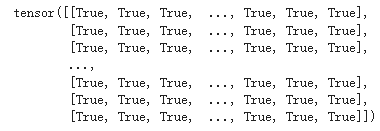
另外:最后一个时间步的输出等于最后一个隐含层的输出
output_last = output[:,-1,:]

hn_last = hn[-1]

print(output_last.eq(hn_last))
模型输入输出-双向LSTM
首先我们要明确:
output :(seq_len, batch, num_directions * hidden_size)
h_n:(num_layers * num_directions, batch, hidden_size)
c_n :(num_layers * num_directions, batch, hidden_size)
其中num_layers表示层数,这里是1,num_directions表示方向数,由于是双向的,这里是2,也是,我们就有下面的结果:
import torch

import torch.nn as nn

import numpy as np

inputs_numpy = np.random.random((64,32,300))

inputs = torch.from_numpy(inputs_numpy).to(torch.float32)

inputs.shape

hidden_size = 128

lstm = nn.LSTM(300, 128, batch_first=True, num_layers=1, bidirectional=True)

output, (hn, cn) = lstm(inputs)

print(output.shape)

print(hn.shape)

print(cn.shape)
torch.Size([64, 32, 256])
torch.Size([2, 64, 128])
torch.Size([2, 64, 128])
这里面的hn包含两个元素,一个是正向的隐含层输出,一个是方向的隐含层输出。
#获取反向的最后一个output

output_last_backward = output[:,0,-hidden_size:]

#获反向最后一层的hn

hn_last_backward = hn[-1]

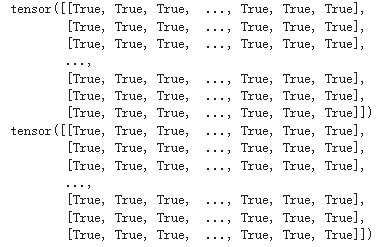
#反向最后的output等于最后一层的hn

print(output_last_backward.eq(hn_last_backward))

#获取正向的最后一个output

output_last_forward = output[:,-1,:hidden_size]

#获取正向最后一层的hn

hn_last_forward = hn[-2]

# 反向最后的output等于最后一层的hn

print(output_last_forward.eq(hn_last_forward))
https://www.cnblogs.com/LiuXinyu12378/p/12322993.html
https://blog.csdn.net/m0_45478865/article/details/104455978
https://blog.csdn.net/foneone/article/details/104002372
关于torch.nn.LSTM()的输入和输出的更多相关文章
- torch.nn.LSTM()函数维度详解
123456789101112lstm=nn.LSTM(input_size, hidden_size, num_la ...
- PyTorch官方中文文档:torch.nn
torch.nn Parameters class torch.nn.Parameter() 艾伯特(http://www.aibbt.com/)国内第一家人工智能门户,微信公众号:aibbtcom ...
- pytorch nn.LSTM()参数详解
输入数据格式:input(seq_len, batch, input_size)h0(num_layers * num_directions, batch, hidden_size)c0(num_la ...
- pytorch中文文档-torch.nn.init常用函数-待添加
参考:https://pytorch.org/docs/stable/nn.html torch.nn.init.constant_(tensor, val) 使用参数val的值填满输入tensor ...
- pytorch中文文档-torch.nn常用函数-待添加-明天继续
https://pytorch.org/docs/stable/nn.html 1)卷积层 class torch.nn.Conv2d(in_channels, out_channels, kerne ...
- torch.nn.functional中softmax的作用及其参数说明
参考:https://pytorch-cn.readthedocs.io/zh/latest/package_references/functional/#_1 class torch.nn.Soft ...
- torch.nn.Embedding理解
Pytorch官网的解释是:一个保存了固定字典和大小的简单查找表.这个模块常用来保存词嵌入和用下标检索它们.模块的输入是一个下标的列表,输出是对应的词嵌入. torch.nn.Embedding(nu ...
- pytorch torch.nn.functional实现插值和上采样
interpolate torch.nn.functional.interpolate(input, size=None, scale_factor=None, mode='nearest', ali ...
- pytorch torch.nn 实现上采样——nn.Upsample
Vision layers 1)Upsample CLASS torch.nn.Upsample(size=None, scale_factor=None, mode='nearest', align ...
随机推荐
- Python+Selenium - js操作
js操作:日期框 本部分涉及两个知识点:DOM树和js DOM树教程链接: https://www.w3school.com.cn/htmldom/index.asp js教程链接 https://w ...
- c++ 各种数据结构的时间空间复杂度
普通线段树 时间 log2(n); 空间 n+log2(n)+log4(n)+log(8)n+.....+logn(n)==n*4; 动态开点线段树 时间 log2(n); 空间 q*log2( ...
- 自动调试用于移动GPU的卷积网络
自动调试用于移动GPU的卷积网络 对特定设备进行自动调试对于获得最佳性能至关重要.这是有关如何调试整个卷积网络的说明文档. TVM中Mobile GPU的算子实现以模板形式编写.模板具有许多可调旋钮( ...
- Python 应用领域以及版本之间的区别
Python 应用领域以及版本之间的区别 一.Python应用领域 1. Python+人工智能,给你更多研究方向选择! 2. 企业级综合实战项目,集六大前沿技术为一体 二. Python 2与Pyt ...
- vscode使用版本控制git commit unstaged时提示对话框的设置
使用 vscode 版本控制提交代码时,如果有 unstaged file,会有一个弹出框: 选择 always 或者 never ,这个框下次就不再弹出了. 如果你想让他再次出现,请去setting ...
- Django(63)drf权限源码分析与自定义权限
前言 上一篇我们分析了认证的源码,一个请求认证通过以后,第二步就是查看权限了,drf默认是允许所有用户访问 权限源码分析 源码入口:APIView.py文件下的initial方法下的check_per ...
- Django OperationalError错误解决
Django项目实践中通过页面http://127.0.0.1:8000/admin/添加数据时报错,见下图 解决方法: 参考链接: https://stackoverflow.com/questio ...
- 2、java基础语法(上):变量与运算符
关键字与保留字 关键字 定义:被Java语言赋予了特殊含义,用做专门用途的字符串(单词) 特点:关键字中所有字母都为小写 官方地址:https://docs.oracle.com/javase/tut ...
- SpringCloud-OAuth2(二):实战篇
如果不了解Oauth2 是什么.工作流程的可以看我上一篇文章: SpringCloud-OAuth2(一):基础篇 这篇讲的内容是:Oauth2在SpringBoot/SpringCloud中的实战. ...
- 为什么PMOS比NMOS的沟道导通电阻大,速度慢,价格高-透彻详解
原文地址点击这里: 在前一节,我们对PMOS与NMOS两种增强型场效应管的开关电路作了详细的介绍, 并且还提到过一种广为流传的说法:相对于NMOS管,PMOS管的沟道导通电阻更大.速度更慢.成本更高等 ...