
经典多级时间轮定时器(C语言版)
经典多级时间轮定时器(C语言版)

文章目录
1. 序言
最近一直在找时间轮的C语言实现代码,发现很多都是Java或者c++实现的。而我对其他语言不熟悉,看不太懂。关于C实现的,让我如沐春风的实现没找到,github上也只找打一个135星的项目,它的具体实现还没来得及看。后来经过多方搜索,找到了两个比较类似的代码,博主都称参考Linux源码中的实现,但是我没有找到对应的代码,个人感觉他们代码实现的很好,经过整理后再次分享出来供以后学习(反正我自己写不出来,我尝试写了一个简单时间轮的代码,是在不敢直视)。
言归正传
2. 多级时间轮实现框架

上图是5个时间轮级联的效果图。中间的大轮是工作轮,只有在它上的任务才会被执行;其他轮上的任务时间到后迁移到下一级轮上,他们最终都会迁移到工作轮上而被调度执行。
多级时间轮的原理也容易理解:就拿时钟做说明,秒针转动一圈分针转动一格;分针转动一圈时针转动一格;同理时间轮也是如此:当低级轮转动一圈时,高一级轮转动一格,同时会将高一级轮上的任务重新分配到低级轮上。从而实现了多级轮级联的效果。
2.1 多级时间轮对象

- 多级时间轮应该至少包括以下内容:
- 每一级时间轮对象
- 轮子上指针的位置
关于轮子上指针的位置有一个比较巧妙的办法:那就是位运算。比如定义一个无符号整型的数:
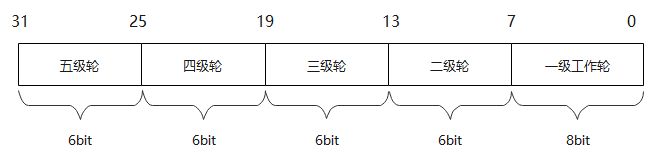
通过获取当前的系统时间便可以通过位操作转换为时间轮上的时间,通过与实际时间轮上的时间作比较,从而确定时间轮要前进调度的时间,进而操作对应时间轮槽位对应的任务。
为什么至少需要这两个成员呢?
- 定义多级时间轮,首先需要明确的便是级联的层数,也就是说需要确定有几个时间轮。
- 轮子上指针位置,就是当前时间轮运行到的位置,它与真实时间的差便是后续时间轮需要调度执行,它们的差值是时间轮运作起来的驱动力。
多级时间轮对象的定义
//实现5级时间轮 范围为0~ (2^8 * 2^6 * 2^6 * 2^6 *2^6)=2^32

struct tvec_base

{

    unsigned long 		current_index;

    pthread_t  			thincrejiffies;

    pthread_t  			threadID;

    struct tvec_root 	tv1;	/*第一个轮*/

    struct tvec      	tv2;	/*第二个轮*/

    struct tvec      	tv3;	/*第三个轮*/

    struct tvec      	tv4;	/*第四个轮*/

    struct tvec      	tv5;	/*第五个轮*/

};
2.2 时间轮对象

我们知道每一个轮子实际上都是一个哈希表,上面我们只是实例化了五个轮子的对象,但是五个轮子具体包含什么,有几个槽位等等没有明确(即struct tvec和struct tvec_root)。
#define TVN_BITS 		6

#define TVR_BITS 		8

#define TVN_SIZE 		(1<<TVN_BITS)

#define TVR_SIZE 		(1<<TVR_BITS)

struct tvec {

    struct list_head vec[TVN_SIZE];/*64个格子*/

};

struct tvec_root{

    struct list_head vec[TVR_SIZE];/*256个格子*/

};
此外,每一个时间轮都是哈希表,因此它的类型应该至少包含两个指针域来实现双向链表的功能。这里我们为了方便使用通用的struct list_head的双向链表结构。
2.3 定时任务对象
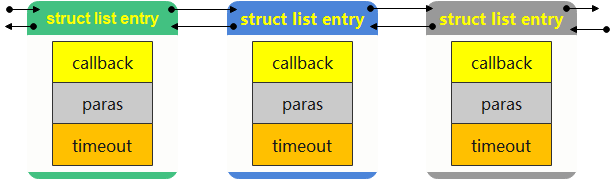
定时器的主要工作是为了在未来的特定时间完成某项任务,而这个任务经常包含以下内容:
- 任务的处理逻辑(回调函数)
- 任务的参数
- 双向链表节点
- 到时时间
定时任务对象的定义
typedef void (*timeouthandle)(unsigned long );

struct timer_list{

    struct list_head entry;          //将时间连接成链表

    unsigned long expires;           //超时时间

    void (*function)(unsigned long); //超时后的处理函数

    unsigned long data;              //处理函数的参数

    struct tvec_base *base;          //指向时间轮

};
在时间轮上的效果图:

2.4 双向链表
在时间轮上我们采用双向链表的数据类型。采用双向链表的除了操作上比单链表复杂,多占一个指针域外没有其他不可接收的问题。而多占一个指针域在今天大内存的时代明显不是什么问题。至于双向链表操作的复杂性,我们可以通过使用通用的struct list结构来解决,因为双向链表有众多的标准操作函数,我们可以通过直接引用list.h头文件来使用他们提供的接口。
struct list可以说是一个万能的双向链表操作框架,我们只需要在自定义的结构中定义一个struct list对象即可使用它的标准操作接口。同时它还提供了一个类似container_of的接口,在应用层一般叫做list_entry,因此我们可以很方便的通过struct list成员找到自定义的结构体的起始地址。
关于应用层的log.h, 我将在下面的代码中附上该文件。如果需要内核层的实现,可以直接从linux源码中获取。
2.5 联结方式
多级时间轮效果图:

3. 多级时间轮C语言实现
3.1 双向链表头文件: list.h
提到双向链表,很多的源码工程中都会实现一系列的统一的双向链表操作函数。它们为双向链表封装了统计的接口,使用者只需要在自定义的结构中添加一个struct list_head结构,然后调用它们提供的接口,便可以完成双向链表的所有操作。这些操作一般都在list.h的头文件中实现。Linux源码中也有实现(内核态的实现)。他们实现的方式基本完全一样,只是实现的接口数量和功能上稍有差别。可以说这个list.h文件是学习操作双向链表的不二选择,它几乎实现了所有的操作:增、删、改、查、遍历、替换、清空等等。这里我拼凑了一个源码中的log.h函数,终于凑够了多级时间轮中使用到的接口(原来的博主没有提供list.h文件,只能自己去东拼西凑)。

#if !defined(_BLKID_LIST_H) && !defined(LIST_HEAD)

#define _BLKID_LIST_H

#ifdef __cplusplus

extern "C" {

#endif

/*

 * Simple doubly linked list implementation.

 *

 * Some of the internal functions ("__xxx") are useful when

 * manipulating whole lists rather than single entries, as

 * sometimes we already know the next/prev entries and we can

 * generate better code by using them directly rather than

 * using the generic single-entry routines.

 */

struct list_head {

	struct list_head *next, *prev;

};

#define LIST_HEAD_INIT(name) { &(name), &(name) }

#define LIST_HEAD(name) \

	struct list_head name = LIST_HEAD_INIT(name)

#define INIT_LIST_HEAD(ptr) do { \

	(ptr)->next = (ptr); (ptr)->prev = (ptr); \

} while (0)

static inline void

__list_add(struct list_head *entry,

                struct list_head *prev, struct list_head *next)

{

    next->prev = entry;

    entry->next = next;

    entry->prev = prev;

    prev->next = entry;

}

/**

 * Insert a new element after the given list head. The new element does not

 * need to be initialised as empty list.

 * The list changes from:

 *      head → some element → ...

 * to

 *      head → new element → older element → ...

 *

 * Example:

 * struct foo *newfoo = malloc(...);

 * list_add(&newfoo->entry, &bar->list_of_foos);

 *

 * @param entry The new element to prepend to the list.

 * @param head The existing list.

 */

static inline void

list_add(struct list_head *entry, struct list_head *head)

{

    __list_add(entry, head, head->next);

}

/**

 * Append a new element to the end of the list given with this list head.

 *

 * The list changes from:

 *      head → some element → ... → lastelement

 * to

 *      head → some element → ... → lastelement → new element

 *

 * Example:

 * struct foo *newfoo = malloc(...);

 * list_add_tail(&newfoo->entry, &bar->list_of_foos);

 *

 * @param entry The new element to prepend to the list.

 * @param head The existing list.

 */

static inline void

list_add_tail(struct list_head *entry, struct list_head *head)

{

    __list_add(entry, head->prev, head);

}

static inline void

__list_del(struct list_head *prev, struct list_head *next)

{

    next->prev = prev;

    prev->next = next;

}

/**

 * Remove the element from the list it is in. Using this function will reset

 * the pointers to/from this element so it is removed from the list. It does

 * NOT free the element itself or manipulate it otherwise.

 *

 * Using list_del on a pure list head (like in the example at the top of

 * this file) will NOT remove the first element from

 * the list but rather reset the list as empty list.

 *

 * Example:

 * list_del(&foo->entry);

 *

 * @param entry The element to remove.

 */

static inline void

list_del(struct list_head *entry)

{

    __list_del(entry->prev, entry->next);

}

static inline void

list_del_init(struct list_head *entry)

{

    __list_del(entry->prev, entry->next);

    INIT_LIST_HEAD(entry);

}

static inline void list_move_tail(struct list_head *list,

				  struct list_head *head)

{

	__list_del(list->prev, list->next);

	list_add_tail(list, head);

}

/**

 * Check if the list is empty.

 *

 * Example:

 * list_empty(&bar->list_of_foos);

 *

 * @return True if the list contains one or more elements or False otherwise.

 */

static inline int

list_empty(struct list_head *head)

{

    return head->next == head;

}

/**

 * list_replace - replace old entry by new one

 * @old : the element to be replaced

 * @new : the new element to insert

 *

 * If @old was empty, it will be overwritten.

 */

static inline void list_replace(struct list_head *old,

				struct list_head *new)

{

	new->next = old->next;

	new->next->prev = new;

	new->prev = old->prev;

	new->prev->next = new;

}

/**

 * Retrieve the first list entry for the given list pointer.

 *

 * Example:

 * struct foo *first;

 * first = list_first_entry(&bar->list_of_foos, struct foo, list_of_foos);

 *

 * @param ptr The list head

 * @param type Data type of the list element to retrieve

 * @param member Member name of the struct list_head field in the list element.

 * @return A pointer to the first list element.

 */

#define list_first_entry(ptr, type, member) \

    list_entry((ptr)->next, type, member)

static inline void list_replace_init(struct list_head *old,

					struct list_head *new)

{

	list_replace(old, new);

	INIT_LIST_HEAD(old);

}

/**

 * list_entry - get the struct for this entry

 * @ptr:	the &struct list_head pointer.

 * @type:	the type of the struct this is embedded in.

 * @member:	the name of the list_struct within the struct.

 */

#define list_entry(ptr, type, member) \

	((type *)((char *)(ptr)-(unsigned long)(&((type *)0)->member)))

/**

 * list_for_each - iterate over elements in a list

 * @pos:	the &struct list_head to use as a loop counter.

 * @head:	the head for your list.

 */

#define list_for_each(pos, head) \

	for (pos = (head)->next; pos != (head); pos = pos->next)

/**

 * list_for_each_safe - iterate over elements in a list, but don't dereference

 *                      pos after the body is done (in case it is freed)

 * @pos:	the &struct list_head to use as a loop counter.

 * @pnext:	the &struct list_head to use as a pointer to the next item.

 * @head:	the head for your list (not included in iteration).

 */

#define list_for_each_safe(pos, pnext, head) \

	for (pos = (head)->next, pnext = pos->next; pos != (head); \

	     pos = pnext, pnext = pos->next)

#ifdef __cplusplus

}

#endif

#endif /* _BLKID_LIST_H */
这里面一般会用到一个重要实现:container_of, 它的原理如果不清楚的话,可以阅读另一篇专门介绍该函数的博文:container of()函数简介
3.2 调试信息头文件: log.h
这个头文件实际上不是必须的,我只是用它来添加调试信息(代码中的errlog(), log()都是log.h中的宏函数)。它的效果是给打印的信息加上颜色,效果如下:

log.h的代码如下:
#ifndef _LOG_h_

#define _LOG_h_

#include <stdio.h>

#define COL(x)  "\033[;" #x "m"

#define RED     COL(31)

#define GREEN   COL(32)

#define YELLOW  COL(33)

#define BLUE    COL(34)

#define MAGENTA COL(35)

#define CYAN    COL(36)

#define WHITE   COL(0)

#define GRAY    "\033[0m"

#define errlog(fmt, arg...) do{     \

    printf(RED"[#ERROR: Toeny Sun:"GRAY YELLOW" %s:%d]:"GRAY WHITE fmt GRAY, __func__, __LINE__, ##arg);\

}while(0)

#define log(fmt, arg...) do{     \

    printf(WHITE"[#DEBUG: Toeny Sun: "GRAY YELLOW"%s:%d]:"GRAY WHITE fmt GRAY, __func__, __LINE__, ##arg);\

}while(0)

#endif
3.3 时间轮代码: timewheel.c
/*

 *毫秒定时器  采用多级时间轮方式  借鉴linux内核中的实现

 *支持的范围为1 ~  2^32 毫秒(大约有49天)

 *若设置的定时器超过最大值 则按最大值设置定时器

 **/

#include <stdio.h>

#include <stdlib.h>

#include <string.h>

#include <unistd.h>

#include <pthread.h>

#include <sys/time.h>

#include "list.h"

#include "log.h"

#define TVN_BITS 		6

#define TVR_BITS 		8

#define TVN_SIZE 		(1<<TVN_BITS)

#define TVR_SIZE 		(1<<TVR_BITS)

#define TVN_MASK 		(TVN_SIZE - 1)

#define TVR_MASK 		(TVR_SIZE - 1)

#define SEC_VALUE 		0

#define USEC_VALUE 		2000

struct tvec_base;

#define INDEX(N) ((ba->current_index >> (TVR_BITS + (N) * TVN_BITS)) & TVN_MASK)

typedef void (*timeouthandle)(unsigned long );

struct timer_list{

    struct list_head entry;          //将时间连接成链表

    unsigned long expires;           //超时时间

    void (*function)(unsigned long); //超时后的处理函数

    unsigned long data;              //处理函数的参数

    struct tvec_base *base;          //指向时间轮

};

struct tvec {

    struct list_head vec[TVN_SIZE];

};

struct tvec_root{

    struct list_head vec[TVR_SIZE];

};

//实现5级时间轮 范围为0~ (2^8 * 2^6 * 2^6 * 2^6 *2^6)=2^32

struct tvec_base

{

    unsigned long 		current_index;

    pthread_t  			thincrejiffies;

    pthread_t  			threadID;

    struct tvec_root 	tv1;	/*第一个轮*/

    struct tvec      	tv2;	/*第二个轮*/

    struct tvec      	tv3;	/*第三个轮*/

    struct tvec      	tv4;	/*第四个轮*/

    struct tvec      	tv5;	/*第五个轮*/

};

static void internal_add_timer(struct tvec_base *base, struct timer_list *timer)

{

    struct list_head *vec;

    unsigned long expires = timer->expires;

    unsigned long idx = expires - base->current_index;

#if 1

    if( (signed long)idx < 0 ) /*这里是没有办法区分出是过时还是超长定时的吧?*/

    {

        vec = base->tv1.vec + (base->current_index & TVR_MASK);/*放到第一个轮的当前槽*/

    }

	else if ( idx < TVR_SIZE ) /*第一个轮*/

    {

        int i = expires & TVR_MASK;

        vec = base->tv1.vec + i;

    }

    else if( idx < 1 << (TVR_BITS + TVN_BITS) )/*第二个轮*/

    {

        int i = (expires >> TVR_BITS) & TVN_MASK;

        vec = base->tv2.vec + i;

    }

    else if( idx < 1 << (TVR_BITS + 2 * TVN_BITS) )/*第三个轮*/

    {

        int i = (expires >> (TVR_BITS + TVN_BITS)) & TVN_MASK;

        vec = base->tv3.vec + i;

    }

    else if( idx < 1 << (TVR_BITS + 3 * TVN_BITS) )/*第四个轮*/

    {

        int i = (expires >> (TVR_BITS + 2 * TVN_BITS)) & TVN_MASK;

        vec = base->tv4.vec + i;

    }

    else											 /*第五个轮*/

    {

        int i;

        if (idx > 0xffffffffUL)

        {

            idx = 0xffffffffUL;

            expires = idx + base->current_index;

        }

        i = (expires >> (TVR_BITS + 3 * TVN_BITS)) & TVN_MASK;

        vec = base->tv5.vec + i;

    }

#else

	/*上面可以优化吧*/;

#endif

    list_add_tail(&timer->entry, vec);

}

static inline void detach_timer(struct timer_list *timer)

{

    struct list_head *entry = &timer->entry;

    __list_del(entry->prev, entry->next);

    entry->next = NULL;

    entry->prev = NULL;

}

static int __mod_timer(struct timer_list *timer, unsigned long expires)

{

    if(NULL != timer->entry.next)

        detach_timer(timer);

    internal_add_timer(timer->base, timer);

    return 0;

}

//修改定时器的超时时间外部接口

int mod_timer(void *ptimer, unsigned long expires)

{

    struct timer_list *timer  = (struct timer_list *)ptimer;

    struct tvec_base *base;

	base = timer->base;

    if(NULL == base)

        return -1;

    expires = expires + base->current_index;

    if(timer->entry.next != NULL  && timer->expires == expires)

        return 0;

    if( NULL == timer->function )

    {

        errlog("timer's timeout function is null\n");

        return -1;

    }

	timer->expires = expires;

    return __mod_timer(timer,expires);

}

//添加一个定时器

static void __ti_add_timer(struct timer_list *timer)

{

    if( NULL != timer->entry.next )

    {

        errlog("timer is already exist\n");

        return;

    }

    mod_timer(timer, timer->expires);

}

/*添加一个定时器  外部接口

 *返回定时器

 */

void* ti_add_timer(void *ptimewheel, unsigned long expires,timeouthandle phandle, unsigned long arg)

{

    struct timer_list  *ptimer;

    ptimer = (struct timer_list *)malloc( sizeof(struct timer_list) );

    if(NULL == ptimer)

        return NULL;

    bzero( ptimer,sizeof(struct timer_list) );

    ptimer->entry.next = NULL;

    ptimer->base = (struct tvec_base *)ptimewheel;

    ptimer->expires = expires;

    ptimer->function  = phandle;

    ptimer->data = arg;

    __ti_add_timer(ptimer);

    return ptimer;

}

/*

 *删除一个定时器  外部接口

 *

 * */

void ti_del_timer(void *p)

{

    struct timer_list *ptimer =(struct timer_list*)p;

    if(NULL == ptimer)

        return;

    if(NULL != ptimer->entry.next)

        detach_timer(ptimer);

    free(ptimer);

}

/*时间轮级联*/

static int cascade(struct tvec_base *base, struct tvec *tv, int index)

{

    struct list_head *pos,*tmp;

    struct timer_list *timer;

    struct list_head tv_list;

	/*将tv[index]槽位上的所有任务转移给tv_list,然后清空tv[index]*/

    list_replace_init(tv->vec + index, &tv_list);/*用tv_list替换tv->vec + index*/

    list_for_each_safe(pos, tmp, &tv_list)/*遍历tv_list双向链表,将任务重新添加到时间轮*/

    {

        timer = list_entry(pos,struct timer_list,entry);/*struct timer_list中成员entry的地址是pos, 获取struct timer_list的首地址*/

        internal_add_timer(base, timer);

    }

    return index;

}

static void *deal_function_timeout(void *base)

{

    struct timer_list *timer;

    int ret;

    struct timeval tv;

    struct tvec_base *ba = (struct tvec_base *)base;

    for(;;)

    {

        gettimeofday(&tv, NULL);

        while( ba->current_index <= (tv.tv_sec*1000 + tv.tv_usec/1000) )/*单位:ms*/

        {

           struct list_head work_list;

           int index = ba->current_index & TVR_MASK;/*获取第一个轮上的指针位置*/

           struct list_head *head = &work_list;

		   /*指针指向0槽时,级联轮需要更新任务列表*/

           if(!index && (!cascade(ba, &ba->tv2, INDEX(0))) &&( !cascade(ba, &ba->tv3, INDEX(1))) && (!cascade(ba, &ba->tv4, INDEX(2))) )

               cascade(ba, &ba->tv5, INDEX(3));

            ba->current_index ++;

            list_replace_init(ba->tv1.vec + index, &work_list);

            while(!list_empty(head))

            {

                void (*fn)(unsigned long);

                unsigned long data;

                timer = list_first_entry(head, struct timer_list, entry);

                fn = timer->function;

                data = timer->data;

                detach_timer(timer);

                (*fn)(data);

            }

        }

    }

}

static void init_tvr_list(struct tvec_root * tvr)

{

    int i;

    for( i = 0; i<TVR_SIZE; i++ )

        INIT_LIST_HEAD(&tvr->vec[i]);

}

static void init_tvn_list(struct tvec * tvn)

{

    int i;

    for( i = 0; i<TVN_SIZE; i++ )

        INIT_LIST_HEAD(&tvn->vec[i]);

}

//创建时间轮  外部接口

void *ti_timewheel_create(void )

{

    struct tvec_base *base;

    int ret = 0;

    struct timeval tv;

    base = (struct tvec_base *) malloc( sizeof(struct tvec_base) );

    if( NULL==base )

        return NULL;

    bzero( base,sizeof(struct tvec_base) );

    init_tvr_list(&base->tv1);

    init_tvn_list(&base->tv2);

    init_tvn_list(&base->tv3);

    init_tvn_list(&base->tv4);

    init_tvn_list(&base->tv5);

    gettimeofday(&tv, NULL);

    base->current_index = tv.tv_sec*1000 + tv.tv_usec/1000;/*当前时间毫秒数*/

    if( 0 != pthread_create(&base->threadID,NULL,deal_function_timeout,base) )

    {

        free(base);

        return NULL;

    }

    return base;

}

static void ti_release_tvr(struct tvec_root *pvr)

{

    int i;

    struct list_head *pos,*tmp;

    struct timer_list *pen;

    for(i = 0; i < TVR_SIZE; i++)

    {

        list_for_each_safe(pos,tmp,&pvr->vec[i])

        {

            pen = list_entry(pos,struct timer_list, entry);

            list_del(pos);

            free(pen);

        }

    }

}

static void ti_release_tvn(struct tvec *pvn)

{

    int i;

    struct list_head *pos,*tmp;

    struct timer_list *pen;

    for(i = 0; i < TVN_SIZE; i++)

    {

        list_for_each_safe(pos,tmp,&pvn->vec[i])

        {

            pen = list_entry(pos,struct timer_list, entry);

            list_del(pos);

            free(pen);

        }

    }

}

/*

 *释放时间轮 外部接口

 * */

void ti_timewheel_release(void * pwheel)

{

    struct tvec_base *base = (struct tvec_base *)pwheel;

    if(NULL == base)

        return;

    ti_release_tvr(&base->tv1);

    ti_release_tvn(&base->tv2);

    ti_release_tvn(&base->tv3);

    ti_release_tvn(&base->tv4);

    ti_release_tvn(&base->tv5);

    free(pwheel);

}

/************demo****************/

struct request_para{

    void *timer;

    int val;

};

void mytimer(unsigned long arg)

{

    struct request_para *para = (struct request_para *)arg;

    log("%d\n",para->val);

    mod_timer(para->timer,3000);  //进行再次启动定时器

	sleep(10);/*定时器依然被阻塞*/

    //定时器资源的释放是在这里完成的

    //ti_del_timer(para->timer);

}

int main(int argc,char *argv[])

{

    void *pwheel = NULL;

    void *timer  = NULL;

    struct request_para *para;

    para = (struct request_para *)malloc( sizeof(struct request_para) );

    if(NULL == para)

        return 0;

    bzero(para,sizeof(struct request_para));

    //创建一个时间轮

    pwheel = ti_timewheel_create();

    if(NULL == pwheel)

        return -1;

    //添加一个定时器

    para->val = 100;

    para->timer = ti_add_timer(pwheel, 3000, &mytimer, (unsigned long)para);

    while(1)

    {

        sleep(2);

    }

    //释放时间轮

    ti_timewheel_release(pwheel);

    return 0;

}
3.4 编译运行
toney@ubantu:/mnt/hgfs/em嵌入式学习记录/4. timerwheel/2. 多级时间轮$ ls

a.out  list.h  log.h  mutiTimeWheel.c

toney@ubantu:/mnt/hgfs/em嵌入式学习记录/4. timerwheel/2. 多级时间轮$ gcc mutiTimeWheel.c -lpthread

toney@ubantu:/mnt/hgfs/em嵌入式学习记录/4. timerwheel/2. 多级时间轮$ ./a.out

[#DEBUG: Toeny Sun: mytimer:370]:100

[#DEBUG: Toeny Sun: mytimer:370]:100

[#DEBUG: Toeny Sun: mytimer:370]:100

[#DEBUG: Toeny Sun: mytimer:370]:100

[#DEBUG: Toeny Sun: mytimer:370]:100

[#DEBUG: Toeny Sun: mytimer:370]:100

[#DEBUG: Toeny Sun: mytimer:370]:100

[#DEBUG: Toeny Sun: mytimer:370]:100

[#DEBUG: Toeny Sun: mytimer:370]:100

[#DEBUG: Toeny Sun: mytimer:370]:100

[#DEBUG: Toeny Sun: mytimer:370]:100

[#DEBUG: Toeny Sun: mytimer:370]:100

[#DEBUG: Toeny Sun: mytimer:370]:100

[#DEBUG: Toeny Sun: mytimer:370]:100

[#DEBUG: Toeny Sun: mytimer:370]:100

[#DEBUG: Toeny Sun: mytimer:370]:100

[#DEBUG: Toeny Sun: mytimer:370]:100

[#DEBUG: Toeny Sun: mytimer:370]:100

[#DEBUG: Toeny Sun: mytimer:370]:100

[#DEBUG: Toeny Sun: mytimer:370]:100

[#DEBUG: Toeny Sun: mytimer:370]:100

[#DEBUG: Toeny Sun: mytimer:370]:100

[#DEBUG: Toeny Sun: mytimer:370]:100

[#DEBUG: Toeny Sun: mytimer:370]:100

[#DEBUG: Toeny Sun: mytimer:370]:100

[#DEBUG: Toeny Sun: mytimer:370]:100

[#DEBUG: Toeny Sun: mytimer:370]:100

[#DEBUG: Toeny Sun: mytimer:370]:100
从结果可以看出:如果添加的定时任务是比较耗时的操作,那么后续的任务也会被阻塞,可能一直到超时,甚至一直阻塞下去,这个取决于当前任务是否耗时。这个理论上是绝不能接受的:一个任务不应该也不能去影响其他的任务吧。但是目前没有对此问题进行改进和完善,以后有机会再继续完善吧。
经典多级时间轮定时器(C语言版)的更多相关文章
- 记录——时间轮定时器(lua 实现)
很长一段时间里,我错误的认识了定时器.无意中,我发现了“时间轮”这个名词,让我对定时器有了新的看法. 我错误的认为,定时器只需要一个 tick 队列,按指定的时间周期遍历队列,检查 tick 倒计时满 ...
- go:基于时间轮定时器方案
/* * http://blog.csdn.net/yueguanghaidao/article/details/46290539 * 修改内容:为定时器增加类型和参数属性,修改回调函数类型 */ p ...
- .Net 之时间轮算法(终极版)
关于时间轮算法的起始 我也认真的看了时间轮算法相关,大致都是如下的一个图 个人认为的问题 大部分文章在解释这个为何用时间轮的时候都再说 假设我们现在有一个很大的数组,专门用于存放延时任务.它的精度达到 ...
- [从源码学设计]蚂蚁金服SOFARegistry之时间轮的使用
[从源码学设计]蚂蚁金服SOFARegistry之时间轮的使用 目录 [从源码学设计]蚂蚁金服SOFARegistry之时间轮的使用 0x00 摘要 0x01 业务领域 1.1 应用场景 0x02 定 ...
- Kafka中时间轮分析与Java实现
在Kafka中应用了大量的延迟操作但在Kafka中 并没用使用JDK自带的Timer或是DelayQueue用于延迟操作,而是使用自己开发的DelayedOperationPurgatory组件用于管 ...
- kafka时间轮的原理(一)
概述 早就想写关于kafka时间轮的随笔了,奈何时间不够,技术感觉理解不到位,现在把我之前学习到的进行整理一下,以便于以后并不会忘却.kafka时间轮是一个时间延时调度的工具,学习它可以掌握更加灵活先 ...
- Go语言中时间轮的实现
最近在工作中有一个需求,简单来说就是在短时间内会创建上百万个定时任务,创建的时候会将对应的金额相加,防止超售,需要过半个小时再去核对数据,如果数据对不上就需要将加上的金额再减回去. 这个需求如果用Go ...
- SpringBoot定时任务 - 经典定时任务设计:时间轮(Timing Wheel)案例和原理
Timer和ScheduledExecutorService是JDK内置的定时任务方案,而业内还有一个经典的定时任务的设计叫时间轮(Timing Wheel), Netty内部基于时间轮实现了一个Ha ...
- .Net之时间轮算法(终极版)定时任务
TimeWheelDemo 一个基于时间轮原理的定时器 对时间轮的理解 其实我是有一篇文章(.Net 之时间轮算法(终极版))针对时间轮的理论理解的,但是,我想,为啥我看完时间轮原理后,会采用这样的方 ...
随机推荐
- 声明提前(hoist)
程序执行前,都会先找到var声明的变量和function声明的函数. 一.var声明的变量 程序 结果 console.log(a); var a=10; console.log(a); //unde ...
- 图文实例解析,InnoDB 存储引擎中行锁的三种算法
前文提到,对于 InnoDB 来说,随时都可以加锁(关于加锁的 SQL 语句这里就不说了,忘记的小伙伴可以翻一下上篇文章),但是并非随时都可以解锁.具体来说,InnoDB 采用的是两阶段锁定协议(tw ...
- Spring Cloud分区发布实践(3) 网关和负载均衡
注意: 因为涉及到配置测试切换, 中间环节需按此文章操作体验, 代码仓库里面的只有最后一步的代码 准备好了微服务, 那我们就来看看网关+负载均衡如何一起工作 新建一个模块hello-gateway, ...
- InnoDB锁机制-转载
InnoDB锁机制 1. 锁类型 锁是数据库区别与文件系统的一个关键特性,锁机制用于管理对共享资源的并发访问. InnoDB使用的锁类型,分别有: 共享锁(S)和排他锁(X) 意向锁(IS和IX) 自 ...
- vue传值 ---- >> 子传父,$emit()
划重点: $emit 绑定一个自定义事件event,当这个这个语句被执行到的时候,就会将参数arg传递给父组件,父组件通过@event监听并接收参数. 子组件: 1 <template& ...
- CVE-2021-3156 复现
测试环境 OS: Ubuntu 18.04.5 LTS GCC: gcc version 7.5.0 (Ubuntu 7.5.0-3ubuntu1~18.04) Make: GNU Make 4.1 ...
- Burp - Turbo Intruder
Turbo Intruder 基础使用总结,把Python代码都记录下,要是有啥骚姿势,求各位师傅交流. 个人感觉超强的一款Burp插件,反正超快 Link: https://github.com/P ...
- 解决win10快速访问不能取消固定
最近发现win10的快速访问不能取消固定,比如ftp和smb之类的都不能取消固定 最后百度了一下发现一个简易的方法: 在文件资源管理器地址栏输入:%APPDATA%\Microsoft\Windows ...
- Linux进程理解与实践(二)僵尸&孤儿进程 和文件共享
孤儿进程与僵尸进程 孤儿进程: 如果父进程先退出,子进程还没退出那么子进程的父进程将变为init进程.(注:任何一个进程都必须有父进程) [cpp] view plaincopy #include & ...
- C++小知识——显示VS大括号/花括号折叠按钮
这个功能默认是关闭的,打开路径如下: 将大纲语句块改为"True" 这个功能其实很有必要真不知道为啥默认要关闭这个功能. 站在巨人的肩膀上的思想,其实已经在互联网程序员之间深入人心 ...