
深入理解SpringAOP之代理对象
本篇文章主要带大家简单分析一下AOP的代理对象,至于AOP是什么,如何配置等基础性知识,不在这里讨论。阅读前请先参考:代理模式,在这之前我们需要了解springframework的三个核心接口与getBean方法
一、FactoryBean&BeanFactory&ObjectFactory
这三个接口都为Springframework的核心接口,虽然这三个名字很像,但是意义却千差万别。面试的时候也常问它们之间的区别。BeanFactory本身就是一个bean的工厂,同时也是我们的IOC容器,而FactoryBean是一个特殊的Bean,我们可以来看看这个接口:
/*

 * Copyright 2002-2016 the original author or authors.

 *

 * Licensed under the Apache License, Version 2.0 (the "License");

 * you may not use this file except in compliance with the License.

 * You may obtain a copy of the License at

 *

 *      http://www.apache.org/licenses/LICENSE-2.0

 *

 * Unless required by applicable law or agreed to in writing, software

 * distributed under the License is distributed on an "AS IS" BASIS,

 * WITHOUT WARRANTIES OR CONDITIONS OF ANY KIND, either express or implied.

 * See the License for the specific language governing permissions and

 * limitations under the License.

 */

package org.springframework.beans.factory;

import org.springframework.lang.Nullable;

/**

 * Interface to be implemented by objects used within a {@link BeanFactory} which

 * are themselves factories for individual objects. If a bean implements this

 * interface, it is used as a factory for an object to expose, not directly as a

 * bean instance that will be exposed itself.

 *

 * <p><b>NB: A bean that implements this interface cannot be used as a normal bean.</b>

 * A FactoryBean is defined in a bean style, but the object exposed for bean

 * references ({@link #getObject()}) is always the object that it creates.

 *

 * <p>FactoryBeans can support singletons and prototypes, and can either create

 * objects lazily on demand or eagerly on startup. The {@link SmartFactoryBean}

 * interface allows for exposing more fine-grained behavioral metadata.

 *

 * <p>This interface is heavily used within the framework itself, for example for

 * the AOP {@link org.springframework.aop.framework.ProxyFactoryBean} or the

 * {@link org.springframework.jndi.JndiObjectFactoryBean}. It can be used for

 * custom components as well; however, this is only common for infrastructure code.

 *

 * <p><b>{@code FactoryBean} is a programmatic contract. Implementations are not

 * supposed to rely on annotation-driven injection or other reflective facilities.</b>

 * {@link #getObjectType()} {@link #getObject()} invocations may arrive early in

 * the bootstrap process, even ahead of any post-processor setup. If you need access

 * other beans, implement {@link BeanFactoryAware} and obtain them programmatically.

 *

 * <p>Finally, FactoryBean objects participate in the containing BeanFactory's

 * synchronization of bean creation. There is usually no need for internal

 * synchronization other than for purposes of lazy initialization within the

 * FactoryBean itself (or the like).

 *

 * @author Rod Johnson

 * @author Juergen Hoeller

 * @since 08.03.2003

 * @see org.springframework.beans.factory.BeanFactory

 * @see org.springframework.aop.framework.ProxyFactoryBean

 * @see org.springframework.jndi.JndiObjectFactoryBean

 */

public interface FactoryBean<T> {

    /**

     * Return an instance (possibly shared or independent) of the object

     * managed by this factory.

     * <p>As with a {@link BeanFactory}, this allows support for both the

     * Singleton and Prototype design pattern.

     * <p>If this FactoryBean is not fully initialized yet at the time of

     * the call (for example because it is involved in a circular reference),

     * throw a corresponding {@link FactoryBeanNotInitializedException}.

     * <p>As of Spring 2.0, FactoryBeans are allowed to return {@code null}

     * objects. The factory will consider this as normal value to be used; it

     * will not throw a FactoryBeanNotInitializedException in this case anymore.

     * FactoryBean implementations are encouraged to throw

     * FactoryBeanNotInitializedException themselves now, as appropriate.

     * @return an instance of the bean (can be {@code null})

     * @throws Exception in case of creation errors

     * @see FactoryBeanNotInitializedException

     */

    @Nullable

    T getObject() throws Exception;

    /**

     * Return the type of object that this FactoryBean creates,

     * or {@code null} if not known in advance.

     * <p>This allows one to check for specific types of beans without

     * instantiating objects, for example on autowiring.

     * <p>In the case of implementations that are creating a singleton object,

     * this method should try to avoid singleton creation as far as possible;

     * it should rather estimate the type in advance.

     * For prototypes, returning a meaningful type here is advisable too.

     * <p>This method can be called <i>before</i> this FactoryBean has

     * been fully initialized. It must not rely on state created during

     * initialization; of course, it can still use such state if available.

     * <p><b>NOTE:</b> Autowiring will simply ignore FactoryBeans that return

     * {@code null} here. Therefore it is highly recommended to implement

     * this method properly, using the current state of the FactoryBean.

     * @return the type of object that this FactoryBean creates,

     * or {@code null} if not known at the time of the call

     * @see ListableBeanFactory#getBeansOfType

     */

    @Nullable

    Class<?> getObjectType();

    /**

     * Is the object managed by this factory a singleton? That is,

     * will {@link #getObject()} always return the same object

     * (a reference that can be cached)?

     * <p><b>NOTE:</b> If a FactoryBean indicates to hold a singleton object,

     * the object returned from {@code getObject()} might get cached

     * by the owning BeanFactory. Hence, do not return {@code true}

     * unless the FactoryBean always exposes the same reference.

     * <p>The singleton status of the FactoryBean itself will generally

     * be provided by the owning BeanFactory; usually, it has to be

     * defined as singleton there.

     * <p><b>NOTE:</b> This method returning {@code false} does not

     * necessarily indicate that returned objects are independent instances.

     * An implementation of the extended {@link SmartFactoryBean} interface

     * may explicitly indicate independent instances through its

     * {@link SmartFactoryBean#isPrototype()} method. Plain {@link FactoryBean}

     * implementations which do not implement this extended interface are

     * simply assumed to always return independent instances if the

     * {@code isSingleton()} implementation returns {@code false}.

     * <p>The default implementation returns {@code true}, since a

     * {@code FactoryBean} typically manages a singleton instance.

     * @return whether the exposed object is a singleton

     * @see #getObject()

     * @see SmartFactoryBean#isPrototype()

     */

    default boolean isSingleton() {

        return true;

    }

}
这里面有三个方法,分别为:getObject,getObjectType,isSingleton。根据文档解释,它只是一个生产对象的工厂,被Spring管理 。这个工厂负责提供我们需要的对象。当需要特殊的方式创建Bean时,则考虑实现该接口。我举个例子来说明:
package org.hzgj.spring.study;

import org.springframework.beans.factory.FactoryBean;

import org.springframework.stereotype.Component;

@Component

public class WaterFactoryBean implements FactoryBean<Water> {

    @Override

    public Water getObject() throws Exception {

        Water water=new Water();

        water.setCapacity(20);

        return water;

    }

    @Override

    public Class<?> getObjectType() {

        return Water.class;

    }

    @Override

    public boolean isSingleton() {

        return true;

    }

}

//.....

package org.hzgj.spring.study;

@Deprecated

public class Water {

    private int capacity;

    public int getCapacity() {

        return capacity;

    }

    public void setCapacity(int capacity) {

        this.capacity = capacity;

    }

    public void test() {

        System.out.println("test");

    }

    @Deprecated

    public void test1() {

        System.out.println("test1");

    }

}

//.....

  ClassPathXmlApplicationContext applicationContext = new ClassPathXmlApplicationContext("spring-config.xml");

        Water water = applicationContext.getBean(Water.class);

        water.test1();

// ....能够成功获取到对象
在上面例子里,我们本身是要获得Water对象,那么此时Water对象实际上是通过FactoryBean创建的,因此我们在获取对象时可以添加我们自己的逻辑。
下面我们根据源代码来追溯一下getBean与BeanFactory关联,具体可以参考一下AbstractBeanFactory的doGetBean方法,那么在这里简单的说明一下执行过程:
1) 如果是单例对象的Bean会去缓存中获取
我们先看一下getSinglelone方法:
/** Cache of singleton objects: bean name --> bean instance */

    private final Map<String, Object> singletonObjects = new ConcurrentHashMap<String, Object>(256);

/** Cache of singleton factories: bean name --> ObjectFactory */

    private final Map<String, ObjectFactory<?>> singletonFactories = new HashMap<String, ObjectFactory<?>>(16);

/** Cache of early singleton objects: bean name --> bean instance */

    private final Map<String, Object> earlySingletonObjects = new HashMap<String, Object>(16);

/**

     * Return the (raw) singleton object registered under the given name.

     * <p>Checks already instantiated singletons and also allows for an early

     * reference to a currently created singleton (resolving a circular reference).

     * @param beanName the name of the bean to look for

     * @param allowEarlyReference whether early references should be created or not

     * @return the registered singleton object, or {@code null} if none found

     */

    protected Object getSingleton(String beanName, boolean allowEarlyReference) {

        Object singletonObject = this.singletonObjects.get(beanName);

        if (singletonObject == null && isSingletonCurrentlyInCreation(beanName)) {

            synchronized (this.singletonObjects) {

                singletonObject = this.earlySingletonObjects.get(beanName);

                if (singletonObject == null && allowEarlyReference) {

                    ObjectFactory<?> singletonFactory = this.singletonFactories.get(beanName);

                    if (singletonFactory != null) {

                        singletonObject = singletonFactory.getObject();

                        this.earlySingletonObjects.put(beanName, singletonObject);

                        this.singletonFactories.remove(beanName);

                    }

                }

            }

        }

        return (singletonObject != NULL_OBJECT ? singletonObject : null);

    }
在这里我们获取单例对象时一定和ObjectFactory有关系
2)从它的parentBeanFactory中获取
// Check if bean definition exists in this factory.

            BeanFactory parentBeanFactory = getParentBeanFactory();

            if (parentBeanFactory != null && !containsBeanDefinition(beanName)) {

                // Not found -> check parent.

                String nameToLookup = originalBeanName(name);

                if (args != null) {

                    // Delegation to parent with explicit args.

                    return (T) parentBeanFactory.getBean(nameToLookup, args);

                }

                else {

                    // No args -> delegate to standard getBean method.

                    return parentBeanFactory.getBean(nameToLookup, requiredType);

                }

            }
3)处理bean的dependsOn
final RootBeanDefinition mbd = getMergedLocalBeanDefinition(beanName);

                checkMergedBeanDefinition(mbd, beanName, args);

                // Guarantee initialization of beans that the current bean depends on.

                String[] dependsOn = mbd.getDependsOn();

                if (dependsOn != null) {

                    for (String dep : dependsOn) {

                        if (isDependent(beanName, dep)) {

                            throw new BeanCreationException(mbd.getResourceDescription(), beanName,

                                    "Circular depends-on relationship between '" + beanName + "' and '" + dep + "'");

                        }

                        registerDependentBean(dep, beanName);

                        getBean(dep);

                    }

                }
4)根据bean的scope类型来获取对应的bean
    // Create bean instance.

                if (mbd.isSingleton()) {

                    sharedInstance = getSingleton(beanName, new ObjectFactory<Object>() {

                        @Override

                        public Object getObject() throws BeansException {

                            try {

                                return createBean(beanName, mbd, args);

                            }

                            catch (BeansException ex) {

                                // Explicitly remove instance from singleton cache: It might have been put there

                                // eagerly by the creation process, to allow for circular reference resolution.

                                // Also remove any beans that received a temporary reference to the bean.

                                destroySingleton(beanName);

                                throw ex;

                            }

                        }

                    });

                    bean = getObjectForBeanInstance(sharedInstance, name, beanName, mbd);

                }

                else if (mbd.isPrototype()) {

                    // It's a prototype -> create a new instance.

                    Object prototypeInstance = null;

                    try {

                        beforePrototypeCreation(beanName);

                        prototypeInstance = createBean(beanName, mbd, args);

                    }

                    finally {

                        afterPrototypeCreation(beanName);

                    }

                    bean = getObjectForBeanInstance(prototypeInstance, name, beanName, mbd);

                }

                else {

                    String scopeName = mbd.getScope();

                    final Scope scope = this.scopes.get(scopeName);

                    if (scope == null) {

                        throw new IllegalStateException("No Scope registered for scope name '" + scopeName + "'");

                    }

                    try {

                        Object scopedInstance = scope.get(beanName, new ObjectFactory<Object>() {

                            @Override

                            public Object getObject() throws BeansException {

                                beforePrototypeCreation(beanName);

                                try {

                                    return createBean(beanName, mbd, args);

                                }

                                finally {

                                    afterPrototypeCreation(beanName);

                                }

                            }

                        });

                        bean = getObjectForBeanInstance(scopedInstance, name, beanName, mbd);

                    }

                    catch (IllegalStateException ex) {

                        throw new BeanCreationException(beanName,

                                "Scope '" + scopeName + "' is not active for the current thread; consider " +

                                "defining a scoped proxy for this bean if you intend to refer to it from a singleton",

                                ex);

                    }

                }

            }

            catch (BeansException ex) {

                cleanupAfterBeanCreationFailure(beanName);

                throw ex;

            }

        }
5) 根据需要做类型转换
// Check if required type matches the type of the actual bean instance.

        if (requiredType != null && bean != null && !requiredType.isAssignableFrom(bean.getClass())) {

            try {

                return getTypeConverter().convertIfNecessary(bean, requiredType);

            }

            catch (TypeMismatchException ex) {

                if (logger.isDebugEnabled()) {

                    logger.debug("Failed to convert bean '" + name + "' to required type '" +

                            ClassUtils.getQualifiedName(requiredType) + "'", ex);

                }

                throw new BeanNotOfRequiredTypeException(name, requiredType, bean.getClass());

            }

        }
6)getObjectForBeanInstance
通过源代码我们可以发觉 getObjectForBeanInstance方法调用频率异常之高,那么我们就来看一看,它到底是做什么的:
/**

     * Get the object for the given bean instance, either the bean

     * instance itself or its created object in case of a FactoryBean.

     * @param beanInstance the shared bean instance

     * @param name name that may include factory dereference prefix

     * @param beanName the canonical bean name

     * @param mbd the merged bean definition

     * @return the object to expose for the bean

     */

    protected Object getObjectForBeanInstance(

            Object beanInstance, String name, String beanName, RootBeanDefinition mbd) {

        // Don't let calling code try to dereference the factory if the bean isn't a factory.

        if (BeanFactoryUtils.isFactoryDereference(name) && !(beanInstance instanceof FactoryBean)) {

            throw new BeanIsNotAFactoryException(transformedBeanName(name), beanInstance.getClass());

        }

        // Now we have the bean instance, which may be a normal bean or a FactoryBean.

        // If it's a FactoryBean, we use it to create a bean instance, unless the

        // caller actually wants a reference to the factory.

        if (!(beanInstance instanceof FactoryBean) || BeanFactoryUtils.isFactoryDereference(name)) {

            return beanInstance;

        }

        Object object = null;

        if (mbd == null) {

            object = getCachedObjectForFactoryBean(beanName);

        }

        if (object == null) {

            // Return bean instance from factory.

            FactoryBean<?> factory = (FactoryBean<?>) beanInstance;

            // Caches object obtained from FactoryBean if it is a singleton.

            if (mbd == null && containsBeanDefinition(beanName)) {

                mbd = getMergedLocalBeanDefinition(beanName);

            }

            boolean synthetic = (mbd != null && mbd.isSynthetic());

            object = getObjectFromFactoryBean(factory, beanName, !synthetic);

        }

        return object;

    }
这段代码最主要是看看是否需要从FactoryBean获取对象的。
最后我们在聊聊ObjectFactory:
public interface ObjectFactory<T> {

    /**

     * Return an instance (possibly shared or independent)

     * of the object managed by this factory.

     * @return an instance of the bean (should never be {@code null})

     * @throws BeansException in case of creation errors

     */

    T getObject() throws BeansException;

}
该接口和FactoryBean很像,根据文档说明其getObject方法的返回值不建议为null,另外我们可以发现Bean为singlone时会大量的使用ObjectFactory处理,代码示例:
package org.hzgj.spring.study;

import org.springframework.beans.BeansException;

import org.springframework.beans.factory.ObjectFactory;

import org.springframework.stereotype.Component;

@Component

public class WaterFactory implements ObjectFactory {

    @Override

    public Object getObject() throws BeansException {

        return new Water();

    }

}

//这样子无法获取water,它只单纯是个工厂
ObjectFactory更像是一个在BeanFactory通过Bean名称关联的对象,只不过它在运行时确定getObject()方法返回的对象内容,再者它不像BeanFactory一样能够制定Bean的类型
二、AOP的核心探究
2.1、核心接口初探
为什么刚开始要说FactoryBean,因为它的文档注释已经提醒我们去参考ProxyFactoryBean了,ProxyFactoryBean是生成目标对象代理的核心,那么我们在此先看一下类图:
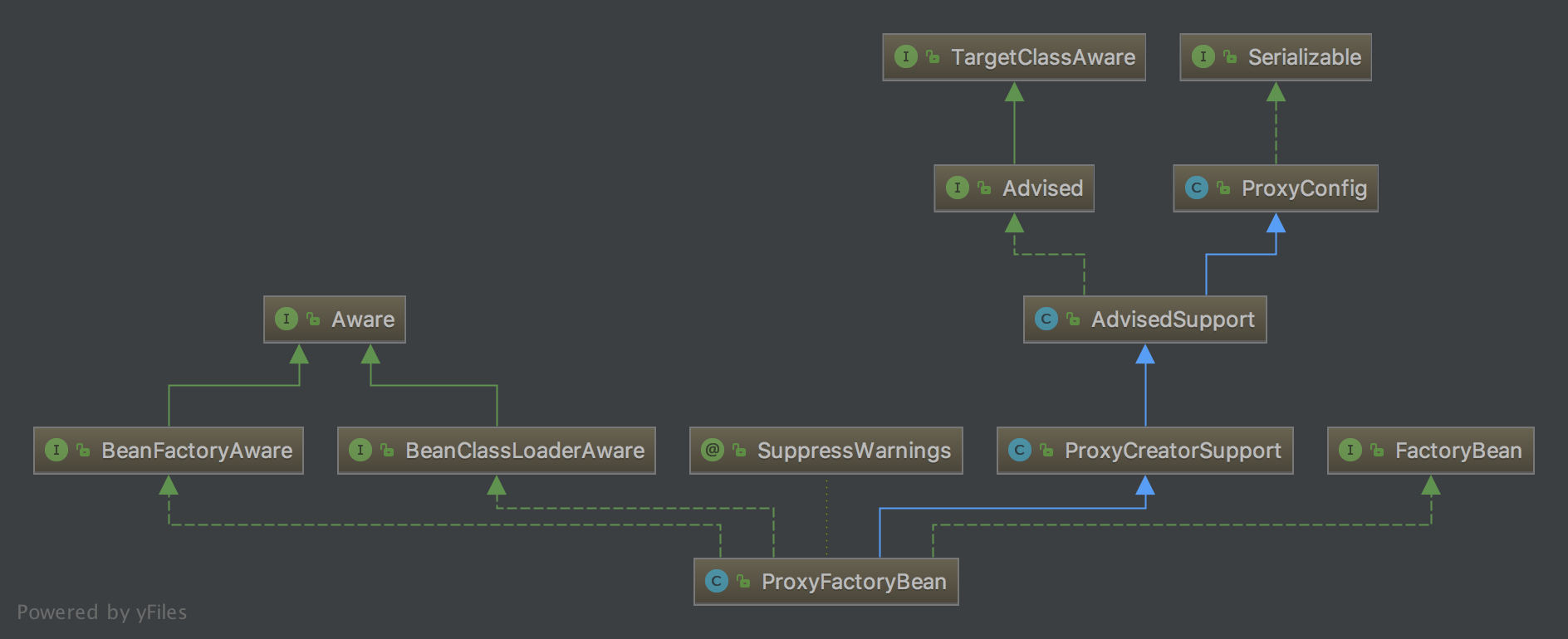
我们可以得知ProxyFactoryBean实现了FactoryBean。
关于AOP的几个重要的核心接口和类如下:
ProxyConfig:
/*

 * Copyright 2002-2012 the original author or authors.

 *

 * Licensed under the Apache License, Version 2.0 (the "License");

 * you may not use this file except in compliance with the License.

 * You may obtain a copy of the License at

 *

 *      http://www.apache.org/licenses/LICENSE-2.0

 *

 * Unless required by applicable law or agreed to in writing, software

 * distributed under the License is distributed on an "AS IS" BASIS,

 * WITHOUT WARRANTIES OR CONDITIONS OF ANY KIND, either express or implied.

 * See the License for the specific language governing permissions and

 * limitations under the License.

 */

package org.springframework.aop.framework;

import java.io.Serializable;

import org.springframework.util.Assert;

/**

 * Convenience superclass for configuration used in creating proxies,

 * to ensure that all proxy creators have consistent properties.

 *

 * @author Rod Johnson

 * @author Juergen Hoeller

 * @see AdvisedSupport

 */

public class ProxyConfig implements Serializable {

    /** use serialVersionUID from Spring 1.2 for interoperability */

    private static final long serialVersionUID = -8409359707199703185L;

    private boolean proxyTargetClass = false;

    private boolean optimize = false;

    boolean opaque = false;

    boolean exposeProxy = false;

    private boolean frozen = false;

    /**

     * Set whether to proxy the target class directly, instead of just proxying

     * specific interfaces. Default is "false".

     * <p>Set this to "true" to force proxying for the TargetSource's exposed

     * target class. If that target class is an interface, a JDK proxy will be

     * created for the given interface. If that target class is any other class,

     * a CGLIB proxy will be created for the given class.

     * <p>Note: Depending on the configuration of the concrete proxy factory,

     * the proxy-target-class behavior will also be applied if no interfaces

     * have been specified (and no interface autodetection is activated).

     * @see org.springframework.aop.TargetSource#getTargetClass()

     */

    public void setProxyTargetClass(boolean proxyTargetClass) {

        this.proxyTargetClass = proxyTargetClass;

    }

    /**

     * Return whether to proxy the target class directly as well as any interfaces.

     */

    public boolean isProxyTargetClass() {

        return this.proxyTargetClass;

    }

    /**

     * Set whether proxies should perform aggressive optimizations.

     * The exact meaning of "aggressive optimizations" will differ

     * between proxies, but there is usually some tradeoff.

     * Default is "false".

     * <p>For example, optimization will usually mean that advice changes won't

     * take effect after a proxy has been created. For this reason, optimization

     * is disabled by default. An optimize value of "true" may be ignored

     * if other settings preclude optimization: for example, if "exposeProxy"

     * is set to "true" and that's not compatible with the optimization.

     */

    public void setOptimize(boolean optimize) {

        this.optimize = optimize;

    }

    /**

     * Return whether proxies should perform aggressive optimizations.

     */

    public boolean isOptimize() {

        return this.optimize;

    }

    /**

     * Set whether proxies created by this configuration should be prevented

     * from being cast to {@link Advised} to query proxy status.

     * <p>Default is "false", meaning that any AOP proxy can be cast to

     * {@link Advised}.

     */

    public void setOpaque(boolean opaque) {

        this.opaque = opaque;

    }

    /**

     * Return whether proxies created by this configuration should be

     * prevented from being cast to {@link Advised}.

     */

    public boolean isOpaque() {

        return this.opaque;

    }

    /**

     * Set whether the proxy should be exposed by the AOP framework as a

     * ThreadLocal for retrieval via the AopContext class. This is useful

     * if an advised object needs to call another advised method on itself.

     * (If it uses {@code this}, the invocation will not be advised).

     * <p>Default is "false", in order to avoid unnecessary extra interception.

     * This means that no guarantees are provided that AopContext access will

     * work consistently within any method of the advised object.

     */

    public void setExposeProxy(boolean exposeProxy) {

        this.exposeProxy = exposeProxy;

    }

    /**

     * Return whether the AOP proxy will expose the AOP proxy for

     * each invocation.

     */

    public boolean isExposeProxy() {

        return this.exposeProxy;

    }

    /**

     * Set whether this config should be frozen.

     * <p>When a config is frozen, no advice changes can be made. This is

     * useful for optimization, and useful when we don't want callers to

     * be able to manipulate configuration after casting to Advised.

     */

    public void setFrozen(boolean frozen) {

        this.frozen = frozen;

    }

    /**

     * Return whether the config is frozen, and no advice changes can be made.

     */

    public boolean isFrozen() {

        return this.frozen;

    }

    /**

     * Copy configuration from the other config object.

     * @param other object to copy configuration from

     */

    public void copyFrom(ProxyConfig other) {

        Assert.notNull(other, "Other ProxyConfig object must not be null");

        this.proxyTargetClass = other.proxyTargetClass;

        this.optimize = other.optimize;

        this.exposeProxy = other.exposeProxy;

        this.frozen = other.frozen;

        this.opaque = other.opaque;

    }

    @Override

    public String toString() {

        StringBuilder sb = new StringBuilder();

        sb.append("proxyTargetClass=").append(this.proxyTargetClass).append("; ");

        sb.append("optimize=").append(this.optimize).append("; ");

        sb.append("opaque=").append(this.opaque).append("; ");

        sb.append("exposeProxy=").append(this.exposeProxy).append("; ");

        sb.append("frozen=").append(this.frozen);

        return sb.toString();

    }

}
该类定义代理类最基本的代理配置
Advised:
/*

 * Copyright 2002-2015 the original author or authors.

 *

 * Licensed under the Apache License, Version 2.0 (the "License");

 * you may not use this file except in compliance with the License.

 * You may obtain a copy of the License at

 *

 *      http://www.apache.org/licenses/LICENSE-2.0

 *

 * Unless required by applicable law or agreed to in writing, software

 * distributed under the License is distributed on an "AS IS" BASIS,

 * WITHOUT WARRANTIES OR CONDITIONS OF ANY KIND, either express or implied.

 * See the License for the specific language governing permissions and

 * limitations under the License.

 */

package org.springframework.aop.framework;

import org.aopalliance.aop.Advice;

import org.springframework.aop.Advisor;

import org.springframework.aop.TargetClassAware;

import org.springframework.aop.TargetSource;

/**

 * Interface to be implemented by classes that hold the configuration

 * of a factory of AOP proxies. This configuration includes the

 * Interceptors and other advice, Advisors, and the proxied interfaces.

 *

 * <p>Any AOP proxy obtained from Spring can be cast to this interface to

 * allow manipulation of its AOP advice.

 *

 * @author Rod Johnson

 * @author Juergen Hoeller

 * @since 13.03.2003

 * @see org.springframework.aop.framework.AdvisedSupport

 */

public interface Advised extends TargetClassAware {

    /**

     * Return whether the Advised configuration is frozen,

     * in which case no advice changes can be made.

     */

    boolean isFrozen();

    /**

     * Are we proxying the full target class instead of specified interfaces?

     */

    boolean isProxyTargetClass();

    /**

     * Return the interfaces proxied by the AOP proxy.

     * <p>Will not include the target class, which may also be proxied.

     */

    Class<?>[] getProxiedInterfaces();

    /**

     * Determine whether the given interface is proxied.

     * @param intf the interface to check

     */

    boolean isInterfaceProxied(Class<?> intf);

    /**

     * Change the {@code TargetSource} used by this {@code Advised} object.

     * <p>Only works if the configuration isn't {@linkplain #isFrozen frozen}.

     * @param targetSource new TargetSource to use

     */

    void setTargetSource(TargetSource targetSource);

    /**

     * Return the {@code TargetSource} used by this {@code Advised} object.

     */

    TargetSource getTargetSource();

    /**

     * Set whether the proxy should be exposed by the AOP framework as a

     * {@link ThreadLocal} for retrieval via the {@link AopContext} class.

     * <p>It can be necessary to expose the proxy if an advised object needs

     * to invoke a method on itself with advice applied. Otherwise, if an

     * advised object invokes a method on {@code this}, no advice will be applied.

     * <p>Default is {@code false}, for optimal performance.

     */

    void setExposeProxy(boolean exposeProxy);

    /**

     * Return whether the factory should expose the proxy as a {@link ThreadLocal}.

     * <p>It can be necessary to expose the proxy if an advised object needs

     * to invoke a method on itself with advice applied. Otherwise, if an

     * advised object invokes a method on {@code this}, no advice will be applied.

     * <p>Getting the proxy is analogous to an EJB calling {@code getEJBObject()}.

     * @see AopContext

     */

    boolean isExposeProxy();

    /**

     * Set whether this proxy configuration is pre-filtered so that it only

     * contains applicable advisors (matching this proxy's target class).

     * <p>Default is "false". Set this to "true" if the advisors have been

     * pre-filtered already, meaning that the ClassFilter check can be skipped

     * when building the actual advisor chain for proxy invocations.

     * @see org.springframework.aop.ClassFilter

     */

    void setPreFiltered(boolean preFiltered);

    /**

     * Return whether this proxy configuration is pre-filtered so that it only

     * contains applicable advisors (matching this proxy's target class).

     */

    boolean isPreFiltered();

    /**

     * Return the advisors applying to this proxy.

     * @return a list of Advisors applying to this proxy (never {@code null})

     */

    Advisor[] getAdvisors();

    /**

     * Add an advisor at the end of the advisor chain.

     * <p>The Advisor may be an {@link org.springframework.aop.IntroductionAdvisor},

     * in which new interfaces will be available when a proxy is next obtained

     * from the relevant factory.

     * @param advisor the advisor to add to the end of the chain

     * @throws AopConfigException in case of invalid advice

     */

    void addAdvisor(Advisor advisor) throws AopConfigException;

    /**

     * Add an Advisor at the specified position in the chain.

     * @param advisor the advisor to add at the specified position in the chain

     * @param pos position in chain (0 is head). Must be valid.

     * @throws AopConfigException in case of invalid advice

     */

    void addAdvisor(int pos, Advisor advisor) throws AopConfigException;

    /**

     * Remove the given advisor.

     * @param advisor the advisor to remove

     * @return {@code true} if the advisor was removed; {@code false}

     * if the advisor was not found and hence could not be removed

     */

    boolean removeAdvisor(Advisor advisor);

    /**

     * Remove the advisor at the given index.

     * @param index index of advisor to remove

     * @throws AopConfigException if the index is invalid

     */

    void removeAdvisor(int index) throws AopConfigException;

    /**

     * Return the index (from 0) of the given advisor,

     * or -1 if no such advisor applies to this proxy.

     * <p>The return value of this method can be used to index into the advisors array.

     * @param advisor the advisor to search for

     * @return index from 0 of this advisor, or -1 if there's no such advisor

     */

    int indexOf(Advisor advisor);

    /**

     * Replace the given advisor.

     * <p><b>Note:</b> If the advisor is an {@link org.springframework.aop.IntroductionAdvisor}

     * and the replacement is not or implements different interfaces, the proxy will need

     * to be re-obtained or the old interfaces won't be supported and the new interface

     * won't be implemented.

     * @param a the advisor to replace

     * @param b the advisor to replace it with

     * @return whether it was replaced. If the advisor wasn't found in the

     * list of advisors, this method returns {@code false} and does nothing.

     * @throws AopConfigException in case of invalid advice

     */

    boolean replaceAdvisor(Advisor a, Advisor b) throws AopConfigException;

    /**

     * Add the given AOP Alliance advice to the tail of the advice (interceptor) chain.

     * <p>This will be wrapped in a DefaultPointcutAdvisor with a pointcut that always

     * applies, and returned from the {@code getAdvisors()} method in this wrapped form.

     * <p>Note that the given advice will apply to all invocations on the proxy,

     * even to the {@code toString()} method! Use appropriate advice implementations

     * or specify appropriate pointcuts to apply to a narrower set of methods.

     * @param advice advice to add to the tail of the chain

     * @throws AopConfigException in case of invalid advice

     * @see #addAdvice(int, Advice)

     * @see org.springframework.aop.support.DefaultPointcutAdvisor

     */

    void addAdvice(Advice advice) throws AopConfigException;

    /**

     * Add the given AOP Alliance Advice at the specified position in the advice chain.

     * <p>This will be wrapped in a {@link org.springframework.aop.support.DefaultPointcutAdvisor}

     * with a pointcut that always applies, and returned from the {@link #getAdvisors()}

     * method in this wrapped form.

     * <p>Note: The given advice will apply to all invocations on the proxy,

     * even to the {@code toString()} method! Use appropriate advice implementations

     * or specify appropriate pointcuts to apply to a narrower set of methods.

     * @param pos index from 0 (head)

     * @param advice advice to add at the specified position in the advice chain

     * @throws AopConfigException in case of invalid advice

     */

    void addAdvice(int pos, Advice advice) throws AopConfigException;

    /**

     * Remove the Advisor containing the given advice.

     * @param advice the advice to remove

     * @return {@code true} of the advice was found and removed;

     * {@code false} if there was no such advice

     */

    boolean removeAdvice(Advice advice);

    /**

     * Return the index (from 0) of the given AOP Alliance Advice,

     * or -1 if no such advice is an advice for this proxy.

     * <p>The return value of this method can be used to index into

     * the advisors array.

     * @param advice AOP Alliance advice to search for

     * @return index from 0 of this advice, or -1 if there's no such advice

     */

    int indexOf(Advice advice);

    /**

     * As {@code toString()} will normally be delegated to the target,

     * this returns the equivalent for the AOP proxy.

     * @return a string description of the proxy configuration

     */

    String toProxyConfigString();

}
该接口主要定义了代理类的工厂基本的行为,比如说添加Advisor,添加Advise,删除与替换Adivsor等
Adivise:
通知接口,该接口没有方法定义,其常见的子接口有BeforeAdvise,AfterAdvise,MethodInterceptor等
PointCut:
切点接口,该接口定义如下:
/*

 * Copyright 2002-2012 the original author or authors.

 *

 * Licensed under the Apache License, Version 2.0 (the "License");

 * you may not use this file except in compliance with the License.

 * You may obtain a copy of the License at

 *

 *      http://www.apache.org/licenses/LICENSE-2.0

 *

 * Unless required by applicable law or agreed to in writing, software

 * distributed under the License is distributed on an "AS IS" BASIS,

 * WITHOUT WARRANTIES OR CONDITIONS OF ANY KIND, either express or implied.

 * See the License for the specific language governing permissions and

 * limitations under the License.

 */

package org.springframework.aop;

/**

 * Core Spring pointcut abstraction.

 *

 * <p>A pointcut is composed of a {@link ClassFilter} and a {@link MethodMatcher}.

 * Both these basic terms and a Pointcut itself can be combined to build up combinations

 * (e.g. through {@link org.springframework.aop.support.ComposablePointcut}).

 *

 * @author Rod Johnson

 * @see ClassFilter

 * @see MethodMatcher

 * @see org.springframework.aop.support.Pointcuts

 * @see org.springframework.aop.support.ClassFilters

 * @see org.springframework.aop.support.MethodMatchers

 */

public interface Pointcut {

    /**

     * Return the ClassFilter for this pointcut.

     * @return the ClassFilter (never {@code null})

     */

    ClassFilter getClassFilter();

    /**

     * Return the MethodMatcher for this pointcut.

     * @return the MethodMatcher (never {@code null})

     */

    MethodMatcher getMethodMatcher();

    /**

     * Canonical Pointcut instance that always matches.

     */

    Pointcut TRUE = TruePointcut.INSTANCE;

}
Pointcut由ClassFilter和MethodMatcher构成。它通过ClassFilter定位到某些特定类上,通过MethodMatcher定位到某些特定方法上,这样Pointcut就拥有了描述某些类的某些特定方法的能力。
Advisor:
代表一般切面,它仅包含一个Advice,我们说过,因为Advice包含了横切代码和连接点的信息,所以Advior本身就是一个简单的切面,只不过它代表的横切的连接点是所有目标类的所有方法,因为这个横切面太宽泛,所以一般不会直接使用。
2.2、源码分析
我们先来看看ProxyFactoryBean的相关方法
getObject方法:
/**

     * Return a proxy. Invoked when clients obtain beans from this factory bean.

     * Create an instance of the AOP proxy to be returned by this factory.

     * The instance will be cached for a singleton, and create on each call to

     * {@code getObject()} for a proxy.

     * @return a fresh AOP proxy reflecting the current state of this factory

     */

    @Override

    public Object getObject() throws BeansException {

        initializeAdvisorChain();

        if (isSingleton()) {

            return getSingletonInstance();

        }

        else {

            if (this.targetName == null) {

                logger.warn("Using non-singleton proxies with singleton targets is often undesirable. " +

                        "Enable prototype proxies by setting the 'targetName' property.");

            }

            return newPrototypeInstance();

        }

    }
这里面我们关注一下getSingletonInstance方法:
/**

     * Return the singleton instance of this class's proxy object,

     * lazily creating it if it hasn't been created already.

     * @return the shared singleton proxy

     */

    private synchronized Object getSingletonInstance() {

        if (this.singletonInstance == null) {

            this.targetSource = freshTargetSource();

            if (this.autodetectInterfaces && getProxiedInterfaces().length == 0 && !isProxyTargetClass()) {

                // Rely on AOP infrastructure to tell us what interfaces to proxy.

                Class<?> targetClass = getTargetClass();

                if (targetClass == null) {

                    throw new FactoryBeanNotInitializedException("Cannot determine target class for proxy");

                }

                setInterfaces(ClassUtils.getAllInterfacesForClass(targetClass, this.proxyClassLoader));

            }

            // Initialize the shared singleton instance.

            super.setFrozen(this.freezeProxy);

            this.singletonInstance = getProxy(createAopProxy());

        }

        return this.singletonInstance;

    }
在这里我们关在关注一下getProxy(AopProxy aopProxy)方法,AopProxy是一个接口:
/*

 * Copyright 2002-2012 the original author or authors.

 *

 * Licensed under the Apache License, Version 2.0 (the "License");

 * you may not use this file except in compliance with the License.

 * You may obtain a copy of the License at

 *

 *      http://www.apache.org/licenses/LICENSE-2.0

 *

 * Unless required by applicable law or agreed to in writing, software

 * distributed under the License is distributed on an "AS IS" BASIS,

 * WITHOUT WARRANTIES OR CONDITIONS OF ANY KIND, either express or implied.

 * See the License for the specific language governing permissions and

 * limitations under the License.

 */

package org.springframework.aop.framework;

/**

 * Delegate interface for a configured AOP proxy, allowing for the creation

 * of actual proxy objects.

 *

 * <p>Out-of-the-box implementations are available for JDK dynamic proxies

 * and for CGLIB proxies, as applied by {@link DefaultAopProxyFactory}.

 *

 * @author Rod Johnson

 * @author Juergen Hoeller

 * @see DefaultAopProxyFactory

 */

public interface AopProxy {

    /**

     * Create a new proxy object.

     * <p>Uses the AopProxy's default class loader (if necessary for proxy creation):

     * usually, the thread context class loader.

     * @return the new proxy object (never {@code null})

     * @see Thread#getContextClassLoader()

     */

    Object getProxy();

    /**

     * Create a new proxy object.

     * <p>Uses the given class loader (if necessary for proxy creation).

     * {@code null} will simply be passed down and thus lead to the low-level

     * proxy facility's default, which is usually different from the default chosen

     * by the AopProxy implementation's {@link #getProxy()} method.

     * @param classLoader the class loader to create the proxy with

     * (or {@code null} for the low-level proxy facility's default)

     * @return the new proxy object (never {@code null})

     */

    Object getProxy(ClassLoader classLoader);

}
该接口有如下实现类:JdkDynamicAopProxy , CglibAopProxy , ObjenesisCglibAopProxy。
那么在这里我们看一下JdkDynamicAopProxy的源码,我只贴出其中一个关键部分:
@Override

    public Object getProxy(ClassLoader classLoader) {

        if (logger.isDebugEnabled()) {

            logger.debug("Creating JDK dynamic proxy: target source is " + this.advised.getTargetSource());

        }

        Class<?>[] proxiedInterfaces = AopProxyUtils.completeProxiedInterfaces(this.advised, true);

        findDefinedEqualsAndHashCodeMethods(proxiedInterfaces);

        return Proxy.newProxyInstance(classLoader, proxiedInterfaces, this);

    }
那么我们可以看出:JDK的动态代理是AOP的实现方式之一
三、基于AOP的核心类与接口实现代理
1、先定义基本的JavaBean:
package org.hzgj.spring.study;

@Aop

public class Water {

    private int capacity;

    public int getCapacity() {

        return capacity;

    }

    public void setCapacity(int capacity) {

        this.capacity = capacity;

    }

    public void test() {

        System.out.println("test");

    }

    @Aop

    public void test1() {

        System.out.println("test1");

    }

}
2、自定义注解
package org.hzgj.spring.study;

import java.lang.annotation.ElementType;

import java.lang.annotation.Retention;

import java.lang.annotation.RetentionPolicy;

import java.lang.annotation.Target;

@Retention(RetentionPolicy.RUNTIME)

@Target({ElementType.METHOD,ElementType.TYPE})

public @interface Aop {

}
3、定义JavaBean的代理
package org.hzgj.spring.study;

import org.aopalliance.intercept.MethodInterceptor;

import org.aopalliance.intercept.MethodInvocation;

import org.springframework.aop.framework.AbstractSingletonProxyFactoryBean;

import org.springframework.aop.support.DefaultPointcutAdvisor;

import org.springframework.aop.support.annotation.AnnotationMatchingPointcut;

import org.springframework.stereotype.Component;

/**

 *

 */

@Component

public class WaterProxyFactoryBean extends AbstractSingletonProxyFactoryBean {

    public WaterProxyFactoryBean() {

        super.setTarget(new Water());

    }

    @Override

    protected Object createMainInterceptor() {

        AnnotationMatchingPointcut pointcut = new AnnotationMatchingPointcut(Aop.class, Aop.class);

        DefaultPointcutAdvisor advisor = new DefaultPointcutAdvisor(pointcut, (MethodInterceptor) invocation -> {

            System.out.println(1);

            return invocation.proceed();

        });

        return advisor;

    }

}
该类继承AbstractSingletonProxyFactoryBean,然后需要重写createMainInterceptor,我在这里定义了一个DefaultPointcutAdvisor与扫描注解的PointCut,至此切点,通知,代理都有了,那么AOP最基本的条件也就具备了
4、主程序
package org.hzgj.spring.study;

import org.springframework.context.support.ClassPathXmlApplicationContext;

public class Main {

    public static void main(String[] args) {

        ClassPathXmlApplicationContext applicationContext = new ClassPathXmlApplicationContext("spring-config.xml");

        Water water = applicationContext.getBean(Water.class);

        water.test1();

    }

}
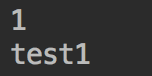
运行成功时会得到如下结果:
深入理解SpringAOP之代理对象的更多相关文章
- 深入理解Spring AOP之二代理对象生成
深入理解Spring AOP之二代理对象生成 spring代理对象 上一篇博客中讲到了Spring的一些基本概念和初步讲了实现方法,当中提到了动态代理技术,包含JDK动态代理技术和Cglib动态代理 ...
- Andorid Binder进程间通信---Binder本地对象,实体对象,引用对象,代理对象的引用计数
本文參考<Android系统源码情景分析>,作者罗升阳. 一.Binder库(libbinder)代码: ~/Android/frameworks/base/libs/binder --- ...
- Spring AOP高级——源码实现(3)AopProxy代理对象之JDK动态代理的创建过程
spring-aop-4.3.7.RELEASE 在<Spring AOP高级——源码实现(1)动态代理技术>中介绍了两种动态代理技术,当然在Spring AOP中代理对象的生成也是运用 ...
- Spring 代理对象,cglib,jdk的问题思考,AOP 配置注解拦截 的一些问题.为什么不要注解在接口,以及抽象方法.
可以被继承 首先注解在类上是可以被继承的 在注解上用@Inherited /** * Created by laizhenwei on 17:49 2017-10-14 */ @Target({Ele ...
- Mybatis-简单基于源码了解获取动态代理对象
这是我们要测试的代码 OderDao就是我们要需要获取的对象. 首先我们根据传入的参数,进入SqlSessionFactoryBuilder 中的对应的build 方法,第一步创键XMLConfigB ...
- AOP之proceedingjoinpoint和joinpoint区别(获取各对象备忘)、动态代理机制及获取原理代理对象、获取Mybatis Mapper接口原始对象
现在AOP的场景越来越多,所以我们有必要理解下和AOP相关的一些概念和机制. import org.aspectj.lang.reflect.SourceLocation; public interf ...
- 深入理解 Java 动态代理机制
Java 有两种代理方式,一种是静态代理,另一种是动态代理.对于静态代理,其实就是通过依赖注入,对对象进行封装,不让外部知道实现的细节.很多 API 就是通过这种形式来封装的. 代理模式结构图(图片来 ...
- mybatis源码分析(四)---------------代理对象的生成
在mybatis两种开发方式这边文章中,我们提到了Mapper动态代理开发这种方式,现在抛出一个问题:通过sqlSession.getMapper(XXXMapper.class)来获取代理对象的过程 ...
- SignalR代理对象异常:Uncaught TypeError: Cannot read property 'client' of undefined 推出的结论 SignalR 简单示例 通过三个DEMO学会SignalR的三种实现方式 SignalR推送框架两个项目永久连接通讯使用 SignalR 集线器简单实例2 用SignalR创建实时永久长连接异步网络应用程序
SignalR代理对象异常:Uncaught TypeError: Cannot read property 'client' of undefined 推出的结论 异常汇总:http://www ...
随机推荐
- python的文件操作file:(内置函数,如seek、truncate函数)
file打开文件有两种方式,函数用file()或者open().打开后读入文件的内容用read()函数,其读入是从文件当前指针位置开始,所以需要控制指针位置用: 一.先介绍下file读入的控制函数: ...
- 小强的HTML5移动开发之路(20)——HTML5 Web SQL Database
来自:http://blog.csdn.net/dawanganban/article/details/18220761 一.Web Database介绍 WebSQL数据库API实际上不是HTML5 ...
- Zookeeper实现master选举
使用场景 有一个向外提供的服务,服务必须7*24小时提供服务,不能有单点故障.所以采用集群的方式,采用master.slave的结构.一台主机多台备机.主机向外提供服务,备机负责监听主 ...
- Java进阶(二十三)java中long类型转换为int类型
java中long类型转换为int类型 由int类型转换为long类型是向上转换,可以直接进行隐式转换,但由long类型转换为int类型是向下转换,可能会出现数据溢出情况: 主要以下几种转换方法,供参 ...
- Ext.Net 1.x_Ext.Net.GridPanel之Access数据库分页显示
using System; using System.Collections.Generic; using System.Linq; using System.Text; using System.D ...
- 《java入门第一季》之面向对象(内部类到底在哪里?)
/* 内部类概述: 把类定义在其他类的内部,这个类就被称为内部类. 举例:在类A中定义了一个类B,类B就是内部类. 内部的访问特点: A:内部类可以直接访问外部类的成员,包括私有. B:外部类要访问内 ...
- Github Coding Developer Book For LiuGuiLinAndroid
Github Coding Developer Book For LiuGuiLinAndroid 收集了这么多开源的PDF,也许会帮到一些人,现在里面的书籍还不是很多,我也在一点点的上传,才上传不到 ...
- 主流列式数据库评测:InfiniDB
).本文测试的InfiniDB版本是2010年12月20日发布的2.02版,下载文件名分别为InfiniDB64-2.0.2-2.exe 和InfiniDB64-ent-2.0.2-2.exe.安装文 ...
- 100个Myeclipse6.5免费注册码
下面提供了100个MyEclipse6.5的注册码供大家使用: register name:cghidigfa Serial:pLR8ZC-855550-6359775146444620 ------ ...
- Java-HttpServlet
/** * * Provides an abstract class to be subclassed to create * an HTTP servlet suitable for a Web s ...