
Good Bye 2017
太菜了啊,一不小心就goodbye rating了
1 second
256 megabytes
standard input
standard output
Your friend has n cards.
You know that each card has a lowercase English letter on one side and a digit on the other.
Currently, your friend has laid out the cards on a table so only one side of each card is visible.
You would like to know if the following statement is true for cards that your friend owns: "If a card has a vowel on one side, then it has an even digit on the other side." More specifically, a vowel is one of 'a', 'e', 'i', 'o' or 'u', and even digit is one of '0', '2', '4', '6' or '8'.
For example, if a card has 'a' on one side, and '6' on the other side, then this statement is true for it. Also, the statement is true, for example, for a card with 'b' and '4', and for a card with 'b' and '3' (since the letter is not a vowel). The statement is false, for example, for card with 'e' and '5'. You are interested if the statement is true for all cards. In particular, if no card has a vowel, the statement is true.
To determine this, you can flip over some cards to reveal the other side. You would like to know what is the minimum number of cards you need to flip in the worst case in order to verify that the statement is true.
The first and only line of input will contain a string s (1 ≤ |s| ≤ 50), denoting the sides of the cards that you can see on the table currently. Each character of s is either a lowercase English letter or a digit.
Print a single integer, the minimum number of cards you must turn over to verify your claim.
ee
2
z
0
0ay1
2
In the first sample, we must turn over both cards. Note that even though both cards have the same letter, they could possibly have different numbers on the other side.
In the second sample, we don't need to turn over any cards. The statement is vacuously true, since you know your friend has no cards with a vowel on them.
In the third sample, we need to flip the second and fourth cards.
原谅我英语不好,看懂了就是统计元音和奇数个数
#include<bits/stdc++.h>

using namespace std;

string c="aeiou13579";

int main()

{

    string s;

    cin>>s;

    int ans=;

    for(int i=;s[i];i++)

        for(int j=;c[j];j++)

            if(s[i]==c[j])

                ans++;

    cout<<ans;

    return ;

}
1 second
256 megabytes
standard input
standard output
Bob programmed a robot to navigate through a 2d maze.
The maze has some obstacles. Empty cells are denoted by the character '.', where obstacles are denoted by '#'.
There is a single robot in the maze. It's start position is denoted with the character 'S'. This position has no obstacle in it. There is also a single exit in the maze. It's position is denoted with the character 'E'. This position has no obstacle in it.
The robot can only move up, left, right, or down.
When Bob programmed the robot, he wrote down a string of digits consisting of the digits 0 to 3, inclusive. He intended for each digit to correspond to a distinct direction, and the robot would follow the directions in order to reach the exit. Unfortunately, he forgot to actually assign the directions to digits.
The robot will choose some random mapping of digits to distinct directions. The robot will map distinct digits to distinct directions. The robot will then follow the instructions according to the given string in order and chosen mapping. If an instruction would lead the robot to go off the edge of the maze or hit an obstacle, the robot will crash and break down. If the robot reaches the exit at any point, then the robot will stop following any further instructions.
Bob is having trouble debugging his robot, so he would like to determine the number of mappings of digits to directions that would lead the robot to the exit.
The first line of input will contain two integers n and m (2 ≤ n, m ≤ 50), denoting the dimensions of the maze.
The next n lines will contain exactly m characters each, denoting the maze.
Each character of the maze will be '.', '#', 'S', or 'E'.
There will be exactly one 'S' and exactly one 'E' in the maze.
The last line will contain a single string s (1 ≤ |s| ≤ 100) — the instructions given to the robot. Each character of s is a digit from 0 to 3.
Print a single integer, the number of mappings of digits to directions that will lead the robot to the exit.
5 6
.....#
S....#
.#....
.#....
...E..
333300012
1
6 6
......
......
..SE..
......
......
......
01232123212302123021
14
5 3
...
.S.
###
.E.
...
3
0
For the first sample, the only valid mapping is  , where D is down, L is left, U is up, R is right.
全排列24种情况啊,等等为毛我写的只有23种,挂了两个题果断GG(do,while都不懂的我果断GG啊,但是我感觉思路很简洁啊,就是让1 2 3 4分别去代表U D L R,然后我a[0]代表上,a[1]代表下,a[2]代表左,a[3]代表右
#include<bits/stdc++.h>

using namespace std;

string s[];

int a[],sx,sy;

int main()

{

    int n,m;

    cin>>n>>m;

    for(int i=;i<n;i++)

        cin>>s[i];

    for(int i=;i<n;i++)

        for(int j=;j<m;j++)

        if(s[i][j]=='S')sx=i,sy=j;

    string c;

    cin>>c;

    for(int i=;i<;i++)

        a[i]=i+;

    int ans=;

    do

    {

        int f=;

        int tx=sx,ty=sy;

        for(int i=;c[i];i++)

        {

            if(c[i]==a[])

                tx-=;

            else if(c[i]==a[])

                tx+=;

            else if(c[i]==a[])

                ty-=;

            else ty+=;

            if(tx<||ty<||tx>=n||ty>=m)

                break;

            if(s[tx][ty]=='#')break;

            if(s[tx][ty]=='E'){f=;break;}

        }

        ans+=f;

    }while(next_permutation(a,a+));

    cout<<ans;

    return ;

}
2 seconds
256 megabytes
standard input
standard output
Carol is currently curling.
She has n disks each with radius r on the 2D plane.
Initially she has all these disks above the line y = 10100.
She then will slide the disks towards the line y = 0 one by one in order from 1 to n.
When she slides the i-th disk, she will place its center at the point (xi, 10100). She will then push it so the disk’s ycoordinate continuously decreases, and x coordinate stays constant. The disk stops once it touches the line y = 0or it touches any previous disk. Note that once a disk stops moving, it will not move again, even if hit by another disk.
Compute the y-coordinates of centers of all the disks after all disks have been pushed.
The first line will contain two integers n and r (1 ≤ n, r ≤ 1 000), the number of disks, and the radius of the disks, respectively.
The next line will contain n integers x1, x2, ..., xn (1 ≤ xi ≤ 1 000) — the x-coordinates of the disks.
Print a single line with n numbers. The i-th number denotes the y-coordinate of the center of the i-th disk. The output will be accepted if it has absolute or relative error at most 10 - 6.
Namely, let's assume that your answer for a particular value of a coordinate is a and the answer of the jury is b. The checker program will consider your answer correct if  for all coordinates.
6 2
5 5 6 8 3 12
2 6.0 9.87298334621 13.3370849613 12.5187346573 13.3370849613
The final positions of the disks will look as follows:
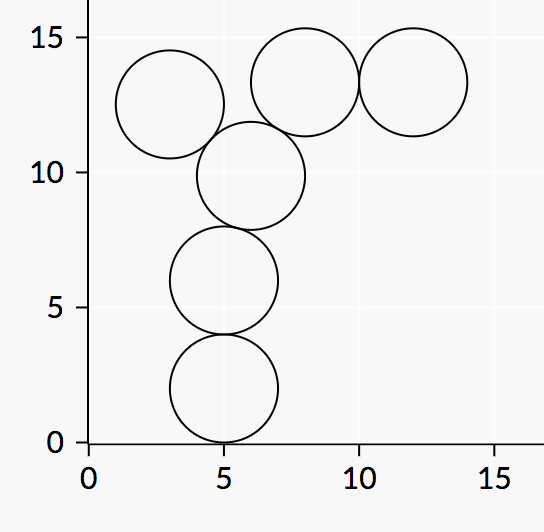
In particular, note the position of the last disk.
C我逃了开根为负的情况,但是也不会是0啊,最起码是r
#include<bits/stdc++.h>

using namespace std;

int x[];

double y[];

int main()

{

    int n,r;

    cin>>n>>r;

    for(int i=;i<n;i++)

        cin>>x[i];

    for(int i=;i<n;i++)

    {

        y[i]=r;

        for(int j=;j<i;j++)

           if(fabs(x[j]-x[i])<=.*r)

           y[i]=max(y[i],y[j]+sqrt(*r*r-(x[i]-x[j])*(x[i]-x[j])));

    }

    for(int i=;i<n;i++)

    printf("%.12f ",y[i]);

    return ;

}
2 seconds
256 megabytes
standard input
standard output
You are given three integers k, pa and pb.
You will construct a sequence with the following algorithm: Initially, start with the empty sequence. Each second, you do the following. With probability pa / (pa + pb), add 'a' to the end of the sequence. Otherwise (with probability pb / (pa + pb)), add 'b' to the end of the sequence.
You stop once there are at least k subsequences that form 'ab'. Determine the expected number of times 'ab' is a subsequence in the resulting sequence. It can be shown that this can be represented by P / Q, where P and Q are coprime integers, and  . Print the value of
  .
.
The first line will contain three integers integer k, pa, pb (1 ≤ k ≤ 1 000, 1 ≤ pa, pb ≤ 1 000 000).
Print a single integer, the answer to the problem.
1 1 1
2
3 1 4
370000006
The first sample, we will keep appending to our sequence until we get the subsequence 'ab' at least once. For instance, we get the sequence 'ab' with probability 1/4, 'bbab' with probability 1/16, and 'aab' with probability 1/8. Note, it's impossible for us to end with a sequence like 'aabab', since we would have stopped our algorithm once we had the prefix 'aab'.
The expected amount of times that 'ab' will occur across all valid sequences is 2.
For the second sample, the answer is equal to  .
.
#include<bits/stdc++.h>

using namespace std;

const int MD=1e9+,N=;

int dp[N][N];

int po(int a,int x)

{

    int ans=;

    while(x)

    {

        if(x&) ans=1LL*ans*a%MD;

        a=1LL*a*a%MD;

        x>>=;

    }

    return ans;

}

int main()

{

    int k,a,b,ta,tb,ans=;

    scanf("%d%d%d",&k,&a,&b);

    ta=1LL*a*po(a+b,MD-)%MD;

    tb=MD-ta+;

    dp[][]=;

    for(int i=; i<=k; i++)

        for(int j=; j<k-i; j++)

        {

            dp[i+][j]=(dp[i+][j]+1LL*dp[i][j]*ta%MD)%MD;

            if(j+i+i>=k)ans=(ans+1LL*dp[i][j]*tb%MD*(j+i+i-k)%MD)%MD;

            else dp[i][j+i]=(dp[i][j+i]+1LL*dp[i][j]*tb%MD)%MD;

        }

    ans=(ans+k+1LL*a*po(b,MD-)%MD)%MD;

    printf("%d\n",ans);

}
Good Bye 2017的更多相关文章
- Good Bye 2017 A B C
Good Bye 2017 A New Year and Counting Cards 题目链接: http://codeforces.com/contest/908/problem/A 思路: 如果 ...
- Hello 2018, Bye 2017
2017年过去了,过去一年经历了太多,改变了好多好多,可以说人生进入了另一个阶段,有可能是成熟吧. 回顾2017 去年换了新工作,离开了将近工作了8年的公司,不带走一丝云彩,为其任劳任怨,最后没有任何 ...
- Good Bye 2017(送命场)
9815人数场,9500+围观神仙打架...断断续续打Codeforces也快有一年啦,第一次打Good Bye场,满怀前排膜tourist的心愿参加了这场送命场,虽然没看到tourist.不过还是得 ...
- Good Bye 2017 E. New Year and Entity Enumeration
先按照绿点进行分块 第一个绿点和最后一个绿点之后很好处理不说了 两个绿点之间的讨论: 有两种方案 1:红(蓝)点和绿点顺序连接,距离为相邻绿点距离(也就是双倍绿点距离) 2:红(蓝)点和绿点的点阵中寻 ...
- Good Bye 2017 D. New Year and Arbitrary Arrangement
看了别人的题解 首先这题是一个dp dp[i][j] i是当前有多少个a j是当前有多少个ab子序列 dp[i][j] = dp[i+1][j]*Pa + dp[i][i+j]*Pb; i,j 时加一 ...
- Good Bye 2017 G. New Year and Original Order
G. New Year and Original Order time limit per test 2 seconds memory limit per test 256 megabytes inp ...
- Good Bye 2017 C. New Year and Curling
Carol is currently curling. She has n disks each with radius r on the 2D plane. Initially she has al ...
- Good Bye 2017 部分题解
D. New Year and Arbitrary Arrangement 分析 \(dp[i][j]\) 表示已有 \(i\) 个 \(a\) 和 \(j\) 个 \(ab\) 的情况下继续构造能得 ...
- 【EOJ Monthly 2018.2 (Good bye 2017)】
23333333333333333 由于情人节要回家,所以就先只放代码了. 此题是与我胖虎过不去. [E. 出老千的 xjj] #include<cstdio> #include<c ...
随机推荐
- SQL Server 查询性能优化——创建索引原则
索引是什么?索引是提高查询性能的一个重要工具,索引就是把查询语句所需要的少量数据添加到索引分页中,这样访问数据时只要访问少数索引的分页就可以.但是索引对于提高查询性能也不是万能的,也不是建立越多的索引 ...
- LoadRunner问题解决
1.问题:复制脚本,修改后并保存,直接在controller中加载脚本,无法创建用户,出现“Loadrunner Controller cannot create Vusers. Ensure th ...
- POJ 1845 Sumdiv (数学,乘法逆元)
题意: 给出数字A和B,要求AB的所有因子(包括AB和1)之和 mod 9901 的结果. 思路: 即使知道公式也得推算一阵子. 很容易知道,先把分解得到,那么得到,那么的所有因子之和的表达式如下: ...
- [VC]关于ocx打包为cab的使用
把打包的工具makecert.exe等放在c:/windows/system32/里才能在dos下面使用 注:如果本机使用可以codebase="http://localhost/testa ...
- javascript报错:ReferenceError: $ is not defined解决办法
原因很简单,要么是未导入jquery包,要么是导入的顺序不对. 例如,我在制作Chrome扩展程序时,其中的一块代码如下: 然后运行时报上述错误. 解决方法:我们不难发现script位置有问题,因为$ ...
- java基础—配置环境变量
前言 学习java的第一步就要搭建java的学习环境,首先是要安装JDK,JDK安装好之后,还需要在电脑上配置"JAVA_HOME”."path”."classpath& ...
- JavaScript无提示关闭当前页面窗口,兼容IE/Firefox/Chrome
<script type="text/javascript" language="javascript"> function fc(){ var b ...
- java基础——接口与抽象类的区别
(1)首先接口和抽象类的设计目的就是不一样的.接口是对动作的抽象,而抽象类是对根源的抽象. (2)对于抽象类,一个类只能继承一个抽象类.但是一个类可以同时实现多个接口. (3)接口是公开的,里面不能有 ...
- UITableView上添加按钮,按钮点击效果延迟的解决办法
在自定义的TableView的初始化方法做如下操作 - (instancetype)initWithFrame:(CGRect)frame { self = [super initWithFrame: ...
- 初涉网络流[EK&dinic]
主要还是板子 Edmonds-Karp 从S开始bfs,直到找到一条到达T的路径后将该路径增广,并重复这一过程. 在处理过程中,为了应对“找到的一条路径把其他路径堵塞”的情况,采用了建反向弧的方式来实 ...