
Objective-C Composite Objects
We can create subclass within a class cluster that defines a class that embeds within it an object. These class objects are composite objects.
So you might be wondering what's a class cluster. So we will first see what's a class cluster.
Class Clusters
Class clusters are a design pattern that the Foundation framework makes extensive use of. Class clusters group a number of private concrete subclasses under a public abstract superclass. The grouping of classes in this way simplifies the publicly visible architecture of an object-oriented framework without reducing its functional richness. Class clusters are based on the Abstract Factory design pattern.
To make it simple, instead of creating multiple classes for similar functions, we create a single class that will take care of its handling based on the value of input.
For example, in NSNumber we have many clusters of classes like char, int, bool and so on. We group all of them to a single class that takes care of handling the similar operations in a single class. NSNumber actually wraps the value of these primitive types into objects.
So what's exactly composite object?
By embedding a private cluster object in an object of our own design, we create a composite object. This composite object can rely on the cluster object for its basic functionality, only intercepting messages that the composite object wants to handle in some particular way. This architecture reduces the amount of code we must write and lets you take advantage of the tested code provided by the Foundation Framework.
This is explained in the following figure.
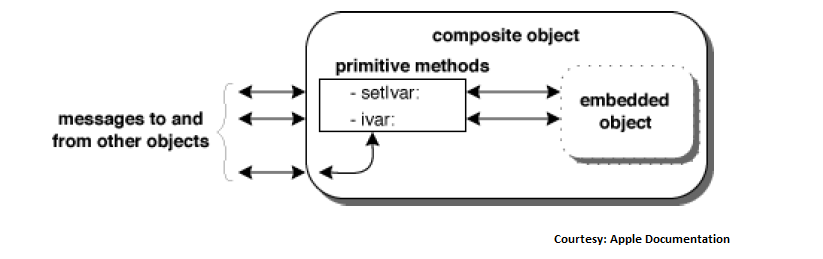
The composite object must declare itself to be a subclass of the cluster's abstract superclass. As a subclass, it must override the superclass' primitive methods. It can also override derived methods, but this isn't necessary because the derived methods work through the primitive ones.
The count method of the NSArray class is an example; the intervening object's implementation of a method it overrides can be as simple as:
- (unsigned)count

{

    return [embeddedObject count];

}
In the above example, embedded object is actually of type NSArray.
A Composite Object example
Now in order to see a complete example, let's look at the example from the Apple documentation which is given below.
#import <Foundation/Foundation.h>

@interface ValidatingArray : NSMutableArray

{

    NSMutableArray *embeddedArray;

}

+ validatingArray;

- init;

- (unsigned)count;

- objectAtIndex:(unsigned)index;

- (void)addObject:object;

- (void)replaceObjectAtIndex:(unsigned)index withObject:object;

- (void)removeLastObject;

- (void)insertObject:object atIndex:(unsigned)index;

- (void)removeObjectAtIndex:(unsigned)index;

@end

@implementation ValidatingArray

- init

{

   self = [super init];

   if (self) {

      embeddedArray = [[NSMutableArray allocWithZone:[self zone]] init];

   }

   return self;

}

+ validatingArray

{

   return [[self alloc] init] ;

}

- (unsigned)count

{

   return [embeddedArray count];

}

- objectAtIndex:(unsigned)index

{

    return [embeddedArray objectAtIndex:index];

}

- (void)addObject:(id)object

{

   if (object != nil) {

      [embeddedArray addObject:object];

   }

}

- (void)replaceObjectAtIndex:(unsigned)index withObject:(id)object;

{

   if (index <[embeddedArray count] && object != nil) {

       [embeddedArray replaceObjectAtIndex:index withObject:object];

   }

}

- (void)removeLastObject;

{

   if ([embeddedArray count] > ) {

       [embeddedArray removeLastObject];

   }

}

- (void)insertObject:(id)object atIndex:(unsigned)index;

{

   if (object != nil) {

       [embeddedArray insertObject:object atIndex:index];

   }

}

- (void)removeObjectAtIndex:(unsigned)index;

{

   if (index <[embeddedArray count]) {

       [embeddedArray removeObjectAtIndex:index];

   }

}

@end

int main()

{

   NSAutoreleasePool * pool = [[NSAutoreleasePool alloc] init];

   ValidatingArray *validatingArray = [ValidatingArray validatingArray];

   [validatingArray addObject:@"Object1"];

   [validatingArray addObject:@"Object2"];

   [validatingArray addObject:[NSNull null]];

   [validatingArray removeObjectAtIndex:];

   NSString *aString = [validatingArray objectAtIndex:];

   NSLog(@"The value at Index 1 is %@",aString);

   [pool drain];

   return ;

}
Now when we compile and run the program, we will get the following result.
-- ::54.294 demo[] The value at Index is Object2
In the above example, we can see that validating array's one function would not allow adding null objects that will lead to crash in the normal scenario. But our validating array takes care of it. Similarly, each of the method in validating array adds validating processes apart from the normal sequence of operations.
Objective-C Composite Objects的更多相关文章
- Composite Design Pattern in Java--转
https://dzone.com/articles/composite-design-pattern-in-java-1 The composite pattern is meant to &quo ...
- [转]Design Pattern Interview Questions - Part 1
Factory, Abstract factory, prototype pattern (B) What are design patterns? (A) Can you explain facto ...
- [转]Design Pattern Interview Questions - Part 4
Bridge Pattern, Composite Pattern, Decorator Pattern, Facade Pattern, COR Pattern, Proxy Pattern, te ...
- linux内核的makefile.txt讲解
linux内核的linux-3.6.5\Documentation\kbuild\makefiles.txt Linux Kernel Makefiles This document describe ...
- Linux内核Makefile文件(翻译自内核手册)
--译自Linux3.9.5 Kernel Makefiles(内核目录documention/kbuild/makefiles.txt) kbuild(kernel build) 内核编译器 Thi ...
- SOLID architecture principles using simple C# examples
转:http://www.codeproject.com/Articles/703634/SOLID-architecture-principles-using-simple-Csharp?msg=4 ...
- CG&Game资源(转)
cg教程下载: http://cgpeers.com http://cgpersia.com http://bbs.ideasr.com/forum-328-1.html http://bbs.ide ...
- Kbuild文件
3 Kbuild文件 大部分内核中的Makefile都是使用Kbuild组织结构的Kbuild Makefile.这章将介绍Kbuild Makefile的语法. 对于Kbuild文件名来讲,Kbui ...
- Automake
Automake是用来根据Makefile.am生成Makefile.in的工具 标准Makefile目标 'make all' Build programs, libraries, document ...
随机推荐
- MongoDB:搭建三节点 Replica Set 环境
今天学习了搭建 MongDB 复制环境,实验环境是在虚拟机上同一系统,并搭建三节点 Replica Set,根据文档上的描述,mongodb 复制配置简单,并且能够自动 failover,这些高级特性 ...
- phpStorm的远端部署
首先远端服务器的路径: /var/www -rwxrwxrwx jiangzhaowei jiangzhaowei 6月 index.html* lr-xr-xr-x root root 2月 php ...
- Android Studio3.0中dependencies依赖由compile变为implementation的区别
前言 Android Studio版本更新至3.0了,更新后,连带着com.android.tools.build:gradle 工具也升级到了3.0.0,在3.0.0中使用了最新的Gralde 4. ...
- Mogodb 存储DateTime问题
由于mogodb默认用的是国际日期utc和中国时间有8小时时差. c#当中利用特别属性来解决,如: /// <summary> /// 创建日期 /// < ...
- Fuzzy Search
题意: 考虑模板串B和给定串A,给定K,对于模板串上给定位置j的字符,如果能在给定串上i左右K个字符内找到相同字符,则说可以匹配. 问有多少匹配. 解法: 考虑对于每一种字符分开求. 对于当前字符ch ...
- 【Hadoop】MapReduce笔记(三):MapReduce的Shuffle和Sort阶段详解
一.MapReduce 总体架构 整体的Shuffle过程包含以下几个部分:Map端Shuffle.Sort阶段.Reduce端Shuffle.即是说:Shuffle 过程横跨 map 和 reduc ...
- tensorflow weight_variable going
# coding: utf-8 import tensorflow as tf from tensorflow.examples.tutorials.mnist import input_data d ...
- MySQL Bug剖析之Slave节点并行复制死锁
此文已由作者温正湖授权网易云社区发布. 欢迎访问网易云社区,了解更多网易技术产品运营经验. 有天一早,DBA同学就找上来了,说有个DDB集群下的RDS实例Slave节点(从库)死锁了,请求支援.说实话 ...
- 打包时,指定war包的名称
在pom.xml中修改finalName节点的值即可,如下: <build> <plugins> <plugin> <groupId>org.sprin ...
- UGUI技术之LayoutGroup布局实现详解
继续学习unity4.6,unity的LayoutGroup分为三种, Horizontal Layout Group(水平布局)Vertical Layout Group(垂直布局)Grid Lay ...