
CDI services--interceptors(拦截器)
1.拦截器综述
拦截器的功能是定义在Java拦截器规范。
拦截器规范定义了三种拦截点:
- 业务方法拦截,
- 生命周期回调侦听,
- 超时拦截(EJB)方法。
在容器的生命周期中进行拦截
|
1
2
3
4
|
public class DependencyInjectionInterceptor { @PostConstruct public void injectDependencies(InvocationContext ctx) { ... }} |
EJB超时时使用的拦截器
|
1
2
3
4
5
|
public class TimeoutInterceptor { @AroundTimeout public Object manageTransaction(InvocationContext ctx) throws Exception { ... }} |
在业务上,对某一个Bean的方法进行拦截
|
1
2
3
4
5
|
public class TransactionInterceptor { @AroundInvoke public Object manageTransaction(InvocationContext ctx) throws Exception { ... }} |
@AroundInvoke注释指定了要用作拦截器的方法,拦截器方法与被拦截的业务方法执行同一个java调用堆栈、同一个事务和安全上下文中。用@AroundInvoke注释指定的方法必须遵守以下格式:public Object XXX(javax.interceptor.InvocationContext ctx) throws Exception
下面是javax.interceptor.InvocationContext封装了客户端所调用业务方法的一些信息。
|
1
2
3
4
5
6
7
8
9
|
package javax.interceptor;public interface InvocationContext{ public Object getTarget(); public Method getMethod(); public Ojbect[] getParameters(); public void setParameters(Object[] newArgs); public java.util.Map<String, Ojbect> getContextData(); public Object proceed() throws Exception;} |
- getTarget() 指向被调用的bean实例
- getMethod() 指向被拦截的业务方法
- getParameters() 获取被拦截业务方法的参数
- setParameters() 设置被拦截业务方法的参数
- getContextData() 返回一个Map对象,它在整个方法调用期间都可以被访问到。位于同一个方法调用内的不同拦截器之间可以利用它来传递上下文相关的数据。
示例:
|
1
2
3
4
5
6
7
8
9
10
11
12
13
14
15
16
17
18
19
20
21
22
|
//被拦截的方法@Interceptors(HelloInterceptor.class)public class HelloChinaBean { public String SayHello(String name) { return name +"Hello World."; }}//拦截器定义public class HelloInterceptor { @AroundInvoke public Object log(InvocationContext ctx) throws Exception { try{ if (ctx.getMethod().getName().equals("SayHello")){ System.out.println("Holle World!!!" ); } return ctx.proceed(); }catch (Exception e) { throw e; } }} |
2.拦截器绑定(Interceptor bindings)
假设我们想要申明一些bean的事务。我们先要的是一个拦截器绑定类型来指定哪些bean我们要申明.
首先定义一个注解
|
1
2
3
4
|
@InterceptorBinding@Target({METHOD, TYPE})@Retention(RUNTIME)public @interface Transactional {} |
现在我们可以很容易地指定类ShoppingCart是事务性对象:
|
1
2
|
@Transactionalpublic class ShoppingCart { ... } |
或者我们可以指定一个方法的事务
|
1
2
3
|
public class ShoppingCart { @Transactional public void checkout() { ... }} |
2.拦截器实现(Implementing interceptors)
我们实际上要实现提供了这种事务管理方面的拦截器,所以我们需要做的是创建一个标准的拦截,并配上@Interceptor和@transactional注解.
|
1
2
3
4
5
6
|
@Transactional @Interceptorpublic class TransactionInterceptor { @AroundInvoke public Object manageTransaction(InvocationContext ctx) throws Exception { ... }} |
拦截器可以利用依赖注入:
|
1
2
3
4
5
6
7
8
|
@Transactional @Interceptorpublic class TransactionInterceptor { @Resource UserTransaction transaction; @AroundInvoke public Object manageTransaction(InvocationContext ctx) throws Exception { ... }} |
多个拦截器可以使用相同的拦截器绑定类型。
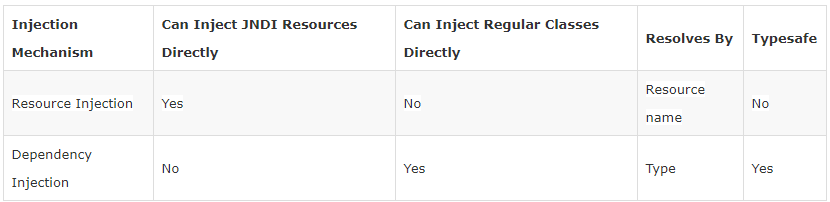
@Resource和@Inject的区别:
3.启用拦截器(Enabling interceptors)
默认情况下,所有拦截器被禁用.要使用拦截器.需要在bean.xml中进行配置,以启用.从CDI 1.1起拦截器可以使用@Priority注释为整个应用程序启用。
|
1
2
3
4
5
6
7
8
9
10
|
<beans xmlns="http://xmlns.jcp.org/xml/ns/javaee" xmlns:xsi="http://www.w3.org/2001/XMLSchema-instance" xsi:schemaLocation=" http://xmlns.jcp.org/xml/ns/javaee http://xmlns.jcp.org/xml/ns/javaee/beans_1_1.xsd"> <interceptors> <class>org.mycompany.myapp.TransactionInterceptor</class> </interceptors></beans> |
这样有2个好处:
- 拦截器比较重要,在XML中确保其确定性行为
- 它让我们在部署时启用或禁用拦截器类。
当然也可以配置启用多个拦截器
|
1
2
3
4
5
6
7
8
9
10
11
|
<beans xmlns="http://xmlns.jcp.org/xml/ns/javaee" xmlns:xsi="http://www.w3.org/2001/XMLSchema-instance" xsi:schemaLocation=" http://xmlns.jcp.org/xml/ns/javaee http://xmlns.jcp.org/xml/ns/javaee/beans_1_1.xsd"> <interceptors> <class>org.mycompany.myapp.SecurityInterceptor</class> <class>org.mycompany.myapp.TransactionInterceptor</class> </interceptors></beans> |
拦截器毕竟比较重要,不推荐使用@Priority启用.
在CDI中,XML配置的优先级高于@Priority.
关于@Priority可以参考下列:
public static class Interceptor.Priority
extends Object
Priorities that define the order in which interceptors are invoked. These values should be used with the Priority annotation.
Interceptors defined by platform specifications should have priority values in the range PLATFORM_BEFORE up until LIBRARY_BEFORE, or starting at PLATFORM_AFTER.
Interceptors defined by extension libraries should have priority values in the range LIBRARY_BEFORE up until APPLICATION, or LIBRARY_AFTER up until PLATFORM_AFTER.
Interceptors defined by applications should have priority values in the range APPLICATION up until LIBRARY_AFTER.
An interceptor that must be invoked before or after another defined interceptor can choose any appropriate value.
Interceptors with smaller priority values are called first. If more than one interceptor has the same priority, the relative order of these interceptor is undefined.
For example, an extension library might define an interceptor like this:
|
1
2
3
|
@Priority(Interceptor.Priority.LIBRARY_BEFORE+10) @Interceptor public class ValidationInterceptor { ... } |
4.Interceptor bindings with members(拦截器注解属性)
假设我们想要添加一些额外的信息给我们的@transactional注解:
|
1
2
3
4
5
6
7
|
@InterceptorBinding@Target({METHOD, TYPE})@Retention(RUNTIME)public @interface Transactional { boolean requiresNew() default false;} |
下面是requiresNew为true的拦截器
|
1
2
3
4
5
6
|
@Transactional(requiresNew = true) @Interceptorpublic class RequiresNewTransactionInterceptor { @AroundInvoke public Object manageTransaction(InvocationContext ctx) throws Exception { ... }} |
如下使用:
|
1
2
|
@Transactional(requiresNew = true)public class ShoppingCart { ... } |
但是如果我们只有一个拦截器,我们希望容器拦截器绑定时忽略requiresNew的值,也许这些信息只用于拦截器实现。我们可以使用@Nonbinding注释:
|
1
2
3
4
5
6
7
|
@InterceptorBinding@Target({METHOD, TYPE})@Retention(RUNTIME)public @interface Secure { @Nonbinding String[] rolesAllowed() default {};} |
5.Multiple interceptor binding annotations(多重拦截器绑定注解)
通常我们使用拦截器绑定的组合类型绑定多个拦截器bean。例如,下面的声明将用于绑定TransactionInterceptor和SecurityInterceptor这2个拦截器到ShoppingCart.
|
1
2
|
@Secure(rolesAllowed="admin") @Transactionalpublic class ShoppingCart { ... } |
然而,在非常复杂的情况下,一个拦截器本身可能指定拦截器绑定类型:
|
1
2
|
@Transactional @Secure @Interceptorpublic class TransactionalSecureInterceptor { ... } |
那么这个拦截器可以绑定到checkout() 方法,以下任何组合都可使用:
|
1
2
3
4
5
6
7
8
9
10
11
12
13
14
15
16
17
18
|
public class ShoppingCart { @Transactional @Secure public void checkout() { ... }}@Securepublic class ShoppingCart { @Transactional public void checkout() { ... }}@Transactionalpublic class ShoppingCart { @Secure public void checkout() { ... }}@Transactional @Securepublic class ShoppingCart { public void checkout() { ... }} |
6. Interceptor binding type inheritance(拦截器绑定类型继承)
Java语言支持注解的一个限制就是缺乏注解继承.注解应该重用内置已有的.就如同下面这段代码表达的意思
|
1
2
|
//实际没这写法public @interface Action extends Transactional, Secure { ... } |
幸运的是,CDI围绕Java没有的这个特性开展了一些工作.
我们会标注一个拦截器绑定类型,其有其他拦截器的绑定类型,(称为元注解)
表述起来有点费劲,就如同下面代码这样.
|
1
2
3
4
5
|
@Transactional @Secure@InterceptorBinding@Target(TYPE)@Retention(RUNTIME)public @interface Action { ... } |
现在任何Bean绑定 Action这个注解 ,其实就是绑定到了@Transactional @Secure.(就是拦截器TransactionInterceptor和拦截器SecurityInterceptor). (甚至TransactionalSecureInterceptor,如果它存在.)
7.Use of @Interceptors(同时用多个拦截器)
这个注解@Interceptors是拦截器规范定义的,cdi是支持的<使用托管bean和EJB规范>.如下:
|
1
2
3
4
5
|
@Interceptors({TransactionInterceptor.class, SecurityInterceptor.class})public class ShoppingCart { public void checkout() { ... }} |
但缺点也很明显,不推荐使用.缺点如下:
- 拦截器在代码中是硬编码.
- 拦截器在部署时不好更改.
- 拦截器命令是非全局的——它是在类级别由拦截器的顺序列出.
因此还是使用上面CDI的使用方式比较好.
CDI services--interceptors(拦截器)的更多相关文章
- (vue.js)axios interceptors 拦截器中添加headers 属性
(vue.js)axios interceptors 拦截器中添加headers 属性:http://www.codes51.com/itwd/4282111.html 问题: (vue.js)axi ...
- flume1.8 Interceptors拦截器(五)
1. Flume Interceptors Flume有能力修改/删除流程中的events.这是在拦截器(interceptor)的帮助下完成的.拦截器(Interceptors)是实现org.apa ...
- springMVC之mvc:interceptors拦截器的用法
1.配置拦截器 在springMVC.xml配置文件增加: <mvc:interceptors> <!-- 日志拦截器 --> <mvc:interceptor> ...
- angular之interceptors拦截器
<!DOCTYPE html> <html ng-app="nickApp"> <head> <meta charset="UT ...
- springMVC <mvc:interceptors>拦截器的使用
首先在springMVC.xml配置如下代码 <!-- 拦截器 --> <mvc:interceptors> <bean class="com.base.Acc ...
- angular http interceptors 拦截器使用分享
拦截器 在开始创建拦截器之前,一定要了解 $q和延期承诺api 出于全局错误处理,身份验证或请求的任何同步或异步预处理或响应的后处理目的,希望能够在将请求移交给服务器之前拦截请求,并在将请求移交给服务 ...
- Interceptors - 拦截器
1.概述 Flume有能力在运行阶段修改/删除Event,这是通过拦截器(Interceptors)来实现的. 拦截器需要实现org.apache.flume.interceptor.Intercep ...
- vue interceptors(拦截器)
拦截器 顾名思义: 就是半路个您劫持, 拦截器 其实在项目和自己写demo中,总会遇到请求方面需要在请求头里面做判断或者添加一些东西, 这时候 vue 中应用中axios的 interceptors ...
- vue拦截器Vue.http.interceptors.push
刚开始学vue,github上down了一个开源项目,看源代码的时候看到了这个地方: /** * @export * @param {any} request * @param {any} next ...
- SpringMVC 文件上传&拦截器&异常处理
文件上传 Spring MVC 为文件上传提供了直接的支持,这种支持是通过即插即用的 MultipartResolver 实现的.Spring 用 Jakarta Commons FileUpload ...
随机推荐
- SQL反模式学习笔记13 使用索引
目标:优化性能 改善性能最好的技术就是在数据库中合理地使用索引. 索引也是数据结构,它能使数据库将指定列中的某个值快速定位在相应的行. 反模式:无规划的使用索引 1.不使用索引或索引不足 2.使用了 ...
- SOUI taobao SVN目录结构说明
- Linux基础系统优化
Linux的网络功能相当强悍,一时之间我们无法了解所有的网络命令,在配置服务器基础环境时,先了解下网络参数设定命令. ifconfig 查询.设置网卡和ip等参数 ifup,ifdown 脚本命 ...
- Redis自学笔记:4.4进阶-消息通知
4.4消息通知 4.4.1任务队列 传递任务的队列.与任务队列进行交互的实体有两类,一类是生产者,一类是消费者. 生产者将需要处理的任务放入任务队列中,二消费者不断从任务队列中读入任务 信息并执行. ...
- DAPP 开发直通车-如何基于NEL 轻钱包来开发DAPP
之前做了 DAPP 开发直通车,通讲了一下开发一个DAPP的过程. 但是涉及多工种,多步骤.入手还是非常困难的. 经过不懈的努力,做了很多铺垫工作之后,我终于可以告诉你: 开发DAPP f ...
- (转)RBAC权限模型——项目实战
一.前言 权限一句话来理解就是对资源的控制,对web应用来说就是对url的控制,关于权限可以毫不客气的说几乎每个系统都会包含,只不过不同系统关于权限的应用复杂程序不一样而已,现在我们在用的权限模型基本 ...
- XVIII Open Cup named after E.V. Pankratiev. Ukrainian Grand Prix
A. Accommodation Plan 对于已知的$K$个点,离它们距离都不超过$L$的点在树上是一个连通块,考虑在每种方案对应的离$1$最近的点统计. 即对于每个点$x$,统计离它距离不超过$L ...
- bzoj2982: combination(lucas定理板子)
2982: combination Time Limit: 1 Sec Memory Limit: 128 MBSubmit: 664 Solved: 397[Submit][Status][Di ...
- GMA Round 1 新年的复数
传送门 新年的复数 已知$\left\{\begin{matrix}A>B>0\\ AB=1\\ (A+B)(A-B)=2\sqrt{3}\end{matrix}\right.$ 求$(A ...
- C语言复习0_准备工作
前言: 第一次接触C语言是大一下学期的时候,2013年上半年,那个时候的开发工具还是VS C++,今天了解了一下,常用的开发工具变成了CodeBlocks.决定趁着毕业到入职这一段CD时间,拾起这门语 ...