
Codeforces709


A
Kolya is going to make fresh orange juice. He has n oranges of sizes a1, a2, ..., an. Kolya will put them in the juicer in the fixed order, starting with orange of size a1, then orange of size a2 and so on. To be put in the juicer the orange must have size not exceeding b, so if Kolya sees an orange that is strictly greater he throws it away and continues with the next one.
The juicer has a special section to collect waste. It overflows if Kolya squeezes oranges of the total size strictly greater than d. When it happens Kolya empties the waste section (even if there are no more oranges) and continues to squeeze the juice. How many times will he have to empty the waste section?
The first line of the input contains three integers n, b and d (1 ≤ n ≤ 100 000, 1 ≤ b ≤ d ≤ 1 000 000) — the number of oranges, the maximum size of the orange that fits in the juicer and the value d, which determines the condition when the waste section should be emptied.
The second line contains n integers a1, a2, ..., an (1 ≤ ai ≤ 1 000 000) — sizes of the oranges listed in the order Kolya is going to try to put them in the juicer.
Print one integer — the number of times Kolya will have to empty the waste section.
 #include<stdio.h>

 #include<stdlib.h>

 #include<string>

 #include<string.h>

 #include<iostream>

 #include<algorithm>

 #include<queue>

 #include<math.h>

 #include<vector>

 #include<map>

 #include<set>

 #define il inline

 #define re register

 using namespace std;

 int n,b,d,a[],c,ans;

 int main(){

     scanf("%d%d%d",&n,&b,&d);

     for(int i=;i<=n;i++){

         scanf("%d",&a[i]);

         if(a[i]>b) continue;

         c+=a[i];

         if(c>d){

             c=;ans++;

         }

     }

     cout<<ans;

     return ;

 }
B
Vasya takes part in the orienteering competition. There are n checkpoints located along the line at coordinates x1, x2, ..., xn. Vasya starts at the point with coordinate a. His goal is to visit at least n - 1 checkpoint in order to finish the competition. Participant are allowed to visit checkpoints in arbitrary order.
Vasya wants to pick such checkpoints and the order of visiting them that the total distance travelled is minimized. He asks you to calculate this minimum possible value.
The first line of the input contains two integers n and a (1 ≤ n ≤ 100 000, - 1 000 000 ≤ a ≤ 1 000 000) — the number of checkpoints and Vasya's starting position respectively.
The second line contains n integers x1, x2, ..., xn ( - 1 000 000 ≤ xi ≤ 1 000 000) — coordinates of the checkpoints.
Print one integer — the minimum distance Vasya has to travel in order to visit at least n - 1 checkpoint.
 #include<stdio.h>

 #include<stdlib.h>

 #include<string>

 #include<string.h>

 #include<iostream>

 #include<algorithm>

 #include<queue>

 #include<math.h>

 #include<vector>

 #include<map>

 #include<set>

 #define il inline

 #define re register

 using namespace std;

 int n,x,a[];

 int main(){

     scanf("%d%d",&n,&x);

     for(int i=;i<=n;i++)

         scanf("%d",&a[i]);

     sort(a+,a+n+);

     if(n==){

         cout<<"";return ;

     }

     if(x<a[]){

         cout<<abs(a[n-]-x);return ;

     }

     if(x>a[n]){

         cout<<abs(a[]-x);return ;

     }

     if(n==){

         cout<<min(abs(a[]-x),abs(a[n]-x));return ;

     }

     cout<<min(min(abs(x-a[]),abs(a[n]-x))+abs(a[]-a[n]),min(abs(x-a[]),abs(x-a[n-]))+abs(a[]-a[n-]));

     return ;

 }
C
You are given a non-empty string s consisting of lowercase English letters. You have to pick exactly one non-empty substring of s and shift all its letters 'z'  'y' 'x'
  'b' 'a' 'z'. In other words, each character is replaced with the previous character of English alphabet and 'a' is replaced with 'z'.
What is the lexicographically minimum string that can be obtained from s by performing this shift exactly once?
The only line of the input contains the string s (1 ≤ |s| ≤ 100 000) consisting of lowercase English letters.
Print the lexicographically minimum string that can be obtained from s by shifting letters of exactly one non-empty substring.
 #include<stdio.h>

 #include<stdlib.h>

 #include<string>

 #include<string.h>

 #include<iostream>

 #include<algorithm>

 #include<queue>

 #include<math.h>

 #include<vector>

 #include<map>

 #include<set>

 #define il inline

 #define re register

 using namespace std;

 char s[];

 int n,a,b;

 il bool chk(){

     for(int i=;i<=n;i++)

         if(s[i]!='a') return false;

     return true;

 }

 int main(){

     scanf("%s",s+);n=strlen(s+);

     if(chk()){

         for(int i=;i<n;i++)

             printf("a");

         cout<<'z';return ;

     }

     a=;

     while(s[a]=='a') a++;

     for(int i=;i<a;i++) printf("%c",s[i]);

     for(int i=a;i<=n;i++){

         if(s[i]!='a'){

             printf("%c",s[i]-);

         }

         else{

             for(int j=i;j<=n;j++)

                 printf("%c",s[j]);

             return ;

         }

     }

     return ;

 }
D
For each string s consisting of characters '0' and '1' one can define four integers a00, a01, a10 and a11, where axy is the number ofsubsequences of length 2 of the string s equal to the sequence {x, y}.
In these problem you are given four integers a00, a01, a10, a11 and have to find any non-empty string s that matches them, or determine that there is no such string. One can prove that if at least one answer exists, there exists an answer of length no more than1 000 000.
The only line of the input contains four non-negative integers a00, a01, a10 and a11. Each of them doesn't exceed 10^9.
If there exists a non-empty string that matches four integers from the input, print it in the only line of the output. Otherwise, print "Impossible". The length of your answer must not exceed 1 000 000.
这个嘛,预处理要多少个1和0,然后01和10加起来的数目是固定的,因此满足一个就好了。
 #include<stdio.h>

 #include<stdlib.h>

 #include<string>

 #include<string.h>

 #include<iostream>

 #include<algorithm>

 #include<queue>

 #include<math.h>

 #include<vector>

 #include<map>

 #include<set>

 #define il inline

 #define re register

 using namespace std;

 typedef long long ll;

 ll n=-,a1,a2,a3,a4,s=-,t=-,a,p;

 int main(){

     cin>>a1>>a2>>a3>>a4;a=a1+a2+a3+a4;

     for(ll i=;i<=;i++){

         if(i*(i-)/==a){

             n=i;break;

         }

     }

     if(n==-){

         cout<<"Impossible";return ;

     }

     if(a1==a){

         for(int i=;i<=n;i++)

             printf("");

         return ;

     }

     if(a4==a){

         for(int i=;i<=n;i++)

             printf("");

         return ;

     }

     for(ll i=;i<=;i++){

         if(i*(i-)/==a1){

             s=i;break;

         }

     }

     for(ll i=;i<=;i++){

         if(i*(i-)/==a4){

             t=i;break;

         }

     }

     if(s==-&&t==-){

         cout<<"Impossible";return ;

     }

     if(a2+a3!=s*t){

         cout<<"Impossible";return ;

     }

     p=a2/s+(a2%s>);

     if(p>t){

         cout<<"Impossible";return ;

     }

     for(int i=;i<=t-p;i++)

         printf("");

     for(int i=;i<=s;i++){

         printf("");

         if(a2%s==i){

             printf("");

         }

     }

     for(int i=;i<=a2/s;i++)

         printf("");

     return ;

 }
E
Tree is a connected acyclic graph. Suppose you are given a tree consisting of n vertices. The vertex of this tree is called centroid if the size of each connected component that appears if this vertex is removed from the tree doesn't exceed  .
.
You are given a tree of size n and can perform no more than one edge replacement. Edge replacement is the operation of removing one edge from the tree (without deleting incident vertices) and inserting one new edge (without adding new vertices) in such a way that the graph remains a tree. For each vertex you have to determine if it's possible to make it centroid by performing no more than one edge replacement.
The first line of the input contains an integer n (2 ≤ n ≤ 400 000) — the number of vertices in the tree. Each of the next n - 1 lines contains a pair of vertex indices ui and vi (1 ≤ ui, vi ≤ n) — endpoints of the corresponding edge.
Print n integers. The i-th of them should be equal to 1 if the i-th vertex can be made centroid by replacing no more than one edge, and should be equal to 0 otherwise.
如果有两个重心,则把重心边破开,把其中一边接到另外一边即可
如果有一个重心,则找到重心最大的一个子树,把它断开和当前点接上。
如果当前点在那个子树上,就和次大的接上。
 #include<stdio.h>

 #include<stdlib.h>

 #include<string>

 #include<string.h>

 #include<iostream>

 #include<algorithm>

 #include<queue>

 #include<math.h>

 #include<vector>

 #include<map>

 #include<set>

 #define il inline

 #define re register

 using namespace std;

 const int N=;

 struct edge{int next,to;

 } e[N];

 int g[N],n,M,cn,c[],fir,sec,color[N],s[N];

 il void addedge(int x,int y){

     e[++M]=(edge){g[x],y};g[x]=M;

 }

 il void dfs1(int h,int fa){

     bool flag=true;

     for(int i=g[h];i;i=e[i].next){

         if(e[i].to==fa) continue;

         dfs1(e[i].to,h);

         if(s[e[i].to]>n/) flag=false;

     }

     if(n-s[h]<=n/&&flag==true){

         c[cn++]=h;

     }

 }

 il void dfs2(int h,int fa){

     s[h]=;

     for(int i=g[h];i;i=e[i].next){

         if(fa==e[i].to||e[i].to==c[]) continue;

         dfs2(e[i].to,h);s[h]+=s[e[i].to];

     }

 }

 il void dfs3(int h,int fa){

     for(int i=g[h];i;i=e[i].next){

         if(fa==e[i].to||e[i].to==c[]) continue;

         color[e[i].to]=;dfs3(e[i].to,h);

     }

 }

 il void predo(){

     dfs2(,);

     dfs1(,);

 }

 int main(){

     scanf("%d",&n);

     for(int i=,x,y;i<n;i++){

         scanf("%d%d",&x,&y);

         addedge(x,y);

         addedge(y,x);

     }

     predo();

     if(cn==){

         for(int i=;i<=n;i++)

             printf("1 ");

         return ;

     }

     dfs2(c[],);

     for(int j=g[c[]];j;j=e[j].next){

         if(e[j].to==c[]||e[j].to==c[]) continue;

         if(s[e[j].to]>s[fir]){

             sec=fir;

             fir=e[j].to;

         }

         else if(s[e[j].to]>s[sec]){

             sec=e[j].to;

         }

     }

     color[fir]=;dfs3(fir,);

     for(int i=;i<=n;i++){

         if(i==c[]){

             printf("1 ");continue;

         }

         if(color[i]){

             if(n-s[sec]-s[i]<=n/){

                 printf("1 ");

             }

             else printf("0 ");

         }

         else{

             if(n-s[fir]-s[i]<=n/){

                 printf("1 ");

             }

             else{

                 printf("0 ");

             }

         }

     }

     return ;

 }
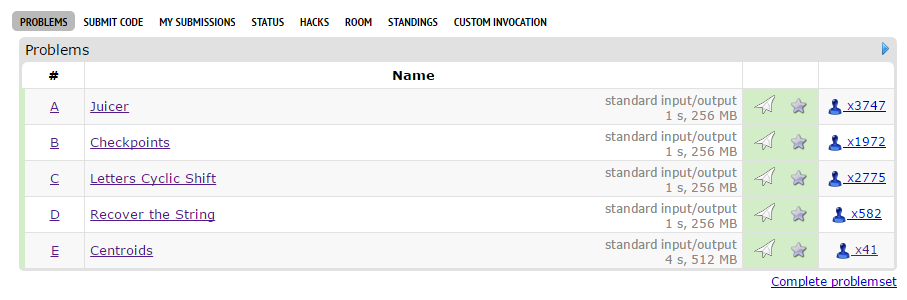
Codeforces709的更多相关文章
随机推荐
- Linux系统基础网络配置老鸟精华篇
对于linux高手看似简单的网络配置问题,也许要说出所以然来也并不轻松,因此仍然有太多的初学者徘徊在门外就不奇怪了,这里,老男孩老师花了一些时间总结了这个文档小结,也还不够完善,欢迎大家补充,交流.谢 ...
- 【索引】MySQL索引
一.索引的定义及作用 1. 二.索引的创建及删除 1.1查看表的索引 show index from tblname; 1.2.创建索引 1.22创建普通索引 ALTER TABLE `table_n ...
- 基于ejabberd简单实现xmpp群聊离线消息
首先,xmpp服务器是基于ejabberd.离线消息模块是mod_interact,原地址地址:https://github.com/adamvduke/mod_interact: 修改后实现群聊离线 ...
- Pycharm 2018.2.1-2018.1
请支持正版,谢谢! 下载激活包 激活包地址 解压后会得到两个包: JetbrainsCrack-2.10-release-enc.jar JetbrainsCrack-3.1-release-enc. ...
- asp.net mvc同一个view展示多个不同列表思路
asp.net mvc一个模型一个view容易展示,可是遇到像首页那样,要同时调用好几个不同表的内容一小部分展示时,该怎么是好呢? 下边根据我的测试,用的是mvc access数据测试 先建立一个强类 ...
- [转]Zookeeper系列(一)
一.ZooKeeper的背景 1.1 认识ZooKeeper ZooKeeper---译名为“动物园管理员”.动物园里当然有好多的动物,游客可以根据动物园提供的向导图到不同的场馆观赏各种类型的动物,而 ...
- 作业 20181120-3 Beta发布
此作业要求参见:https://edu.cnblogs.com/campus/nenu/2018fall/homework/2408 小组介绍 组长:付佳 组员:张俊余 李文涛 孙赛佳 田良 于洋 段 ...
- Scrum立会报告+燃尽图(十月二十九日总第二十次)
此作业要求参见:https://edu.cnblogs.com/campus/nenu/2018fall/homework/2288 项目地址:https://git.coding.net/zhang ...
- 个人第十一周PSP
11.24 --11.30本周例行报告 1.PSP(personal software process )个人软件过程. 类型 任务 开始时间 结束时间 中断时间 实际用 ...
- ZOJ 1842 Prime Distance(素数筛选法2次使用)
Prime Distance Time Limit: 2 Seconds Memory Limit: 65536 KB The branch of mathematics called nu ...