
来一手 AOP 注解方式进行日志记录
系统日志对于定位/排查问题的重要性不言而喻,相信许多开发和运维都深有体会。
通过日志追踪代码运行状况,模拟系统执行情况,并迅速定位代码/部署环境问题。
系统日志同样也是数据统计/建模的重要依据,通过分析系统日志能窥探出许多隐晦的内容。
如系统的健壮性(服务并发访问/数据库交互/整体响应时间...)
某位用户的喜好(分析用户操作习惯,推送对口内容...)
当然系统开发者还不满足于日志组件打印出来的日志,毕竟冗余且篇幅巨长。
so,对于关键的系统操作设计日志表,并在代码中进行操作的记录,配合 SQL 统计和搜索数据是件很愉快的事情。
本篇旨在总结在 Spring 下使用 AOP 注解方式进行日志记录的过程,如果能对你有所启发阁下不甚感激。
1. 依赖类库
       <dependency>

            <groupId>org.aspectj</groupId>

            <artifactId>aspectjweaver</artifactId>

            <version>${aspectjweaver.version}</version>

        </dependency>
AspectJ 中的很多语法结构基本上已成为 AOP 领域的标准。
Spring 也有自己的 Spring-AOP,采用运行时生成代理类,底层可以选用 JDK 或者 CGLIB 动态代理。
通俗点,AspectJ 在编译时增强要切入的类,而 Spring-AOP 是在运行时通过代理类增强切入的类,效率和性能可想而知。
Spring 在 2.0 的时候就已经开始支持 AspectJ ,现在到 4.X 的时代已经很完美的和 AspectJ 拥抱到了一起。
开启扫描 AspectJ 注解的支持:
    <!-- proxy-target-class等于true是强制使用cglib代理,proxy-target-class默认false,如果你的类实现了接口 就走JDK代理,如果没有,走cglib代理  -->

    <!-- 注:对于单利模式建议使用cglib代理,虽然JDK动态代理比cglib代理速度快,但性能不如cglib -->

    <aop:aspectj-autoproxy proxy-target-class="true"/>
2. 定义切入点日志注解

目标操作日志表,其中设计了一些必要的字段,具体字段请拿捏具体项目场景,根据表结构设计注解如下。
@Inherited

@Target(ElementType.METHOD)

@Retention(RetentionPolicy.RUNTIME)

public @interface OperationLog {

    String operationModular() default "";

    String operationContent() default "";

}
上述我只做了两个必要的参数,一个为操作的模块,一个为具体的操作内容。
其实根据项目场景这里参数的设计可以非常丰富,不被其他程序员吐槽在此一举。
3. 编写处理日志切点类
   @Pointcut("@annotation(com.rambo.spm.common.aop.OperationLog)")

    public void operationLogAspect() {

    }
类的构造函数上描述了该类要拦截的为 OperationLog 的注解方法, 同样你也可以配置 XML 进行拦截。
切入点的姿势有很多,不仅是正则同样也支持组合表达式,强大的表达式能让你精准的切入到任何你想要的地方。
更多详情:http://blog.csdn.net/zhengchao1991/article/details/53391244
看到这里如果你对 Spring AOP 数据库事务控制熟悉,其实 Spring AOP 记录日志是相似的机制。
    @Before("operationLogAspect()")

    public void doBefore(JoinPoint joinPoint) {

        logger.info("before aop:{}", joinPoint);

        //do something

    }

    @Around("operationLogAspect()")

    public Object doAround(ProceedingJoinPoint point) {

        logger.info("Around:{}", point);

        Object proceed = null;

        try {

            proceed = point.proceed();

            //do somthing

        } catch (Throwable throwable) {

            throwable.printStackTrace();

            logger.error("日志 aop 异常信息:{}", throwable.getMessage());

        }

        return proceed;

    }

    @AfterThrowing("operationLogAspect()")

    public void doAfterThrowing(JoinPoint pjp) {

        logger.info("@After:{}", pjp);

        //do somthing

    }

    @After("operationLogAspect()")

    public void doAfter(JoinPoint pjp) {

        logger.info("@After:{}", pjp);

    }

    @AfterReturning("operationLogAspect()")

    public void doAfterReturning(JoinPoint point) {

        logger.info("@AfterReturning:{}", point);

    }
AspectJ 提供了几种通知方法,通过在方法上注解这几种通知,解析对应的方法入参,你就能洞悉切点的一切运行情况。
前置通知(@Before):在某连接点(join point)之前执行的通知,但这个通知不能阻止连接点前的执行(除非它抛出一个异常);
返回后通知(@AfterReturning):在某连接点(join point)正常完成后执行的通知:例如,一个方法没有抛出任何异常,正常返回;
抛出异常后通知(@AfterThrowing):方法抛出异常退出时执行的通知;
后通知(@After):当某连接点退出的时候执行的通知(不论是正常返回还是异常退出);
环绕通知(@Around):包围一个连接点(joinpoint)的通知,如方法调用;
通知方法中的值与构造函数一致,指定该通知对哪个切点有效,
上述 @Around 为最强大的一种通知类型,可以在方法调用前后完成自定义的行为,它可选择是否继续执行切点、直接返回、抛出异常来结束执行。
@Around 之所以如此强大是和它的入参有关,别的注解注解入参只容许 JoinPoint ,而 @Around 注解容许入参 ProceedingJoinPoint。
package org.aspectj.lang;

import org.aspectj.runtime.internal.AroundClosure;

public interface ProceedingJoinPoint extends JoinPoint {

    void set$AroundClosure(AroundClosure var1);

    Object proceed() throws Throwable;

    Object proceed(Object[] var1) throws Throwable;

}
反编译 ProceedingJoinPoint 你会恍然大悟,Proceedingjoinpoint 继承了 JoinPoint 。
在 JoinPoint 的基础上暴露出 proceed 这个方法。proceed 方法很重要,这是 aop 代理链执行的方法。
暴露出这个方法,就能支持 aop:around 这种切面(而其他的几种切面只需要用到 JoinPoint,这跟切面类型有关), 能决定是否走代理链还是走自己拦截的其他逻辑。
如果项目没有特定的需求,妥善使用 @Around 注解就能帮你解决一切问题。
    @Around("operationLogAspect()")

    public Object doAround(ProceedingJoinPoint point) {

        logger.info("Around:{}", point);

        Object proceed = null;

        try {

            proceed = point.proceed();

            Object pointTarget = point.getTarget();

            Signature pointSignature = point.getSignature();

            String targetName = pointTarget.getClass().getName();

            String methodName = pointSignature.getName();

            Method method = pointTarget.getClass().getMethod(pointSignature.getName(), ((MethodSignature) pointSignature).getParameterTypes());

            OperationLog methodAnnotation = method.getAnnotation(OperationLog.class);

            String operationModular = methodAnnotation.operationModular();

            String operationContent = methodAnnotation.operationContent();

            OperationLogPO log = new OperationLogPO();

            log.setOperUserid(SecureUtil.simpleUUID());

            log.setOperUserip(HttpUtil.getClientIP(getHttpReq()));

            log.setOperModular(operationModular);

            log.setOperContent(operationContent);

            log.setOperClass(targetName);

            log.setOperMethod(methodName);

            log.setOperTime(new Date());

            log.setOperResult("Y");

            operationLogService.insert(log);

        } catch (Throwable throwable) {

            throwable.printStackTrace();

            logger.error("日志 aop 异常信息:{}", throwable.getMessage());

        }

        return proceed;

    }
别忘记将上面切点处理类/和要切入的类托管给 Spring,Aop 日志是不是很简单,复杂的应该是 aspectj 内部实现机制,有机会要看看源码哦。
处理切点类完整代码:
@Aspect

@Component

public class OperationLogAspect {

    private static final Logger logger = LoggerFactory.getLogger(OperationLogAspect.class);

    //ProceedingJoinPoint 与 JoinPoint

    //注入Service用于把日志保存数据库

    //这里我用resource注解,一般用的是@Autowired,他们的区别如有时间我会在后面的博客中来写

    @Resource

    private OperationLogService operationLogService;

    //@Pointcut("execution (* com.rambo.spm.*.controller..*.*(..))")

    @Pointcut("@annotation(com.rambo.spm.common.aop.OperationLog)")

    public void operationLogAspect() {

    }

    @Before("operationLogAspect()")

    public void doBefore(JoinPoint joinPoint) {

        logger.info("before aop:{}", joinPoint);

        gePointMsg(joinPoint);

    }

    @Around("operationLogAspect()")

    public Object doAround(ProceedingJoinPoint point) {

        logger.info("Around:{}", point);

        Object proceed = null;

        try {

            proceed = point.proceed();

            Object pointTarget = point.getTarget();

            Signature pointSignature = point.getSignature();

            String targetName = pointTarget.getClass().getName();

            String methodName = pointSignature.getName();

            Method method = pointTarget.getClass().getMethod(pointSignature.getName(), ((MethodSignature) pointSignature).getParameterTypes());

            OperationLog methodAnnotation = method.getAnnotation(OperationLog.class);

            String operationModular = methodAnnotation.operationModular();

            String operationContent = methodAnnotation.operationContent();

            OperationLogPO log = new OperationLogPO();

            log.setOperUserid(SecureUtil.simpleUUID());

            log.setOperUserip(HttpUtil.getClientIP(getHttpReq()));

            log.setOperModular(operationModular);

            log.setOperContent(operationContent);

            log.setOperClass(targetName);

            log.setOperMethod(methodName);

            log.setOperTime(new Date());

            log.setOperResult("Y");

            operationLogService.insert(log);

        } catch (Throwable throwable) {

            throwable.printStackTrace();

            logger.error("日志 aop 异常信息:{}", throwable.getMessage());

        }

        return proceed;

    }

    @AfterThrowing("operationLogAspect()")

    public void doAfterThrowing(JoinPoint pjp) {

        logger.info("@AfterThrowing:{}", pjp);

    }

    @After("operationLogAspect()")

    public void doAfter(JoinPoint pjp) {

        logger.info("@After:{}", pjp);

    }

    @AfterReturning("operationLogAspect()")

    public void doAfterReturning(JoinPoint point) {

        logger.info("@AfterReturning:{}", point);

    }

    private void gePointMsg(JoinPoint joinPoint) {

        logger.info("切点所在位置:{}", joinPoint.toString());

        logger.info("切点所在位置的简短信息:{}", joinPoint.toShortString());

        logger.info("切点所在位置的全部信息:{}", joinPoint.toLongString());

        logger.info("切点AOP代理对象:{}", joinPoint.getThis());

        logger.info("切点目标对象:{}", joinPoint.getTarget());

        logger.info("切点被通知方法参数列表:{}", joinPoint.getArgs());

        logger.info("切点签名:{}", joinPoint.getSignature());

        logger.info("切点方法所在类文件中位置:{}", joinPoint.getSourceLocation());

        logger.info("切点类型:{}", joinPoint.getKind());

        logger.info("切点静态部分:{}", joinPoint.getStaticPart());

    }

    private HttpServletRequest getHttpReq() {

        RequestAttributes requestAttributes = RequestContextHolder.getRequestAttributes();

        ServletRequestAttributes servletRequestAttributes = (ServletRequestAttributes) requestAttributes;

        return servletRequestAttributes.getRequest();

    }

}
上述三步骤之后,你就可以在想记录日志的方法上面添加注解来进行记录操作日志,像下面这样。
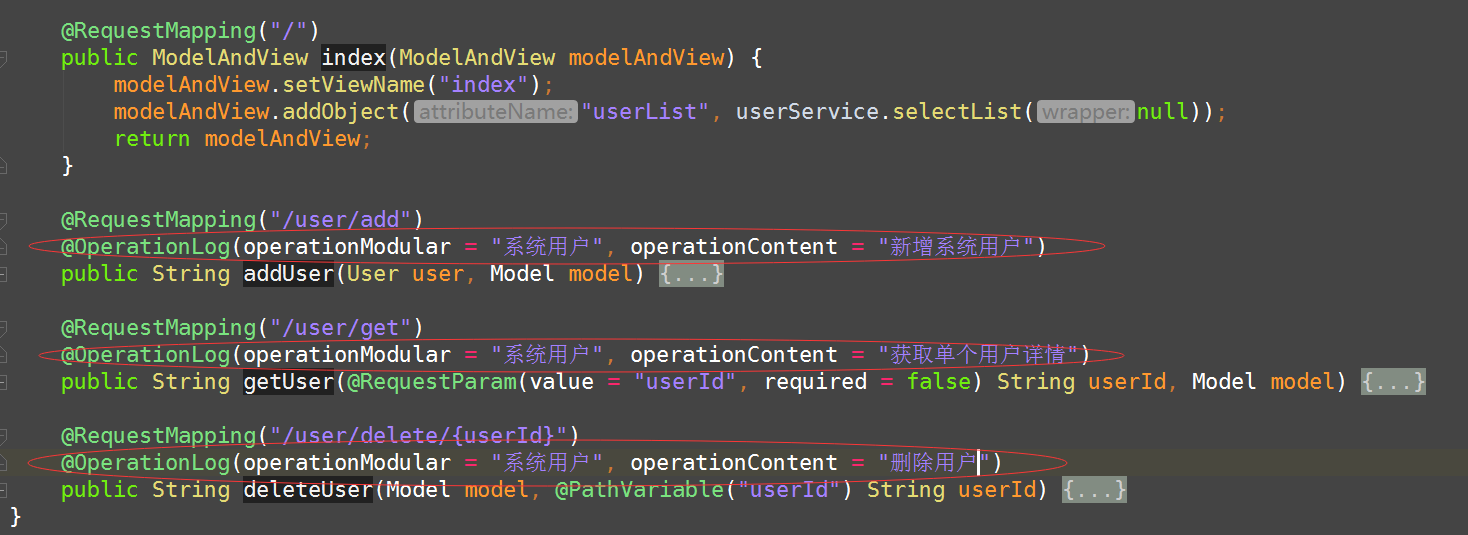
源码托管地址:https://git.oschina.net/LanboEx/spmvc-mybatis.git 有这方面需求和兴趣的可以检出到本地跑一跑。
来一手 AOP 注解方式进行日志记录的更多相关文章
- Jeecg中通过Spring_AOP+注解方式实现日志的管理
转载;https://blog.csdn.net/ma451152002/article/details/77234236 Jeecg中通过Spring_AOP+注解方式实现日志的管理 一.设计思路 ...
- Spring系列之aAOP AOP是什么?+xml方式实现aop+注解方式实现aop
Spring系列之aop aop是什么?+xml方式实现aop+注解方式实现aop 什么是AOP? AOP为Aspect Oriented Programming 的缩写,意识为面向切面的编程,是通过 ...
- AOP注解方式ApsectJ开发
AOP注解方式ApsectJ开发 引入配置文件 编写切面类配置 使用注解的AOP对象目标类进行增强 在配置文件中开启以注解形式进行AOP开发 在切面类上添加注解 注解AOP通知类型 @Before前置 ...
- springboot搭建环境之使用@Slf4j注解方式,进行日志管理
如果不想每次都写private final Logger logger = LoggerFactory.getLogger(XXX.class); 可以用注解@Slf4j 需要引入依赖为: < ...
- spring AOP自定义注解方式实现日志管理
今天继续实现AOP,到这里我个人认为是最灵活,可扩展的方式了,就拿日志管理来说,用Spring AOP 自定义注解形式实现日志管理.废话不多说,直接开始!!! 关于配置我还是的再说一遍. 在appli ...
- springAOP注解方式实现日志操作
通过自定义注解调用方法执行日志存储: package com.zktx.platform.log2; import java.lang.reflect.Method; import java.util ...
- 基于AOP和ThreadLocal实现日志记录
基于AOP和ThreadLocal实现的一个日志记录的例子 主要功能实现 : 在API每次被请求时,可以在整个方法调用链路中记录一条唯一的API请求日志,可以记录请求中绝大部分关键内容.并且可以自定义 ...
- 转:Spring AOP 注解方式实现的一些“坑”
使用过Spring AOP的注解方式实现,也入过不少坑,现在做一下记录,希望有同样需求的朋友可以少走弯路 使用之前还是先过一下官方文档吧,至少可以少走弯路,不用担心英文读不懂,其实只看代码例子就能理解 ...
- spring aop注解方式与xml方式配置
注解方式 applicationContext.xml 加入下面配置 <!--Spring Aop 启用自动代理注解 --> <aop:aspectj-autoproxy proxy ...
随机推荐
- Hadoop和MapReduce初识
我们生活在大数据时代!!!微博.微信.云存储等大数据的需求,Hadoop由此诞生. 以下面部分数据为例: 1)Facebook存储着约100亿张照片,约1PB存储容量: 2)纽约证券交易所每天产生1T ...
- javascript中event.clientX和event.clientY用法的注意事项
今天做项目用到了event.clientX和event.clientY,给元素定位,用定位的时候,让top和left等于事件元素的的坐标 <!DOCTYPE html> <html& ...
- [0] 自定义特性AttributeUsage
using System;using System.Collections.Generic;using System.Linq;using System.Text; namespace Fxframe ...
- JS监听div的resize事件
原文地址:http://zhangyiheng.com/blog/articles/div_resize.html 需求 开发过程中经常遇到的一个问题就是如何监听一个div的size变化. 比如我用c ...
- 【分享】我们用了不到200行代码实现的文件日志系统,极佳的IO性能和高并发支持,附压力测试数据
很多项目都配置了日志记录的功能,但是,却只有很少的项目组会经常去看日志.原因就是日志文件生成规则设置不合理,将严重的错误日志跟普通的错误日志混在一起,分析起来很麻烦. 其实,我们想要的一个日志系统核心 ...
- phpstorm显示行号
在Windows上. 其View->Active Editor->Show Line Numbers (仅适用于当前和变化File->Settings->Editor-> ...
- Backbone中父子view之间的值传递
backbone中,使用最多的莫过于在view中进行操作,如模板的渲染以及事件函数的定义.为了提高代码的可维护性,一般地我们会写多个视图即view,将界面按照功能的不同进行模块化划分,模块与view一 ...
- 使用matplotlib快速绘图
matplotlib的pyplot子库提供了和matlab类似的绘图API,方便用户快速绘制2D图表.让我们先来看一个简单的例子: # -*- coding: utf-8 -*- import num ...
- 一键将Web应用发布到云-Azure Web App
我们现在越来越多的传统应用,逐步向云端迁移,原先私有云的部署模式,逐步向云端PaaS IaaS转变.例如: 我们在云端Azure中申请VM虚拟机,将我们的Web应用部署到VM的IIS中,同时做云服务的 ...
- Spark认识&环境搭建&运行第一个Spark程序
摘要:Spark作为新一代大数据计算引擎,因为内存计算的特性,具有比hadoop更快的计算速度.这里总结下对Spark的认识.虚拟机Spark安装.Spark开发环境搭建及编写第一个scala程序.运 ...