
java的Integer中也会有缓存
在上篇《java的自动拆箱会发生NPE》博客中接收了java中的Integer中的自动拆箱产生的NPE,其实对于所有的包装类来说都是一样的,都会产生这样的问题,大家需要举一反三,做学问学知识要懂得反思总结。
一、前情回顾
先回顾下上次的知识点,
自动拆箱 实际调用的是intValue()方法
自动装箱 实际调用的是valueOf(int i)方法
其他的包装类,小伙伴们自己总结
二、Integer的本地缓存
好了话不多说,书接上回,开始这次的分享,上次说到在自动装箱的时候还大有玄机,这个玄机就是本地缓存。这个玄机在自动装箱的方法中,如下
/**

     * Returns an {@code Integer} instance representing the specified

     * {@code int} value.  If a new {@code Integer} instance is not

     * required, this method should generally be used in preference to

     * the constructor {@link #Integer(int)}, as this method is likely

     * to yield significantly better space and time performance by

     * caching frequently requested values.

     *

     * This method will always cache values in the range -128 to 127,

     * inclusive, and may cache other values outside of this range.

     *

     * @param  i an {@code int} value.

     * @return an {@code Integer} instance representing {@code i}.

     * @since  1.5

     */

    public static Integer valueOf(int i) {

        if (i >= IntegerCache.low && i <= IntegerCache.high)

            return IntegerCache.cache[i + (-IntegerCache.low)];

        return new Integer(i);

    }
先看下其方法说明吧,用我大学英语六级的水平给大家翻译下,献丑了大家莫怪,
返回一个代表指定int的Integer对象,如果一个新的Integer实例不是必需的,这个方法通常使用构造方法来生成,另一方面,这个方法通常为了节省空间和实际会缓存一些经常使用的值
这个方法会缓存[-128~127]间的值,也可能会缓存这个范围以外的值
翻译的太差劲了,大体意思是如果参数在[-128,127]间则会从缓存中取,如果不在则直接生成Integer的实例。还有很重要的一点最大值可以配置。
看方法的逻辑也是这样的,看下Integer初始化缓存的代码,在Integer中有静态内部类IntegerCache,代码
private static class IntegerCache {

       //缓存区间,最小值

        static final int low = -128;

       //缓存区间,最大值,可配置

        static final int high;

      //缓存

        static final Integer cache[];

        static {

            // high value may be configured by property

            int h = 127;

           //获得配置的缓存区间最大值

            String integerCacheHighPropValue =

                sun.misc.VM.getSavedProperty("java.lang.Integer.IntegerCache.high");

            if (integerCacheHighPropValue != null) {

                try {

                    int i = parseInt(integerCacheHighPropValue);

                    i = Math.max(i, 127);

                    // Maximum array size is Integer.MAX_VALUE

                    h = Math.min(i, Integer.MAX_VALUE - (-low) -1);

                } catch( NumberFormatException nfe) {

                    // If the property cannot be parsed into an int, ignore it.

                }

            }

            high = h;

            cache = new Integer[(high - low) + 1];

            int j = low;

          //for循环,生成缓存

            for(int k = 0; k < cache.length; k++)

                cache[k] = new Integer(j++);

            // range [-128, 127] must be interned (JLS7 5.1.7)

            assert IntegerCache.high >= 127;

        }

        private IntegerCache() {}

    }
上面的代码加注释足以说明一切,不再一一解释了,默认情况下Integer中存在[-128,127]范围内的的256个缓存Integer实例。
三、验证本地缓存
上面说到,在Integer中存在缓存,重要的一点是在调用valueOf()方法的时候才会校验缓存,valueOf方法共有以下几个
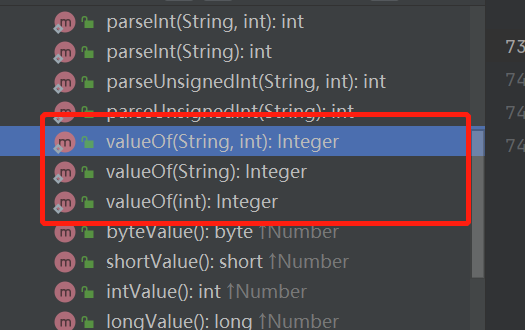
重要声明,在使用构造方法的时候是没有缓存的,看构造方法
 /**

     * Constructs a newly allocated {@code Integer} object that

     * represents the specified {@code int} value.

     *

     * @param   value   the value to be represented by the

     *                  {@code Integer} object.

     */

    public Integer(int value) {

        this.value = value;

    }
那么在验证的时候就不能使用构造方法的方式,需要使用自动装箱的方式。
1、构造方法没有缓存
public class TestIntegerConstruct {

    public static void main(String[] args) {

        Integer i1=new Integer(1);

        Integer i2=new Integer(1);

        System.out.println(i1==i2);

    }

}
打印结果为,
false

Process finished with exit code 0
打印出来为false,说明i1和i2为两个不同的对象。
2、valueOf()方法才有的缓存
使用valueOf构造两个Integer对象,
public class TestValueOf {

    public static void main(String[] args) {

        Integer i1=1;

        Integer i2=1;

        System.out.println(i1==i2);

    }

}
打印结果为,
true

Process finished with exit code 0
说明i1和i2为同一个实例,这里使用的是==来判断,对引用对象来说判断的不正是其地址。
多说一点,这里两个引用类型的比较,大家不要像我这里似的,使用“==”,请使用equals方法,使用“==”比较的是内存地址,在大部分情况下,内存地址肯定不相等,而使用equals方法就说不准了,equals方法比较的是什么?
3、Integer的equals方法
看下Integer的equals方法比较的是什么东西
public boolean equals(Object obj) {

        if (obj instanceof Integer) {

            return value == ((Integer)obj).intValue();

        }

        return false;

    }
看到没,搜先判断的是类型,然后调用其intValue方法,也就是拆箱,比较的是Integer中value的值,也就是数值的比较。
四、总结
本文,分享了Integer中的本地缓存,需要明白以下几个问题,
1、什么时候会用到本地缓存?--调用valueOf方法的时候
2、本地缓存的大小;--默认为[-128,127],最大值可设置
3、equals方法比较的是什么;--比较的是值得大小,非内存地址
往期推荐

java的Integer中也会有缓存的更多相关文章
- 谈谈Integer中的静态类IntegerCache
学习的本质就是一个赋值的过程,用新知识来覆盖你的旧知识或者无知(null).掌握知识是自己的, 分享知识,才能帮助更多的人,创造更大的价值.学贵以恒,以此自勉,与君共享.----曦阳X ...
- 【JDK】:java.lang.Integer源码解析
本文对JDK8中的java.lang.Integer包装类的部分数值缓存技术.valueOf().stringSize().toString().getChars().parseInt()等进行简要分 ...
- Integer 中的缓存类IntegerCache
2014年去某公司笔试的时候遇到这么一道题: public class Test { public static void main(String[] args) { Integer int1 = I ...
- Java之戳中痛点 - (7)善用Java整型缓存池
先看一段代码: package com.test; import java.util.Scanner; public class IntegerCache { public static void m ...
- Java自动装箱中的缓存原理
今天看到一道'经典'面试题: Integer a = 100; Integer b = 100; System.out.println(a==b); Integer a2 = 200; Integer ...
- 对Integer类中的私有IntegerCache缓存类的一点记录
对Integer类中的私有IntegerCache缓存类的一点记录 // Integer类有内部缓存,存贮着-128 到 127. // 所以,每个使用这些数字的变量都指向同一个缓存数据 // 因此可 ...
- Java Integer中的IntegerCache小记
同事今天给我发了一个关于Java拆装箱的ppt,里面有这么一段代码 Integer c = Integer.valueOf(3); Integer d = Integer.valueOf(3); ...
- Integer 中的缓存类 IntegerCache
我们先看一段代码: public class TestAutoBoxing { public static void main(String[] args) { //-128到127之间 Intege ...
- Java.lang.Integer类中toString(int i, int radix)的具体实现
Java.lang.Integer.toString(int i,int radix)方法可以实现将一个int类型的10进制的数据转换为指定进制的数据. api文档中介绍: 返回第二个参数指定的基数中 ...
随机推荐
- Django模块导入
Django模块导入篇 Django基础 urls.py 导入app中的视图函数 from app名字 import views app.view视图函数中导入models.py中的类 from ap ...
- 对路径“C:\inetpub\wwwroot\Test\Temper\”的访问被拒绝 【已解决】
在IIS7上部署IIS站点时,出现如下错误: 对路径"C:\inetpub\wwwroot\Test\Temper\"的访问被拒绝: 原因是:程序对"C:\inetpub ...
- CF1479X Codeforces Round #700
C Continuous City(图的构造) 题目大意:让你构造一个n\le 32的有向无环无重边图,使得从1走到n的所有路径长度在L,R之间,且每种长度的路径只有唯一一条,$L,R\le 1e6$ ...
- Vscode的使用小技巧
命令行启动code 如果你的系统是Linux系统(我使用的是Ubuntu 16.04)这样就可以直接使用 code + filename来编辑文件(就像vi + filename) 如果你的系统是Ma ...
- pytorch方面
(113条消息) Pytorch基础:Torch.mul.Torch.mm与Torch.matmul的异同_名字填充中的博客-CSDN博客_pytorch torch.mul (111条消息) pyt ...
- 使用Redis实现关注好友的功能
现在很多社交都有关注或者添加粉丝的功能, 类似于这样的功能我们如果采用数据库做的话只是单纯得到用户的一些粉丝或者关注列表的话是很简单也很容易实现, 但是如果我想要查出两个甚至多个用户共同关注了哪些人或 ...
- ThreadPoolTaskExecutor原理、详解及案例
为什么要用线程池? 服务器应用程序中经常出现的情况是:单个任务处理的时间很短而请求的数目却是巨大的. 构建服务器应用程序的一个过于简单的模型应该是:每当一个请求到达就创建一个新线程,然后在新线程中为请 ...
- Canvas将图片转换成base64形式展示的常见问题及解决方案
导航1:https://blog.csdn.net/weixin_30668887/article/details/98822699 导航2:https://stackoverflow.com/que ...
- switch 是否能作用在byte 上,是否能作用在long 上,是否能作用在String上?
答:在Java 5以前,switch(expr)中,expr只能是byte.short.char.int.从Java 5开始,Java中引入了枚举类型,expr也可以是enum类型,从Java 7开始 ...
- Linux常用命令-学习笔记
Linux命令格式: 命令 [命令参数] [命令对象] # 命令之间的参数和对象用单个空格进行分割 # "[]"代表可选,{}代表必选其中的一项,|代表或者的关系,<> ...