
Understanding Memory Technology Devices in Embedded Linux
转:
NAND Chip Drivers
NAND technology users such as USB pen drives, DOMs, Compact Flash memory, and SD/MMC cards emulate standard storage interfaces such as SCSI or IDE over NAND flash, so you don't need to develop NAND drivers to communicate with them.5 On-board NAND flash chips need special drivers, however, and are the topic of this section.
As you learned previously in this chapter, NAND flash chips, unlike their NOR counterparts, are not connected to the CPU via data and address lines. They interface to the CPU through special electronics called a NAND flash controller that is part of many embedded processors. To read data from NAND flash, the CPU issues an appropriate read command to the NAND controller. The controller transfers data from the requested flash location to an internal RAM memory, also part of the controller. The data transfer is done in units of the flash chip's page size (for example, 2KB). In general, the denser the flash chip, the larger is its page size. Note that the page size is different from the flash chip's block size, which is the minimum erasable flash memory unit (for example, 16KB). After the transfer operation completes, the CPU reads the requested NAND contents from the internal RAM. Writes to NAND flash are done similarly, except that the controller transfers data from the internal RAM to flash. The connection diagram of NAND flash memory on an embedded device is shown in Figure 17.3.
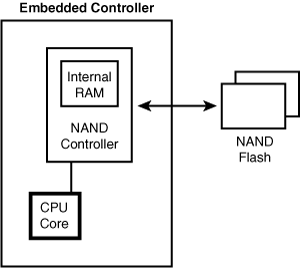
Figure 17.3 NAND flash connection.
Because of this unconventional mode of addressing, you need special drivers to work with NAND storage. MTD provides such drivers to manage NAND-resident data. If you are using a supported chip, you have to enable only the appropriate low-level MTD NAND driver. If you are writing a NAND flash driver, however, you need to explore two datasheets: the NAND flash controller and the NAND flash chip.
NAND flash chips do not support automatic configuration using protocols such as CFI. You have to manually inform MTD about the properties of your NAND chip by adding an entry to thenand_flash_ids[] table defined in drivers/mtd/nand/nand_ids.c. Each entry in the table consists of an identifier name, the device ID, page size, erase block size, chip size, and options such as the bus width.
There is another characteristic that goes hand in hand with NAND memory. NAND flash chips, unlike NOR chips, are not faultless. It's normal to have some problem bits and bad blocks scattered across NAND flash regions. To handle this, NAND devices associate a spare area with each flash page (for example, 64 bytes of spare area for each 2KB data page). The spare area contains out-of-band (OOB) information to help perform bad block management and error correction. The OOB area includes error correcting codes (ECCs) to implement error correction and detection. ECC algorithms correct single-bit errors and detect multibit errors. The nand_ecclayout structure defined ininclude/mtd/mtd-abi.h specifies the layout of the OOB spare area:
struct nand_ecclayout {

  uint 32_t eccbytes;

  uint32_t  eccpos[64];

  uint32_t  oobavail;

  struct    nand_oobfree oobfree[MTD_MAX_OOBFREE_ENTRIES];

};
In this structure, eccbytes holds the number of OOB bytes that store ECC data, and eccpos is an array of offsets into the OOB area that contains the ECC data. oobfree records the unused bytes in the OOB area available to flash filesystems for storing flags such as clean markers that signal successful completion of erase operations.
Individual NAND drivers initialize their nand_ecclayout according to the chip's properties. Figure 17.4illustrates the layout of a NAND flash chip having a page size of 2KB. The OOB semantics used by the figure is the default for 2KB page-sized chips as defined in the generic NAND driver,drivers/mtd/nand/nand_base.c.
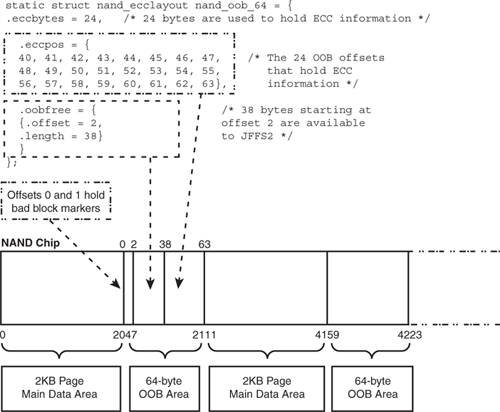
Figure 17.4 Layout of a NAND flash chip.
Often, the NAND controller performs error correction and detection in hardware by operating on the ECC fields in the OOB area. If your NAND controller does not support error management, however, you will need to get MTD to do that for you in software. The MTD nand_ecc driver (drivers/mtd/nand/nand_ecc.c) implements software ECC.
Figure 17.4 also shows OOB memory bytes that contain bad block markers. These markers are used to flag faulty flash blocks and are usually present in the OOB region belonging to the first page of each block. The position of the marker inside the OOB area depends on the properties of the chip. Bad block markers are either set at the factory during manufacture, or by software when it detects wear in a block. MTD implements bad block management in drivers/mtd/nand/nand_bbt.c.
The mtd_partition structure used in Listing 17.1 for the NOR flash in Figure 17.2 works for NAND memory, too. After you MTD-enable your NAND flash, you can access the constituent partitions using standard device nodes such as /dev/mtd/X and /dev/mtdblock/X. If you have a mix of NOR and NAND memories on your hardware, X can be either a NOR or a NAND partition. If you have a total of more than 32 flash partitions, accordingly change the value of MAX_MTD_DEVICES ininclude/linux/mtd/mtd.h.
To effectively make use of NAND storage, you need to use a filesystem tuned for NAND access, such as JFFS2 or YAFFS2, in tandem with the low-level NAND driver. We discuss these filesystems in the next section.
Understanding Memory Technology Devices in Embedded Linux的更多相关文章
- Linux MTD (Memory Technology Device) subsystem analysis -For Atheros char device
Linux MTD (Memory Technology Device) subsystem analysis For Atheros char device 读了Linux MTD 源代码分析 对这 ...
- (转)Understanding Memory in Deep Learning Systems: The Neuroscience, Psychology and Technology Perspectives
Understanding Memory in Deep Learning Systems: The Neuroscience, Psychology and Technology Perspecti ...
- 【转载】关于Embedded Linux启动的经典问题
转载自:http://linux.chinaunix.net/techdoc/install/2009/04/13/1107608.shtml 发信人: armlinux (armlinux), 信区 ...
- Understanding Memory Management(2)
Understanding Memory Management Memory management is the process of allocating new objects and remov ...
- Qt for Embedded Linux
1. Qt for Embedded Linux http://doc.qt.io/qt-5/embedded-linux.html 2. Installing Qt for Embedded Lin ...
- 构建自己的embedded linux系统
[教程]使用buildroot完全自定义自己的embedded linux系统(nand)http://www.eeboard.com/bbs/thread-38377-1-1.html [教程] [ ...
- [转]A Guide To using IMU (Accelerometer and Gyroscope Devices) in Embedded Applications.
原文地址http://www.starlino.com/imu_guide.html Introduction There’s now a FRENCH translation of this art ...
- Memory Leak Detection in Embedded Systems
One of the problems with developing embedded systems is the detection of memory leaks; I've found th ...
- How to Add Memory, vCPU, Hard Disk to Linux KVM Virtual Machine
ref: https://www.thegeekstuff.com/2015/02/add-memory-cpu-disk-to-kvm-vm/ In our previous article of ...
随机推荐
- android自定义SlideMenu
完美解决ListView中子项焦点不可被Touch的BUG. 1.在Ecl ...
- Spring 对数据库的支持
DAO DAO是用于访问数据的对象,大多数时候,我们将数据保存在数据库中,但这不是唯一选择. 用户也可以将数据保存在数据文件或者LDAP中 DAO屏蔽了数据操作的具体细节 Spring本质上希望能够以 ...
- 股神小L [贪心]
题面 思路 股票题肯定是贪心或者$dp$啊 这个题比较$naive$,可以看出来你这里买股票的过程一定是能不买就不买,能卖就拣最贵的日子卖,而且时间不能倒流(废话= =||) 所以我们按照时间从前往后 ...
- html 过滤器 c#
using System.Text.RegularExpressions; using System.Web; internal class HtmlHelper { /// <summ ...
- OpenCV 2.4.9 学习笔记(3)—— OpenCV自动为输出数组(矩阵)分配内存
OpenCV大部分时候会为OpenCV方法中的输出数据(方法的参数)自动分配内存,所以如果一个方法的参数有一个或者多个输入数组(cv::Mat 实例)和一些输出数组时,OpenCV会自动为输出数组分配 ...
- 埃及分数问题_迭代加深搜索_C++
一.题目背景 http://codevs.cn/problem/1288/ 给出一个真分数,求用最少的1/a形式的分数表示出这个真分数,在数量相同的情况下保证最小的分数最大,且每个分数不同. 如 19 ...
- JSP中include指令和include动作浅析
一. JSP工作原理 JSP文件是一种Servlet,其工作方式是先部署源代码后编译为.class文件.JSP会在客户端第一次请求JSP文件时被编译成Servlet,由Servlet处理客户端的请求. ...
- (转)MSI - Enable MSI Logging
转自: http://www.cnblogs.com/atempcode/archive/2007/04/10/707917.html 安装MSI安装包的时候, 有时会遇到错误, 这时LOG文件就非常 ...
- How to duplicate a UIButton in Objective C?
http://stackoverflow.com/questions/1092875/how-to-duplicate-a-uibutton-in-objective-c 1down vote To ...
- CString::GetLength()获得字节数
按照MSDN的说吗,在选用MBCS多字节字符串编码时,该方法会得到正确的字节数.此时没有问题. For multibyte character sets (MBCS), GetLength count ...